HOSPITAL OF ST. CROSS, HANTS.
Reading edition
(The Church.)
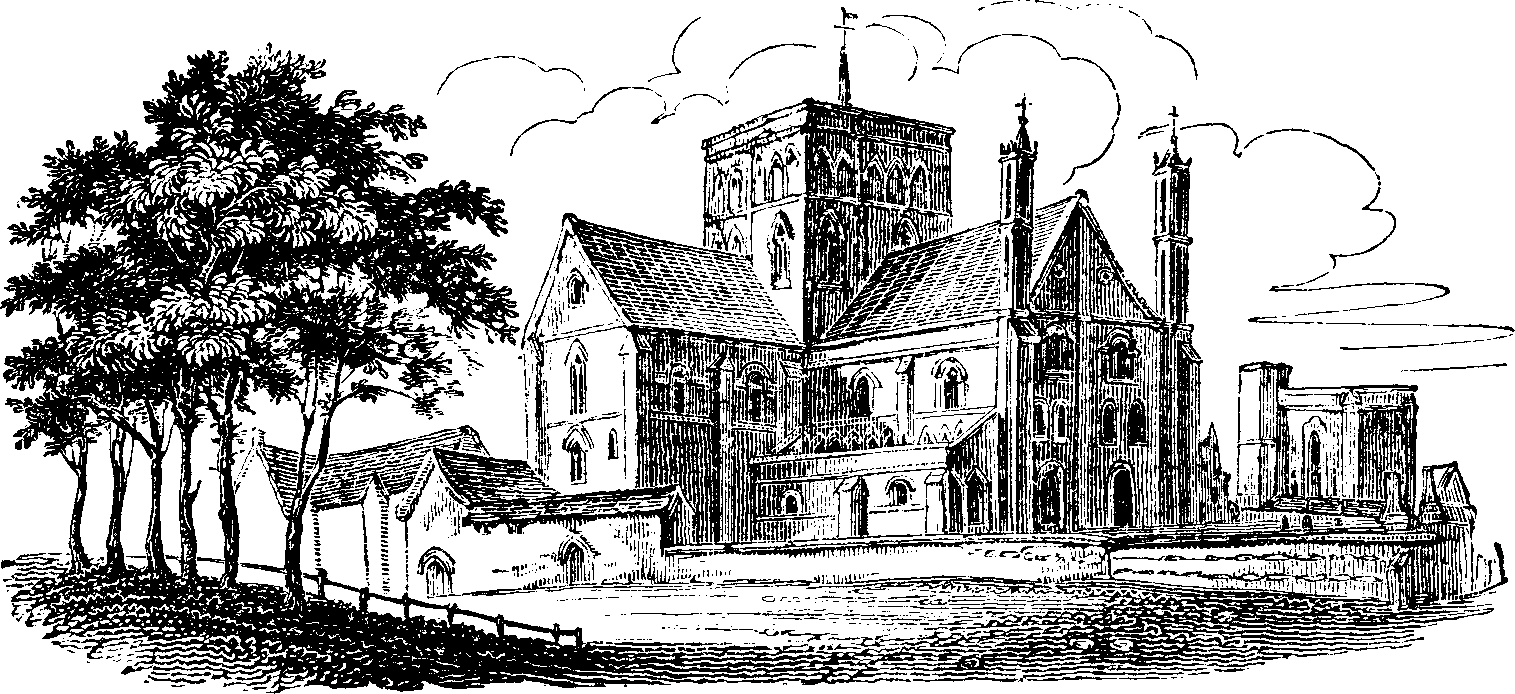
St. Cross, however, "never was a monastery, but only an hospital for the support of ancient and infirm men, living together in a regular and devout manner." The original founder was Henry de Blois, bishop of Winchester, who instituted it, between the years 1132 and 1136; and required that "thirteen poor men, so decayed and past their strength that without charitable assistance they cannot maintain themselves, shall abide continually in the hospital, who shall be provided with proper clothing and beds suitable to their infirmities; and shall have an allowance daily of good wheat bread, good beer, three messes each for dinner, and one for supper. That beside these thirteen poor, a hundred other poor, of modest behaviour and the most indigent that can be found, shall be received daily at dinner-time, and shall have each a loaf of coarser bread, one mess, and a proper allowance of beer, with leave to carry away with them whatever remains of their meat and drink after dinner." They were to dine in a hall appointed for the purpose, and called Hundred Mennes Hall, from this circumstance. The establishment also contained an endowment for a master, a steward, four chaplains, thirteen clerks, and seven choristers.
Dr. Milner observes "the present establishment of St. Cross is but the wreck of its two ancient institutions; it having been severely fleeced, though not quite destroyed, like so many other hospitals at the Reformation. Instead of seventy residents, as well clergy as laity, who were here entirely supported, besides one hundred out-members, who daily received their meat and drink, the charity consists at present but of ten residing brethren and three out-pensioners, exclusive of one chaplain and the master. It is true, however, that certain "doles" of bread continue to be distributed to the poor of the neighbourhood; and what is, perhaps, the only vestige left in the kingdom of the simplicity and hospitality of ancient times, the porter is daily furnished with a certain quantity of good bread and beer, of which every traveller, or other person whosoever, that knocks at the lodge, and calls for relief, is entitled to partake gratuitously."
Such was the state of the charity when Dr. Milner wrote, or, in the year 1809. Our Correspondent, P.Q. has furnished us with the following information to the 20th of last May.
"On the 3rd of May, 10th of August, and the eve of the festivals of Easter, Whitsuntide, and Christmas, annually, the whole of the brethren and the steward of the house assemble and form two lines or ranks, at sunset, within the door of the outer gateway; when, to every person (even to infants) who applies at the gate, is given a loaf of brown bread, weighing about three pounds. This distribution is continued until all the bread is given away; and if the applicants should exceed the loaves in number, to each of the remaining persons is given an halfpenny, be they ever so numerous.
"These 'doles' are very beneficial to the poor of Winchester and vicinity; for to all who attend and obtain an early admission a loaf is given. I know, that when I was a boy, and never missed going to the 'doles,' some families, where the children were numerous, received from seven to ten loaves.
"Likewise every traveller who applies at the porter's lodge at the outer gate of this hospital is entitled to, and receives, a horn of good beer and a loaf or slice of bread. This demand is frequently made by persons of a different quality from that intended by the founder, for the sake of attesting the peculiarity of the custom. The quantity of bread given to each person is about four ounces—of beer about three-fourths of a pint."
We next proceed to describe the exterior of the venerable church: the interior will form the subject of a future article.