Notes of a Reader.
Reading edition
LAURENCEKIRK SNUFF-BOXES.
[Probably one of the most amusing articles in Mr. Macculloch's bulky Dictionary of Commerce of 1,150 pages, is the following account of the manufacture of the celebrated Laurencekirk snuff-boxes. It is right, however, to explain, that Mr. Macculloch only mentions these boxes here for the purpose of giving the following details, not to be met with in any other publication.]
These beautiful boxes were first manufactured at the village of Laurencekirk, in Kincardineshire, about forty years since. The original inventer was a cripple hardly possessed of the power of locomotion. In place of curtains, his bed (rather a curious workshop) was surrounded with benches and receptacles for tools, in the contrivance and use of which he discovered the utmost ingenuity. The inventer, instead of taking out a patent, confided his secret to a joiner in the same village, who in a few years amassed a considerable property; while the other died, as he had lived, in the greatest poverty. The great difficulty of the manufacture lies in the formation of the hinge, which in a genuine box is so delicately made as hardly to be visible. Peculiar, or, as they are called, secret tools are required in its formation; and though they must have been improved by time and experience, the mystery attached to their preparation is still so studiously kept up, that the workmen employed in one shop are rigorously debarred from having any communication with those employed in another.
About the beginning of this century, an ingenious individual belonging to the village of Cumnock, in Ayrshire, of the name of Crawford, having seen one of the Laurencekirk snuff-boxes, succeeded, after various attempts, by the assistance of a watchmaker of the same village, who made the tools, in producing a similar box; and by his success, not only laid the foundation of his own fortune, but greatly enriched his native parish and province. For awhile, the Laurencekirk boxes were most in demand; but Mr. Crawford and his neighbours in Cumnock not only copied the art, but so improved and perfected it, that in a very few years, for every box made in the north there were, probably, twenty made in the south. In 1826, the Cumnock trade was divided amongst eight master manufacturers, who employed considerably more than 100 persons. The demand at that time equalled the supply, and it was calculated that the trade yielded from 7,000l. to 8,000l. annually,—a large product for a manufacture seemingly so insignificant, and consisting almost exclusively of the wages of labour. Plane is the wood in common use, and the cost of the wood in an ordinary sized box does not exceed 1d.; the paints and varnish are rated at 2d.; and though something is lost by selecting timber of the finest colour, the whole expense of the raw material falls considerably short of 1/2 per cent. on the return it yields!
Snuff-box, like pin making, admits of subdivision of labour; and in all workshops of any size three classes of persons are employed—painters, polishers, and joiners. At the period alluded to, an industrious joiner earned from 30s. to 40s. weekly, a painter from 45s. to 3l., and a polisher considerably less than either. When Mr. Crawford first commenced business he obtained almost any price he chose to ask; and many instances occurred, in which ordinary sized snuff-boxes sold at 2l. 12s. 6d., and ladies' work-boxes at 25l. But as the trade increased, it became necessary to employ apprentices, who first became journeymen and then masters; and such have been the effects of improvement and competition, that articles such as are specified above, may now be obtained at the respective prices of six and twenty-five shillings. While the joiner's part of the art has remained pretty stationary, that of the painter has been gradually improving. By means of the Pentagraph, which is much employed, the largest engravings are reduced to the size most convenient for the workman, without injuring the prints in the slightest degree; and hence a snuff-box manufacturer, like a Dunfermline weaver, can work to order by exhibiting on wood his employer's coat of arms, or in short, any object he may fancy within the range of the pictorial art. Some of the painters display considerable talent, and as often as they choose to put forth their strength, produce box-lids, which are really worthy of being preserved as pictures. At first, nearly the whole subjects chosen as ornaments, were taken from Burns's poems; and there can be no doubt, that the "Cotter's Saturday Night," "Tam O'Shanter," "Willie brewed a peck o' maut," &c. &c., have penetrated in this form into every quarter of the habitable globe. Now, however, the artists of Cumnock take a wider range; the studios of Wilkie, and other artists, have been laid under contribution; landscapes are as often met with as figures; and there is scarcely a celebrated scene in the country that is not pictured forth more or less perfectly on the lid of a Cumnock snuff-box. A few years ago, the art in question was much affected by the long-continued depression of the weaving business; so much so, that many left it for some other employment. And some of those who emigrated, having made a good deal of money, instead of being cooped up in a workshop, are now thriving proprietors in Upper Canada. But after a brief interval the trade rallied; and though prices are low, it is now more flourishing than ever. In Cumnock the number of hands has increased considerably, and in Mauchline there is one workshop so extensive that it may almost be compared to a cotton mill or factory. In other quarters the trade is extending, such as Helensburgh near Greenock, Catrine, Maxwelltown, Dumfries, &c. The principal markets for the snuff-boxes are London, Liverpool, Glasgow, and Edinburgh. At one time large lots of boxes were exported to South America, and probably are so at present. Cumnock, in a word, in regard to its staple manufacture, is in that palmy state so well described by a modern writer:—"the condition most favourable to population is that of a laborious, frugal people ministering to the demands of opulent neighbours; because this situation, while it leaves them every advantage of luxury, exempts them from the evils which accompany its admission into a country. Of the different kinds of luxury, those are the most innocent which afford employment to the greatest number of artists and manufacturers; or those in which the price of the work bears the greatest proportion to that of the raw material." Some very wretched imitations of Cumnock boxes have been produced in different parts of England; but they can deceive no one who ever saw a genuine box. The hinge, as well as the finishing, is clumsy in the extreme.
[Mr. Macculloch acknowledges himself indebted for this curious and instructive article to his esteemed friend "John M'Diarmid, Esq. Editor of the Dumfries Courier, one of the best provincial papers published in the empire."
By the way, what a colossal labour must have been the preparation of the above Dictionary. How it reminds us of the words of poor, patient Antony Wood: "What toyle hath been taken, as no man thinketh, so no man believeth, but he that hath made the trial." Yet it has often occurred to us that the compiler, or editor, as he is complimentarily called, is barely treated with proper respect in these days. What is all knowledge but a continued accumulation and comparison of facts, by "following the example of time?" Yet, all this is not original; but we ask, in what does the intellectual originality of the present day consist? does it add a spark to the minds of men which they cannot find in the labours of past ages? New books (we mean new original works) are like dull, pointless flints; the reader cannot scintillate, strike-fire, or steal from them; they are mere changes of words, often at the sacrifice of sense to sound. A flashy novel would, perhaps, secure the writer more celebrity than Mr. Macculloch's Dictionary will obtain for him, though his reputation for talent and industry want not the false glory, the common-place praise—the dullest outpourings—of a very dull perception. Perhaps the whole series of the Waverley Novels might have been written while this Dictionary was in course of compilation.
We heartily wish that Mr. Macculloch's work may become as popular as it deserves. It will then enjoy extensive fame. It would be difficult, perhaps impossible, to acquaint the reader with its mass of well-arranged materials; its laborious abstracts, documents, and information upon every point that bears upon the main subjects, commerce and commercial navigation, practical, theoretical, and historical. It deserves to be the library of every counting-house, manufactory, and workshop in the empire; it is, indeed, a delightful relief to mere figures, and we should think better of the man whom we caught dipping into its pages by turns with his book of accounts: for, with Addison, we have no noble opinion of a man who is ever poring over his cash-book, and deriving all his ideas of happiness from its balances.]
COMPARATIVE MORTALITY.
A curious official paper has been circulated, ordered by the House of Commons, showing the comparative mortality in many large towns, &c., of the kingdom, from 1813 up to the present year. Among the towns included in this comparative calculation of mortality are, Leeds (town), Bradford, Holbeck, Beeston, Wigan, Preston, Norwich, Bolton-le-Moors, London, Bury, (Lancashire), Essex, &c. The result of the investigation of mortality may be concisely stated as follows:—Of children born there die, in Leeds, 53 per cent. under 5 years of age, and 62 per cent. under 20 years of age; in Bradford, 47 per cent. under 5, and 59 per cent. under 20 years of age; in Beeston, 39 per cent. under 5, and 52 per cent. under 20 years of age; in Holbeck, 50 per cent. under 5, and 62 per cent. under 20 years of age; in Norwich, 42 per cent. under 5, and 50 per cent. under 20 years of age; in Bolton, 49 per cent. under 5, and 61 per cent. under 20 years of age; in Wigan, 48 per cent. under 5, and 59 per cent. under 20 years of age; in London, 38 per cent. under 5, and 46 per cent. under 20 years of age; in Rutland, 29 per cent. under 5, and 37-1/2 per cent. under 20 years of age, &c. It further appears, that in Essex, Rutland, and the metropolis, persons live to an advanced age in a greater extent than others.—Morning Herald.
LEE, KENT.
The rural village of Lee is situate six miles south of London, on the south side of Blackheath, and on the road to Maidstone. It is a place of considerable antiquity; and was originally written Legheart, and in old Latin, Laga, i.e. a place which lies sheltered. "The manor was held of Edward the Confessor by Alwin. William the Conqueror gave it to his half-brother, Odo, bishop of Baieux, and Earl of Kent, of whom it was held by Walter de Donay." In the time of the Confessor, it was valued at 3l. and in Domesday at 100s. Its extent is somewhat more than 1,000 acres. Hasted enumerates the successive lords, among whom were Lord Rivers, who was beheaded at Banbury in 1649; and his son, Anthony, Earl Rivers, who was beheaded at Pomfret, in 1483. The manor was purchased by Sir Francis Baring, bart., in 1798.
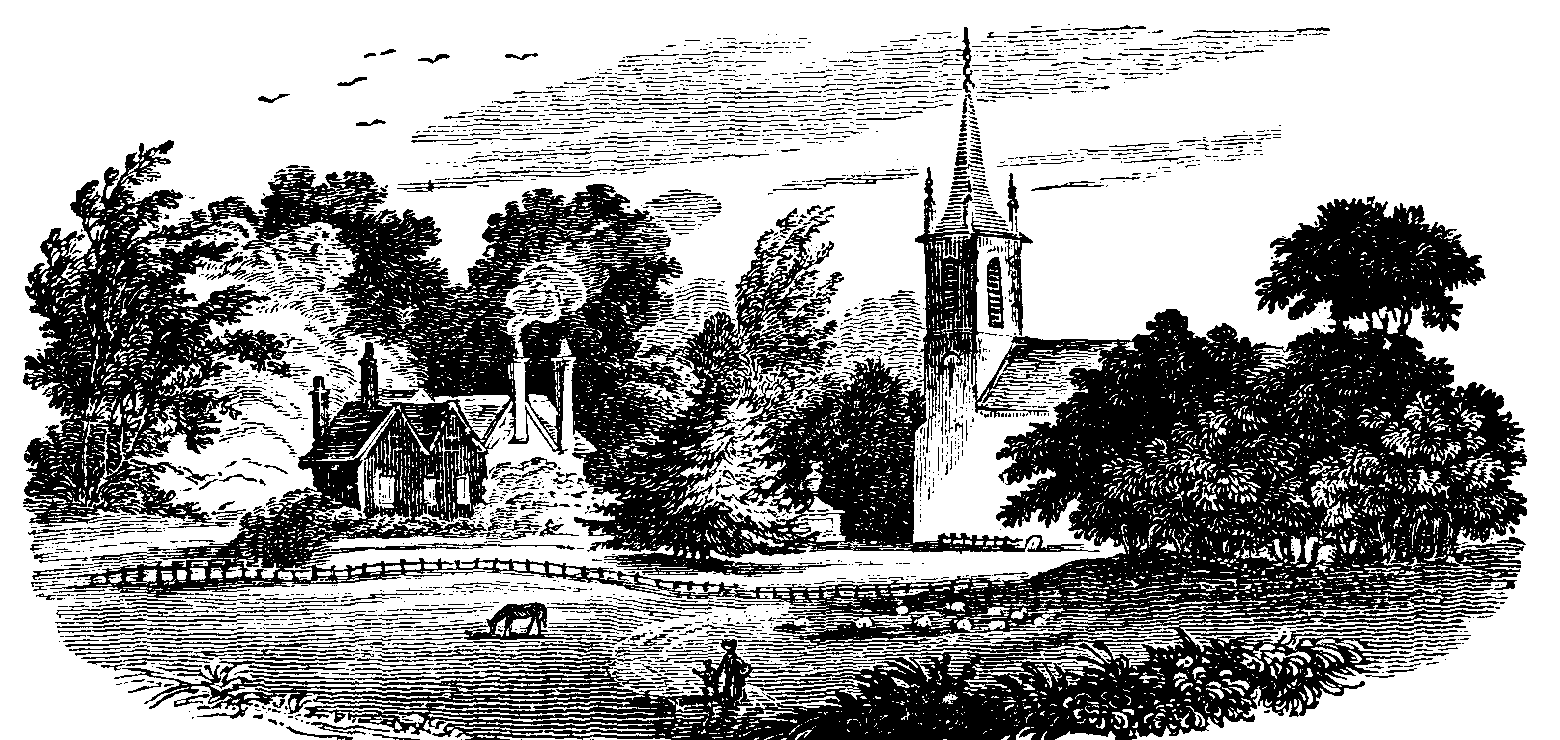
Lee Church and Parsonage.
The picturesque vignette includes the church and parsonage. The Church is in what is called the pointed style, or rather in humble imitation of antiquity, for it is a recent structure built on the site of the walls of the old church, but with the addition of side-aisles. Nearly two centuries before the erection of the present church, the villagers reported the old building to be in a state too ruinous to admit of repair: how long did its stability gainsay their judgment, while they were laid asleep about the walls. The church was an appendage to the manor till the time of Charles I., who granted away the fee of the manor, but reserved the patronage of the church to the crown, where it continues to this time. It was valued l5 Edward I. at 10 marks; in the king's books it is at 3l. 11s. 8d.; and the yearly tenths at 7s. 2d. The parsonage has much of the snug character of the glebe-house; it was rebuilt in 1636, by the rector, the Rev. Abraham Sherman.
In the church are some monumental brasses and a handsome tomb of marble and alabaster. One of the former is to the memory of Nicholas Ansley, or Annesley, Esq. who died in 1593; with the following inscription:—
When the Quene Elizabeth full five years had rain'd, Then Nicholas Ansley, whos corps lyes here interred, At fyve and twenty yeres of age was entertayned Into her servis, where well himself he caried In eche man's love till fifty and eight yeres ould, Being Sergant of the Seller, death him contrould.
Above is an upright figure (on a brass plate,) of the deceased, in armour, kneeling at a desk. The latter monument is to Brian Annesley, Esq. (son of Nicholas) gentleman pensioner to Queen Elizabeth. It consists of an elliptic arch supported by Corinthian columns, and ornamented with a Mosaic pattern studded with roses. Beneath lie the effigies of Annesley, in armour, and his wife, in a gown and ruff; their son, and three daughters.
In the churchyard, among the tombs, is that of Dr. Halley, who succeeded Flamstead as Astronomer Royal at Greenwich, where he died in 1741-2: Halley published a treatise on Comets, when he was nineteen years old; and first applied the barometer to measure heights. Here also lie William Pate, whom Swift, in his Letters, calls the learned woollen-draper: Sir Samuel Fludyer, bart., the courtly lord mayor; Parsons, the comedian, with this quaint epitaph:—
Here Parsons lies, oft on life's busy stage With nature, reader, hast thou seen him vie; He science knew, knew manners, knew the age, Respected knew to live, lamented die.
Harris says that Samuel Purchas resided at Lee, and there wrote a great part of his collection of travels, or "Celebrated Pilgrimages and Relations of the World."
Among the grateful recollection of Lee we must not omit the alms-house, chapel, and school-house founded by C. Boone, Esq. in 1638.