THE MIRROR OF LITERATURE, AMUSEMENT, AND INSTRUCTION.
Reading edition
Vol. 20. No. 564. SATURDAY, SEPTEMBER 1, 1832. [PRICE 2d.
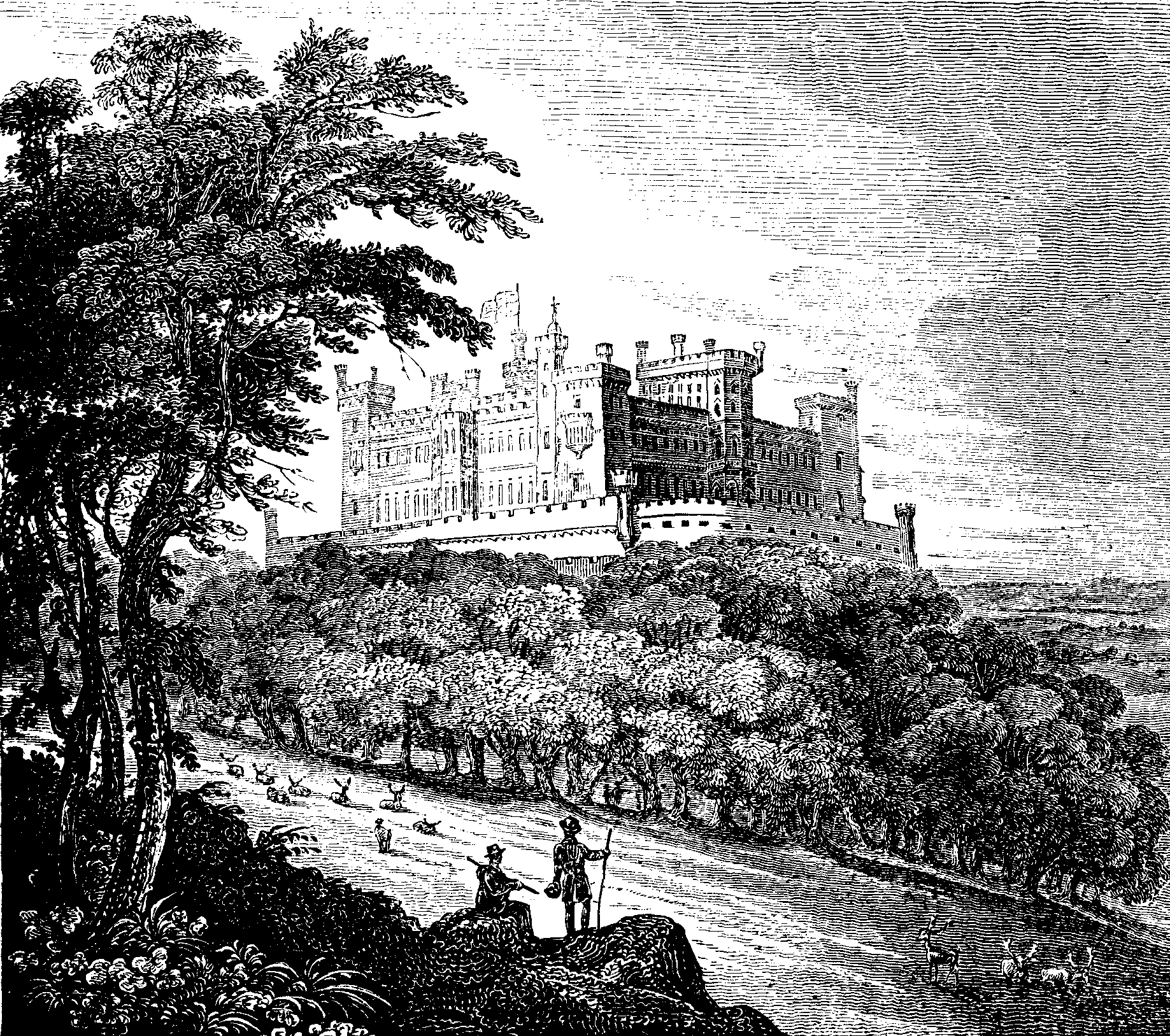
BELVOIR CASTLE.
Belvoir Castle, (or Bever, as it was formerly and is now sometimes called,) in situation and aspect partly resembles "majestic Windsor." It has a similar "princely brow," being placed upon an abrupt elevation of a kind of natural cliff, forming the termination of a peninsular hill, the basis of which is red grit stone, but now covered with vegetable mould, well turfed by nature and art, and varied into terraces of different elevation. It has been the seat of the noble family of Manners for several generations; it claims the priority of every other seat in the county wherein it is situate; and is one of the most magnificent castellated structures in the kingdom.
That Belvoir has been the site of a castle since the Norman Conquest appears well established. Leland says, "The Castle of Belvoir standeth in the utter part of that way of Leicestershire, on the nape of an high hill, steep up each way, partly by nature, partly by working of men's hands, as it may evidently be perceived. Whether there were any castle there before the Conquest or no I am not sure, but surely I think no rather than ye. Toteneius was the first inhabiter after the Conquest. Then it came to Albeneius, and from Albeney to Ros."
The Belvoir estate came into the Manners family, by the marriage of Eleanor with Robert de Manners of Ethale, Northumberland. Eleanor was the eldest sister of Edmund, Lord Ros, who resided at the manor-house of Elsinges, in Enfield, Middlesex, where he died without issue in the year 1508. His sisters became heiresses to the estates, and Belvoir being part of the moiety of Eleanor, became the property of the Manners family, who have continued to possess it to the present time.
It is now time to speak of the present magnificence of Belvoir. The castle which surrounds a quadrangular court, occupies nearly the summit of the hill, which is ascended by superb stone steps. On the castle are mounted seven small pieces of cannon, which were presented to the Duke of Rutland by George the Third; from these pieces 21 rounds were fired Nov. 5, 1808, in commemoration of the Gunpowder Plot. The view from the terraces and towers comprehends the whole vale of Belvoir, and the adjoining country as far as Lincoln, including twenty-two of the Duke of Rutland's manors. On the southern slope of the hill are enclosed terraces, on which there are several flower-gardens, surrounded by extensive shrubberies. The kitchen-gardens extend to eight acres. The park is of great extent, and contains fine forest trees which form a woodland beneath the hill, so extensive as to afford shelter for innumerable rooks. There are likewise thriving plantations, containing some remarkably fine young oaks.
Belvoir Castle has one of the most superb interiors in the kingdom: its furniture and decorations are of the most costly description. It also contains one of the most valuable collections of paintings, whether considered for the variety of schools, or the judicious choice of the works of each master. Among those who have contributed to this invaluable assemblage, are Poussin, Carlo Dolci, Guido, Claude Lorraine, Salvator Rosa, Murillo, Reubens, Teniers, and Reynolds. The collection was principally formed by John, the third duke, and Charles, his successor, who were munificent patrons of the arts. All the modern pictures, of which there are a considerable number, were collected by the former duke.
The last general repairs of Belvoir Castle are stated to have cost the noble owner upwards of 60,000£. The structure has been more than once extensively injured by fire. A conflagration there in October, 1816, consumed a large portion of the ancient part of the castle, and several of the pictures. Among them was Sir Joshua Reynolds's Nativity, a composition of thirteen figures, and in dimensions 12 feet by 18. This noble picture was purchased by the late Duke of Rutland for 1,200 guineas.
THE PAINTER'S LAST PASSION.
A hectic hue is on my feverish cheek, And slowly throbs my pulse—but it will cease; And cease, too, will the visions instinct, Impalpable, and deep, that haunt my soul! Death, who can dash the chalice from the lips Of Pleasure's votary, and hush the lyre While poetry is breathing on its strings; Death, who can quench the spirit which portrays Beauty's resemblance on the marble urn, Will steep my feelings in oblivion's gloom, Ere wintry winds disperse the sunny leaves That cluster round the bosom of the rose. But I have communed with enchanting shapes, And felt the silver gush of many a song Amid the air, until my spirit seem'd Instinct with glorious draughts of paradise! Mine eyes have scarcely closed their burning lids For many a night; and I have watch'd the stars That smiled upon me from the brow of heaven, Like deep blue orbs familiar to my youth; But now abstraction clouds me, and the fire— Ambition's fire—it can be nothing less— Deserts its lonely shrine; but I must give The last bright touch to this bewitching form, This pictured rainbow of my solitude! I have invested her with loveliness More pure than beings of the earth assume, And Memory calls her beauteous image back From the forgotten things of distant years, Warm, eloquent, and holy, as the balm Of flow'rs impearl'd with dew, which summer skies Diffuse around—I mark the marble brow Of polish'd symmetry, the eyes more blue Than violets in their vernal bloom, the neck Swanlike, and moulded with ethereal grace; And feel their magic influence on my mind. I will embody them, and give the stamp Of fervid genius to their various charms, Ere this last aspiration is extinct In the unbroken slumbers of the tomb! For I have had prophetic monitors To warn me of my fate, and I must leave All that is lovely in this lovely world. It is a summer eve—the sunbeams tinge The glassy bosom of the quiet lake; The music of the birds enchants the air, And Nature's verdant robe is gemm'd with flow'rs. From which the breeze derives its liquid balm. Oh! in my youth, this hour has been to me Bright as the fairy arch upon the clouds Of earthly grief and gloom, and even now It gives the silent fountain of my heart A renovated action, and recalls The energies that long ago were mine. My fancy wanders as I thus portray The lineaments on which 'tis bliss to gaze: How beautiful their prototype! to whom I breath'd in youth the most impassion'd words, And felt as if Elysium had disclosed Its glory to my eye—around this brow, Stainless as marble, cluster golden curls Like sunbeams on the bosom of the cloud, And o'er the radiant azure orbs beneath, The snowy lids suspend their glossy fringe. Upon such beauty shall my pencil stamp Its immortality, and make it seem More beautiful in Fancy's softest glow; And, my beloved! when this warm hand that traced Thy pictured charms is mouldering in the dust, Thou wilt proclaim the painter's mastery, And consecrate the canvass with a power Which shall defy the wasting hand of Time! G.R.C.
PRESERVATION OF A HUMAN BODY.
In a vault under the Font of the Old Church of St. Dunstan in the West, has lately been discovered the leaden coffin of a "Mr. Moody," (without a Christian name,) who "died in the year 1747, aged 70 years." After this interment of 85 years, the face was found not decomposed, but perfect; the mouth extended—the teeth and eye-brows unimpaired, and to the touch, the flesh solid (covered with a cloth) and no appearance of worms; which puzzles the common opinion that such insects prey upon the dead:
"And food for worms brave Percy!"
exclaimed Prince Henry over the expiring body of Hotspur.
This observation was made by a person who saw the remains on the 8th of August, 1832, an older object by twelve years, and without teeth,—a gum-biter!
AN OLD INHABITANT OF CLIFFORD'S INN.
THE ROSE OF THE CASTLE.
A summer morn, with all its golden light, Gilded the snowy bosom of the cloud, And robed the verdant earth with sunny hues. The bees sang music to their passion-flow'rs, The birds, with melody which seem'd to gush From joyful hearts, entranced the crystal air; But, spectre-like, the ancient castle frown'd Over the deep, whose softly-rippling waves Reflected its array of ruined towers. In times of old, the gallant chiefs for whom Its stately walls arose, the men who made Their names a terror to the Saracen, Adopted as their symbol in the field, The rose—that flower of faction and of blood! I saw it sculptured on the marble shield Which graced the lofty gate, it was enroll'd Among the records of departed days; Over the hearth, upon the pictured crest It met mine eye, and to my mind recall'd The glorious deeds of England's chivalry. The Rose—it appear'd on the portal proud, Which the ivy robed in its mournful shroud; As the sunshine gleam'd in the silent hall I traced its image upon the wall. Although the castle was old and grey, And its summer of glory had pass'd away, Though the roof had fall'n, and the walls sunk low, The rose still smiled in the sunbeam's glow. But, oh! that symbol of purest faith Had cheer'd the heart in the hour of death, And shone triumphant o'er the brave As they crush'd the power of the sceptred slave. It seem'd like a spell on the lips of all Whom the trumpet call'd from their festive hall, And the soldier to it upturn'd his eye As he lay on the grassy turf to die. But it gleams no more on land or sea, A star to the feudal chivalry! On the silent hearth, and the ivied tower, Hath it found a last forsaken bower. G.R.C.