THE MIRROR OF LITERATURE, AMUSEMENT, AND INSTRUCTION.
Reading edition
VOL. XX. NO. 562.] SATURDAY, AUGUST 18, 1832. [PRICE 2d.
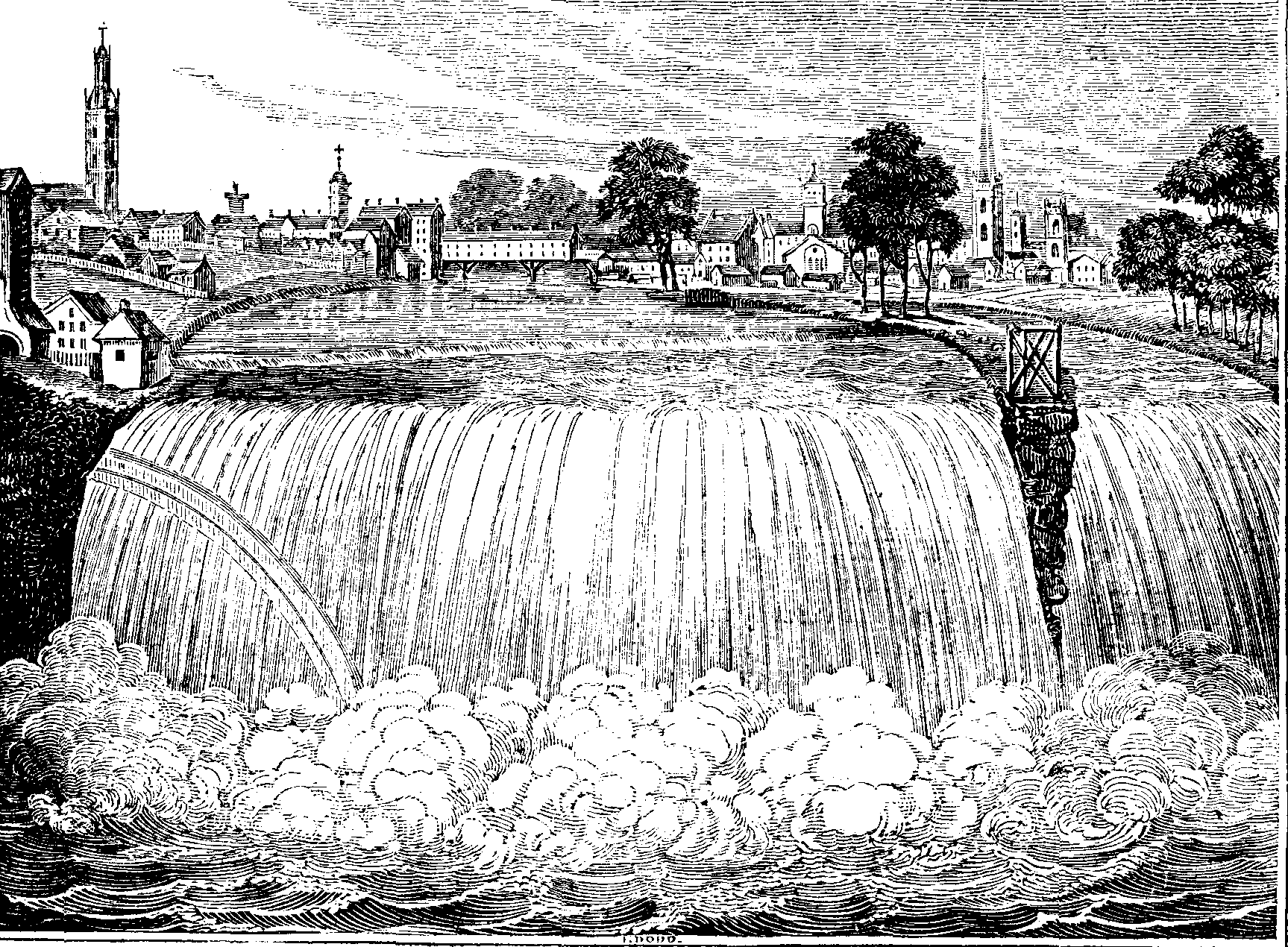
FALLS OF THE GENESEE.
The Genesee is one of the most picturesque rivers of North America. Its name is indeed characteristic: the word Genesee being formed from the Indian for Pleasant Valley, which term is very descriptive of the river and its vicinity. Its falls have not the majestic extent of the Niagara; but their beauty compensates for the absence of such grandeur.
The Engraving includes the falls of the river, with the village of Rochester, seven miles south of Lake Ontario. This place, for population, extent, and trade, will soon rank among the American cities: it was not settled until about the close of the last war; its progress was slow until the year 1820, from which period it has rapidly improved. In 1830 it contained upwards of 12,000 inhabitants: the first census of the village was taken in December, 1815, when the number of inhabitants was three hundred and thirty-one. The aqueduct which takes the Erie canal across the river forms a prominent object of interest to all travellers. It is of hewn stone, containing eleven arches of 50 feet span: its length is 800 feet, but a considerable part of each end is hidden from view by mills erected since its construction.
On the brink of the island which separates the main stream of the river from that produced by the waste water from the mill-race, will be seen a scaffold or platform from which an eccentric but courageous adventurer, named Sam Patch, made a desperate leap into the gulf beneath. Patch had obtained some celebrity in freaks of this description, though his feats be not recorded, like the hot-brained patriotism of Marcus Curtius in olden history. At the fall of Niagara, Patch had before made two leaps in safety—one of 80 and the other of 130 feet, in a vast gulf, foaming and tost aloft from the commotion produced by a fall of nearly 200 feet. In November, 1829, Patch visited Rochester to astonish the citizens by a leap from the falls. His first attempt was successful, and in the presence of thousands of spectators he leaped from the scaffold to which we have directed the attention of the reader, a distance of 100 feet, into the abyss, in safety. He was advertised to repeat the feat in a few days, or, as he prophetically announced it his "last jump," meaning his last jump that season. The scaffold was duly erected, 25 feet in height, and Patch, an hour after the time was announced, made his appearance. A multitude had collected to witness the feat; the day was unusually cold, and Sam was intoxicated. The river was low, and the falls near him on either side were bare. Sam threw himself off, and the waters (to quote the bathos of a New York newspaper) "received him in their cold embrace. The tide bubbled as the life left the body, and then the stillness of death, indeed, sat upon the bosom of the waters." His body was found past the spring at the mouth of the river, seven miles below where he made his fatal leap. It had passed over two falls of 125 feet combined, yet was not much injured. A black handkerchief taken from his neck while on the scaffold, and tied about the body, was still there. He is stated to have had perfect command of himself while in the air; and, says the journalist already quoted, "had he not been given to habits of intoxication, he might have astonished the world, perhaps for years, with the greatest feats ever performed by man."
The Genesee river waters one of the finest tracts of land in the state of New York. Its alluvial flats are extensive, and very fertile. These are either natural prairies, or Indian clearings, (of which, however, the present Indians have no tradition,) and lying, to an extent of many thousand acres, between the villages of Genesee, Moscow, and Mount Morris, which now crown the declivities of their surrounding uplands; and, contrasting their smooth verdure with the shaggy hills that bound the horizon, and their occasional clumps of spreading trees, with the tall and naked relics of the forest, nothing can be more agreeable to the eye, long accustomed to the uninterrupted prospect of a level and wooded country.
SONG FROM THE ALBUM OF A POET.
By G.R. Carter.
THE HOMEWARD VOYAGE.
Away o'er the dancing wave, Like the wings of the white seamew; How proudly the hearts of the youthful brave Their dreams of bliss renew! And as on the pathless deep, The bark by the gale is driven, How glorious it is with the stars to keep A watch on the beautiful heaven. The winds o'er the ocean bear Rich fragrance from the flow'rs, That bloom on the sward, and sparkle there Like stars in their dark blue bow'rs. The visions of those that sail O'er the wave with its snow-white foam, Are haunted with scenes of the beauteous vale That encloses their peaceful home. They have wander'd through groves of the west, Illumed with the fire-flies' light; But their native land kindles a charm in each breast, Unwaken'd by regions more bright. The haunts that were dear to the heart As an exquisite dream of romance, Strew thoughts, like sweet flow'rs, round its holiest part, And their fancy-bound spirits entrance. Then away with the fluttering sail! And away with the bounding wave! While the musical sounds of the ocean-gale Are wafted around the brave!
Ray wittily observes that an obscure and prolix author may not improperly be compared to a Cuttle-fish, since he may be said to hide himself under his own ink.
LINES
FROM THE GERMAN OF KÖRNER.
Written on the morning of the Battle of Dänneberg.
Doubt-beladen, dim and hoary, O'er us breaks the mighty day, And the sunbeam, cold and gory, Lights us on our fearful way. In the womb of coming hours, Destinies of empires lie, Now the scale ascends, now lowers, Now is thrown the noble die. Brothers, the hour with warning is rife; Faithful in death as you're faithful in life, Be firm, and be bound by the holiest tie, In the shadows of the night, Lie behind us shame and scorn; Lies the slave's exulting might, Who the German oak has torn. Speech disgrac'd in future story, Shrines polluted (shall it be?) To dishonour pledg'd our glory, German brothers, set it free. Brothers, your hands, let your vengeance be burning, By your actions, the curses of heaven be turning, On, on, set your country's Palladium free. Hope, the brightest, is before us, And the future's golden time, Joys, which heaven will restore us, Freedom's holiness sublime. German bards and artists' powers, Woman's truth, and fond caress, Fame eternal shall be ours, Beauty's smile our toils shall bless. Yet 'tis a deed that the bravest might shake, Life and our heart's blood are set on the stake; Death alone points out the road to success. God! united we will dare it; Firm this heart shall meet its fate, To the altar thus I bear it, And my coming doom await. Fatherland, for thee we perish, At thy fell command 'tis done, May our loved ones ever cherish Freedom, which our blood has won. Liberty, grow o'er each oak-shadow'd plain, Grow o'er the tombs of thy warriors slain, Fatherland, hear thou the oath we have sworn. Brothers, towards your hearts' best treasures, Cast one look, on earth the last, Turn then from those once prized pleasures, Wither'd by the hostile blast. Though your eyes be dim with weeping, Tears like these are not from fear, Trust to God's own holy keeping, With your last kiss, all that's dear. All lips that pray for us, all hearts that we rend With parting, O father, to thee we commend, Protect them and shield them from wrongs and despair.
H.
EQUANIMITY OF TEMPER.
The author of "A Tradesman's Lays."
Probably our correspondent may recollect Sir William and the orange, at one of the contested City elections. A "greasy rogue" before the hustings, seeing the baronet candidate take an orange from his pocket, put up for the fruit, with the cry "Give us that orange, Billy." Sir William threw him the fruit, which the fellow had no sooner sucked dry, than he began bawling with increased energy, "No Curtis," "No Billy," &c. Such an ungrateful act would have soured even Seneca; but Sir William merely gave a smile, with a good-natured shake of the head. Sir William Curtis possessed a much greater share of shrewdness and good sense than the vulgar ever gave him credit for. At the Sessions' dinners, he would keep up the ball of conversation with the judges and gentlemen of the bar, in a fuller vein than either of his brother aldermen. It is true that he had wealth and distinction, all which his fellow citizens at table did not enjoy; and these possessions, we know, are wonderful helps to confidence, if they do not lead the holder on to assurance.—Ed. M.