SELECT BIBLIOGRAPHY
Reading edition
M. Chaptal
M. Chaptal
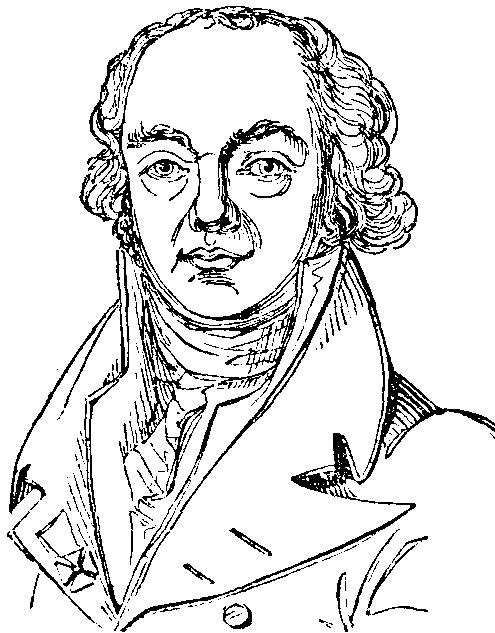
M. Chaptal, the celebrated chemist, born at Montpellier in 1755, died a few days since at Paris, in his 77th year. He studied medicine and natural philosophy when very young, and under promising patronage. Before the Revolution he published some valuable works, and formed two or three chemical establishments, and for his successful labours the King had given him the order of St Michael. When the Revolution began, M. Chaptal headed the insurgents at Montpellier, who took possession of the citadel in 1791.
Chaptal now retired from political life, and established a chemical manufactory in the neighbourhood of Paris; but he was soon after chosen a member of the Conservative Senate, and made grand officer of the Legion of Honour. In 1806, he was present at the placing of the trophied column in the Place Vendome, to commemorate the battle of Austerlitz. Chaptal was soon after made a Count, and received the grand cross of the Legion of Honour.
In 1813, when the Allies began to approach the French frontiers, Chaptal was dispatched to support the falling power of Napoleon; he failed to do so; and when the Austrians approached the capital, he retired to Clermont, but after the taking of Paris he hastened to the city. He was made a member of the Academy of Sciences upon its re-organization.
Upon the return of Napoleon from Elba, he named Chaptal director-general of manufactures and commerce, and immediately after minister of state, in which latter capacity he pronounced, in the name of all the ministers, a very flattering address to Napoleon. At the restoration of the Bourbons, Chaptal again retired into private life, and continued to enjoy the society of a large circle of literary and scientific friends till his death.
Upon the application of chemistry to the arts of life, Chaptal is considered to have been the most distinguished writer of his time. His works are, Conspectus Physiologicus de Fontibus differentiarum relat. ad Scientias, 1777; Analytical Table of a Course of Chemistry delivered at Montpellier, 1783; Elements of Chemistry; Treatise on Saltpetre and Tar; a Table of the principal Earthy Salts and Substances; an Essay on perfectioning the Chemical Art in France; a Theoretical and Practical Treatise on the Cultivation of the Vine; the Art of making Wines, &c.; the Art of Making, Managing, and Perfectioning Wines, a work which has been productive of great improvement in the wines of many districts in France; the Art of Dyeing Cotton Red; Chemistry applied to the Arts; the Chemical Principles of the Arts of Dyeing and Scouring. M. Chaptal has also furnished many excellent articles to the Annals of Chemistry, and the Dictionary of Agriculture. Among his miscellaneous productions, a paper on Geological Changes is entitled to special mention as one of the most beautiful compositions of its class.
GOETHE
GOETHE
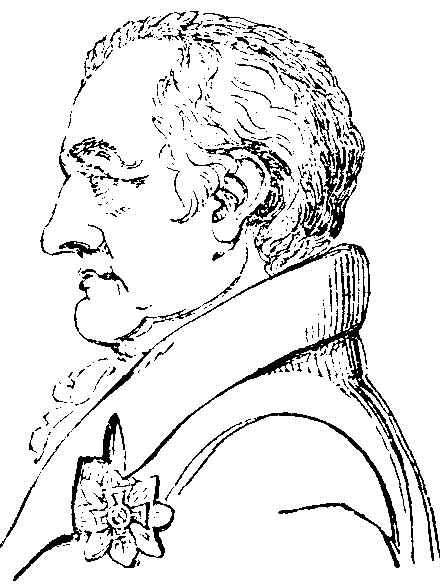
John Wolfgang von Goethe was born at Frankfort, August 28, 1749, and died at Weimar, March 22, 1832, aged eighty-two years and seven months. He was a sickly child, and consequently participated but little in children’s pastimes. Youth—melancholy, or early habits of reflection, and an independence on others for amusement or formation of opinions were thus generated, which, operating on his exquisite organization, contributed to make him the master-spirit of his age. Thus, in his autobiography and diary, it is highly instructive to mark the effect of the various circumstances in which he was placed, on his train of thought. Events, which on most children’s minds “are only reflected as on looking-glasses but make no impression,” produced an effect on him of which the influence was never effaced. The coronation of Joseph II. at Frankfort, the annual mass, and the noble old city itself, with its associations of feudalism and German art, are portrayed by him seventy years after the feelings they had excited, with all the vividness of yesterday’s impressions. It is probable that no one ever possessed such acute sensibility as Goethe. He could “hang a thought on every thorn.”
Goethe’s father was a man of easy circumstances, and of some literary merit: he had a great love for the fine arts, and had made a small collection of objects of virtù in his travels through Italy. All this worked on the young poet, and at eight or nine years old he wrote a short description of twelve pictures, portraying the history of Joseph. At fifteen years of age he went to the university of Leipsic, where he studied law; he took the degree of doctor at Strasbourg. In 1768 he left Leipsic, and after a short tour settled for some time in Alsace, where the beautiful Gretchen won his heart, and obtained for herself in Faust and Egmont, a more lasting monument than brass. On leaving Alsace, he returned home; but soon left it again to practise in the Imperial Chamber at Wezlar. Here he witnessed the tragical event that gave rise to his romance of the Sorrows of Werter. In 1775, he went to Weimar, on an invitation from the Grand Duke, and remained there till the end of his life, loaded with all the honours a German sovereign could bestow, ennobled, a privy councillor, and for many years of his life prime minister; “a treatment of genius hitherto unknown in the annals of literature, or of Mecaenaship; and a splendid exception to the indifference with which rulers generally regard intellectual excellence.”
In 1786, Goethe travelled in Italy, from whence he went to Sicily, and then returned to Rome, where he gave himself ardently up to the study of antiquities. At the end of three years he returned to his own country, and settled at Weimar, which was then called the Athens of Germany. Here were at that time a number of celebrated men, at the head of whom were Goethe, Wieland, and Schiller. In this congenial society, Goethe resided till his death. A view of his house, with an account of an interview with the poet, about five years since, by Dr. Granville, will be found in The Mirror, vol. xviii. After the deaths of Wieland and Schiller, the reputation of Goethe greatly increased. To form some idea of the sort of worship that was paid to him in his own country, in his lifetime, it is only necessary to read the chapter of Madame de Staël’s Germany, dedicated to that subject. The admirers of Goethe formed a sort of sect, a body amongst themselves, over whom, says Madame de Staël, the influence of Goethe was really incomprehensible. Among the honours paid to him by the illustrious men of Europe, must not be forgotten the tribute of Napoleon. When the Congress of Erfurt was held, Napoleon wished to see Goethe, with whom he conversed for some time, and at the close of the conversation he gave the poet the decoration of the Legion of Honour. In 1825, a splendid bronze medal was struck by order of the Grand Duke, and presented to Goethe, to commemorate the fiftieth year of the poet’s residence at his court.
As Goethe wrote every sort of poem, from the simple ballad to the epic, and from a proverb to a tragedy, a mere list of his works would occupy some columns. His first appearance in print was in the annuals and literary journals. But his Gotz of the Iron Hand, published with his name in 1773, and his Werther, in the year after, called at once the attention of his country to the young master-mind. The influence of these two works on the literature of Germany was electric. Hosts of imitators sprung up among the fruitful fry of small authors, and flourished until Goethe himself, by his wit, his irony, and his eloquence, put an end to the sickly sentimentalism, which he had first called into action. Gotz and Werther alone survive the creations of which they formed the nucleii. Such a production as the first, indeed, at the age of twenty-three, at once placed Goethe at the head of his country’s literature, a place which he preserved undisputed to the hour of his death.
We have referred to the multitudinous nature of the works of Goethe. Their variety was proportionate to their number. It has been well observed that “his mind never seems to have grown old, but to have presented a new phasis at each stage of his existence.” Not satisfied by taking his rank amongst the first poets of his time, his ardent genius led him to study all the different branches of literature, physical science, natural history, and the fine arts. He alike delighted in the imaginative beauty of poetry, and the abstrusest problems in science—the romantic and the real—the creative fancy and unwearied research of a truly great mind. It is, however, a matter of regret that Goethe was no politician. The character of his mind would not lead the observer to expect this feature. “A chilling scepticism, as to the progressive improvement of man, runs through all his writings, and, of course, prevented all attempts to make human institutions more productive of human happiness.” Nevertheless, it may be urged, that social amelioration may be effected by other means than by direct problems of political economy, unfashionable as the doctrine may sound. Chateaubriand has eloquently written “there is nothing beautiful, sweet, or grand in life, but in its mysteries.” Goethe probably entertained a kindred sentiment. Thus, the calculator may reckon him “behind the age,” or his favourite views of human improvement.
Goethe remained single till his fifty-eighth year, when he married his housekeeper, by whom he had a family. His affection for his son, who died about two years since, was unbounded. After his death, Goethe was but the shadow of that which he once had been. To his daughter-in-law he was indebted for that tenderness and assiduity which soothed his declining years. When upwards of eighty years of age, he meditated literary projects with the vigour and enthusiasm of youthful genius. Indeed, his constitution was unimpaired, and seemed to promise some years of life: his death therefore excited at Weimar, a feeling of surprise as well as sorrow.
The remains of the poet, after lying in state in the hall of his mansion for five hours, were deposited, on March 26, in the grand ducal family vault at Weimar near to those of Schiller. On the same day, the theatre which had been closed from respect to his memory, was opened with the representation of his Tasso. An epilogue was composed for the occasion by Chancellor Muller, the intimate friend of Goethe. Its last stanza produced a profound impression upon the audience:—“The spot where great men have exercised their genius remains for ever sacred. The waves of time silently efface the hours of life; but not the great works which they have seen produced. What the power of genius has created, is rarified like the air of the Heavens,—its apparition is fugitive,—its works are eternal.”
Goethe has left several MSS. for publication. Among them is a volume of his early life in Weimar, a volume of poems, the second part of “Faust,” interesting letters, &c.