OPORTO.
Reading edition
OPORTO.
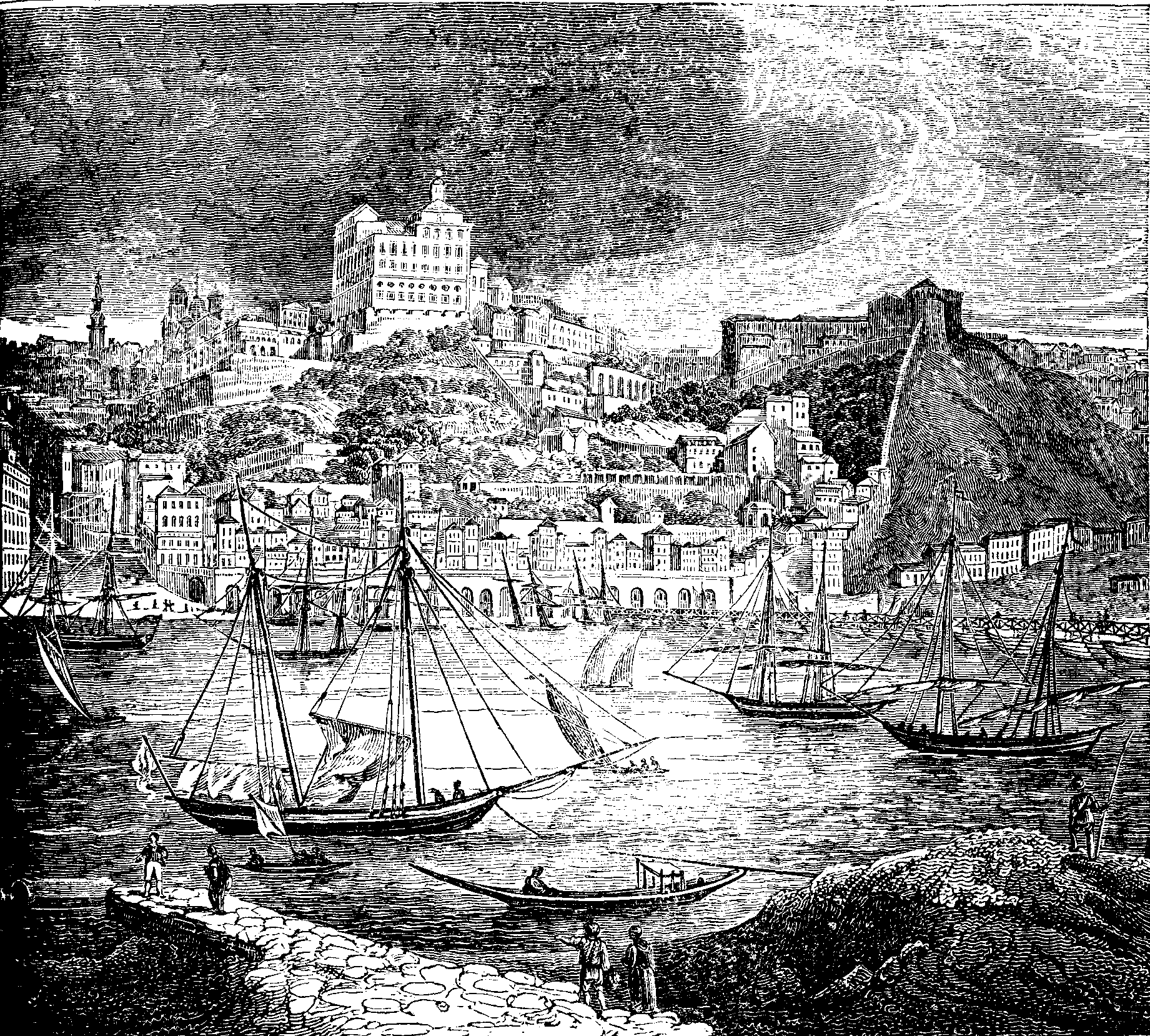
Persons who are looking for "news from the seat of war" will probably hail the timely appearance of this Engraving, and regard it as folks sitting at a play do a drop-scene between the acts. The reader knows our pacific politics: we are of the pen, not of the sword; but we cannot be indifferent to a great political result, when
Old men, and beldams, in the streets Do prophesy upon it.
To economize time and space we must quit this enchanting spot. Gondolas, like those at Venice, are used on the river, but will not suffice for our celerity. We must reach at once the point of our Engraving. The view is taken from Villa Nova, an important suburb of Oporto, on the opposite bank of the river. The city may be divided into the high and the low town. It contains, in a civil sense, five wards, or bairros, of which the Sé, or cathedral hill, and the Vittoria, or height opposite to the Sé, (and crowned by a church, which was founded in commemoration of a celebrated battle fought on the spot with the Moors, which terminated in their defeat and expulsion from the place,) form the town properly called Oporto; and it is possible still to trace the remains of the old wall, which formerly surrounded and defended the place. The three other quarters, San Idelfonso, Miragaya, and Villa Nova, are open. The latter is connected with the principal town by a bridge of boats, which is so badly constructed as to be scarcely able to sustain the violent power of the river when swelled by winter torrents. The Douro, like the Rhine and the Rhone, and all other rivers which flow through a rocky and often confined channel, commits at certain seasons the greatest ravages; and property to a considerable amount is annually lost at Oporto, by the irresistible force with which the river pours down and carries every thing before it. A bridge of granite has been long talked of to connect Villa Nova and Oporto, but the funds are not yet forthcoming, and the expense will be considerable.
"On the quays," says Mr. Kinsey, "are seen fine blocks of granite, already converted into form, having their edges cased with wood, ready to be shipped off for buildings in Brazil, where it appears that no good stone, or, at least, so durable as this, can be procured;—pipe-staves from Memel,—flax and iron,—and occasionally coals from the north of England. There are generally at anchor in the river between Villa Nova and Oporto, Russian, Brazilian, English, American, Dutch, Danish, and some French vessels; but many of the latter nation are not to be found in the Portuguese ports. Two thirds of the shipping to be seen in the Douro, are British, Brazilian, or Portuguese."
The gardens of the city are luxuriantly stored. Brazilian plants, easily distinguished by their gaudy colours, vines on trellis, superb lemon-trees, lime and orange-trees, pear, apple, and plum-trees, and Alpine strawberries are in abundance. The Indian cane, with its splendid blossom, whose colour resembles that of the Guernsey, or rather the Chinese lily, is a gay addition to the ornaments of this earthly paradise. Mr. Kinsey says "The ulmis adjungere vitem is well known in poetical description, but in Portugal, besides overshadowing their artificial supporters, the vines are seen attaching themselves to, or hanging down in luxuriant festoons from forest-trees, such as the oak, chestnut, and cork, in all the wildness of nature, and not unfrequently insinuating themselves among the branches of myrtle-trees, which attain a considerable size in the hedge-rows, and contrasting their large, purple bunches with the snow-white blossom. The union is truly poetical, and its novelty is charming to the eye of a northern traveller. A vine is often purposely planted by the farmer under an oak-tree, whose boughs it soon over-runs, repaying the little labour expended in its cultivation by its fruit, and the lop of its branches. Ten pipes of green wine, vinho verde, expressed from these grapes, will yield one pipe of excellent brandy. Being light and sharp, the vinho verde is preferred by the generality of Portuguese in the summer, to wines of superior strength and quality."
The population of Oporto and Villa Nova was stated by Colonel Batty in 1830, to amount to about 80,000 inhabitants.
POETS, MINOR AND MAJOR.
Perhaps no branch of literary reputation is so difficult to establish as that of first-rate poetic excellence. During the last fifty years, many meritorious competitors for bardic renown have successively aspired to public favour, and have each in their turns exhibited their fancy-woven bouquets, as containing a more beautiful assemblage of "flowers of all hue," as Milton divinely sings, than those which their equally emulative and praiseworthy compeers have, in their best attempts, laid out upon the parterre of the public. In the poetic foreground of the above period, are to be seen the names of Pye, Ogilvie, Whitehead, Tasker, Mason, Cowper, Merry, Jerningham, Woty, Hurdis, Pratt, Fitzgerald, &c. over whose metrical effusions, with the exception of the fifth and sixth, the clouds of obscurity have long since cast a darkening hue. Even the "Elegaic Sonnets" of Charlotte Smith, which first appeared in 1784, and formed a sort of poetical era in point of popularity, have long since "fallen into the sere and yellow leaf," as it was discriminately hinted by Burns would be the case with his soul-breathing Letters; the Sonnets by the Rev. W.L. Bowles, although emanating from a beautiful fountain-spring of thought and feeling, which should have screened their writer from the venomous shaft of Byron, have already sunk beneath the meridian of their popularity; and the loaded ornamental rhymes of Darwin; the prettily embroidered couplets of Miss Seward, together with the Della Cruscan Rhymes of Mary Robinson, Mrs. Cowley, &c. are left like daisies, plucked from the greensward, to perish beneath unfeeling neglect. Who now reads the verses of Ann Yearsley, the poetic milkwoman, who was so lauded beyond her deserts, by Mrs. H. More?—few or none. Why is this revolution in public taste? Because those master-spirits which guide the present age, have given birth to a species of poetry more legitimate and useful in its design, and more valuable in its tendencies and characteristics. Instead of the "namby pamby" verses of the period I have alluded to, and the coarse scurrility of style which runs with a discolouring vein through the satirical pages of Dr. Wolcot, we have now the heart-stirring metres of a Campbell, as in that beautiful rainbow of poetic loveliness and imagination, his "Pleasures of Hope." We have now a series of pictures bearing an impress as pleasant as the gleams of warm autumn in the "Pleasures of Memory," by Rogers; the wildness of Loutherbourgh, the grandeur of Salvator Rosa, the terror-striking forms of Fuseli, embodied with increased energy in the immortal Lays of Byron: the every-day incidents of life, copied with the graphic fidelity of a Sharp, and bearing the faithful stamp of cottage grouping, which distinguished the pencil of a Morland,—in the natural paintings of Crabbe. We have Catullus stealing from his couch, to breathe a new intonation into the harp of Moore; and last of all, we have the votaress of virtue and moral feeling, the Cambrian minstrel, Mrs. Hemans, making melancholy appear as delightful as love.
The Author of a Tradesman's Lays.
STANZAS FOR MUSIC.
Though the waves of old Time are darkly advancing, There still is one spot where the sunbeams are glancing, There glow the gay visions of youth's sunny morn, Safe from the ocean-wave, safe from the storm: For Memory keeps the spot fresh and green ever, The dark tides of Time, shall sweep over it never! There Fancy, her mirror holds up to the eye, And lovely the forms that come wandering by, Like music come softly the sounds that have fled, The voices of lov'd ones, the tones of the dead: Oh Memory! keep that spot fresh and green ever, And the dark tides of Time, sweep over it never. For beautiful Hope, wanders oft to the Isle, With her wreath of bright flowers, and radiant smile. She stands with her finger upraised to the sky, And she dries the sad tear-drop in Memory's eye: An emerald green, be that Island for ever, May the dark tides of Time, sweep over it never! Kirton, Lindsey. ANNE R.