THE NEW CHURCH OF ST. DUNSTAN IN THE WEST.
Reading edition
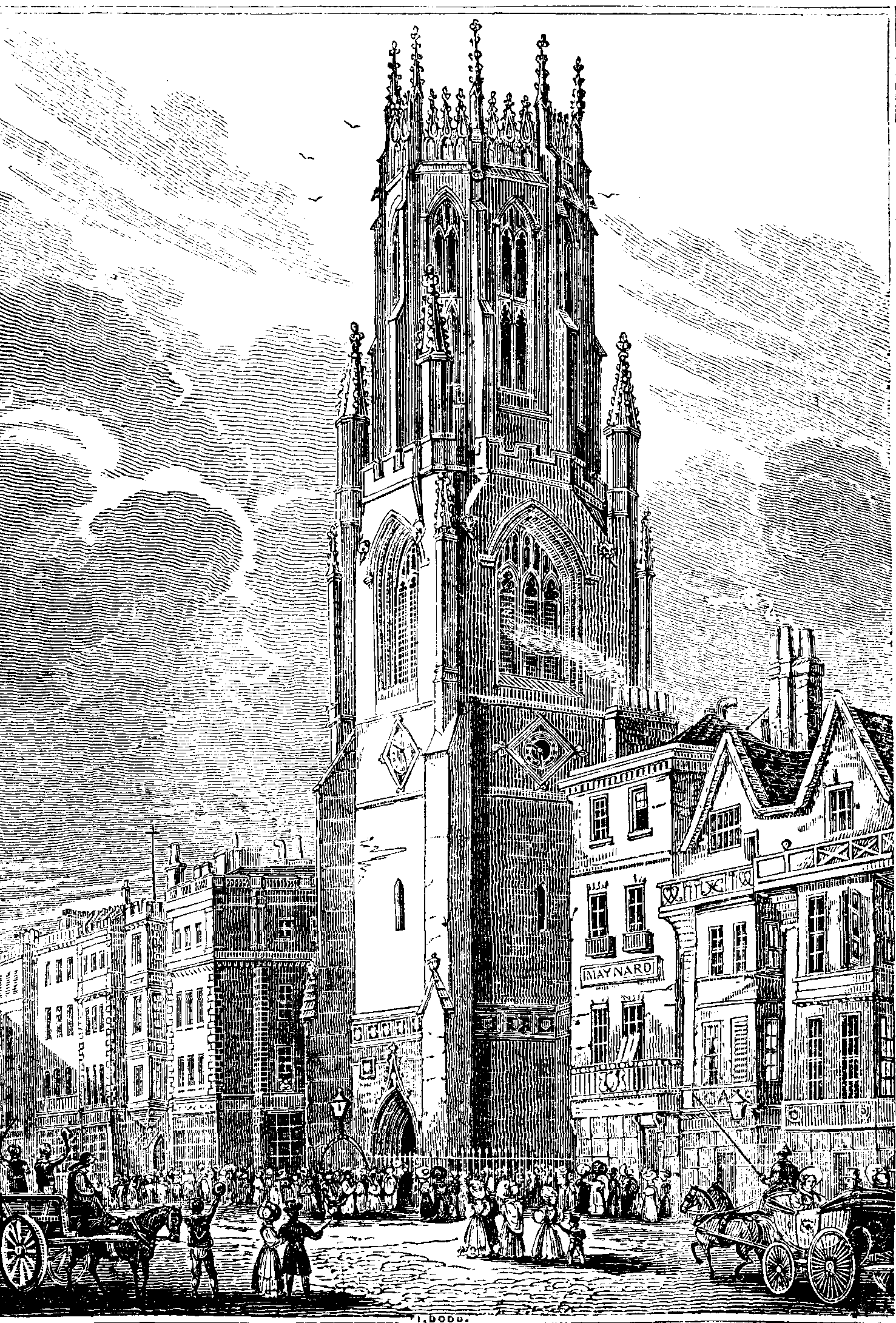
The body of the church is of fine brick, finished with stone, and of octagon form, about 50 feet diameter. The interior has eight recesses; one of these being occupied by the altar with a large pointed window above, and three others by the organ and galleries for the children of the parish schools: the remaining four recesses are unoccupied by galleries; against their walls are placed the sepulchral monuments from the old church. The octagon form was often adopted in the lady-chapels at the east end of our most ancient cathedrals, where the recesses were devoted to tombs and private chapels. The upper or clere story is supported on arches, with an enriched gothic window in each compartment. The roof springs from clustered columns, branching into an enriched groined ceiling, with a very large and embellished pendent key-stone in the centre, from which will be suspended the chandelier to light the whole of the interior. The ornaments of this key-stone are of a very elegant character: its foliated tracery, as well as the richness of the bosses, corbels, and other embellishments throughout the interior, are extremely beautiful. The pewing, gallery fronts, and fittings will be of fine oak; and we learn that the altar and eight clere story windows will be filled with painted glass. The church is calculated to hold about 900 persons.
The tower is connected with the main body by a lobby, and will front the street, enclosed with a handsome railing. The builders of the church are Messrs. Browne and Atkinson, of Goswell-street, London; and the pewing and interior fittings are about to be executed by Messrs. Cubitt.
We could occupy a column or a page with enumerating the monumental remains of the old church, although we have already mentioned the principal of them. (See Mirror, vol. xiv. p. 145-243.) It is our intention to return to them, even if it be but to point the attention of the lover of parochial antiquities to a Series of Views of St. Dunstan and its Monuments, with an Historical Account of the Church, by the Rev. J.F. Denham; which by its concise yet satisfactory details, leads us to wish that every parish in the metropolis were illustrated by so accomplished an annalist.
ITALIAN HYMN TO THE MADONNA.
When the cypress-tree is weeping With the bright rose o'er the tomb. And the sunny orb is sleeping On the mountain's brow of gloom. Sweet mother at thy shrine Our spirits melt in prayer, Beneath the loveliness divine, Which art has pictured there. Or when the crystal star of Even Is mirror'd in the silent sea, And we can almost deem that heaven Derives its calmest smile from thee. Oh, virgin, if the lute Invokes thy name in song, Be thine the only voice that's mute, Amid the tuneful throng. When battle waves her falchion gory, Over the dead on sea or land, And one proud heart receives the glory, Won by the blood of many a band, If the hero's prayer to thee, From his fading lips be given, Awake his heart to ecstacy, With brightest hopes of heaven. Madonna! on whose bosom slumber'd, The infant, Christ, with sunny brow, The viewless hours have pass'd unnumber'd, Since we adored thy shrine as now; But not the gorgeous sky, Nor the blue expansive sea, To us such beauty could supply, As that which hallow'd thee! And when the scenes of life are faded From our dim eyes like phantom-things, When gentlest hearts with gloom are shaded, And cease to thrill at Fancy's strings, Thou, like the rainbow's form, When summer skies are dark, Shalt give thy light amid the storm, And guide the Wanderer's bark! G.R. CARTER.