DUNHEVED CASTLE, CORNWALL.
Reading edition
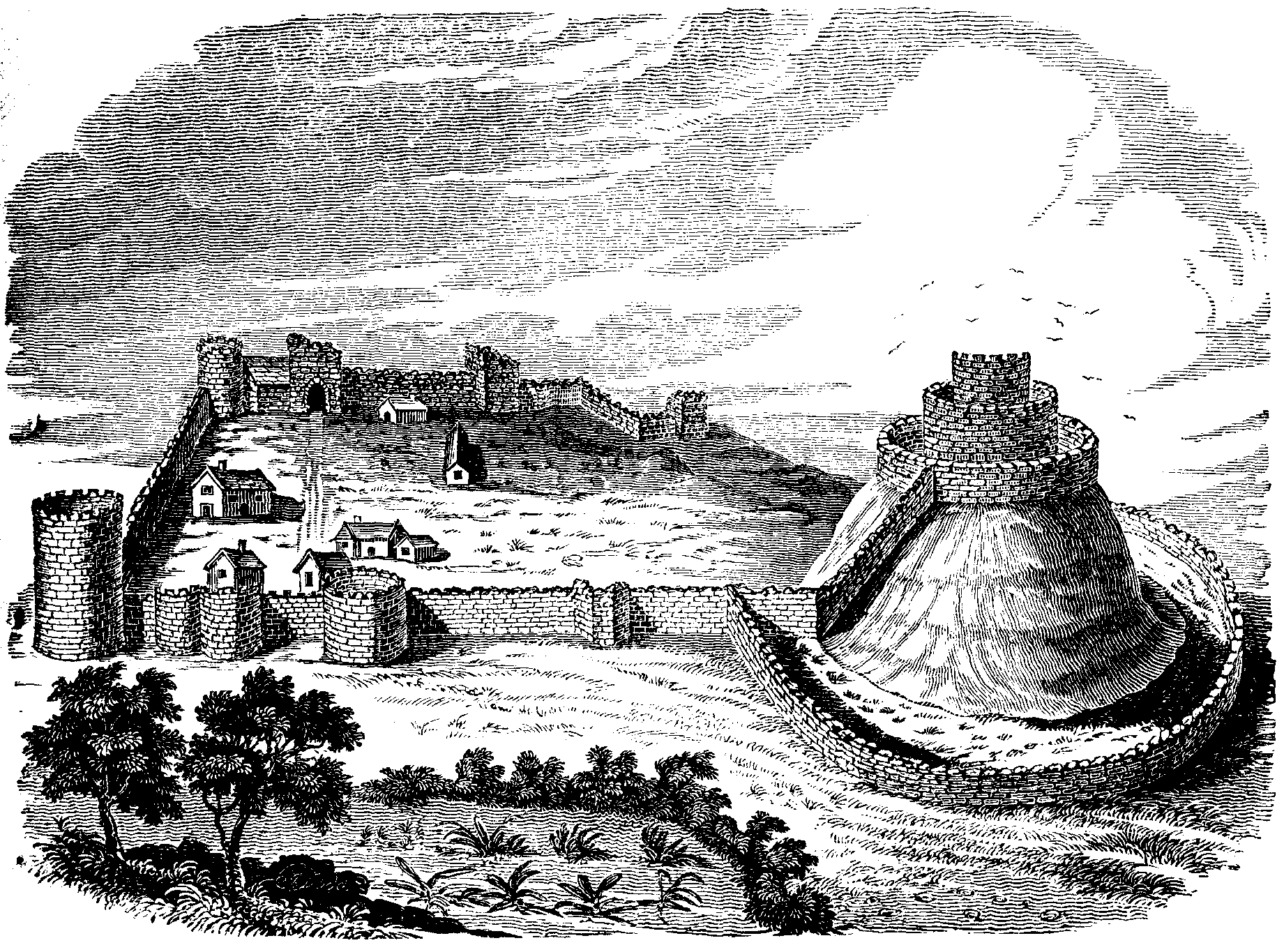
These mouldering ruins occupy the crest of the hill, upon which stands the town of Launceston, near the centre of the eastern side of the county of Cornwall. They are the works of a thousand years since, when might triumphed over right with an unsparing hand, and when men perpetrated by fire and sword millions of murders, which, through the ignorance and credulity of their fellow creatures, have been glossed over with the vain glory of heroism.
The ancient name of Launceston was Dunheved, or the Swelling Hill; its present appellation, according to Borlase, the antiquarian illustrator of Cornwall, signifies, in mixed British, the Church of the Castle. The latter structure is the most important object in the town, to which, in all probability, it gave origin. The remains surround a considerable extent of ground, and prove it to have been a very strong and important fortress. Borlase, who examined the building with great attention about the middle of the last century, thus describes it:—
"The principal entrance is on the north-east, the gateway 120 feet long; whence, turning to the right, you mount a terrace, running parallel to the rampart till you come to the angle, on which there is a round tower, now called the Witches' Tower, from which the terrace runs away to the left at right angles, and continues on a level parallel to the rampart, which is nearly of the thickness of 12 feet, till you come to a semicircular tower, and, as I suppose, a guard-room and gate. From this the ground rises very quick, and, through a passage of seven feet wide, you ascend the covered way betwixt two walls, which are pierced with narrow windows for observation, and yet cover the communication between the base-court and the keep or dungeon. The whole keep is 93 feet diameter; it consisted of three wards: the wall of the first ward was not quite three feet thick; and therefore, I think, could only be a parapet for soldiers to fight from, and defend the brow of the hill. Six feet within it stands the second wall, which is twelve feet thick, and has a staircase three feet wide, at the left hand of the entrance, running up to the top of the rampart; the entrance of this staircase has a round arch of stone over it. Passing on to the left, you find the entrance into the innermost ward, and on the left of that entrance a winding staircase conducts you to the top of the innermost rampart; the wall of which is 10 feet thick, and 32 feet high from the floor; the inner room is 18 feet 6 inches diameter; it was divided by a planking into two rooms. The upper room had to the east and west two large openings, which were both windows and (as I am inclined to think) doors, also in time of action to pass from this dungeon out upon the principal rampart, from which the chief defence was to be made; for it must be observed, that the second ward was covered with a flat roof, at the height of that rampart, which made the area very roomy and convenient for numbers. These openings, therefore, upon occasion, served as passages for the soldiers to go from one rampart to the other. In the upper room of the innermost building there was a chimney to the north; underneath there was a dungeon, which had no lights. The lofty taper hill, on which this strong keep is built, is partly natural and partly artificial. It spread farther in the town anciently than it does now; and, by the radius of it, was 320 feet diameter, and very high."
The reader may more than once have noticed our predilection for illustrating the castellated antiquities of Britain in our pages. We have a threefold object in this choice: first, the architectural investigation of these structures is of untiring interest; the events of their histories are so many links in the annals of our country; while they enable us to take comprehensive glances of the domestic manners of times past, and by contrasting them with the present, to appreciate the peaceful state of society in which we live.
Happily, such means of defence as castles supplied to our ancestors, are no longer requisite. The towers, ramparts, and battlements that once awed the enemy, or struck terror into an oppressed people, are now mere objects of curiosity, The unlettered peasant gazes upon their ruins with idle wonder; the antiquary explores their flittering masses with admiration and delight. The breaches of the last siege are unrepaired; the courtyard is choked up and overgrown with luxuriant weeds; the walls become dank and discoloured with rank vegetation; the winds and rains of heaven displace and disintegrate their massive stones; the tempest tears them as in a terrific siege; or the slow and silent devastations of nature go on beneath ivy and mossy crusts obscuring the proud work of man's hand, and defacing its glories in desert waste. Such effects the reader may witness in a few of the illustrations of the present volume: the long tale of conquest upon conquest is told from the Norman sway to the Revolution, in the history of Pontefract Castle (page 50); the picturesqueness of decay in the towers of Wilton (page 306); and the stratagems of war in the mounds and lines of Dunheved.
THE LATE MR. COLTON.
(From a Correspondent.)
The recent death of this eccentric man of letters may perhaps render the following recollections generally interesting.
I remember once spending an afternoon with him at Mr. Tucker's, quill merchant, Middleton-street, Clerkenwell; when I was delighted with the spontaneous flow of his Latin, his quotations from the ancient and modern poets, and indeed his masterly and eloquent developement of every subject that his acute intellect chose to dilate upon; I was, however, sorry to perceive there was occasionally a want of "holding in" in his conversation upon points which a due self-respect for those acquirements which he possessed, equal to any individual living, should have taught him to have observed. To describe this deficiency as laconically as possible, Mr. Colton wanted that mental firmness which the unfortunate Burns has aptly enough termed "Self-control." I once saw him, in the company of the above mentioned Mr. Tucker, seat himself, at Edmonton Fair, in one of those vulgar vehicles called swings: he was highly delighted with the novelty of the exercise, which he enjoyed amidst the rude stare and boisterous grins of the motley group around him; "this is life," said he, upon getting out of the swing, "what shall we see next?" In his poem of Hypocrisy, he has beautifully eulogized General Graham, who showed his sense of this intellectual tribute by sending the author a complimentary piece of plate. Like Goldsmith, Mr. Colton entertained an unfortunate predilection for gaming, and although he often proved a better match for his wily antagonists than "the mild bard of Auburn" was to his, still he was subject to the fluctuations of the Goddess of Chance, and the quiet charms of literature which once had a beautiful hold upon his mind, were succeeded by the demons of worldly anxiety, which heavy losses, among professed gamesters as acute as himself, would occasionally subject him to. ENORT.
NAPOLEON AT ST. HELENA.
(To the Editor.)
Perhaps the following traits of the national fidelity of the French people may not be unacceptable to some of your readers. During my stay at St. Helena, about six months ago, a French transport arrived with an old regiment of French soldiers, who had fought under Napoleon, and who had been from France ever since the exile of the emperor. When they came on shore, they marched in regularity and silence to the tomb, before which they knelt (many weeping) and uttered prayers for their fallen emperor: this done, they marched back to the town with the same regularity and silence, and returned to their ship much affected.
SCRIPTURAL HERALDRY.
(To the Editor.)
At Sturminster Newton, in Dorsetshire, there is an Infant and Sunday School, founded by the Rev. T.L. Fox. A handsome bronzed gateway forms the entrance, which is surmounted by an escutcheon, containing what may be termed the Christian's armorial bearings, (see Ephesians vi. 14, &c.) The shield itself denotes "the shield of faith;" on the four divisions are emblazoned "the girdle of truth;" "the breast-plate of righteousness;" "feet, shod with the gospel of peace," and "the sword of the spirit;" the crest is "the helmet of salvation," over which is a crown of glory; the motto "THE FOUNDATION OF GOD STANDETH SURE." The benevolence of the reverend founder of this establishment should not pass unnoticed. Pope has described his character to a tittle, in his Man of Ross—
"Who bade the heaven directed spire to rise," &c.
Not only has he rebuilt the church in handsome style—presented it with a noble organ, &c., and founded the above school, but the whole business of his life appears to be to provide by his munificence for the present comfort, and by his pastoral labours, for the future happiness, of all around him.
A humble slab of white marble over the south door of the church, bears the following inscription:
TO RECORD THEIR GRATITUDE
FOR MUNIFICENCE, DIRECTED TO THE INCREASE
OF CHARITY AND RELIGION,
THIS STONE IS DEDICATED BY THE INHABITANTS
OF STURMINSTER NEWTON,
TO THE REVD. THOMAS LANE FOX,
A. D. 1827.
COLBOURNE.