Notes of a Reader
Reading edition
IMPROVEMENT OF LANCASHIRE.
The west of England has considerably the advantage over the eastern side of the island. One way or another nature did much more for it. It is true, that the eastern side was civilized much earlier; yet human ingenuity and industry have of late years been much more successfully employed in turning the gifts of nature to the best possible account. Ireland and America are customers, for whom, though they were long in coming, it was worth while to wait. After all, Lancashire is the most remarkable and characteristic feature in the comparison. From being among the most backward parts of England, this county has worked its way into the front rank. The contrast between its condition up to the middle of the last century, and the astonishing spectacle which it exhibits at present, belongs to the transformation which a hundred years create in a newly settled country like America, far more than to the gradual improvements and changes of an old English county.
It would be curious to analyze the concurrent causes, and marshal the successive steps, by which Lancashire has advanced;—not only succeeding in appropriating to itself a leading interest in the creative inventions of Watt and Arkwright, but connecting its name in honourable alliance with literature and science. The very circumstances from which a contrary presumption would originally have been drawn, have (singularly enough) principally contributed to its extraordinary progress. Lancashire owes the canals, by which the commercial thoroughfare of that end of England has been turned from the Humber to the Mersey, to the enterprise of a Peer. It owes the docks, which have about them almost a Roman presentiment of future greatness, to the spirit of a Corporation. It owes the taste and accomplishments, by which the character of its wealth has been raised above the drudgery and fanaticism of money-getting, almost entirely to the zeal of a few Dissenters. The name of Governor Clinton is not so pre-eminently united with the canal policy of America, as is the name of the Duke of Bridgewater with the canals of England. He staked his last shilling on the chance of thus cutting out an inland north-west passage to the Atlantic. The corporation of Liverpool, by an enlightened application of their vast resources, have accelerated, consolidated, and secured the realization, of every expectation and contingency which fortune threw in their way. They have hastened, not to say, anticipated, events. There can be as little doubt of the effect which the light radiating from the assemblage of Priestley, Wakefield, Aikin, &c. at Warrington; from the presence of Percival, Henry, Ferriar, and Dalton, at Manchester; and from that of Roscoe and Currie at Liverpool, spread over their circle. The literary attainments and cultivation of the manufacturers and merchants of Lancashire, as a body, seem otherwise likely long to have lagged behind their general powers of understanding, and their real station in society.—Edinburgh Review.
ENNUI OF FASHION.
It must be owned that five years form an awful lapse in human life:—a lapse whose hours and minutes leave no where a trace more sharp and injurious than on the minds and countenances of individuals involved in the buzzing, stinging gnatswarms of fashionable life. Elsewhere, existence marches with a more dignified step, and the scenes pictured among the records of our memory assume a grander aspect; they lie in masses,—their shadows are broader,—their lights more brilliantly thrown out. But reminiscences of a life of ton are as vexatious as they are frivolous. The season of 1829 differs from that of 1830, only inasmuch as its quadrilles are varied with galoppes as well as waltzes, and danced at Lady A.'s and Lady B.'s,—instead of the Duchess of D.'s, and Countess E.'s. The Duchess is dead,—the Countess ruined;—but no matter!—there are still plenty of balls to be had. "Another and another still succeeds!" Since young ladies will grow up to be presented, lady-mothers and aunts must continue to project breakfasts, water parties, and galas, whereby to throw them in the way of flirtation, courtship, and marriage. Mischief, in her most smiling mask, sits like the beautiful witch in Thalaba at an everlasting spinning-wheel, weaving a mingled yarn of sin and sorrow for the daughters of Fashion. Although the cauldron of Hecate and her priestesses has vanished from the heath at Forres, it bubbles in nightly incantations among the elm-trees of Grosvenor Square; and Hopper and Hellway, Puckle and Straddling, now croak forth their chorus of rejoicing where golden lamps swing blazing over the écarté tables, and the soft strains of the Mazurka enervate the atmosphere of the gorgeous temples of May Fair. Never yet was there a woman really improved in attraction by mingling with the motley throng of the beau monde. She may learn to dress better, to step more gracefully; her head may assume a more elegant turn, her conversation become more polished, her air more distinguished; —but in point of attraction she acquires nothing. Her simplicity of mind departs;—her generous, confiding impulses of character are lost;—she is no longer inclined to interpret favourably of men and things,—she listens without believing,—sees without admiring; has suffered persecution without learning mercy;—and been taught to mistrust the candour of others by the forfeiture of her own. The freshness of her disposition has vanished with the freshness of her complexion; hard lines are perceptible in her very soul, and crowsfeet contract her very fancy. No longer pure and fair as the statue of alabaster, her beauty, like that of some painted waxen effigy, is tawdry and meretricious. It is not alone the rouge upon the cheek and the false tresses adorning the forehead, which repel the ardour of admiration; it is the artificiality of mind with which such efforts are connected that breaks the spell of beauty.
From the Fair of May Fair.
BAMBOROUGH CASTLE
Is situate on the romantic coast of Northumberland, "over against" an obscure town of the same name. It stands upon a basalt rock, of a triangular shape, high, rugged, and abrupt on the land side; flanked by the German Ocean, and strong natural rampires of sand, matted together with sea rushes on the east; and only accessible to an enemy on the south-east, which is guarded by a deep, dry ditch, and a series of towers in the wall, on each side of the gateway. Nature has mantled the rock with lichens of various rich tints: its beetling brow is 150 feet above the level of the sea, upon a stratum of mouldering rock, apparently scorched with violent heat, and having beneath it a close flinty sandstone. Its crown is girt with walls and towers, which on the land side have been nearly all repaired. The outer gateway stands between two fine old towers, with time-worn heads; twelve paces within it is a second gate, which is machicolated, and has a portcullis; and, within this, on the left hand, on a lofty point of rock, is a very ancient round tower of great strength; commanding a pass subject to every annoyance from the besieged. This fort is believed to be of Saxon origin. The keep stands on the area of the rock, having an open space around it. It is square, and of that kind of building which prevailed from the Conquest till about the time of our second Henry. It had no chimney; but fires had been made in the middle of a large room, which was lighted by a window near its top, three feet square. All the other rooms were lighted by slit or loop holes, six inches broad. The walls are of small stones, from a quarry at Sunderland on the sea, three miles distant: within them is a draw well, discovered in 1770, in clearing the cellar from sand and rubbish; its depth is 145 feet, cut through solid rock, of which seventy-five feet are of whinstone. The remains of a chapel were discovered here, under a prodigious mass of land, in the year 1773; its architecture was pure Saxon, and the ancient font being found, was preserved in the keep. The chapel has been rebuilt on the old foundations.
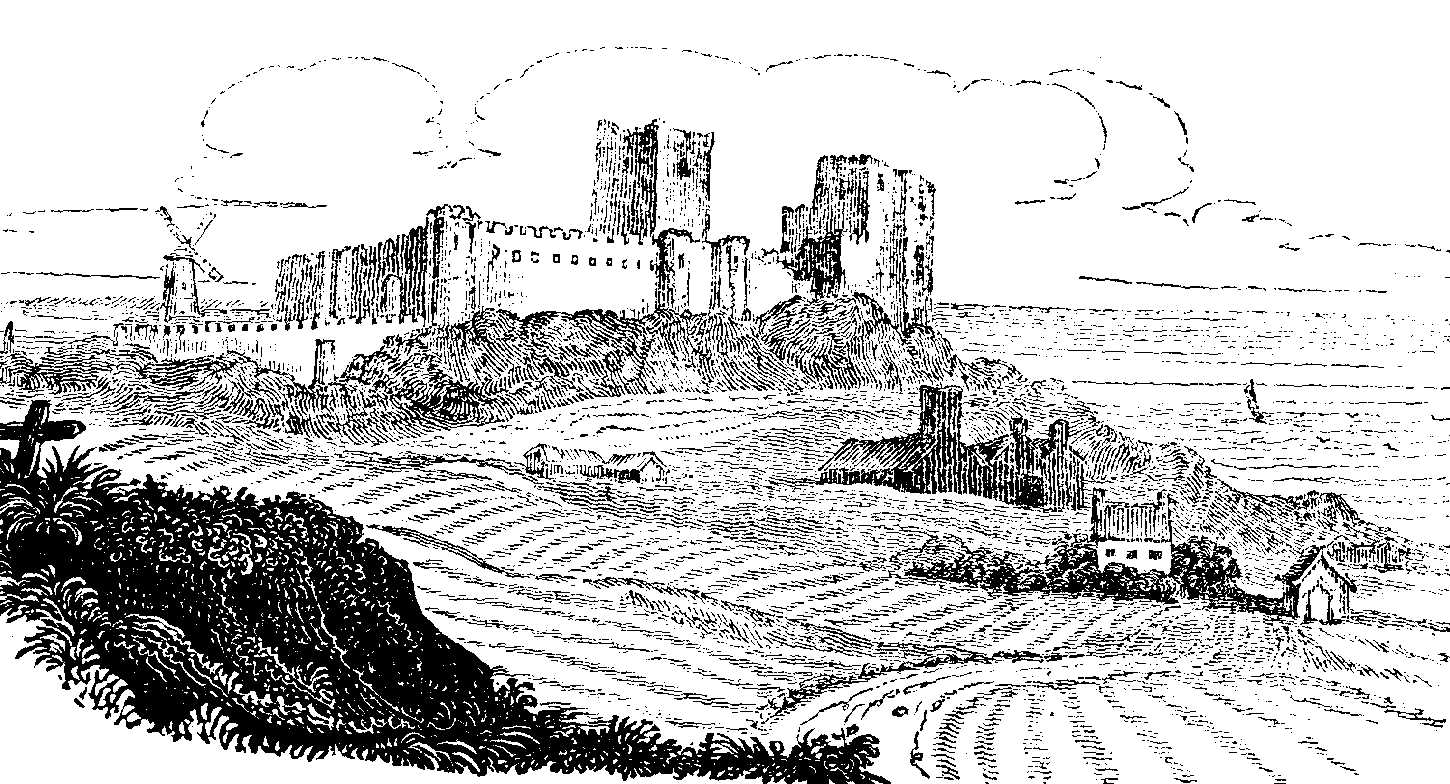
(Bamborough Castle before the general repairs.)
The founder of the Castle is stated by Matthew of Westminster to have been Ida, King of Northumberland. Sir Walter Scott sings
Thy tower, proud Bamborough, mark'd they
here,
King Ida's castle, huge and square,
From its tall rock look grimly down,
A boundless view of the ocean presents itself from the towers of Bamborough Castle, studded with small islands, having the Coquet Island on the south, and the Holy Island on the north.