THE NATURALIST.
Reading edition
LOUDON'S MAGAZINE OF NATURAL HISTORY.
Sundry and manifold are our obligations to this delightful Journal. From the Number (26) for the present month we glean the following:
The Gurnard and Sprat.
Mr. J. Couch, in an interesting paper on the fishes of Cornwall, has the following notes:
"Ray observes that the word gurnard, which may be regarded as the English term, is derived a grunnitu, from grunting like a hog. In this, however, I venture to think this eminent naturalist mistaken. Pengurn is the ancient Cornu-British name for these fishes, and signifies hard head; and its English translation is now sometimes given to the grey gurnard. From the Cornish word gurn (hard), I therefore derive the name, as descriptive of the head of these species. This is a common fish at all seasons; but in December and January it sometimes abounds to such a degree, that, as they are not much esteemed, I have known them sold at thirty for a penny. It keeps near the bottom commonly, at no great distance from land; but sometimes multitudes will mount together to the surface; and move along with the first dorsal fin above the water: they will even quit their native element, and spring to the distance of a yard; thus imitating the flying gurnard, though not to the same extent. In summer they are found basking in the sun, perhaps asleep, as they will at times display no signs of animation, until an attempt is made to seize them.
"In reference to some observations by Mr. Yarrell, in the Zoological Journal, relative to the distinction between the sprat and the young of the pilchard and herring, I can state that Cornish fishermen term the young of both the latter fishes sprats; but, how far this should go in determining the judgment of a naturalist will appear, when I add that I have never seen above one specimen of the genuine sprat in Cornwall, and that was brought me by a fisherman, to be informed what fish it was. In taking fish out of his net by night, he felt it to be neither a pilchard nor a herring, and supposed it something rare."
STRUCTURE OF BIRDS.
Birds may be said to constitute an isolated class of beings. They are distinguished by certain characters from all other animals: their classification does not pass into any other, and cannot, therefore, be consistently introduced into the supposed chain or gradation of natural bodies.
The skeleton or bony frame of birds is in general lighter than in quadrupeds. They have the largest bones of all animals, in proportion to their weight; and their bones are more hollow than those of animals that do not fly: air-vessels also enable them to blow out the hollow parts of their bodies, when they wish to make their descent slower, rise more swiftly, or float in the air. The spine is immovable, but the neck has a greater number of bones, (never less than nine, and varying from that to twenty-four,) and consequently of joints, and more varied motion, than in quadrupeds. The breast-bone is very large, with a prominent keel down the middle, and is formed for the attachment of very strong muscles: the bones of the wings are analagous to those of the fore-legs in quadrupeds, but the termination is in three joints or fingers only, of which the exterior is very short. This will be better understood by the annexed:
Skeleton of a Turkey.
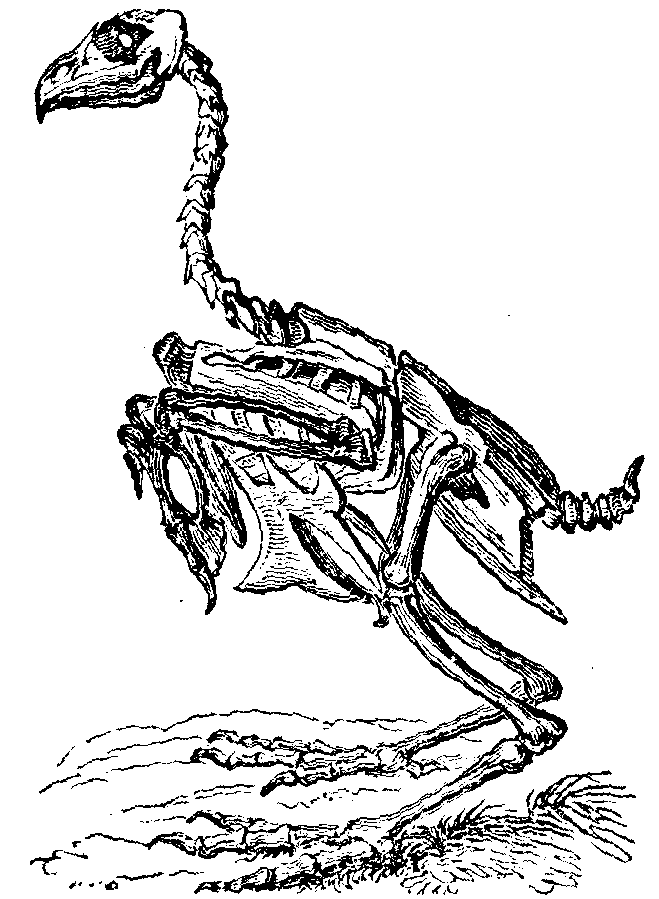
The muscles that move the wings downwards, in many instances, are a sixth part of the weight of the whole body; whereas those of a man are not in proportion one hundredth part so large. The centre of gravity of their bodies is always below the insertion of their wings to prevent them falling on their backs, but near that point on which the body is, during flight, as it were, suspended. The positions assumed by the head and feet are frequently calculated to accomplish these ends, and give to the wings every assistance in continuing the progressive motion. The tail also is of great use, in regulating the rise and fall of birds and even their lateral movements. What are commonly called the legs are analogous to the hind legs in quadrupeds, and they terminate, in general, in four toes, three of which are usually directed forwards, and one backwards; but in some birds there are only two toes, in others three.
Birds exceed quadrupeds in the quantity of their respiration, for they have not only a double circulation, and an aerial respiration, but they respire also through other cavities beside the lungs, the air penetrating through the whole body, and bathing the branches of the aorta, or great artery of the body, as well as those of the pulmonary artery.
Birds are usually classed according to the forms of their bills and feet, from those parts being connected with their mode of life, food, &c. and influencing their total habit very materially.
THE RHINOCEROS BIRD.
This curious bird is of the order Picæ, or Pies, and of the genus Buceros, consisting of birds of rather large size, and distinguished by the disproportionate forms of their beaks, which are often still further remarkable for some kind of large prominence on the upper mandible. The most conspicuous species is the Buceros Rhinoceros of Linnæus, commonly called the Rhinoceros Bird.
The Rhinoceros Bird.
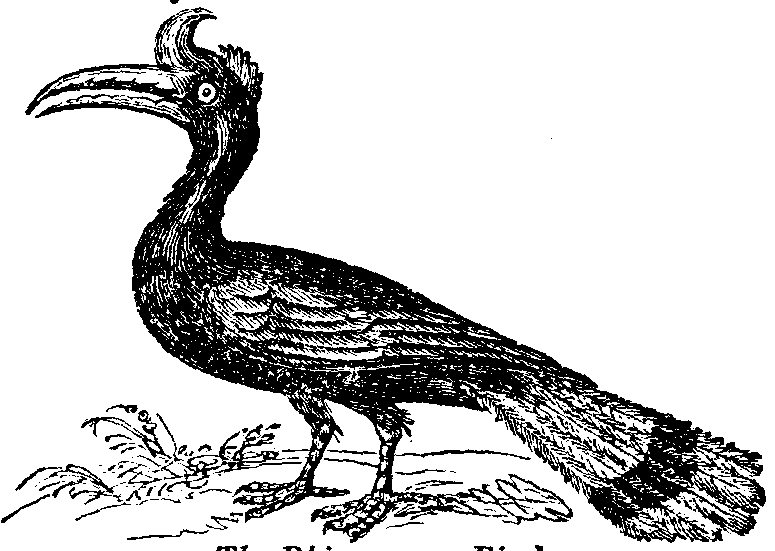
Its general size is that of a Turkey, but with a much more slenderly proportioned body. Its colour is black, with the tail white, crossed by a black bar: the beak is of enormous size, of a lengthened, slightly curved, and pointed shape, and on the upper mandible, towards the base, is an extremely large process, equal in thickness to the bill itself, and turning upwards and backwards in the form of a thick, sharp-pointed horn, somewhat resembling the horn of the rhinoceros. The use of this strange proboscis is by some supposed to be that of enabling the bird more easily to tear out the entrails of its prey; but others affirm that it is not of a predaceous nature, feeding only on vegetable substances. This bird is principally found in the East Indian Islands. A remarkably fine specimen was preserved in the Leverian Museum.