ST. PANCRAS (OLD) CHURCH.
Reading edition
ST. PANCRAS (OLD) CHURCH.
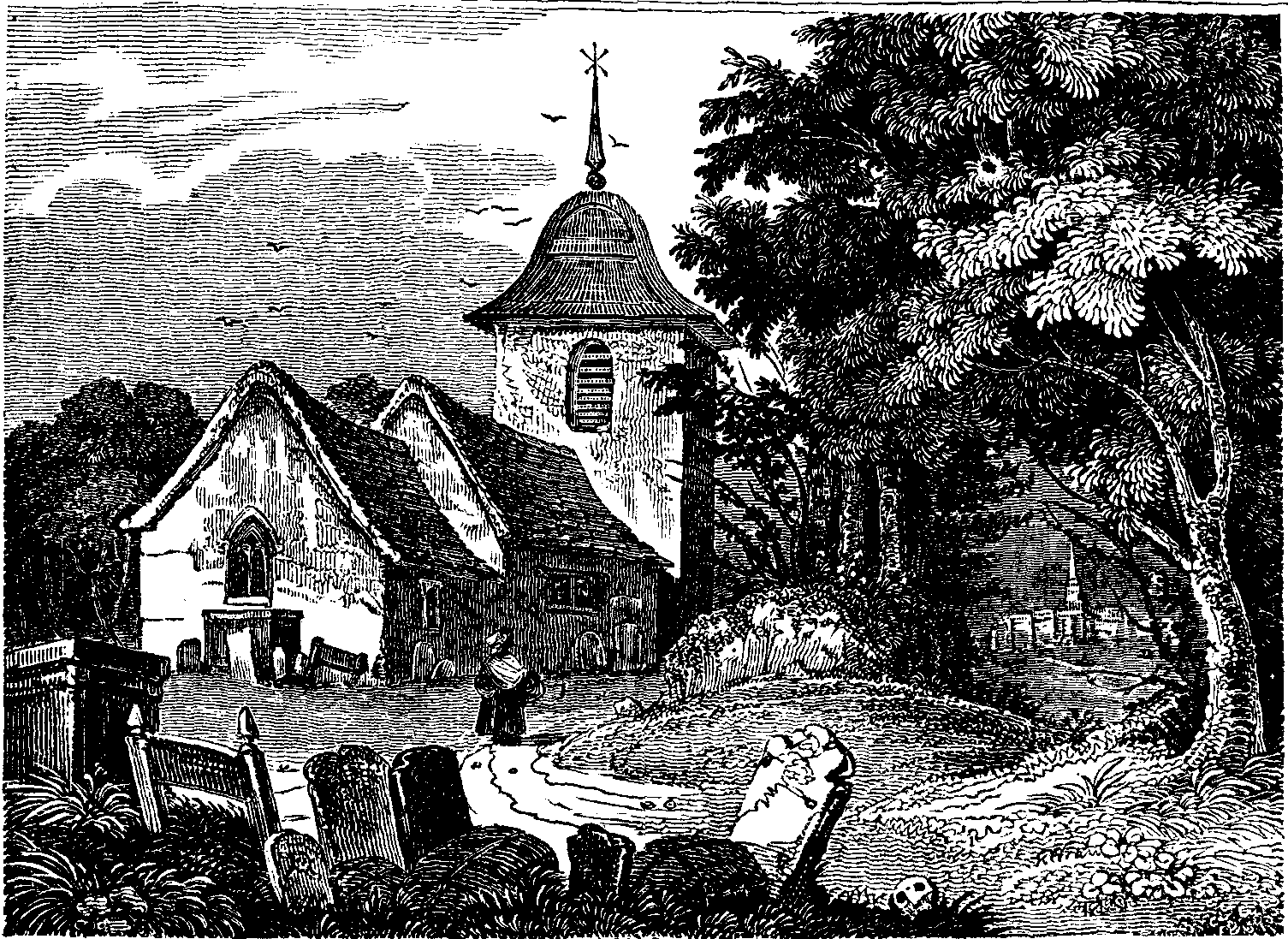
This humble village fane is situated to the north of London, somewhat more than a mile from Holborn Bars. Persons unacquainted with the site, may hitherto have considered it as part and parcel of this vast metropolis: but, lo! here it stands amidst much of its primitive, peaceful rusticity.
It would occupy too much space to detail the progressive increase of this district. When a visitation of the church was made in the year 1251, there were only forty houses in the parish. The desolate situation of the village in the latter part of the sixteenth century is emphatically described by Norden, in his Speculum Britanniæ. After noticing the solitary condition of the church, he says, "yet about this structure have bin manie buildings now decaied, leaving poore Pancras without companie or comfort." In some manuscription additions to his work, the same writer has the following observations:—"Although this place be, as it were, forsaken of all; and true men seldom frequent the same, but upon devyne occasions; yet it is visyted by thieves, who assemble there not to pray, but to wait for praye; and manie fell into their handes, clothed, that are glad when they are escaped naked. Walk not there too late." Newcourt, whose work was published in 1700, says that houses had been built near the church. The first important increase of the parish took place in the neighbourhood of Tottenham Court Road.
In the chancel are monuments of Daniel Clarke, Esq. who had been master-cook to Queen Elizabeth; and of Cooper the artist, whose style approached so near to that of Vandyke, that he has been called Vandyke in miniature: he taught the author of Hudibras to paint; his wife was sister to Pope's mother.
In the churchyard are the tombs of Anthony Woodhead, 1678, who was in his day, the great champion of the Roman Catholic religion, and was reputed to have written the Whole Duty of Man; Lady Slingsby, whose name occurs as an actress in Dryden and Lee's plays, from 1681 to 1689; Jeremy Collier, 1726, the pertinacious non-juror, who repressed the immoralities of the stage; Ned Ward, author of the London Spy, 1731; Leoni, the architect, 1746; Lady Henrietta, wife of Beard, the vocalist, 1753; Van Bleeck, the portrait-painter; Ravenet, the engraver, 1764; Mazzinghi, 1775, leader of the band at Marylebone Gardens, and father of Mazzinghi, the celebrated composer; Henry and Robert Rackett, Pope's nephews; Woollett, the engraver, 1785, to whose memory a monument has been placed in the cloisters of Westminster Abbey; Baron de Wenzel, the celebrated oculist, 1790; Mary Wollestonecraft Godwin, author of a Vindication of the Rights of Woman, 1797; the Rev. Arthur O'Leary, or Father O'Leary, the amiable Franciscan friar, 1802; Paoli, the patriotic Corsican, 1807; Walker editor of the Pronouncing Dictionary; the Chevalier d'Eon, 1810, of epicene notoriety; and Packer, the comedian, 1806, who is said to have performed 4,852 times, besides walking in processions; Edwards, professor of Perspective, 1806; Scheemakers, the statuary, 1808.
In the Beauties of England and Wales, it is stated that 23 acres of land belong to the church; and the great increase of buildings renders these of considerable value; though it is not known to whom the church is indebted for this possession.
ELEGY.
FROM THE GERMAN.
(For the Mirror.)
Through oak-woods green, A silver sheen, Sweet moon, from thee Afforded me A tranquil joy, Me, then, a happy boy. Still makes thy light My window bright, But can no more Lost peace restore: My brow is shaded, My cheek with weeping faded. Thy beams, O moon, Will glitter soon, As softly clear, Upon my bier: For soon, earth must Conceal in youth my dust. C.H.
CLEOPATRA'S NEEDLES.
(For the Mirror.)
"Between the statues, Obelisks were placed: And the learned walls with hieroglyphics grac'd. Pope.
In after ages they were used to immortalize the actions of heroes, and the memory of persons beloved.
The first obelisk we know of was that raised by Rameses, King of Egypt, in the time of the Trojan war. Augustus erected an obelisk at Rome, in the Campus Martius, which served to mark the hours on an horizontal dial, drawn on the pavement. This obelisk was brought from Egypt, and was said to have been formed by Sesostris, near a thousand years before Christ. It was used by Manlius for the same purpose for which it was originally destined, namely, to measure the height of the sun.
P.T.W.
THE DYING MAIDEN'S PARDON TO HER FAITHLESS LOVER.
FROM THE FRENCH.
(For the Mirror.)
If death's keen anguish thou would'st charm Ere speeds his fatal dart, Come, place thine hand—while yet 'tis warm, Upon my breaking heart. And though remorse—thou may'st not feel When its last throb is o'er, Thou'lt say—"that heart which lov'd so well, Shall passion feel no more." E'en love for thee forsakes my soul— Thy work, relentless see, Near as I am life's destin'd gaol, I'm frozen—less than thee. Yet take this heart—I ne'er had more To give thee in thy need: Search well—for at its inmost core, Thy pardon thou may'st read. T.R.P.