ZOOLOGICAL GARDENS, REGENTS'S PARK.
Reading edition
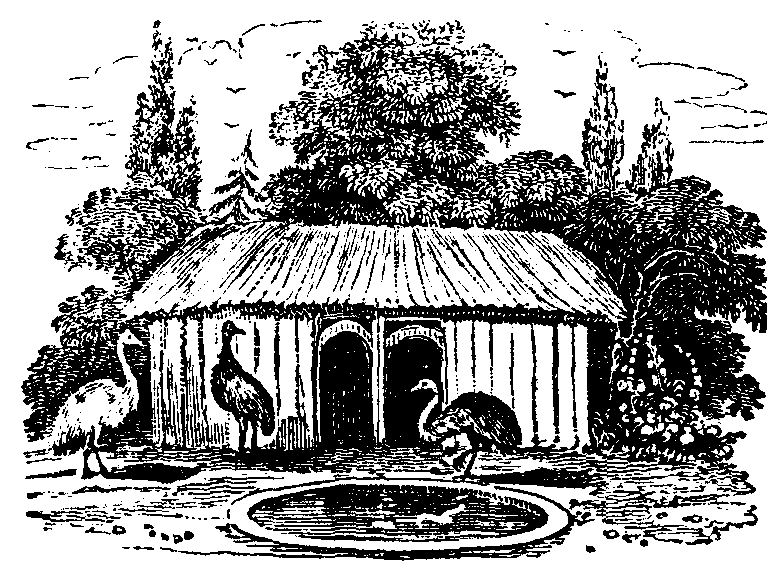
Emu Enclosure
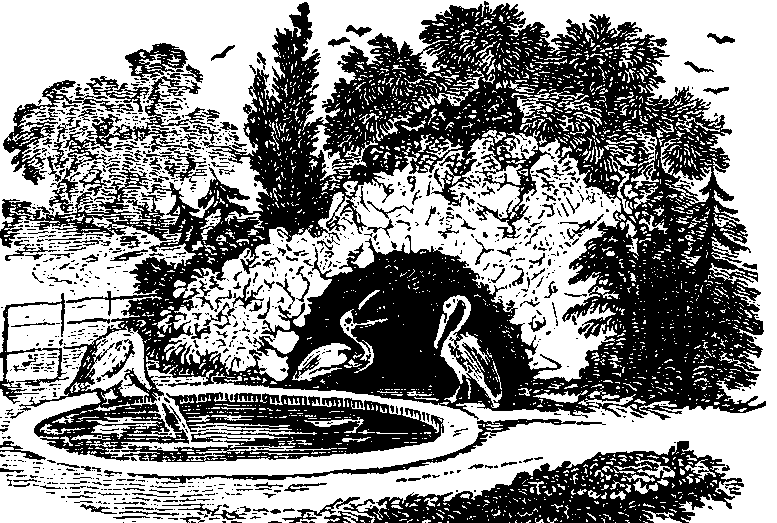
Pelican Enclosure
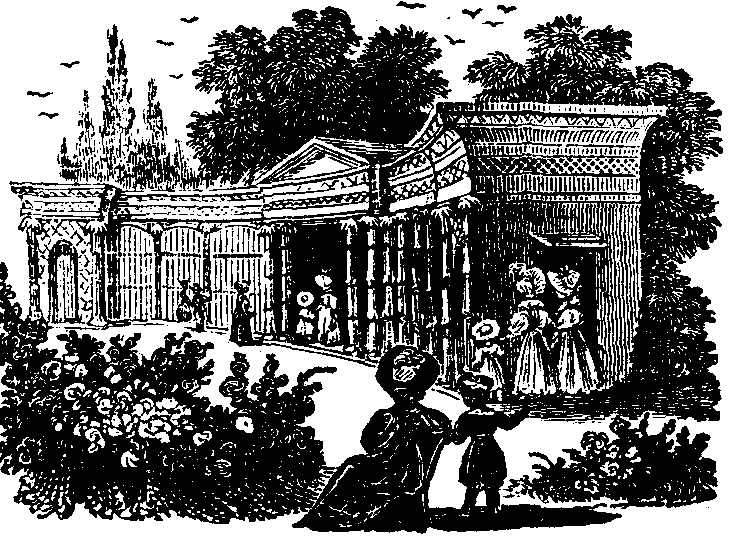
Aviary for Small Birds
"Happy Jerry"
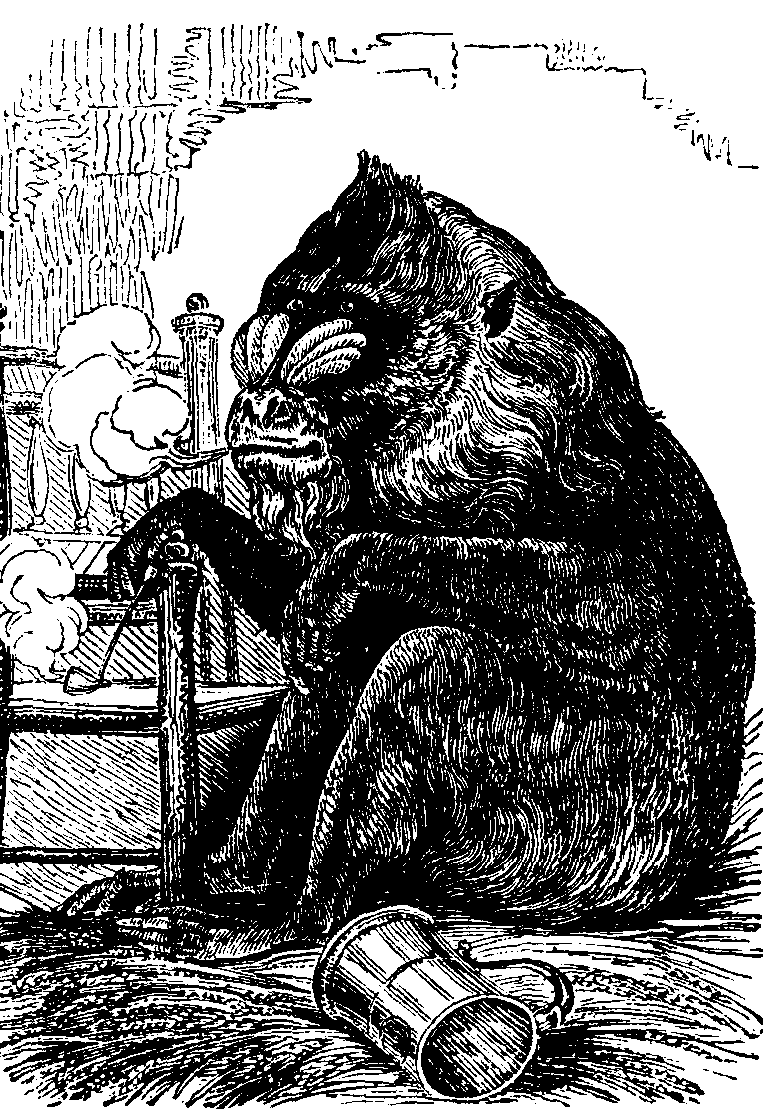
The individual with this felicitous soubriquet, was a specimen of the great Mandrill Baboon, in its adult state, the Papio Maimon of Geoffrey, and the Cynocephalus Maimon of Desmarest. It is a native of the Gold Coast and Guinea, in Africa, where whole droves of them often plunder the orchards and vineyards. Their colours are greyish brown, inclining to olive above; the cheeks are blue and furrowed, and the chin has a sharp-pointed orange beard; the nose grows red, especially towards the end, where it becomes of a bright scarlet. Such are, however, only the colours of the adult animal; the young differs materially, on which account it has been considered by naturalists as a distinct species.
In the autumn of 1831, Jerry's health began to decline, and he was accordingly removed from Charing Cross to the suburban salubrity of the Surrey Zoological Gardens. All was of no avail: though, as a biographer would say of a nobler animal, every remedy was tried to restore him to health. Life's fitful fever was well nigh over with him, and in the month of December last—he died. His body was opened and examined, when it appeared that his death was through old age; and, although he had been a free liver, and, as Mr. Cross facetely observes, "was not a member of a Temperance Society," his internal organization did not seem to have suffered in the way usually consequent upon hard drinking. Perhaps a few ascetic advocates of cant and care-wearing abstinence will think that we ought to conceal this exceptionable fact, lest Jerry's example should be more frequently followed. Justice demands otherwise; and as the biographers of old tell us that Alexander the Great died of hard-drinking, so ought we to record that Happy Jerry's life was not shortened by the imperial propensity: in this case, the monkey has beat the man: proverbially, the man beats the monkey. Jerry had, however, his share of ailment: he had been a martyr to that love-pain, the tooth-ache; several of his large molar teeth being entirely decayed. This circumstance accounted for the gloomy appearance he would sometimes put on, and his covering his head with his hands, and laying it in his chair. Poor fellow! we could have sympathized with him from our very hearts—we mean teeth. Jerry's remains have been carefully embalmed, (we hope in his favourite spirit,) and are now at the Surrey Gardens; where the arrival of a living congener is daily expected. Meanwhile, will nobody write the hic jacet of the deceased? or no publisher engage for his reminiscences? Mr. Cross would probably supply the skeleton—of the memoir—not of his poor dead Jerry. What tales could he have told of the slave-stricken people of the Gold Coast, what horrors of the slave-ship whence he was taken, what a fine graphic picture of his voyage, and his travels in England, à la Prince Puckler Muskau, not forgetting his visit to Windsor Castle.
Baboons may be rendered docile in confinement; though they almost always retain the disposition to revenge an injury. At the Cape, they are often caught when young, and brought up with milk; perhaps Jerry was so nurtured; and Kolben tells us, that they will become as watchful over their master's property as the most valuable house-dog is in Europe. Many of the Hottentots believe they can speak, but that they avoid doing so lest they should be enslaved, and compelled to work! What a libel upon human nature is conveyed in this trait of savage credulity. The bitterest reproofs of man's wickedness are not only to be found in the varnished lessons of civilization. Here is a touching piece of simplicity upon which James Montgomery might found a whole poem.
Baboons, in their native countries, are sometimes hunted with dogs, but their chase is often fatal to the assailants. Mr. Burchell tells us that several of his dogs were wounded by the bites of baboons, and two or three dogs were thus bitten asunder. A species of baboon common in Ceylon, often attains the height of man. It is very fearless; and Bishop Heber relates that an acquaintance of his having on one occasion shot a young baboon, the mother came boldly up and wrested the gun out of his hand without doing him any injury.
By way of pendent, we add the present state of THE ZOOLOGICAL SOCIETY, from the report just completed.
Gross amount of the income of last year £17,6333 Being an increase over the preceding year of 1,857 Receipts of four months of the past year 3,330 Receipts of corresponding months of the present year 3,755 Receipts of the Society since its formation In 1827 £ 4,079 1828 11,515 1829 13,991 1830 15,806 1831 17,6623 ———- Total since its formation £63,053 Visiters to the Gardens. In 1830—224,745 paying 9,773£ 1831—258,936 11,425£ Visiters to the Museum. In 1831—11,636 paying 333£ Number of Fellows 2,074
The Society have obtained a grant of nine acres and a half of land, in the Regent's Park, contiguous to their gardens; and they intend to devote 1,000l. annually to the improvement of the Museum.
THE CURFEW BELL.
(To the Editor.)
Observing in your No. 543, some remarks relating to the ancient custom of ringing the Curfew Bell, and that Reginald, your correspondent, had withheld the name of the village where he heard the Curfew rang, I am led to suppose that it may not be uninteresting to your readers to be informed, that at Saint Helen's Church, Abingdon, this custom is still continued; the bell is rung at eight o'clock every night, and four o'clock every morning, during the winter months; why it is rung in the morning I do not know; perhaps some of your readers can inform me. There are eight bells in Saint Helen's tower, but the fifth or sixth is generally used as the Curfew, to distinguish it from the death-bell, for which purpose the tenor is used, and is rung at the same time at night if a death has happened in the course of the day, and for that night supersedes the necessity of ringing the Curfew. The Curfew Bell is rung, and not tolled, as Reginald states: therefore, what he heard, I suppose to have been the death bell. M.D.
(From another Correspondent.)
The custom of tolling the Curfew is still retained in the town of Sandwich, to which place your correspondent, Reginald, no doubt alludes, as the sea-shore is distant about two miles; hence is distinctly visible the red glare of the Lighthouse on Ramsgate Pier, as also the North Foreland. G.C.
COIN OF EDWARD III.
(For the Mirror.)
A beautiful gold coin, a noble of the reign of Edward III., was discovered, some time since, by the workmen employed in excavating the river Witham, in the city of Lincoln. The coin is in excellent preservation. The impress represents the half-length figure of Edward in a ship, holding a sword in the right hand, and in the left a sceptre and shield, with the inscription "EDWARDUS DEI GRA. REX ANGL., DYS. HYB. ET AGT." On the shield are the arms of England and France quarterly. On the reverse, a cross fleury with lionaux, inscribed, "JESVS AUTEM TRANSIENS PER MEDIUM ILLORUM IBAT." These coins are very scarce, and remarkable as being the first impressed with the figure of a ship; this is said to have been done to commemorate the victory obtained by Edward over the French fleet off Sluys, on Midsummer-day, 1340, and which is supposed to have suggested to Edward the idea of claiming superiority over every other maritime power—a dominion which his successors have now maintained for nearly five hundred years. W.G.C.
PENDERELL JEWEL.
(For the Mirror.)
An ancient medal, or coin, ornamented with jewels, was purchased, a few years since, of one of the descendants of Penderell, to whom it was presented by Charles II., as a valuable token of his gratitude for certain protection afforded by him to that prince, when endeavouring to effect his escape in disguise from England, in the year 1648. It consists of a gold coin of Ferdinand II., dated 1638, surrounded by a row of sixteen brilliants enchased in silver, enriched with blue enamel, and bearing the motto, "Usque ad aris fidelis." The reverse is also enameled, and the jewel is intended to be worn as an ornament to the person. W.G.C.
PECUNIARY COMPENSATION FOR PERSONAL INJURIES.
(For the Mirror.)
The present laws which enable a person to obtain pecuniary compensation for personal injuries, appear to be founded on very ancient precedent. Mr. Sharon Turner, in his History of the Anglo-Saxons, gives a statement of the sums at which our ancestors valued the various parts of their earthly tenements. He says "Homer is celebrated for discriminating the wounds of his heroes with anatomical precision. The Saxon legislators were not less anxious to distinguish between the different wounds to which the body is liable, and which from their laws, we infer that they frequently suffered. In their most ancient laws these were the punishments:
"The loss of an eye or of a leg, appears to have been considered as the most aggravated injury that could arise from an assault, and was therefore punished by the highest fine, or fifty shillings.
"To be made lame, was the next most considerable offence, and the compensation for it was thirty shillings.
"For a wound which caused deafness, twenty-five shillings.
"To lame the shoulder, divide the chine bone, cut off the thumb, pierce the diaphragm, or to tear off the hair and fracture the skull, was each punished by a fine of twenty shillings.
"For cutting off the little finger, eleven shillings.
"For cutting off the great toe, or for tearing off the hair entirely, ten shillings.
"For piercing the nose, nine shillings.
"For cutting off the fore finger, eight shillings.
"For cutting off the gold-finger, for every wound in the thigh, for wounding the ear, for piercing both cheeks, for cutting either nostril, for each of the front teeth, for breaking the jaw bone, for breaking an arm, six shillings.
"For seizing the hair so as to hurt the bone, for the loss of either of the eye teeth, or the middle finger, four shillings.
"For pulling the hair so that the bone become visible, for piercing the ear or one cheek, for cutting off the thumb nail, for the first double tooth, for wounding the nose with the fist, for wounding the elbow, for breaking a rib, or for wounding the vertebrae, three shillings.
"For every nail (probably of the fingers) and for every tooth beyond the first double tooth, one shilling.
"For seizing the hair, fifty scoettas.
"For the nail of the great toe, thirty scoettas.
"For every other nail, ten scoettas."
W.A.R.