The Naturalist.
Reading edition
GLEANINGS IN NATURAL HISTORY.
Observers of Nature seem to be just now appreciating the observation of the benevolent Gilbert White, of Selborne, who lived and died in the last century: "that if stationary men would pay some attention to the districts on which they reside, and would publish their thoughts respecting the objects that surround them, from such materials might be drawn the most complete county histories." Accordingly, a little system of rural philosophy has been founded upon the best of all bases, home-observation, and such books as have resulted from these labours, promise to make the study of Nature more popular than will all the Zoological, Botanical, and Geological Societies of Europe. Among these works we include the cheap reprint of the Natural History of Selborne; Mr. Rennie's delightful observations which are scattered through the Zoological volumes of the Library of Entertaining Knowledge; but more especially the Journal of a Naturalist, published by Mr. Leonard Knapp, about three years since, and stated by the author to have originated in his admiration of Mr. White's Selborne. The volume before us is the result of a congenial feeling, and is written by Edward Jesse, Esq., deputy surveyor of his majesty's parks, by means of which appointment he must have possessed peculiar opportunities and facilities of observation, as is evident in the local recollections throughout his volume. Thus, we find miscellaneous particulars of the Royal Parks and Forests, and from the writer's residence on the bank of the Thames, (we conclude, near Bushy Park,) a few Maxims for an Angler. The whole is a very charming melange, with a most discursive arrangement, it is true, but never falling into dulness, or tiring the reader with too minute detail. We intend, therefore, to range through the volume, and gather a few of its most interesting gleanings to our garner.
Our author thinks he has discovered the use for the remarkable and, indeed, what appears disproportionate length, of the
Claws of the Skylark.
"That they were not intended to enable the bird to search the earth for food, or to fix itself more securely on the branches of trees, is evident, as they neither scratch the ground nor roost on trees. The lark makes its nest generally in grass fields, where it is liable to be injured either by cattle grazing over it, or by the mower. In case of alarm from either these or other causes, the parent birds remove their eggs, by means of their long claws, to a place of greater security; and this transportation I have observed to be effected in a very short space of time. By placing a lark's egg, which is rather large in proportion to the size of the bird, in the foot, and then drawing the claws over it, you will perceive that they are of sufficient length to secure the egg firmly, and by this means the bird is enabled to convey its eggs to another place, where she can sit upon and hatch them. When one of my mowers first told me that he had observed the fact, I was somewhat disinclined to credit it; but I have since ascertained it beyond a doubt, and now mention it as another strong proof of that order in the economy of Nature, by means of which this affectionate bird is enabled to secure its forthcoming offspring. I call it affectionate, because few birds show a stronger attachment to their young."
Instinct allied to reason.
Several interesting anecdotes are quoted to show that there is something more than mere instinct, which influences the conduct of some animals. Bees and spiders afford many traits, but we quote the elephant and parrot:
"I was one day feeding the poor elephant (who was so barbarously put to death at Exeter 'Change) with potatoes, which he took out of my hand. One of them, a round one, fell on the floor, just out of the reach of his proboscis. He leaned against his wooden bar, put out his trunk, and could just touch the potato, but could not pick it up. After several ineffectual efforts, he at last blew the potato against the opposite wall with sufficient force to make it rebound, and he then, without difficulty, secured it. Now it is quite clear, I think, that instinct never taught the elephant to procure his food in this manner; and it must, therefore, have been reason, or some intellectual faculty, which enabled him to be so good a judge of cause and effect. Indeed, the reflecting power of some animals is quite extraordinary. I had a dog who was much attached to me, and who, in consequence of his having been tied up on a Sunday morning, to prevent his accompanying me to church, would conceal himself in good time on that day, and I was sure to find him either at the entrance of the church, or if he could get in, under the place where I usually sat.
"I have been often much delighted with watching the manner in which some of the old bucks in Bushy Park contrive to get the berries from the fine thorn-trees there. They will raise themselves on their hind legs, give a spring, entangle their horns in the lower branches of the tree, give them one or two shakes, which make some of the berries full, and they will then quietly pick them up.
"A strong proof of intellect was given in the case of Colonel O'Kelly's parrot. When the colonel and his parrot were at Brighton, the bird was asked to sing; he answered 'I can't,' Another time he left off in the middle of a tune, and said, 'I have forgot.' Colonel O'Kelly continued the tune for a few notes; the parrot took it up where the Colonel had left off. The parrot took up the bottom of a lady's petticoat, and said 'What a pretty foot!' The parrot seeing the family at breakfast said, 'Won't you give some breakfast to Poll?' The company teazed and mopped him a good deal; he said 'I don't like it.'—(From a Memorandum found amongst the late Earl of Guildford's Papers.)"
Eels.
Several pages are devoted to the economy of these curious creatures, and as many points of their history are warmly contested, Mr. Jesse's experience is valuable.
"Eels feed on almost all animal substances, whether dead or living. It is well known that they devour the young of all water-fowl that are not too large for them. Mr. Bingley states, that he saw exposed for sale at Retford, in Nottinghamshire, a quantity of eels that would have filled a couple of wheelbarrows, the whole of which had been taken out of the body of a dead horse, thrown into a ditch near one of the adjacent villages; and a friend of mine saw the body of a man taken out of the Serpentine River in Hyde Park, where it had been some time, and from which a large eel crawled out. The winter retreat of eels is very curious. They not only get deep into the mud, but in Bushy Park, where the mud in the ponds is not very deep, and what there is, is of a sandy nature, the eels make their way under the banks of the ponds, and have been found knotted together in a large mass. Eels vary much in size in different waters. The largest I ever caught was in Richmond Park, and it weighed five pounds, but some are stated to have been caught in Ireland which weighed from fifteen to twenty pounds. Seven pounds is, I believe, no unusual size. The large ones are extremely strong and muscular. Fishing one day at Pain's Hill, near Cobham, in Surrey, I hooked an eel amongst some weeds, but before I could land him, he had so twisted a new strong double wire, to which the hook was fixed, that he broke it and made his escape."
"It is with considerable diffidence that one would venture to differ in opinion with Sir Humphry Davy, but I cannot help remarking, that, as eels are now known to migrate from fresh water, as was shown in the case of the Richmond Park ponds, this restless propensity may arise from their impatience of the greater degree of warmth in those ponds in the month of May, and not from their wish to get into water still warmer, as suggested by Sir Humphry Davy. Very large eels are certainly found in rivers, the Thames and Mole for instance, where I have seen them so that they must either have remained in them, or have returned from the sea, which Sir H. Davy thinks they never do, though I should add, that the circumstance already related of so many large eels being seen dead or dying during a hot summer, near the Nore, would appear to confirm his assertion. If eels are oviparous, as Sir Humphry Davy thinks they are, would not the ova have been found, especially in the conger,—many of which are taken and brought to our markets, frequently of a very large size? It does not appear, however, that any of the fringes along the air-bladder have ever arrived at such a size and appearance as to have justified any one in the supposition that they were ovaria, though, as has been stated, distinguished naturalists, from the time of Aristotle to the present moment, have been endeavouring to ascertain this fact. Since the above was written, I have been shown ova in the lamprey, and what appeared to have been melt taken from a conger eel, at a fishmonger's in Bond-street. These specimens were preserved by Mr. Yarrell, of Little Ryder-street, St. James's, who had the kindness to open two eels, sent to him from Scotland, in my presence, and in which the fringes were very perceptible, though they were without any ova. That ingenious and indefatigable naturalist is, however, of opinion that eels are oviparous, though he failed in producing proof that the common eels were so.
"In further proof, however, of eels being viviparous, it may be added (if the argument of analogy applies in this case), that the animalculæ of paste eels are decidedly viviparous. Mr. Bingley also, in his animal biography, says that eels are viviparous. Blumenbach says, too, that 'according to the most correct observations they are certainly viviparous.' He adds also, that, the eel is so tenacious of life, that its heart, when removed from the body, retains its irritability for forty hours afterwards."
We are not inclined to attach very considerable importance to Mr. Bingley's experience, much as we admire his entertaining Animal Biography: we believe him to be classed among book-naturalists, and he wrote this work many years since.
(To be continued.)
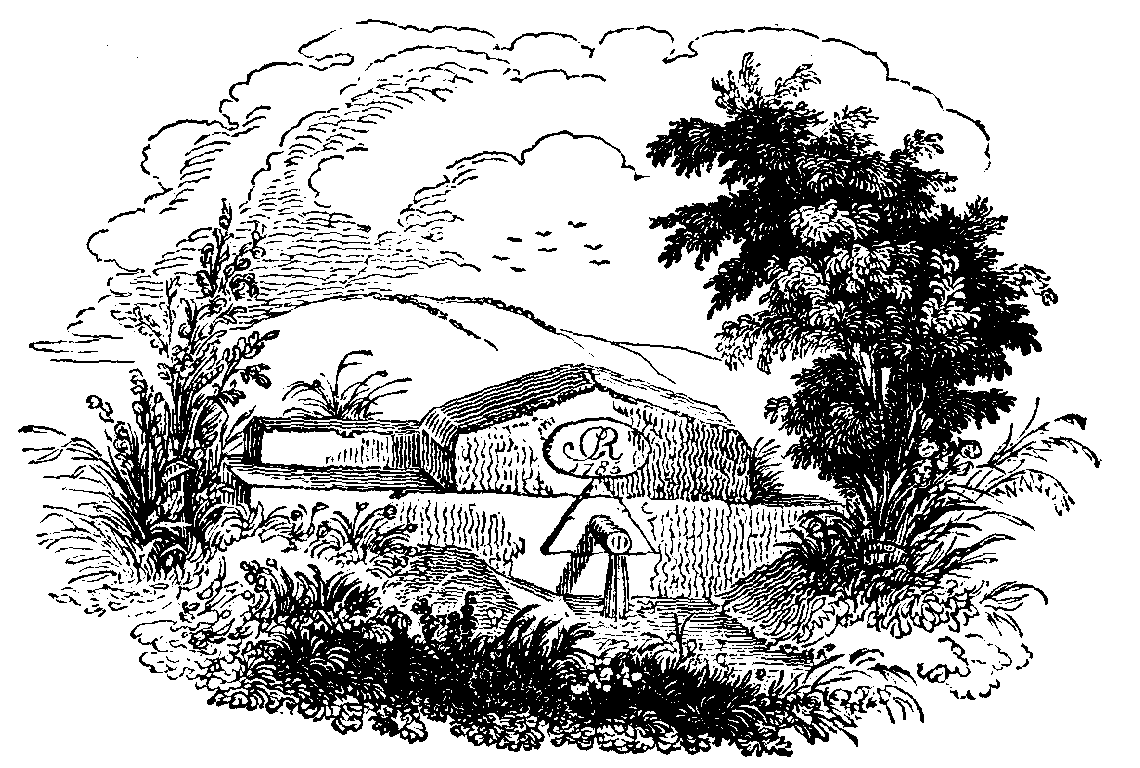
QUEEN ANNE'S SPRING, NEAR ETON.
(From a Correspondent.)
The accompanying sketch represents a sequestered spot of sylvan shade whence rises a Spring which tradition designates Queen Anne's. Here the limpid crystal flows in gentle, yet ceaseless streams, conveying "Health to the sick and solace to the swain."
It has some claims to antiquity; and its merits have been appreciated by royalty. Queen Anne was the first august personage who had recourse to it; in later times, Queen Charlotte for many years had the pure element conveyed to her royal abode at Windsor, and in 1785, a stone, with a cipher and date, was placed there by her illustrious consort, George III. This spring is situate at Chalvey, (a village between Eton and Salt Hill,) on the property of J. Mason, Esq., Cippenham. It was the observation of the esteemed and celebrated Dr. Heberdeen, that it but required a physician to write a treatise on the water, to render it as efficacious as Malvern.
URANIA.