BANKSIDE.—OLD THEATRES.
Reading edition
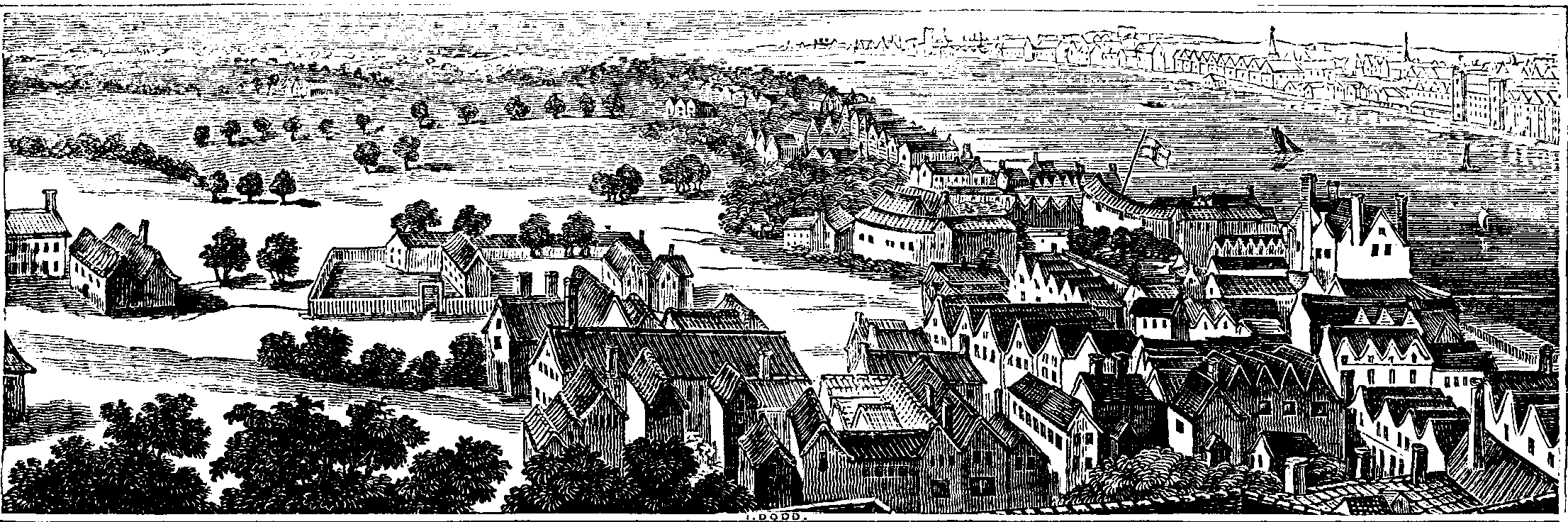
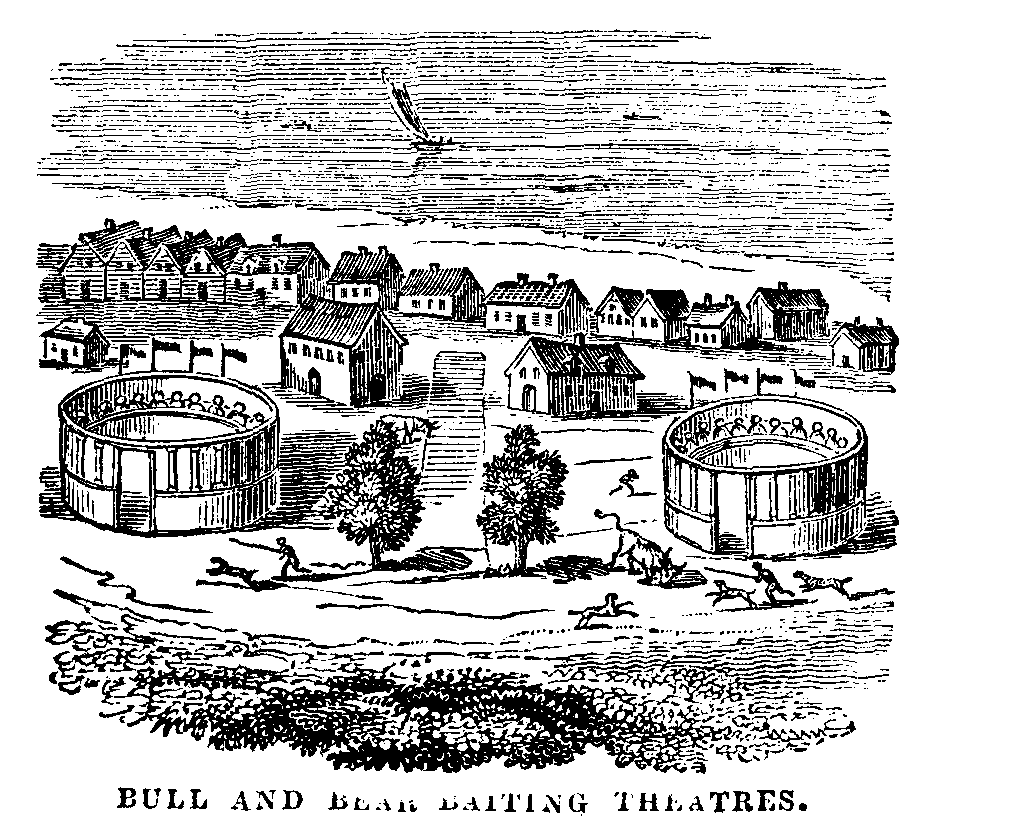
The ancient topography of the southern bank of the Thames (or Bankside) between London and Blackfriars bridges is peculiarly interesting to the lover of dramatic lore, as well as to the inquirer into the sports and pastimes of our ancestors. It appears to have been the Arcadia of the olden metropolis, if such a term be applicable to a place notorious for the indulgence of brutal sports.
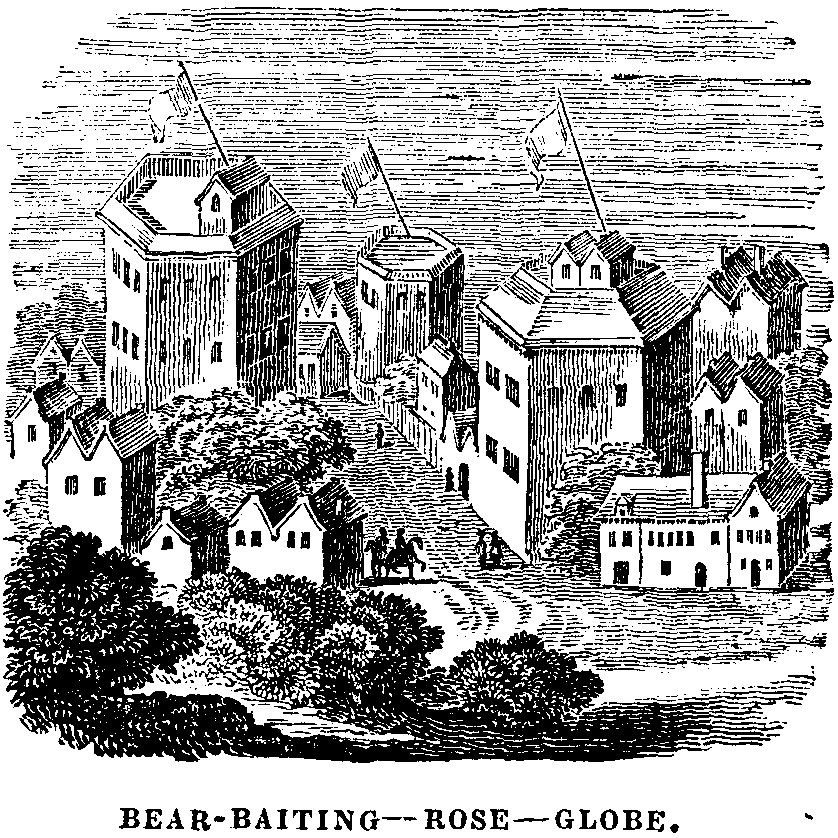
The third Cut includes the GLOBE, ROSE, and BEAR-BAITING THEATRES, as they appeared about the year 1612. Of the Globe we have been furnished with the following account by a zealous correspondent, G.W.:
The Globe Theatre stood on a plot of ground, now occupied by four houses, contiguous to the present Globe Alley, Maiden Lane, Southwark. This theatre was of considerable size. It is not certain when it was built. Hentzner, the German traveller, who gives an amusing description of London in the time of Queen Elizabeth, alludes to it as existing in 1598, but it was probably not built long before 1596. It was an hexagonal, wooden building, partly open to the weather, and partly thatched with reeds, on which, as well as other theatres, a pole was erected, to which a flag was affixed. These flags were probably displayed only during the hours of performance; and it should seem from one of the old comedies that they were taken down in Lent, in which time, during the early part of King James's reign, plays were not allowed to be represented, though at a subsequent period this prohibition was dispensed with by paying a fee to the Master of the Revels.
It was called the Globe from its sign, which was a figure of Hercules, or Atlas, supporting a globe, under which was written, Totus mundus agit histrionem, (All the world acts a play):—and not as many have conjectured, that the Globe though hexagonal at the outside, was a rotunda within, and that it might have derived its name from its circular form.
In 1613, was entered in the Stationers' books, "A doleful ballad of the General Conflagration of the famous Theatre called the Globe."
Taylor, the water poet, commemorates the event in the following lines:
"As gold is better that in fire's tried, So is the Bankside Globe, that late was burn'd; For where before it had a thatched hide, Now to a stately theatre 'tis turn'd; Which is an emblem that great things are won; By those that dare through greatest dangers run."
It is also alluded to in some verses by Ben Jonson, entitled, "An Execration upon Vulcan," from which it appears that Ben Jonson was in the theatre when it was burnt.
This theatre was open in summer and the performances took place by daylight; the King's company usually began to play in the month of May. The exhibitions appear to have been calculated for the lower class of people, and to have been more frequent than those at the Blackfriars, till 1604 or 5, when it became less fashionable and frequented. Being contiguous to the Bear Garden, it is probable that those who resorted there went to the theatre, when the bear-baiting sports were over, and such persons were not likely to form a very refined audience.
We have no description of the interior of the Globe, but that it was somewhat similar to our modern theatres, with an open space in the roof: or perhaps it more resembled an inn-yard, where, in the beginning of Queen Elizabeth's reign, many of our ancient dramatic pieces were performed. The galleries in both were arranged on three sides of the building; the small rooms under the lowest, answered to our present boxes and were called rooms; the yard bears a sufficient resemblance to the pit, as at present in use, and where the common people stood to see the exhibition; from which circumstance they are called by Shakspeare "the groundlings," and by Ben Jonson, "the understanding gentlemen of the ground." The stage was erected in the area, with its back to the gateway where the admission money was taken. The price of admission into the best rooms, or boxes, was in Shakspeare's time, a shilling, though afterwards it appears to have risen to two shillings and half-a-crown. The galleries, or scaffolds, as they were sometimes called, and that part of the house which in private theatres was named the pit, seem to have been the same price, which was sixpence, while in some meaner playhouses it was only a penny, and in others two-pence.
We learn from Sir Henry Hebert, that 20l. was the greatest receipt for one day's performance; by that we may calculate upon the house having contained about 700 persons, at the prices before stated; that is to say, 100 for the boxes, and the rest in the other parts of the house.
Part of the site of this theatre is now occupied by the brewery of Messrs. Barclay and Perkins; and in the History of St. Saviour's, already quoted, we read that "the passage which led to the Globe Tavern, of which the playhouse formed a part, was, till within these few years, known by the name of Globe Alley, and upon its site now stands a large store-house for porter."
The Rose or smaller theatre, was erected in the year 1592, and is stated to have cost £103. 2s. 7d.—a sum which would scarcely pay half the expenses of a modern patent theatre for a single night!
What's gone and what's past help Should be past grief.
Dryden sung
Support the stage, Which so declines that shortly we may see Players and plays reduced to second infancy!
—What would he sing in these times!
Among the numerous memoranda of the topography of this interesting district, we find that the well-known iron foundry of Messrs. Bradley, now occupies the site of a Bear-garden. The Falcon public-house adjoining the foundry of that name, was once the most considerable inn in the county of Surrey, the adjoining foundry being anciently a part of it: and it is said that very near the Falcon was once a mill for the grinding of corn, for the Priory of St. Mary Overy.
To conclude. The accompanying Cuts are copied from one of a series of prints illustrative of the antiquities of the metropolis, published by Messrs. Boydell, in the year 1818.
LACONICS.
(For the Mirror.)
Amongst men of the world comfort merely signifies a great consideration for themselves, and a perfect indifference about others.
Every one who gives way to thought, must, of necessity, become wiser every day; for either the ideas that present themselves to his mind will confirm his yet rickety theories, or observation will teach him that his previous views of things were ill-founded.
Party spirit is like gambling—a vast number of persons trouble themselves about what in the end can be beneficial only to a few.
It is as difficult to win over an enthusiast by force of reasoning, as to persuade a lover of his mistress's faults; or to convince a man who is at law of the badness of his cause.
Knowledge of the world is regarded as an useful, if not an elegant, accomplishment, but this advantage, like every other good, is mixed with some alloy: the acute observer of men and manners cannot but be disgusted with the scenes that take place around him, and his knowledge may at last have the effect of souring his own disposition.
Talents, without the accompaniment of religion, are but fatal presents: they not only add strength to the vices of the individual, but what is worse they render them more conspicuous to the world.
It is strange that the eye of man should have that magic power we have all felt that it possesses. We can contemplate other bright and beautiful objects without withdrawing our gaze; and what is there in the formation of an eye that should create in us any uneasiness? It is the consciousness that the eye is the index of the mind—that when a man fixes his eye on us we are the subject of his thoughts, and that a being gifted with a soul like ourselves is employing its energies and setting its machinery at work about ourselves. It is this conviction that makes us modestly, and almost involuntarily, shrink from such an inspection.
To put ourselves in a passion, in consequence of the misconduct of others, is unquestionably very weak behaviour, but it has also something generous about it; for we are clearly annoying and punishing ourselves, when the offenders only ought to have been the sufferers.
Meanness and conceit are frequently combined in the same character: for he who to obtain transient applause can be indifferent to truth and his own dignity, will be as little scrupulous about them if, by subserviency, he can improve his condition in the world.
The most trivial circumstances are able to put an end to our gratifications; they are like beds of roses, where it is very unlikely all the leaves should be smooth, and even one that is doubled suffices to make us uncomfortable.
Garrulous men are commonly conceited, and they will be found (with very few exceptions) to be superficial as well. They who are in a hurry to tell what they do know, will be equally inclined, from the impulse of prevailing habit, to tell what they do not know.
F.
LEGAL RHYMES.
(For the Mirror.)
According to Goguet, "the first laws of any people were composed in verses, which they sang;" and why should it not be so when Apollo was one of the first of legislators? and under his auspices they were published to the sound of the harp. Pittacus, one of the seven sages of Greece, formed a code of laws in verse, that they might be the easier remembered. The ancient laws of Spain also were chanted in verse, and the custom was preserved a long time among many nations. Mio. Psellus, who lived in the reign of Constantine Ducas, published a synopsis of the law, in verse, and in 1701, Gumaro, a civilian of Naples, taught the dry and intricate system of civil law, in a novel. Coke's Reports have been "done into verse" by an anonymous author; and Cowper, the poet, tells us, that a relation of his who had studied the law, "a gentleman of sprightly parts," began to versify Coke's Institutes; he gives the following specimen of the performance:
"Tenant in fee Simple is he, And need neither quake nor quiver, Who hath his lands, Free from demands, To him and his heirs for ever."
Records, charters, and wills, and many other legal documents, have been written in verse. The following grant was made by Edward the Confessor to Randolf Peperking:
"Iche Edward konyng (king) Have given of my forest the keping, Of the Hundred of Cholmer and Daucing, To Randolph Peperking and to his kindling, (heirs) With heart and hynd, doe and bock, (buck) Hare and fox, cat and brock, (badger) Wild fowell and his flock, Partridge, fesant hen, and fesant cock, With green and wyld stob and stock, To kepen and to yemen (hold) by all his might, Both by day and eke by night: And hounds for to holde, Gode and swift and bolde, Four greyhounds and six beaches, (hound bitches) For hare and fox, and wild cats, And thereof Iche made him my booke, Witness the Bishop Wolston, And book ycleped many on, And Sweyne of Essex, our brother, And token him many other, And our steward Hamelyn, That bysought me for him."
The Dunmow matrimonial flitch of bacon is a well known custom; the oath is in verse, and as follows:
"You shall swear by the custom of your confession, That you never made any nuptial transgression, Since you were married to your wife, By household brawls, or contentious strife, Or otherwise, in bed or at board, Offended each other in deed or in word— Or since the parish clerk said Amen, Wish'd yourselves unmarried again; Or in a twelvemonth and a day, Repented not in thought, any way, But continued true, and in desire, As when you join'd hands in holy quire. If to these conditions, without all fear, Of your own accord you will freely swear, A gammon of bacon you shall receive, And beare it hence with love and good leave, For this is our custom at Dunmow well known, Though the sport be ours, the bacon's your own."
For the custom of riding the black ram, and the penal rhyme thereto attached, we refer the reader to the Spectator, No. 614.
The following rhyming wills have been proved in the Prerogative Court of Canterbury:
"The fifth of May, Being airy and gay And to hip not inclined, But of vigorous mind, And my body in health. I'll dispose of my wealth, And all I'm to leave On this side the grave, To some one or other, And I think to my brother; Because I foresaw That my brethren in law, If I did not take care, Would come in for their share, Which I nowise intended, 'Till their manners are mended, And of that God knows there's no sign. I do therefore enjoin, And do strictly command, Of which witness my hand, That naught I have got Be brought into hotchpot: But I give and devise, As much as in me lies, To the son of my mother, My own dear brother. And to have and to hold All my silver and gold, As th' affectionate pledges Of his brother, JOHN HEDGES."
In the next, the items are more curious and particular:
"What I am going to bequeath When this frail part submits to death— But still I hope the spark divine, With its congenial stars shall shine, My good executors fulfill, And pay ye fairly my last will, With first and second codicil. And first I give to dear Lord Hinton, At Twyford school now, not at Winton, One hundred guineas and a ring, Or some such memorandum thing, And truly much I should have blunder'd, Had I not given another hundred To dear Earl Paulett's second son, Who dearly loves a little fun. Unto my nephew, Stephen Langdon, Of whom none says he e'er has wrong done, The civil laws he loves to hash, I give two hundred pounds in cash. One hundred pounds to my niece, Tudor, (With luring eyes one Clark did view her,) And to her children just among 'em, A hundred more—and not to wrong 'em, In equal shares I freely give it, Not doubting but they will receive it. To Betsy Mudford and Mary Lee, If they with Mrs. Mudford be, Because they round the year did dwell In Davies-street, and serv'd full well. The first ten pounds, the other twenty, And girls, I hope that will content ye. In seventeen hundred and sixty-nine, This with my hand I write and sign, The sixteenth day of fair October, In merry mood, but sound and sober. Past my threescore and fifteenth year, With spirits gay and conscience clear— Joyous and frolicksome, though old, And like this day, serene, but cold; To foes well wishing, and to friends most kind, In perfect charity with all mankind. For what remains I must desire, To use the words of Matthew Prior. Let this my will be well obey'd, And farewell all, I'm not afraid, For what avails a struggling sigh. When soon, or later, all must die? M. DARLEY."
Joshua West, who was known in his sphere "as the poet of the Six Clerks' Office," made his will in rhyme; it is dated 13th December, 1804:
"Perhaps I die not worth a groat, But should I die worth somewhat more, Then I give that, and my best coat, And all my manuscripts in store, To those who will the goodness have To cause my poor remains to rest, Within a decent shell and grave, This is the will of JOSHUA WEST."
In 1654, Henry Phillips published the "Purchasers' Pattern," in which he gives advice to purchasers of estates of inheritance, in verse.
There is also a long article in verse, "On the Distribution of Intestates' Effects: it begins—
"By the laws of the land, It is settled and planned, That intestates' effects shall be spread, At the end of the year, When the debts are all clear, 'Mong the kindred as here may be read."
Before the conclusion, the author says,
"To the rest that succeed, We need not proceed, Enough has already been penn'd, And now it's high time, For our doggrel rhyme To come, lest it err, to an end."
This hint I shall apply to myself, lest my article become as dry and uninteresting as my subject, and conclude with a declaration in which I heartily concur:
"Fee simple, and a simple fee, And all the fees in tail, Are nothing when compared to thee, Thou best of fees—female."
W.A.R.