THE ARBALEST, OR CROSS-BOW.
Reading edition
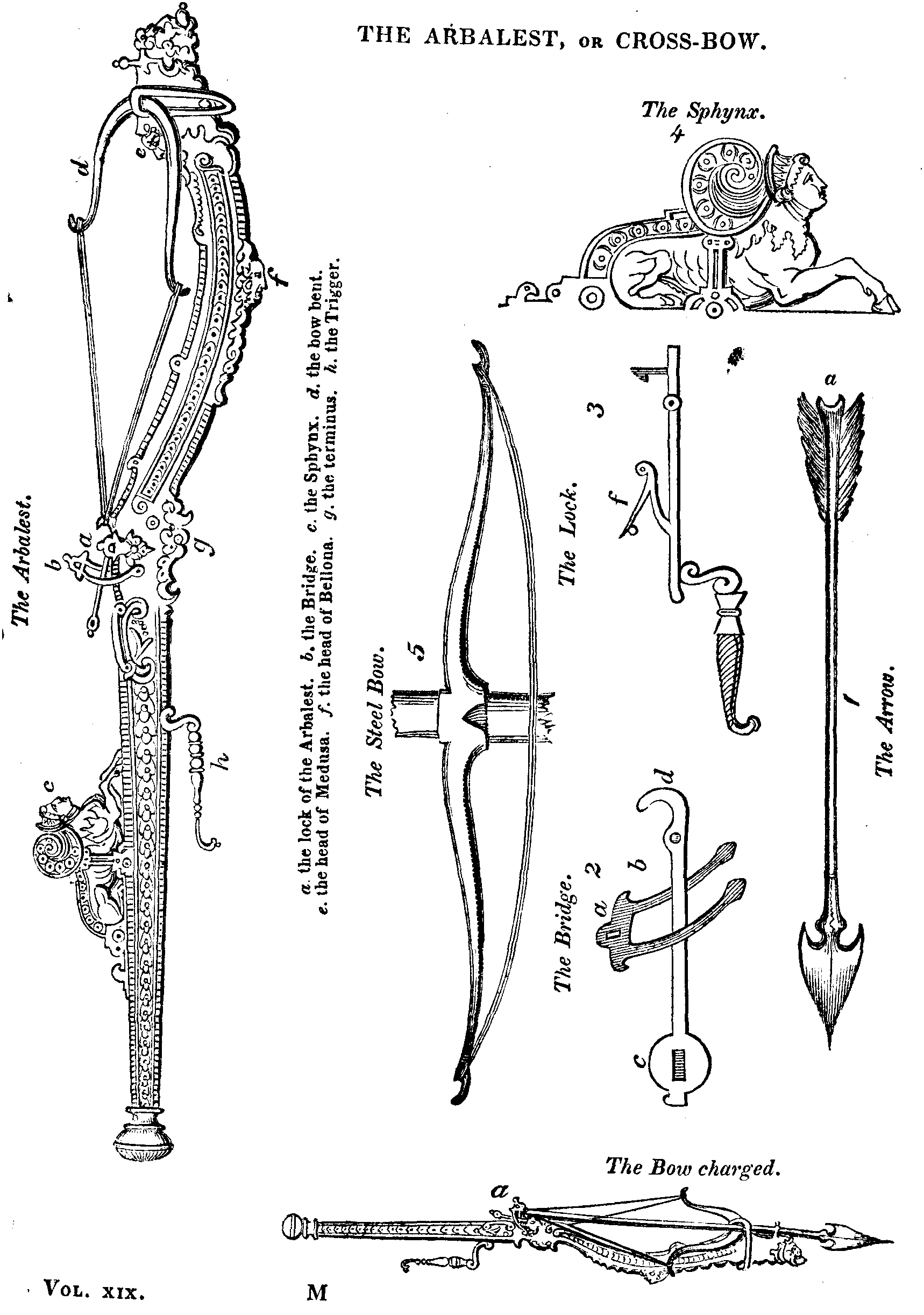
THE ARBALEST, OR CROSS-BOW.
The Bow would appear to have been in most ancient nations the principal implement of war; and to keep alive this "mystery of murder," archery, or the art of shooting with a bow and arrow, seems to have been a favourite pastime in days of peace. In no country, however, has archery been more encouraged than in this island; wherefore the English archers became the best in Europe, and procured many signal victories. Tributary as have been the bow and arrow to some of the brightest scenes in our history, it is not surprising that its exercise should have become cherished among us as an amusement. Strutt tells us that in the early ages of chivalry, the usage of the bow was considered as an essential part of the education of a young man who wished to make a figure in life. Hence the long-bow and cross-bow have been and are playthings in the hands of youth; and would that they had only been the toys of the playground instead of leading men to slaughter each other for the costly toys of the game of life. It is chiefly to the use of the cross-bow that we propose to confine ourselves upon the present occasion.
The arbalest, or cross-bow, was not only much shorter than the long-bow, but fastened also upon a stock, and discharged by means of a catch or trigger, which Mr. Strutt reasonably enough thinks gave rise to the lock on the modern musket. The old logicians illustrate the distinction in their quaintest fashion. Bayle, explaining the difference between testimony and argument, uses this laconic simile, "Testimony is like the shot of a long-bow, which owes its efficacy to the force of the shooter; argument is like the shot of the cross-bow, equally forcible, whether discharged by a dwarf or a giant."
We now meet with several enactments by Edward IV. for the appointment of bowmen with the long-bow; but we pass over these and other records to the 19th year of the reign of Henry VII., who forbade the use of the cross-bow, because "the long-bow had been much used in this realme, whereby honour and victory had been gotten against outward enemies, the realm greatly defended, and much more the dread of all Christian princes by reason of the same." Statutes for the promotion of archery with the long-bow are now very frequent; but the cross-bow is proscribed in the same proportion: and, in the time of Henry VIII. a penalty of ten pounds was inflicted on every one who kept a cross-bow in his house.
Though archery continued to be encouraged by the king and legislature for more than two centuries after the first knowledge of the effects of gunpowder, yet by the latter end of the reign of Henry VIII., it seems to have been partly considered as a pastime.
"An ARBALEST of Foheman's construction, bearing the date 1579, 3 feet 3 inches long, exquisitely carved out of black oak, is now in the possession of A. Nossoc, Esq., the proprietor of a rare and valuable collection of paintings by ancient masters. By this gentleman's kindness I have been able to take a sketch of it, a copy of which I enclose. In these instruments the impulse is not communicated to the arrow directly by the string, but by means of a movable iron bridge, placed behind the string. I subjoin outlines of the arrow used with this kind of bow, and also of its lock.—(See Cuts.)
"The end (a) of the arrow, Fig. 1., was placed against a small square plate of metal (a) of the bridge, and the other end of the arrow rested on the steel bow. The string pulled upon the hook, (d) Fig. 2, and the end (c) acting with a lever advantage communicated its impulse to the bridge, (b) against which was placed the arrow. The figure 3 will explain the rest of the contrivance, (f) being a spring to keep the trigger down.
"The wooden part of the arbalest is beautifully carved with figures; its front extremity is a lion's head holding in its mouth an acorn originally of gold, for which a wooden one is substituted, as is the round stock at the other extremity which was of silver; its lower side has a figure of Bellona, a terminus, &., carved out of it; its upper, a sphynx, head of Medusa, leaves, and numerous other ornaments upon it; the sides are also beautifully carved, and two steel escutcheons on its sides before the bridge have engraved on them a trophy, and two roses.
"As these cross-bows are now extremely rare, I should feel gratified if any correspondent could inform me whether an arbalest of this description is preserved in the Tower, or in any public or private collection of ancient armour; and whether it was used by the Company of Archers after the Restoration."
The Steel Bow is of the shape annexed, Fig. 5, being a resting-place for the fore end of the arrow.
The following description of an archer, his bow, and accoutrements, is given in a MS. written in the time of Queen Elizabeth. "Captains and officers should be skilful of that most noble weapon, and to see that their soldiers according to their draught and strength have good bowes, well nocked, well strynged, every strynge whippe in their nocke, and in the myddes rubbed with wax, braser, and shuting glove, some spare strynges trymed as aforesaid, every man one shefe of arrows, with a case of leather defensible against the rayne, and in the same fower and twentie arrowes, whereof eight of them should be lighter than the residue, to gall or astoyne the enemye with the hail-shot of light arrows, before they shall come within the danger of the harquebuss shot. Let every man have a brigandine, or a little cote of plate, a skull or hufkyn, a mawle of leade of five foote in lengthe, and a pike, and the same hanging by his girdle, with a hook and a dagger; being thus furnished, teach them by musters to marche, shoote, and retire, keepinge their faces upon the enemy's. Sumtyme put them into great nowmbers, as to battell apparteyneth, and thus use them often times practised, till they be perfecte; ffor those men in battel ne skirmish can not be spared. None other weapon maye compare with the same noble weapon."
Even in Elizabeth's reign the bow was thought to be more advantageous than the musket; because the latter was at that period very cumbrous, and unskilful in contrivance, while archery had been carried to the highest perfection. Mr. Grose tells us that an archer could formerly shoot six arrows in the time necessary to charge and discharge a musket; and, as a specimen of the aim to be taken, even in modern days, a practised bowman has been known to shoot twelve arrows in a minute, into a circle not larger than the circumference of a man's hat, at the distance of forty yards.
THE GIPSEY FORTUNE-TELLER.
(For the Mirror.)
Augur only happy days, Gipsey, when thy glancing eye, Fain would dart its piercing rays, Through her future destiny. Life is yet without a shade, She has gathered flowers alone; Tell her not, that roses fade, When the ardent summer's gone. Sully not her early dream, With reality's cold hue, Let her morning brighter seem, Glittering with the early dew. Tell her not, that clouds o'ershading, Rainbows bright will darkly cover; Tell her not, that quickly fading, "All that's bright!" ere noon is over. Tell her not of memory's tear, And affection's broken chain; Tell her not, that every year, Brings but sorrow, care, and pain! Soon the mist will roll away, And the soft enchantment fly: Gipsey, hasten on thy way, Ne'er unrol her destiny! Tell her, if thou wilt, that never, 'Neath the skies may be her home, And if thou that hope hadst ever, Tell her of a world to come!
Kirton, Lindsey.
ANNE R.