OUR LADY'S CHAPEL,
Reading edition
ST. SAVIOUR, SOUTHWARK.
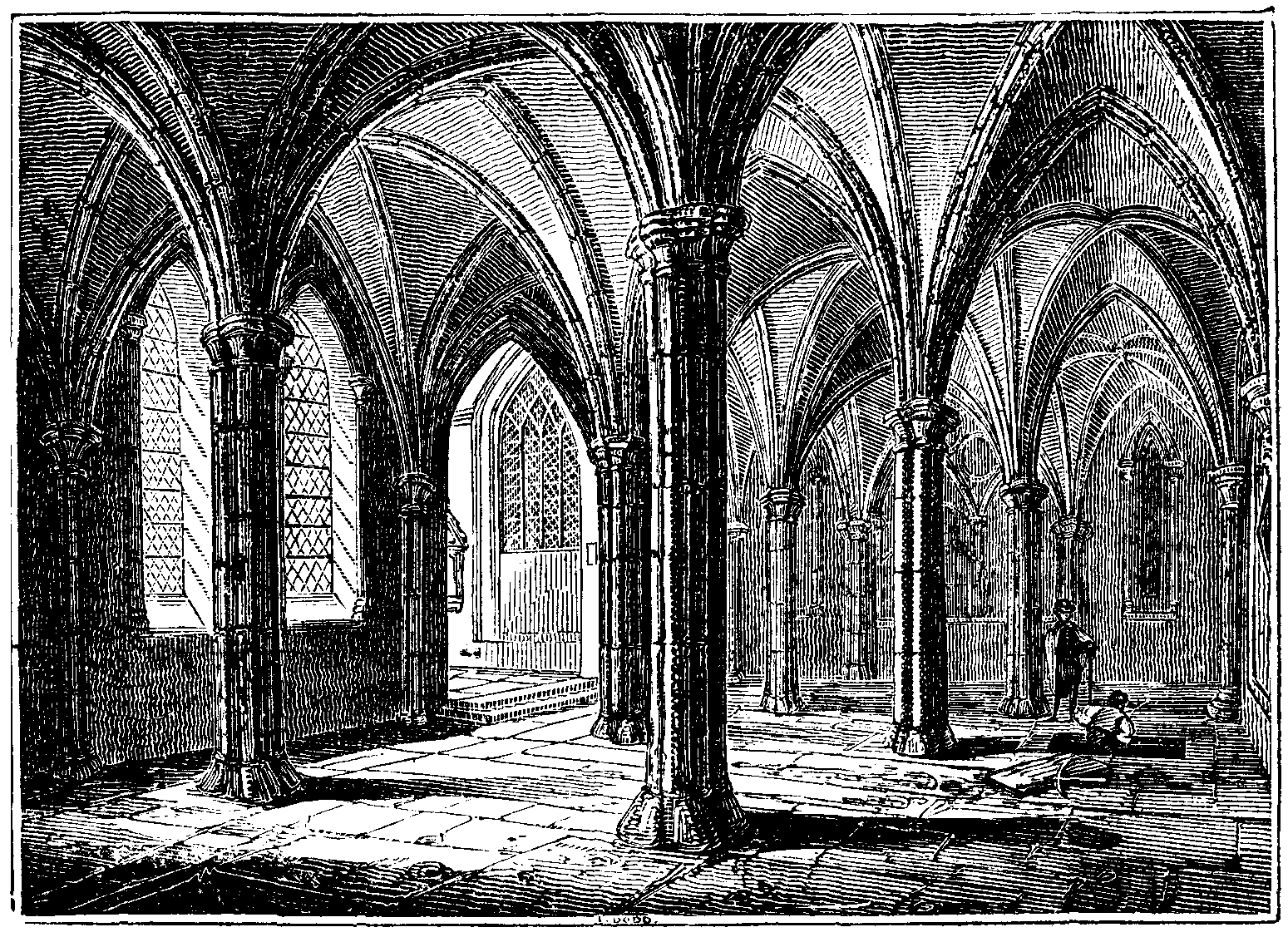
The Engraving represents the interior of the Virgin Mary's Chapel, commonly called the Lady Chapel, and appended to the ancient collegiate church of St. Saviour, Southwark. The exterior view of the Chapel will be found in No. 456 of The Mirror. About eighteen months since part of the western side of the High-street was removed for the approach to the New London Bridge, when this Chapel was opened to view; but its dilapidated appearance was rather calculated to interest antiquarian than public curiosity. The London Bridge Committee recommended the parishioners of St. Saviour to cause the Chapel to be pulled down, and their selfish suggestion would have been complied with, had not some enlightened and public-spirited individuals stepped forth to frustrate the levellers. The parishioners now became two parties. One contended for the restoration of the Chapel, as "one of the most chaste and elegant specimens of early pointed architecture of the thirteenth century of which this country can boast." The levellers, whose muckworm minds, and love of the arts is only shown in that of money-getting—maintained that the demolition of the Chapel would be "a pecuniary saving;" but theirs was a penny-wise and pound-foolish spirit; for, by removing the Chapel, a greater expense would be incurred than in its restoration. The folks could not understand plain figures, and so resolved to take the sense and nonsense of the parish, and the subject has been decided by a majority of 240 in favour of repairing the Chapel. The funds for this purpose, it should be understood, were in course of provision by public subscription, so that the blindness of party zeal threatened to reject a special advantage—the public would find the money if they would allow the Chapel to remain—whereas, had the demolition taken place, the parishioners must themselves have defrayed the consequent expenses. Historians loudly condemn the royal and noble thieves who plundered the Coliseum and the Pantheon to build palaces, yet there are men in our times, who would, if they could, take Dr. Johnson's hint to pound St. Paul's Church into atoms, and with it macadamize their roads; or fetch it away by piecemeal to build bridges with its stones, and saw up its marble monuments into chimneypieces.
The annexed view was taken from the north-west entrance, and shows the character of the groined roof, the supporting pillars, and the entrance to the Bishop's Chapel adjoining, by an ascent of two steps; this Chapel being named from the Tomb of Bishop Andrews, formerly standing in the centre of it. We recommend the reader to a clever paper in the Gentleman's Megazine for the present month, in which the writer proves that Our Lady's Chapel, so far from being an excrescence, as has been idly stated, "bears the same relation to the church an the head does to the body."
NIGHT-MARE.
(For the Mirror.)
Sleeping in night-mare's thunderstorm-wove lap, On sunless mountain high above the pole; With ice for sheets, and lightning for a cap, And tons of loadstones weighing on his soul; And eye out-stretched upon some vasty map Of uncouth worlds, which ever onward roll To infinite—like Revelation's scroll. Now falling headlong from his mountain bed Down sulph'rous space, o'er dismal lakes; Now held by hand of air—on wings of lead He tries to rise—gasping—the hands' hold breaks, And downward he reels through shadows of the dead, Who cannot die though stalking in hell's flakes, Falling, he catches his heart-string on some hook, and—wakes.
E.H. 5
LACONICS.
There is nothing to be said in favour of fashion, and yet how many are contented implicitly to obey its commands: its rules are not even dictated by the standard of taste, for it is constantly running into extremes and condemns one day what it approves the next.
There are some people so incorrigibly stupid and prosing, that wherever they are anxious of securing respect, silence would be their best policy.
As we advance in age, it is singular what a revolution takes place in our feelings. When we arrive at maturity an unkind word is more cutting and distresses us more than any bodily suffering; in our youth it was the reverse.
There is nothing so ravishing to the proud and the great (with all their resources for enjoyment) as to be thought happy by their inferiors.
Such are the casualties of life, that the presentiment of fear is far wiser than that of hope; and it would seem at all times more prudent to be providing against accident, than laying out schemes of future happiness.
The character of any particular people may be looked for with best success in their national works of talent.
There is no absurdity in approving as well as condemning the same individual; for as few people are always in the right, so on the other hand it is improbable they should be always in the wrong.
The most elegant flattery is at second hand; viz., to repeat over again the praises bestowed by others.
Ignorance, simple, helpless ignorance, is not to be imputed as a fault; but very often men are wilfully ignorant.
We have fewer enemies than we imagine: many are too indolent to care at all about us, and if the stream of censure is running against us, the world is too careless to oppose it. If we could hear what is said of us in our absence we should torment ourselves without real cause, for we should seldom hear the real sentiments of the speaker; many things are said in mere wantonness, and many more from the desire of being brilliant.
The man who feels he is in the right is seldom dogmatical, for truth is always calm and requires not violence to enforce her arguments: we should desist from the contest the moment we feel anxious about victory, because that anxiety must make us less particular about the truth.
Quickness of intellect is no proof of solidity: the deepest rivers flow on the smoothest.
The reason why there are so few instances of heroism in modern times is the total decay of political virtue: we are broken up into small parties and associate only with our families, thus forgetting the public, in our regard for private interest: the ancients were taught rather to live for the benefit of the whole community.
An over-refined philosophy begets sensitiveness, and is as little to be coveted as a moderate share of it is beneficial.
It seems to be the business of life to lay by fresh cause for anxiety and discontent by increasing our estate; whereas we should rather know how to lose it all, and yet be contented.
There are some people, who though very amiable in the main, and obliging in their offices to others, have yet that most unhappy propensity of being gloomy over every thing.
It is one of the wisest provisions of Fortune that the same vices which ruin our estates, take away also the means of enjoying them by depriving us of health.
There is more virtue in obscurity than is commonly supposed; and perhaps there have been nobler specimens of magnanimity in low life, than even the page of history can boast.
Knowledge of the world must be combined with study, for this, as well as better reasons: the possession of learning is always invidious, and it requires considerable tact to inform without a display of superiority, and to ensure esteem, as well as call forth admiration.
Deceit has the effect of impoverishing, as well as enriching, men: the prodigal becomes poor by pretending to be richer than he really is, while seeming poverty is the very making of a miser.
F.
STANZAS TO THE SPIRIT OF MORNING.
(For the Mirror.)
Angel of morn! whose beauteous home In light's unfading fountain lies; Whose smiles dispel night's sable gloom, And fill with splendour earth and skies, While o'er the horizon pure and pale, Thy beams are dawning, thee I hail. The star that watches, pure and lone, In yon clear heaven so silently, Looks trembling from its azure throne Upon thy beaming glories nigh; And yields to thee first-born of day, Reluctantly its heavenly sway. Sweet spirit, with that early ray, Which steals so softly through the gloom, Trembling and brightening in its way, What beauties o'er creation come; Ere thy unclouded smiles arise In all their splendour through the skies. The rosy cloud—the azure sky, Earth—ocean, with its heaving breast, Where thy bright hues reflected lie, And there in varying beauty rest, Rejoice in thee; and from the grove, To hail thee, bursts the voice of love. Eternal beauty round thee dwells, And joy thine early steps attends, While music wildly breathing swells, And with thy gales of perfume blends: Pure, beautiful you smile above, Like youth's fond dreams of hope and love. Thy skies of blue, thy beaming light, Thy gales so balmy, wild, and free, Thy lustre on the mountain's height, Have charms beyond all else for me; Whilst my glad spirit fain would rise To hail and meet thee in the skies.
SYLVA.