RETROSPECTIVE GLEANINGS.
Reading edition
ANCIENT NAVY OF ENGLAND.
(To the Editor.)
Allow me to make a few observations in addition to those in a paper signed G.K. in No. 528 of The Mirror. Your correspondent commences with Julius Caesar, and passes over the period intervening between him and King Edgar; and from him till the time of King John. Now, prior to Caesar's invasion of this island, and during the wars between the Romans and Gauls, Caswallwn or Cassivelaunus, sent a numerous body of troops to assist the Armoricans, or natives of Brittany, against the Romans; Caesar himself, says, that his project of invading this country arose from the intelligence he received of the aid the Gauls derived from the Britons; therefore I consider that the mode, let it be what it would, deserved somewhat of the name of a fleet, if not in the modern sense of the word. Caesar says they had large, open vessels, with keels and masts made of wood, and the other parts covered with hides; and about the year 384, Cynan Meiriadog, a chieftain of North Wales, sailed to Armorica with a great body of followers, to support the cause of Maximus, an aspirant to the Roman throne.
Berkeley, in his Naval History, p. 49, says, that at the time of the Saxon invasion, Gurthefyr or Vortimer, King of the Britons, with a fleet, opposed the Saxons under Hengist; and after an obstinate engagement, the Britons were victorious, notwithstanding the inferiority of their vessels to those of the Saxons, both in number and size.
The Welsh, at the time of King Alfred, must have had some knowledge of nautical architecture and affairs, (according to Berkeley's Naval History, p. 69,) for the great Alfred discovering the necessity of establishing a naval force for the purpose of resisting the incursions of the Danes, prevailed on several natives of Wales to superintend its construction, and subsequently conferred on them some of the most distinguished posts in his fleet. And as a proof of the nautical spirit of the Welsh, we have the fact of Prince Madog, son of Owain Gwynedd, about the year 1170, going on a voyage in search of a new country, where he would be free from the dreadful dissensions which were ravaging his native country.
Caer Ludd.
CYMMRO.
ENGLISH PUNISHMENTS IN THE REIGN OF CHARLES II.
(For the Mirror.)
Impoysonments, so ordinarily in Italy, are so abominable amongst English, as 21 Henry VIII. it was made high treason, though since repealed; after which the punishment for it was to be put alive into a caldron of water, and then boiled to death; at present it is felony without benefit of clergy.
If a criminal indicted of petit treason, or felony, refuseth to answer or to put himself upon a legal tryal, then for such standing mute and contumacy, he is presently to undergo that horrible punishment called Peine forte et dure; that is, to be sent back to the prison from whence he came, and there laid in some low, dark room, upon the bare ground, on his back, all naked, his arms and legs drawn with cords, fastened to the several corners of the room; then shall be laid upon his body, iron and stone, so much as he may bear, or more; the next day he shall have three morsels of barley bread without drink, and the third day shall have drink of the water next to the prison door, except it be running water, without bread; and this shall be his diet till he die. Which grievous kind of death some stout fellows have sometimes chosen, that so not being tryed and convicted of their crimes, their estates may not be forfeited to the king, but descend to their children, nor their blood stained.
Perjury, by bearing false witness upon oath, is punished with the pillory, called Callistrigium, burnt in the forehead with a P, his trees growing upon his ground to be rooted up, and his goods confiscated.
G.K.
PORTRAIT OF CHRIST.
(For the Mirror.)
The following extract is from a manuscript in the possession of the family of Kelly, now in Lord Kelly's library, which was taken from the original letter of Publius Lentulus at Rome.
It being the usual custom of the Roman governors to advertise the senate and people of Rome of such material things as happened in their provinces, in the days of the Emperor Tiberius Caesar, Publius Lentulus, President of Judaea, wrote the following epistle to the senate, respecting Our Saviour Jesus Christ.
"There appeared in these our days, a man of great virtue, named Jesus Christ, who is yet living amongst us, and of the Gentiles he is accepted as a Prophet of Truth; but his disciples call him the Son of God. He raiseth the dead, and cureth all manner of diseases: a man of stature somewhat tall and comely, with very reverend countenance, such as beholders may both love and fear: his hair is of the colour of the chestnut, full ripe, plain to his ears, whence downward it is more orient, curling and waving about his shoulders; in the middle of his head is a seam or partition of his hair, after the manner of the Nazarites; his face without spot or wrinkles, beautified with a living red; his nose and mouth so formed as nothing can be represented; his beard thickish, in colour like his hair, not very long, but forked; his look innocent and mature; his eyes grey, clear, and quick. In reproving he is terrible; in admonishing, courteous and fair spoken—pleasant in conversation, mixed with gravity. It cannot be recollected that any have seen him laugh, but many have seen him weep. In proportion of body most excellent; his hands and arms most delectable to behold; in speaking, very temperate, modest, and wise. A man for his singular beauty far surpassing the children of men."
VERITAS.
BRIGHTON IN 1743.
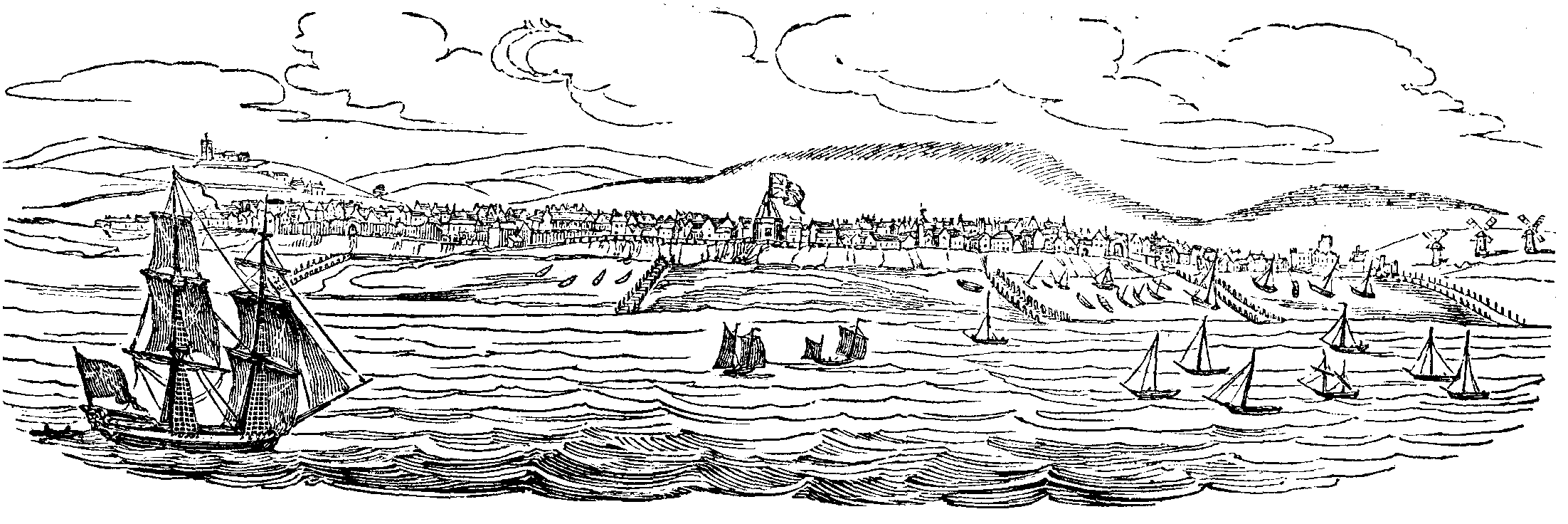
The bay is a bold and deep shore exposed to the open sea: from the banks or cliffs a clean gravel runs to the sea terminating in a hard sand, free from every mixture of ooze, and those offensive beds of mud, so frequently found at the mouths of rivers, and on many shores.
The town is built on a rising hill with a south-east exposition; defended towards the north by hills, whose ascent is easy, and view pleasing; bounded on the west by a fruitful and extensive cornfield, descending gently from the Downs to the banks of the sea, and leading to Shoreham; and on the east by a most beautiful lawn called the Steine, which runs winding up into the country among hills, to the distance of some miles.
The soil here, and over all the south Downs, is a chalk rock covered with earth of various kinds and depths in different places.
The country round Brighthelmston is open and free from woods, and finely diversified with hills and valleys. Hence the advantage of exercise may be always enjoyed in fair weather: it is ever cool on the hills, and a shelter may be constantly found in the valleys from excess of wind.
The Downs here run parallel to the sea; the turf of them is remarkably fine; they are from six to ten miles broad: so that this delightful country cannot be deemed a confined one.
The attachment of our ancestors to this place may be further illustrated by our taking a view of the efforts they made to preserve it.
Suetonius, relating the invasion of Britain by Vespasian, says, "Tricies cum hoste conflixit; duas validissimas gentes, superque xx oppida, et Insulam Vectem Britanniae proximam in deditionem redegit." Cap. iv. Now, that one of these nations inhabited the Downs of Sussex, seems probable from their vicinity to the Isle of Wight, and in some measure confirmed by the lines and intrenchments still subsisting between Brighthelmston and Lewes, where the principal scene of action must have been, and bearing every Roman mark.
That there was a Roman station in this neighbourhood is admitted by the antiquarians, though its exact situation is not as yet ascertained. The Portus Aldurni, placed by the learned Selden at Aldrington, two miles to the west of Brighthelmston, is by the ingenious Tabor presumed to have been at East Bourne, eighteen miles to the east of it: yet there are many local and incidental circumstances belonging to this place, and which are wanting in those towns, that render a conjecture probable as to its having been a Roman station.
The Praepositus of the Exploratores, whose office was to discover the state and motions of the enemy, and who was certainly in this part of Sussex, could be no where more advantageously placed than in the elevated situations of the strong camps at Hollingsbury and White-Hawke, commanding a most extensive view of the whole coast from Beachy-Head to the Isle of Wight. The form of this town is almost a perfect square; the streets are built at right angles to each other, and its situation is to the south east, the favourite one among the Romans. To these may be added, that an urn has been some time ago dug up in this neighbourhood, containing a thousand silver denarii marked from Antoninus Pius to Philip, during which tract of time Britain was probably a Roman province. And, lastly, the vestiges of a true Roman via running from Shoreham towards Lewes, at a small distance above this town have been lately discovered by an ingenious gentleman truly conversant in matters of this nature.
The light sometimes obtained in these dark matters from a similitude of sounds in the ancient and modern names of places, is not to be had in assisting the present conjecture. Its ancient one, as far as I can learn, is no way discoverable; and its modern one may be owing either to this town's belonging formerly to, or being countenanced in a particular manner by a Bishop Brighthelm, who, during the Saxon government of the island, lived in this neighbourhood: or perhaps may be deduced from the ships of this town having their helms better ornamented than those of their neighbouring ones.
During the Saxon aera, this town was almost the centre of the kingdom of the South Saxons; and consequently could not be the scene of much action. It submitted to the various revolutions which prevailed at different times, until the Norman conquest.
The conqueror landed at Hastings forty miles distant to the east of this town; so that his troops never came near it. Yet, the fate of England being decided by the bloody engagement at Battel, this town, with many other large possessions in the county, was granted to William de Warren, who married the Conqueror's daughter: and he soon made it part of the endowment of that rich priory, which he founded at Lewes.
This resigning of the town into the hands of monks was a fatal stroke to its ancient greatness. Too attentive to their own immediate interest, and too regardless of that of their vassals, as soon as they were in possession of it, they laboured, and with success, to obtain an exemption for it from supplying the king with ships, or affording him such other succour, as a large and powerful maritime town ought to have done, on the pretence of its being part of a religious estate.
(To be concluded in our next.)