THE MIRROR OF LITERATURE, AMUSEMENT, AND INSTRUCTION.
Reading edition
Vol. XVII. No. 494. SATURDAY, JUNE 18, 1831. [PRICE 2d.
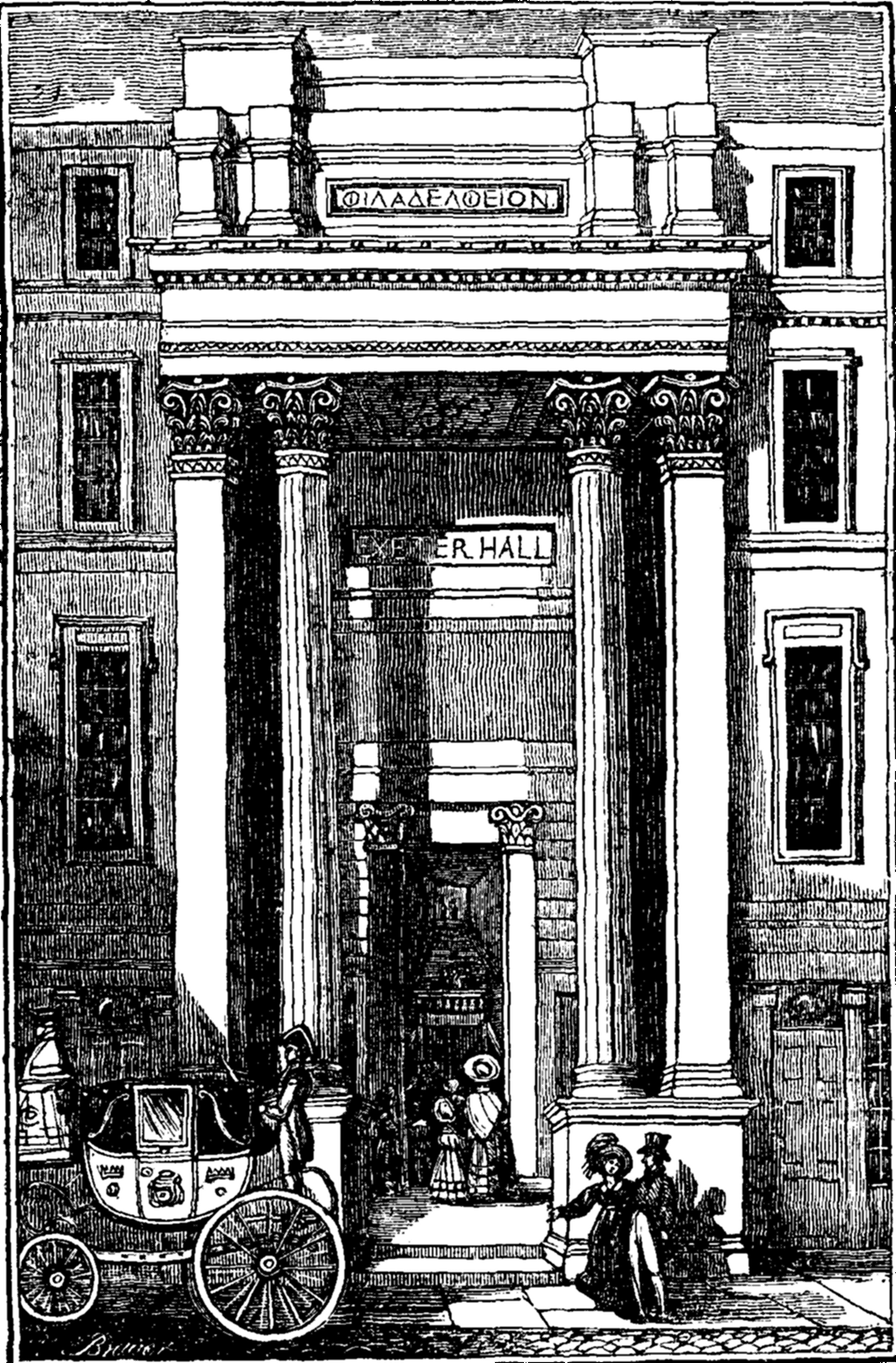
EXETER HALL, STRAND.
We rejoice to see the site of Burleigh House partly occupied by the above Building. Its object is to afford accommodation for the meetings of Philanthropic Societies—so that whatever may be the olden celebrity of the spot, it is reasonable to expect that its present appropriation will be associated with the most grateful recollections.
Exeter Hall has been erected by subscription, by a public company established for the purpose.
WILLS OF SHAKSPEARE, MILTON AND BUONAPARTE.
(To the Editor.)
The last wills and testaments of the three greatest men of modern ages are tied up in one sheet of foolscap, and may be seen together at Doctors Commons. In the will of the "Bard of Avon" is an interlineation in his own handwriting—"I give unto my wife my brown best bed, with the furniture." It is proved by William Byrde, 22nd July, 1616.
The will of the Minstrel of Paradise is a nuncupative one taken by his daughter, the great poet being blind.
The will of Napoleon, to whom future ages, in spite of legitimacy, will confirm the epithet "le grand," is signed in a bold style of handwriting; the codicil, on the contrary, written shortly before his death, exhibits the then weak state of his body.
T.H.K.
VERNAL STANZAS.
(For the Mirror.)
The earth displayed its robe of gorgeous hues, And o'er the tufted violets softly stole The downy pinions of the fragrant wind, Which tuned the brook with music; there were clouds O'er the blue heaven dispersed in various shapes, And touch'd with most impassive light, whereon The heart might dwell and dream of future bliss; And as the sound of distant bells awaked The echoes of the woods, they raised the thoughts To worlds more bright and beautiful than ours! G.R.C. The spring has waved her sunny wing Upon the verdant earth, And winds from distant, places bring The festal tones of mirth; The sky appears an azure field, With clouds emblazoned like a shield. A golden light has touched the woods, And o'er the silent dell A languid breathless quiet broods, Scarce broken by the swell Of streams that whisper through the air, As if they were awaked to pray'r. Survey the lovely scene around, The river beams in gold, Its rippling waves with song resound, And rainbow light unfold, And as the flow'rs unclose their eyes, Their hue seems coloured by the skies. The mould'ring church on yonder slope, Perchance by heaven designed To consecrate the heart with hope, In ivy-wreaths is shrined: Its rural tombs are green with age, And types of earthly pilgrimage. On this delightful vernal day, In scenes so rich and fair, The spirit feels a hallow'd ray Kindling its essence there; And Fancy haunts the mourner's urn, "With thoughts that breathe, and words that burn."
Deal.
G.R.C.
POPULAR SUPERSTITIONS.
(For the Mirror.)
All power of fancy over reason is a degree of insanity.—JOHNSON.
In a former number I gave some observations on apparitions, and I shall here continue my remarks.
I shall here recount one of the most extraordinary tales relating to this subject that I ever heard; I believe the solution is evident, and I am not aware that it has appeared before; but if it has, some of the readers of the Mirror may not have seen it.
A surgeon of Edinburgh was confined to his bed by some illness, and at "the dewy hour of eve," when the room was lighted by nothing but the glimmering and flickering light of a wood fire, he perceived a female sitting at the foot of the bed clothed in white! Imagining that it was some defect in his sight, he gazed more intensely at it, still it was there. He then raised his hand before his eyes and he did not perceive it; on withdrawing it the apparition was there. Closing his eyes he went through a mathematical calculation to convince himself he was in his right senses; upon reopening them he still perceived her there. The fire then went out and he saw no more. I confess I see no difficulty in accounting for this, by supposing the gentleman was afflicted with that horrid disease of which Sir Walter Scott gives many cases in his Demonology and Witchcraft. Although I have no warrant for asserting spirits do not return, yet I must say, all the tales I have ever heard do not necessarily require any such interpretation on them. It may be true, and so may everything which we have no evidence against or for. If my opinion on the subject was to be shaken by anything, it would be with the following story, which was given to me by one whose veracity I have no reason to doubt.
There is, or rather was, a very ancient castle in Lancashire, near Liverpool, called Castle de Bergh, which belongs to a noble family of that name. Many years ago the possessor of the castle, Mr. de Burgh, died, and the castle was then let out to various of the tenantry, among whom was a carpenter. Two years after the death of Mr. de Burgh, as this carpenter was employed in his workshop, about a quarter of a mile from the castle, melting glue, it being evening, and only four of his men with him, he perceived a gentleman in mourning passing the lathe where the men were at work. He was immediately seized with a violent trembling and weakness, his hair stood on end, and a clammy sweat spread over his forehead. The lights were put out, he knew not how, and at last, in fear and terror, he was obliged to return home. On his arrival at the castle, as he was passing up the stairs, he heard a footstep behind, and on turning round he perceived the same apparition. He hastily entered his room, and bolted, locked, and barred the door, but to his horror and surprise this offered no impediment to his ghostly visiter, for the door sprang open at his touch, and he entered the room! The apparition was seen by various others, all of whom asserted it bore the strongest resemblance to their deceased master! One gentleman spoke to him, and the spirit told him "that he was not happy."
Foley Place.
AN ANTIQUARY.
LINES.
(For the Mirror.)
Upon the silent grassy bed, Shall maiden's tears at eve be shed, And friendship's self shall often there Heave the sigh, and breathe the pray'r. Young flowers of spring around shall bloom, And summer's roses deck thy tomb. The primrose ope its modest breast Where thy lamented ashes rest, And cypress branches lowly bend Where thy lov'd form with clay shall blend. The silver willow darkly wave Above thy unforgotten grave, And woodbine leaves will fondly creep, Where * * lies in holy sleep.
Sturminster
.
COLBOURNE.
PARLIAMENTARY SCRAPS.
(For the Mirror.)
Lord Coke, in his fourth institute, defines certain qualities essentially requisite to constitute a good member of parliament; and he refers to a parliament roll, 3 Henry VI., which affirms that a parliament man should have three properties ascribed to the elephant—1. That he hath no gall; 2. That he is inflexible, and cannot bow; 3. That he is of a most ripe and perfect memory.—1. To be without malice, rancour, heat, and envy;—in elephante melancholia transit in nutrimentum corporis: every gallish inclination, if any were, should tend to the good of the whole body—the commonwealth. 2. That he be constant, inflexible, and not be bowed, or turned from the right, either from fear, reward, or favour; not in judgment respect any person. 3. That in remembering perils past, dangers to come may be prevented.
To these, addition is made by Lord Coke of two other properties of elephants: the one, that though they be maximæ virtutis et maximi intellectus, of great strength and understanding, tamen gregatim semper incedunt, yet they are sociable, and go in companies; for animalia gregalia non sunt nociva, sed animalia solivaga sunt nociva: sociable creatures that go in flocks or herds are not hurtful—as deer, sheep, &c.; but beasts that walk solely or singularly, as bears, foxes, &c., are dangerous and hurtful. The other property is, that the elephant is philanthropos, homini erranti viam ostendit. And, in the opinion of Coke, these properties ought every parliament man to have.
Neither the ancient nor modern election statutes mention, or imply, the existence of a "candidate." The old laws direct that the representative shall be freely and indifferently chosen by the electors. The choice was of their own motion, and the person elected was passive. Even at the present day, the law does not contemplate his asking for votes, and therefore does not allow, after the issuing of the writ, sufficient time for a regular canvass. The term "candidate" had its derivation from the person being candidatus, clothed in white, as symbolical of the wearer's purity.
James I. issued a proclamation, in which the voters for members of parliament are directed "not to choose curious and wrangling lawyers, who seek reputation by stirring needless questions."
At the Sussex election, in 1807, an elector, named Morton, voted in right of his patrimonial land at Rusper, which had been in possession of his ancestors 750 years.
W.G.C.
SONNET
TO AN EOLIN HARP, HEARD AT EVENING.
(For the Mirror.)
Soft breathings of aerial melody, Ye seem like love-songs from the elfin land, Or soundings from that heaven-commissioned band, Ushering the good man to the bliss on high. Now swells the chorus full, anon ye die Away upon the breeze, so soft and bland Melting on evening's ear. Sure Love's own hand In kindest mood hath wrought this minstrelsy. How to the lorn heart does its influence creep, As the wild winds sweep o'er the fairy strings, Bringing again departed, perish'd things, O'er which we feel it luxury to weep. Sing on ye zephyr-sprites, your vespers cheer The heart, whose off'ring is a holy tear.
Sturminster.