KILCOLMAN CASTLE, THE RESIDENCE OF THE POET SPENCER.
Reading edition
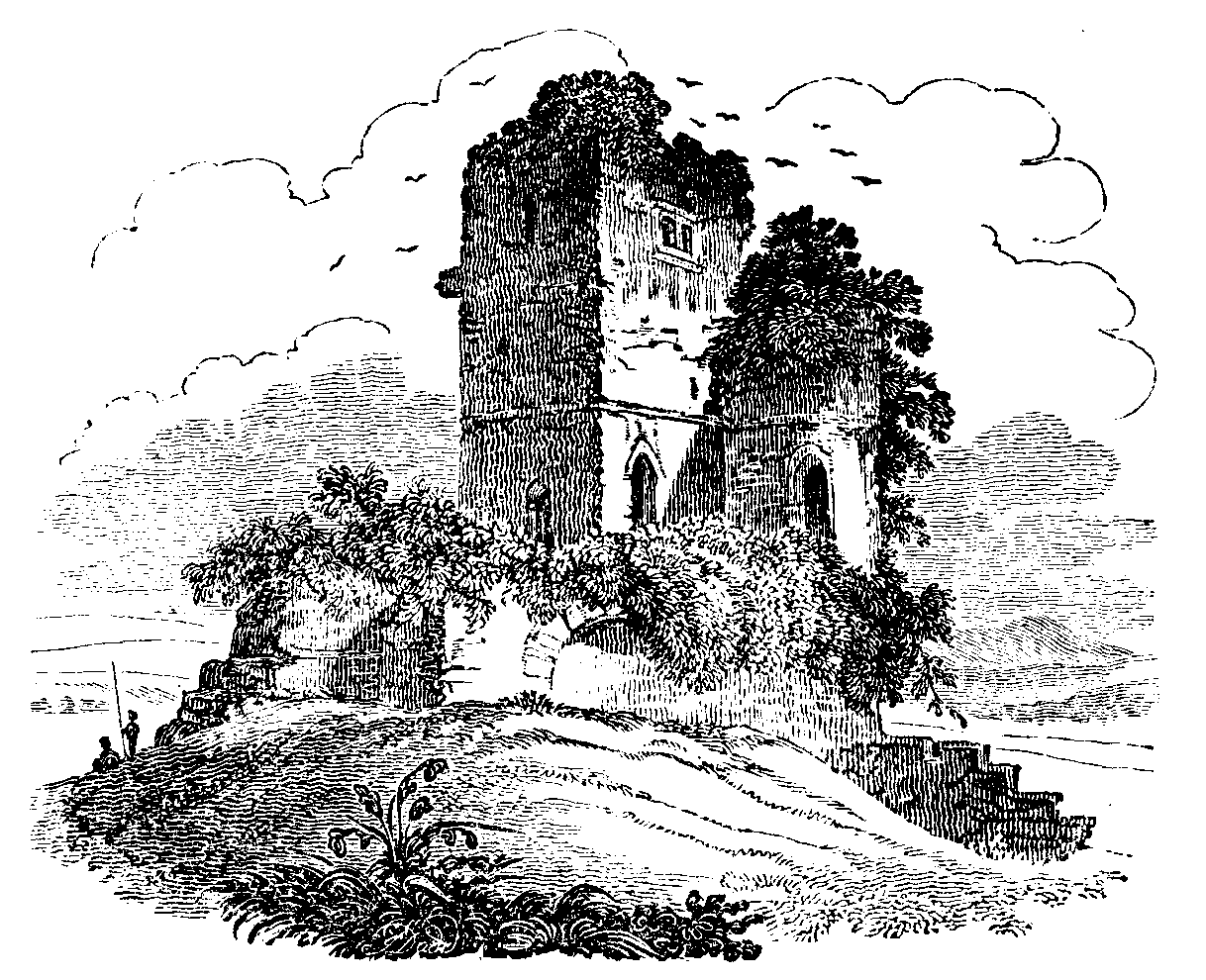
Kilcolman Castle is distant three English miles from Doneraile, and is seated in as unpicturesque a spot as at present could have been selected. Many of the delightful and visionary anticipations I had indulged, from the pleasure of visiting the place where the Fairy Queen had been composed, were at an end on beholding the monotonous reality of the country. Corn fields, divided from pasturage by numerous intersecting hedges, constituted almost the only variety of feature for a considerable extent around; and the mountains bounding the prospect partook even in a greater degree of the same want of variety in their forms. The ruin itself stands on a little rocky eminence. Spreading before it lies a tract of flat and swampy ground, through which, we were informed, the “River Bregog hight” had its course; and though in winter, when swollen by mountain torrents, a deep and rapid stream, its channel at present was completely dried up.
“Sometimes, misguided by the tuneful throng, I look for streams immortalized in song, That lost in silence and oblivion lie; Dumb are their fountains, and their channels dry.”
Judging from what remains, the original form of Kilcolman was an oblong square, flanked by a tower at the south-east corner. The apartment in the basement story has still its stone arched roof entire, and is used as a shelter for cattle; the narrow, screw-like stairs of the tower are nearly perfect, and lead to an extremely small chamber, which we found in a state of complete desolation.
Kilcolman was granted by Queen Elizabeth, on the 27th June, 1586, to Spencer (who went into Ireland as secretary to Lord Grey), with 3,028 acres of land, at the rent of 17l. 3s. 6d.; on the same conditions with the other undertakers (as they were termed) between whom the forfeited Desmond estate was divided. These conditions implied a residence on the ground, and their chief object seems to have been the peopling Munster with English families: a favourite project of Elizabeth’s for strengthening the English influence in Ireland, by creating the tie of consanguinity between the two countries.
It is supposed that this castle was the principal residence of Spencer for about ten years, during which time he composed the works that have chiefly contributed to his fame. But the turbulent and indignant spirit of the Irish regarded not the haunts of the muse as sacred, and wrapped the poet’s dwelling in flames. An infant child of Spencer’s, together with his most valuable property, were consumed, and he returned into England;—where, dejected, and broken-hearted, he died soon after, at an inn in King-street, Westminster.
“It does not appear what became of Spencer’s wife and children. Two sons are said to have survived him, Sylvanus and Peregrine; Sylvanus married Ellen Nangle or Nagle, eldest daughter of David Nangle of Moneanymy, in the county of Cork, by whom he had two sons, Edmund and William Spencer. His other son, Peregrine, also married, and had a son Hugolin, who, after the restoration of Charles II. was replaced by the Court of Claims in as much of the lands as could be found to have been his ancestor’s. Hugolin attached himself to the cause of James II. and after the revolution, was outlawed for treason and rebellion. Some time after his cousin William, son of Sylvanus, became a suitor for the forfeited property, and recovered it by the interest of Mr. Montague, afterwards Earl of Halifax, who was then at the head of the treasury. He had been introduced to Mr. Montague by Congreve, who with others was desirous of honouring the descendant of so great a poet. Dr. Birch describes him as a man somewhat advanced in years, but unable to give any account of the works of his ancestor which are wanting. The family has been since very imperfectly traced.”—Chalmers’s Biog. Dic.
Amongst the literary pilgrims whose veneration for Spencer has prompted them to examine Kilcolman was the celebrated Edmund Burke; nor should the imprudent and enthusiastic Trotter be forgotten; the account given by him of his visits, in 1817, are very pleasing, though highly tinged with that fanaticism to which he ultimately became a victim.