THE MIRROR OF LITERATURE, AMUSEMENT, AND INSTRUCTION.
Reading edition
VOL. XVII, NO. 476.] SATURDAY, FEBRUARY 12, 1831. [PRICE 2d.
LORD BYRON'S PALACE, AT VENICE.
LORD BYRON'S PALACE, AT VENICE.
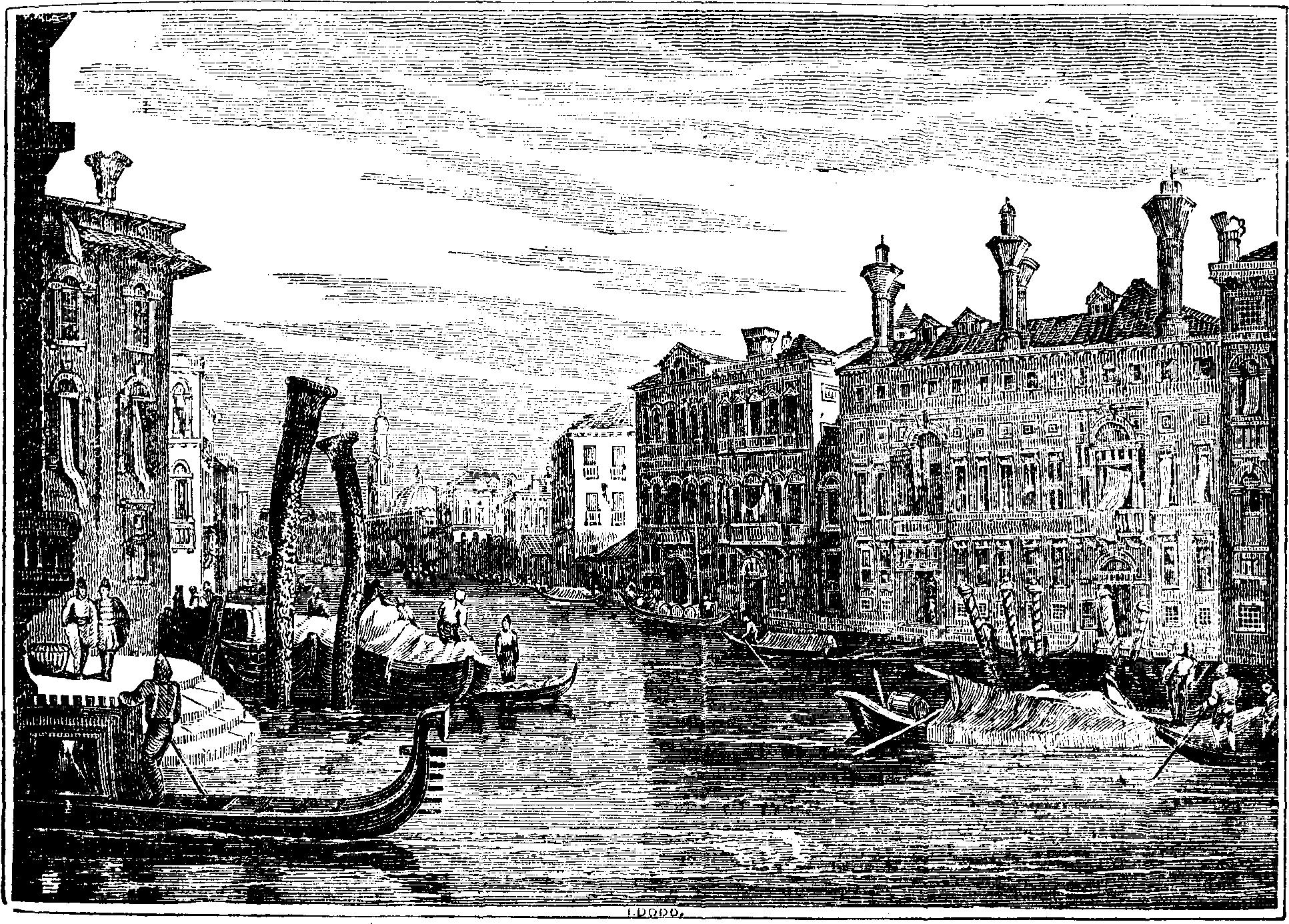
Scores of readers who have been journeying through Mr. Moore's concluding portion of the Life of Lord Byron, will thank us for the annexed Illustration. It presents a view of the palace occupied by Lord Byron during his residence at Venice. When, after his unfortunate marriage, he left England, "in search of that peace of mind which was never destined to be his," Venice naturally occurred to him as a place where, for a time at least, he should find a suitable residence. He had, in his own language, "loved it from his boyhood;" and there was a poetry connected with its situation, its habits, and its history, which excited both his imagination and his curiosity. His situation at this period is thus feelingly alluded to by Mr. Moore:—"The circumstances under which Lord Byron now took leave of England were such as, in the case of any ordinary person, could not be considered otherwise than disastrous and humiliating. He had, in the course of one short year, gone through every variety of domestic misery;—had seen his hearth eight or nine times profaned by the visitations of the law, and been only saved from a prison by the privileges of his rank. He had alienated, as far as they had ever been his, the affections of his wife; and now, rejected by her, and condemned by the world, was betaking himself to an exile which had not even the dignity of appearing voluntary, as the excommunicating voice of society seemed to leave him no other resource. Had he been of that class of unfeeling and self-satisfied natures from whose hard surface the reproaches of others fall pointless, he might have found in insensibility a sure refuge against reproach: but, on the contrary, the same sensitiveness that kept him so awake to the applauses of mankind rendered him, in a still more intense degree, alive to their censure. Even the strange, perverse pleasure which he felt in painting himself unamiably to the world did not prevent him from being both startled and pained when the world took him at his word; and, like a child in a mask before a looking-glass, the dark semblance which he had half in sport, put on, when reflected back upon him from the mirror of public opinion, shocked even himself. * * *
In Venice Tasso's echoes are no more, And silent rows the songless gondolier; Her palaces are crumbling to the shore, And music meets not always now the ear: Those days are gone—but Beauty still is here. States fall, hearts fade—but Nature doth not die, Nor yet forget how Venice once was dear, The pleasant place of all festivity, The revel of the earth, the masque of Italy. But unto us she hath a spell beyond Her name in story, and her long array Of mighty shadows, whose dim forms despond Above the dogeless city's vanish'd sway; Ours is a trophy which will not decay With the Rialto; Shylock and the Moor, And Pierre, cannot be swept or worn away— The keystones of the arch! though all were o'er, For us repeopled were the solitary shore.
Her desolation:—
Statues of glass—all shiver'd—the long file Of her dead Doges are declined to dust; But where they dwelt, the vast and sumptuous pile Bespeaks the pageant of their splendid trust; Their sceptre broken, and their sword in rust; Have yielded to the stranger: empty halls, Thin streets, and foreign aspects, such as must Too oft remind her who and what enthrals, Have flung a desolate cloud o'er Venice' lovely walls.
Thus, Venice, if no stronger claim were thine, Were all thy proud historic deeds forgot, Thy choral memory of the Bard divine, Thy love of Tasso, should have cut the knot Which ties thee to thy tyrants; and thy lot Is shameful to the nations,—most of all, Albion! to thee; the Ocean queen should not Abandon Ocean's children; in the fall Of Venice think of thine, despite thy watery wall. I loved her from my boyhood—she to me Was as a fairy city of the heart, Rising like water-columns from the sea, Of joy the sojourn, and of wealth the mart; And Otway, Radcliffe, Schiller, Shakspeare's art Had stamp'd her image in me, and even so, Although I found her thus, we did not part, Perchance even dearer in her day of woe Than when she was a boast, a marvel and a show. I can repeople with the past—and of The present there is still for eye, and thought, And meditation chasten'd down, enough; And more, it may be, than I hoped or sought; And of the happiest moments which were wrought Within the web of my existence, some From thee, fair Venice! have their colours caught: There are some feelings Time can not benumb, Nor Torture shake, or mine would now be cold and dumb.
Again, in the notes to Childe Harold, where these spirit-breathing lines occur:
"The population of Venice, at the end of the 17th century amounted to nearly two hundred thousand souls. At the last census, taken two years ago, it was no more than about one hundred and three thousand, and it diminishes daily. The commerce and the official employments, which were to be the unexhausted source of Venetian grandeur, have both expired. Most of the patrician mansions are deserted, and would gradually disappear, had not the government, alarmed by the demolition of seventy-two, during the last two years, expressly forbidden this sad resource of poverty. Many remnants of the Venetian nobility are now scattered and confounded with the wealthier Jews upon the banks of the Brenta, whose palladian palaces, have sunk, or are sinking, in the general decay. Of the 'gentil uomo Veneto,' the name is still known, and that is all. He is but the shadow of his former self, but he is polite and kind. The present race cannot be thought to regret the loss of their aristocratical forms, and too despotic government—they think only on their vanished independence. They pine away at the remembrance, and on this subject suspend for a moment their gay good humour. Venice may be said, in the words of the scripture, 'to die daily;' and so general and so apparent is the decline, as to become painful to a stranger, not reconciled to the sight of a whole nation, expiring as it were before his eyes. So artificial a creation having lost that principle which called it into life and supported its existence, must fall to pieces at once, and sink more rapidly than it rose."
Captain Medwin relates Lord Byron's detestation of Venice in unmeasured terms. He likewise tells of his Lordship performing here one of those aquatic feats in which he greatly prided himself; and the Countess Albrizzi mentions a similar incident: "He was seen, on leaving a palace situated on the grand canal, instead of entering his gondola, to throw himself, with his clothes on, into the water, and swim to his house."