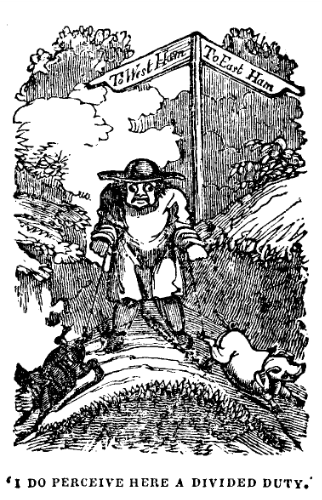
Spirit Of The Annuals.
Reading edition
A FRENCH GENTLEMAN'S LETTER TO AN ENGLISH FRIEND IN LONDON.
Ah my deer frend—I cannot feel the plaisir I expresse to come to your country charming, for you see. We are arrive at Southampton before yesterday at one hour of the afternoon, and we are debarked very nice. I never believe you when at Paris, you tell me that the Englishwomen get on much before our women; but now I agree quite with you; I know you laughing at your countrywomen for take such long steps! My faith! I never saw such a mode to walk; they take steps long like the man! Very pretty women! but not equal to ours! White skins, and the tint fresh, but they have no mouths nor no eyes. Our women have lips like rose-buttons; and eyes of lightning; the English have mouth wide like the toads, and their eyes are like "dreaming sheeps," as one of our very talented writers say, "mouton qui rève." It is excellent, that. I am not perceived so many English ladies tipsy as I expect; our General Pilon say they all drink brandy; this I have not seen very much. I was very surprise to see the people's hair of any colour but red, because all our travellers say there is no other hair seen, except red or white! But I come here filled with candour, and I say I have seen some people whose hair was not red. You tell me often at Paris, that we have no music in France. My dear friend, how you are deceived yourself! Our music is the finest in the world, and the German come after; you other English have no music; and if you had some, you have no language to sing with. It is necessary that you may avow your language is not useful for the purpose ordinary of the world. Your window of shop are all filled at French names—"des gros de Naples," "des gros des Indes," "des gros d'été," &c. If English lady go for demand, show me, if you please, sir, some "fats of Naples," some "fats of India," and some "fats of summer," the linendraper not understand at all. Then the colours different at the silks, people say, "puce évanouie," "oeil de l'empereur," "flammes, d'enfer," "feu de l'opéra;" but you never hear lady say, I go for have gown made of "fainting fleas," or "emperors' eyes," or "opera fires," or of the "flames" of a place which you tell me once for say never to ears polite! You also like very much our musique in England; the street-organs tell you best the taste of the people, and I hear them play always "Le petit tambour," "Oh, gardezvous, bergerette," "Dormez, mes chéres amours," and twenty little French airs, of which we are fatigued there is a long time. I go this morning for make visit to the house of a very nice family. When I am there some time, I demand of the young ladies, what for they not go out? One reply, "Thank you, sir, we are always oblige for stay at home, because papa enjoy such very bad health." I say, "Oh yes! How do you do your papa this morning, misses!" "He is much worse, I am obliged to you, sir!" I bid them good bye, and think in myself how the English are odd to enjoy bad health, and the young ladies much oblige to me because their papa was much worse! "Chacun à son goút," as we say. In my road to come home, I see a board on a gate, and I stopped myself for read him. He was for say, any persons beating carpets, playing cricket, and such like diversions there, should be persecuted. My faith! you other English are so droll to find any diversion in beating carpets! Yet it is quite as amusing as to play the cricket, to beat one little ball with big stick, then run about like madmen, then throw away big stick, and get great knock upon your face or legs. And then at cards again! What stupid game whist! Play for amuse people, but may not laugh any! Ah! how the English are droll! I have nothing of more for say to you at present; but I am soon seeing you, when I do assure you of the eternal regard and everlasting affection of your much attached friend.—Comic Offering.
HOOD'S COMIC ANNUAL.
We have taken a slice, or rather, four cuts, from Mr. Hood's facetious volume. Their fun needs not introduction, for the effect of wit is instantaneous. To talk about them would be like saying "see how droll they are." We omitted the Conditions drawn up by the Provisional Government, (the baker, butcher, publican, &c.) in our account of the revolutionary stir, or as the march-of-mind people call a riot, "the ebullition of popular feeling," at Stoke Pogis. Here they are, worthy of any Vestry in the kingdom, Select or otherwise.
"Conditions.
"1. That for the future, widows in Stoke Pogis shall be allowed their thirds, and Novembers their fifths.
"2. That the property of Guys shall be held inviolable, and their persons respected.
"3. That no arson be allowed, but all bon-fires shall be burnt by the common hangman.
"4. That every rocket shall be allowed an hour to leave the place.
"5. That the freedom of Stoke Pogis be presented to Madame Hengler, in a cartridge-box.
"6. That the military shall not be called out, uncalled for.
"7. That the parish beadle, for the time being, be authorized to stand no nonsense.
"8. That his Majesty's mail be permitted to pass on the night in question.
"9. That all animosities be buried in oblivion, at the Parish expense.
"10. That the ashes of old bon-fires be never raked up.
" (Signed) {WAGSTAFF, High Constable. {WIGSBY."
Our next quotations are two comico-serio Ballads:—
FRENCH AND ENGLISH.
"Good Heaven! why even the little children in France speak French!" ADDISON.
I. Never go to France Unless you know the lingo, If you do, like me, You will repent by jingo, Staring like a fool And silent as a mummy, There I stood alone, A nation with a dummy. II. Chaises stand for chairs, They christen letters Billies, They call their mothers mares, And all their daughters fillies; Strange it was to hear, I'll tell you what's a good 'un, They call their leather queer, And half their shoes are wooden. III. Signs I had to make For every little notion, Limbs all going like A telegraph in motion. For wine I reel'd about, To show my meaning fully, And made a pair of horns. To ask for "beef and bully." IV. Moo! I cried for milk; I got my sweet things snugger, When I kissed Jeannette, 'Twas understood for sugar. If I wanted bread. My jaws I set a-going, And asked for new-laid eggs By clapping hands and crowing. V. If I wished a ride, I'll tell you how I got it: On my stick astride, I made believe to trot it; Then their cash was strange, It bored me every minute, Now here's a hog to change, How many sows are in it. VI. Never go to France Unless you know the lingo; If you do, like me, You will repent, by jingo; Staring like a fool, And silent as a mummy, There I stood alone, A nation with a dummy.
THE DUEL.
A SERIOUS BALLAD.
"Like the two Kings of Brentford smelling at one nosegay."
In Brentford town, of old renown, There lived a Mister Bray. Who fell in love with Lucy Bell, And so did Mr. Clay. To see her ride from Hammersmith, By all it was allowed, Such fair outsides are seldom seen, Such Angels on a Cloud. Said Mr. Bray to Mr. Clay, You choose to rival me, And court Miss Bell, but there your court No thoroughfare shall be. Unless you now give up your suit, You may repent your love I who have shot a pigeon match, Can shoot a turtle dove. So pray before you woo her more, Consider what you do; If you pop aught to Lucy Bell— I'll pop it into you. Said Mr. Clay to Mr. Bray. Your threats I quite explode; One who has been a volunteer Knows how to prime and load. And so I say to you unless Your passion quiet keeps, I who have shot and hit bulls' eyes May chance to hit a sheep's. Now gold is oft for silver changed, And that for copper red; But these two went away to give Each other change for lead. But first they sought a friend a-piece, This pleasant thought to give— When they were dead, they thus should have Two seconds still to live. To measure out the ground not long The seconds then forbore, And having taken one rash step, They took a dozen more. They next prepared each pistol-pan Against the deadly strife, By putting in the prime of death Against the prime of life. Now all was ready for the foes, But when they took their stands. Fear made them tremble so they found They both were shaking hands. Said Mr. C. to Mr. B., Here one of us may fall, And like St. Paul's Cathedral now, Be doom'd to have a ball. I do confess I did attach Misconduct to your name; If I withdraw the charge, will then Your ramrod do the same? Said Mr. B. I do agree— But think of Honour's Courts! If We go off without a shot, There will be strange reports But look, the morning now is bright, Though cloudy it begun; Why can't we aim above, as if We had call'd out the sun? So up into the harmless air Their bullets they did send; And may all other duels have That upshot in the end.
CUTS FROM HOOD'S COMIC ANNUAL.
We next quote brief illustrations of the Cuts on the opposite page. It may be observed that the articles themselves have but little esprit, and that, unlike most occasions, the wit lies in the wood.
First is a Sonnet accompanying the cut "Infantry at Mess."
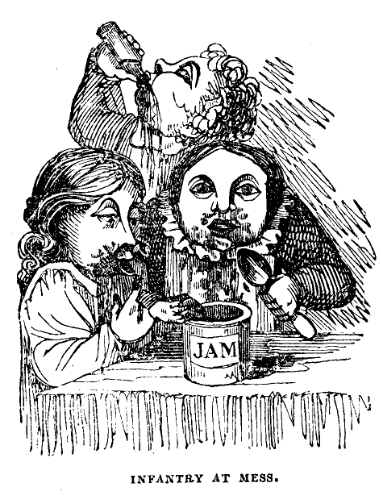
"Sweets to the sweet—farewell."—Hamlet.
Time was I liked a cheesecake well enough; All human children have a sweetish tooth— I used to revel in a pie or puff, Or tart—we all are tarters in our youth; To meet with jam or jelly was good luck, All candies most complacently I cramped. A stick of liquorice was good to suck, And sugar was as often liked as lumped; On treacle's "linked sweetness long drawn out," Or honey, I could feast like any fly, I thrilled when lollipops were hawk'd about, How pleased to compass hardbake or bull's eye, How charmed if fortune in my power cast, Elecampane—but that campaign is past.
"Picking his way," belongs to a day (April 17) in a "Scrape Book," with the motto of "Luck's all:"
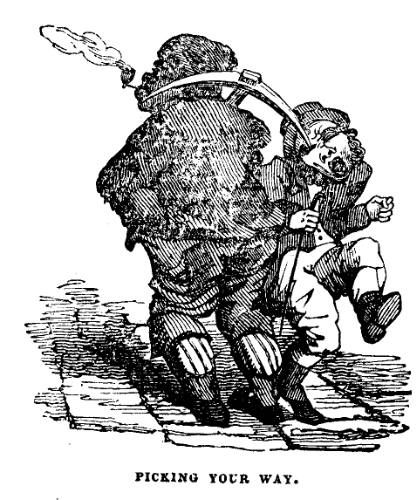
"17th. Had my eye pick'd out by a pavior, who was axing his way, he didn't care where. Sent home in a hackney-chariot that upset. Paid Jarvis a sovereign for a shilling. My luck all over!"
The Schoolmaster's Motto, accompanying "Palmam qui meruit ferat!" is too long for extract.
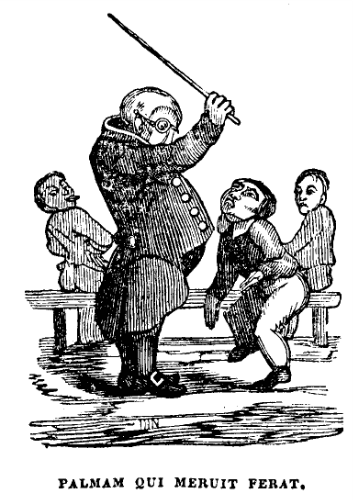
The chief fun of the countryman and his Pigs lies in the cut.