The Naturalist.
Reading edition
THE AMERICAN ALOE.
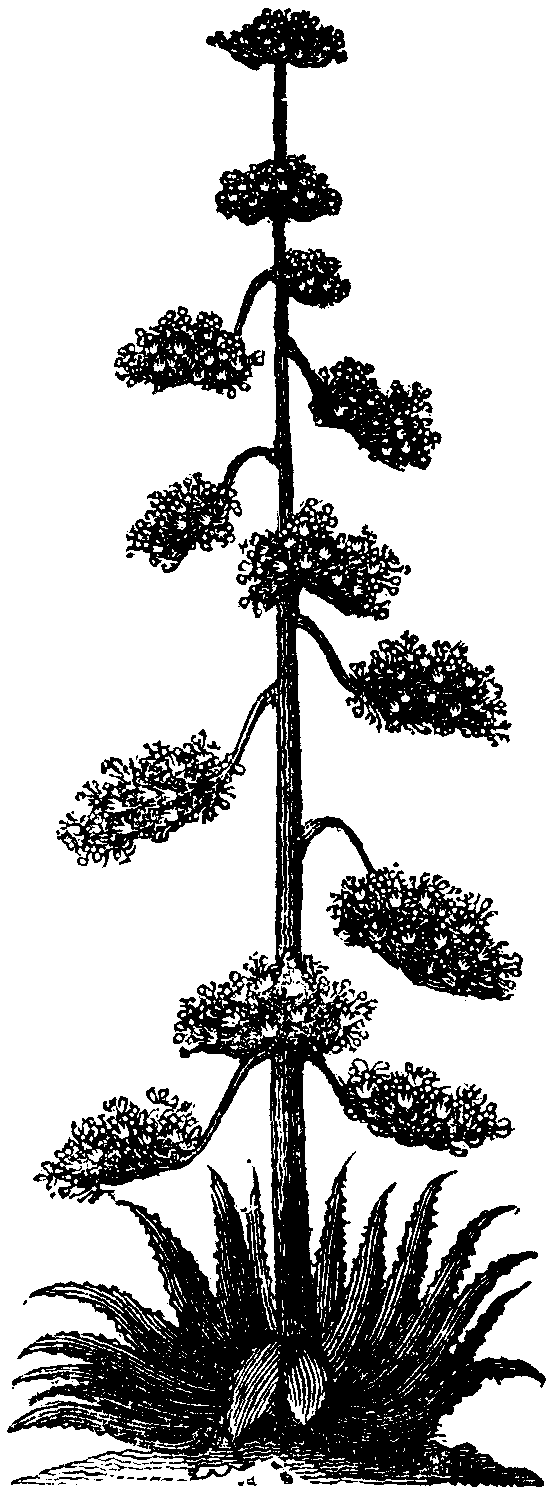
An American Aloe (Agave Americana) is one of the most superb exhibitions in the whole vegetable kingdom. The plant, when vigorous, rises upwards of twenty feet high, and branches out on every side, forming a kind of pyramid, of greenish yellow flowers, in thick clusters at every joint. We often meet with the aloe in our conservatories, and it has been known to flourish in the open air. A Correspondent of the Gardener's Magazine, writing from Gwrich Castle, Abergelay, Denbighshire, tells us that "about eight years back he pulled down one of his hot-houses, in which stood a large American Aloe, known to be 68 years of age. It was in a box about two feet square, and the plant was so large that he determined not to put it in the new house then building; it was, in consequence, placed alongside the south wall in the corner (not expecting it to live,) where it has been ever since, never having been watered in summer, nor matted nor attended to in winter, and it is now as vigorous and as healthy (if not more so) than before. The box was not buried in the ground, and is now falling to pieces. The garden is about 100 yards from the sea."
It is no fable that the Aloe grows about a hundred years (a few more or less) before it blooms; and, after yielding its seed, the stem withers and dies. If we remember right, a beautiful specimen in full bloom, was exhibited three or four years since at the Argyll Rooms, in Regent Street.
It may be as well to mention that the sharp-pointed leaves have been known to inflict serious injury. In the Lancet, No. 313, vol. ii., a case is recorded of a young gardener, who whilst watering some plants in a gentleman's garden, at Camberwell, accidentally struck his hand against an aloe plant, one of the prickles of which passed into the last joint of his lefthand little finger; he regarded the circumstance at the time as but of trifling consequence, on account of its causing him but slight inconvenience; neither were the effects worth notice until two days after the accident, when the part put on a white appearance, and the finger became very stiff, swollen, and painful; these symptoms increased, and by the following morning the whole hand and arm, as far as the elbow, had attained an exceedingly large size. After suffering about two months, the poor fellow was removed into St. Thomas's Hospital, where the diseased arm was amputated by Mr. Travers, and the patient soon recovered his accustomed good health.
MOLES.
In those districts where moles abound, it may be remarked that some of the mole-hills are considerably larger than others. When a hill of enlarged dimensions is thus discovered, we may be almost certain of finding the nest, or den of the mole near it, by digging to a sufficient depth. The fur of the mole is admirably adapted from its softness and short close texture for defending the animal from subterraneous damp, which is always injurious, more or less to non-amphibious animals; and in this climate, no choice of situation could entirely guard against it. It is a singular fact that there are no moles in Ireland. May not the dampness of the climate account for their not thriving there?—Edinburgh Lit. Gaz.
CHANGES IN ANIMALS.
All domestic mammiferous animals introduced into America have become more numerous than the indigenous animals. The hog multiplies very rapidly, and assumes much of the character of the wild boar. Cows did not at first thrive, but, in St. Domingo, only twenty-seven years after its first discovery, 4,000 in a herd was not uncommon, and some herds of 8,000 are mentioned. In 1587, this island exported 35,444 hides, and New Grenada 64,350. Cows never thrive nor multiply where salt is wanting either in the plants or in the water. They give less milk in America, and do not give milk at all if the calves be taken from them. Among horses the colts have all the amble, as those in Europe have the trot: this is probably a hereditary effect. Bright chestnut is the prevailing colour among the wild horses. The lambs which are not from merinos, but the tana basta and burda of the Spaniards, at first are covered with wool, and when this is timely shorn, it grows again; if the proper time is allowed to elapse, the wool falls off, and is succeeded by short, shining, close hair, like that of the goat in the same climate. Every animal, it would appear, like man, requires time to accustom itself to climate.
THE GREAT AMERICAN BITTERN.
A most interesting and remarkable circumstance we learn from the Magazine of Natural History, attends the great American Bittern; it is that it has the power of emitting a light from its breast equal to the light of a common torch, which illuminates the water so as to enable it to discover its prey. As this circumstance is not mentioned by any naturalist, the correspondent of the journal in question, took every precaution to determine, as he has done, the truth of it.