HAMPTON COURT.
Reading edition
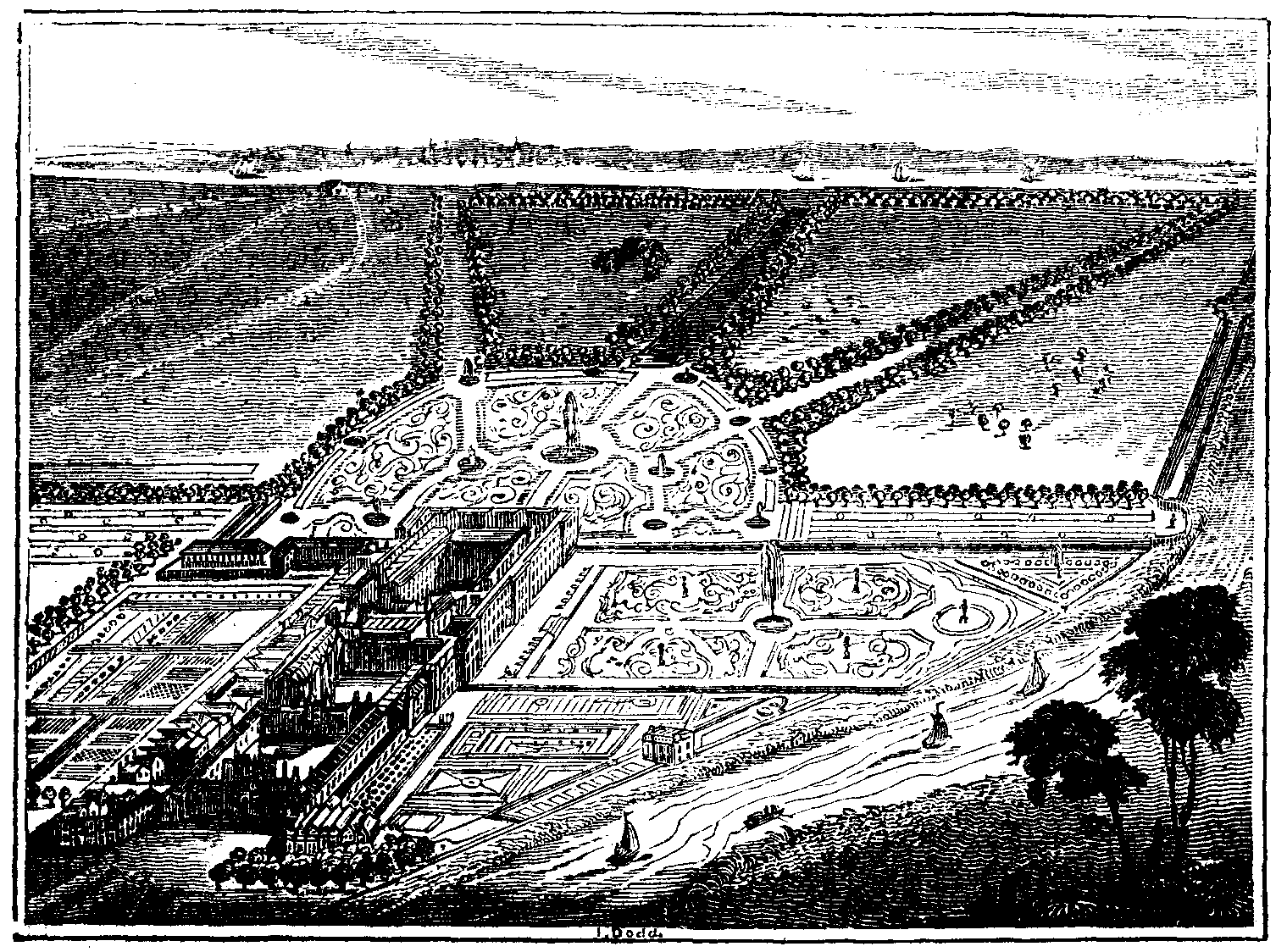
Here is a bird's-eye view of a royal palace and domain "cut out in little stars." It is copied from one of Kipp's Views in Great Britain in the time of Queen Anne, and affords a correct idea of Hampton Court in all its olden splendour.
Henry VIII. added considerably to Wolsey's building, and in the latter part of his reign, it became one of his principal residences. Among the events connected with the palace are the following:—
In 1651, the Honour and Palace of Hampton were sold to creditors of the state; but previously to 1657 it came into the possession of Cromwell, who made it one of his chief residences. Elizabeth, his daughter, was here publicly married to the Lord Falconberg; and the Protector's favourite child, Mrs. Claypoole, died here, and was conveyed with great pomp to Westminster Abbey.
The palace was occasionally inhabited by Charles II. and James II. King William resided much at Hampton Court; he pulled down great part of the old palace, which then consisted of five quadrangles, and employed Sir Christopher Wren to build on its site the Fountain Court, or State Apartments. In July, 1689, the Duke of Gloucester, son of the Princess, afterwards Queen Anne, was born here. The Queen sojourned at Hampton occasionally, as did her successors George I. and II.; but George III. never resided here. When his late serene highness William the Fifth, Stadtholder of the United Provinces, was condemned to quit his country by the French, this palace was appropriated to his use; and he resided here several years. The principal domestic apartments of Hampton Court are now occupied by different private families, who have grants for life from the crown.
The eastern quadrangle, or Fountain Court, erected by Sir Christopher Wren for King William, in 1690, is 100 feet by 177 feet 3 inches. Here is the King's Gallery, 117 feet by 23 feet 6 inches, which was fitted up for the Cartoons of Raphael. On the eastern side of the court is a room in which George I. and George II. frequently dined in public. North-west of the Fountain Court stands the chapel, which forms the southern side of the quadrangle; this was partly built by Wolsey, and was finished by Henry VIII. in 1536, or 1537. The windows were of beautifully stained glass, and the walls decorated with paintings, but these embellishments were demolished in the troublous times of 1745. The chapel was, however, restored by Queen Anne; the floor is of black and white marble, the pews are of Norway oak, and there is some fine carving by Gibbons; the roof is plain Gothic with pendent ornaments.
The gardens, which comprise about 44 acres, were originally laid out by London and Wise. George III. gave the celebrated Brown permission to make whatever improvements his fine taste might suggest; but he declared his opinion that they appeared to the best advantage in their original state, and they accordingly remain so to this day. The extent of the kitchen gardens is about 12 acres. In the privy garden is a grape house 70 feet in length, and 14 in breadth; the interior being wholly occupied by one vine of the black Hamburgh kind, which was planted in the year 1769, and has in a single year, produced 2,200 bunches of grapes, weighing, on an average, one pound each.
The grotesque forms of the gardens, and the mathematical taste in which they are disposed, are advantageously seen in a bird's-eye view as in the Engraving, which represents the tortuous beauty of the parterres, and the pools, fountains, and statues with characteristic accuracy. The formal avenues, radiating as it were, from the gardens or centre, are likewise distinctly shown, as is also the canal formed by Wolsey through the middle avenue. The intervening space, then a parklike waste, is now planted with trees, and stretches away to the village of Thames Ditton; and is bounded on the south by the Thames, and on the north by the high road to Kingston.
The palace is open to the public, and besides its splendid apartments, and numerous buildings, there is a valuable collection of pictures, which are too celebrated to need enumeration. A curious change has taken place in the occupancy of some apartments—many rooms originally intended for domestic offices being now tenanted by gentry. The whole is a vast assemblage of art, and reminds us of the palace of Versailles, which is about the same distance from Paris as Hampton Court from London.
GREECE.
(For the Mirror.)
Alas! for fair Greece, how her glories are failed, Her altars are broken, her trophies are gone, The Crescent her temples and shrines hath invaded, And Freedom hath bow'd to the Mussulman throne. Fair Liberty say! shall the land of Achilles Reluctantly cherish a dastardly slave, Who can crouch at the foot of a despot, whose will is As fickle as wind, and as rude as the wave? Shall the ashes of heroes enshrouded in glory, Be spurn'd in contempt by a barbarous horde, While their sons idly tremble like boys at a story, And shudder to gaze on the point of a sword? Shall Greece, still as lovely as maiden in sorrow, By Freedom's bright ray ne'er be beam'd on again? Shall the sun of Engia ne'er rise on the morrow That lightens her thraldom or loosens her chain? Oh say, shall the proud eye of scorn fall unheeded, The hand, taunting, point to "the land of the brave," And say that Achaia's fair daughters e'er needed An arm to protect them—a hero to save. Rise! courage alone your base station can alter, Let Beauty, let Liberty, spirit you on, And while fetters and stripes are their portion who falter, Remember that Freedom's the stake to be won.
J.O.B.
ESCAPE OF CHARLES II.
(For the Mirror.)
In No. 376, of the MIRROR, is a communication from W.W. respecting the pension granted by Charles II. to the Pendrils, for aiding him in his escape, after the fatal battle of Worcester. There was another family who enjoyed a pension from the same monarch, named Tattersall, one of whom conveyed Charles from Brighton in his open fishing-boat. A descendant is now living at that place, but the family, through ignorance and neglect, have ceased to enjoy the grant.
The house in which the king rested at Brighton, is now an inn, in West Street, called the King's Head, and is kept by a Mr. Eales.
H. BERGER.
LINES WRITTEN IN A LADY'S ALBUM.
(For the Mirror.)
The star is set that lighted me Thro' Fancy's wide domain, And the fairy paths of poesy, I now may seek in vain. 'Tis but when Sorrow's clouds appear, In frowning darkness o'er me, The light of Song bursts forth to cheer The gloomy path before me. As o'er the dusky waves at night, Oft Mariners behold That ocean-form, St. Ermo's light, When tempests are foretold. Two reasons in my mind arise. Why Song is now denied me;— No light can venture near thine eyes, Nor Grief—when thou'rt beside me!
E.
MINSTREL BALLAD.
WRITTEN ON A FLYLEAF OF A VOLUME OF ONE OF THE "WAVERLEY NOVELS."
(For the Mirror.)
Waken, lords and ladies gay, On the mountain dawns the day, All the jolly chase is here, With hawk and horse, and hunting spear; Hounds are in their couples yelling, Hawks are whistling, horns are knelling, Merrily, merrily, mingle they, "Waken, lords and ladies gay." Waken, lords and ladies gay, The mist has left the mountain grey, Springlets in the dawn are streaming, Diamonds on the brake are gleaming, And foresters have busy been, To track the buck in thicket green; Now we come to chant our lay, "Waken, lords and ladies gay." Waken, lords and ladies gay, To the green wood haste away, We can show you where he lies, Fleet of foot, and tall of size; We can show the marks he made When 'gainst the oak his antlers frayed; You shall see him brought to bay. "Waken, lords and ladies gay." Louder, louder, chant the lay, Waken, lords and ladies say, Tell them youth, and mirth and glee, Run a course as well as we, Time, stern huntsman! who can balk, Stanch as hound, and fleet as hawk? Think of this, without delay, Gentle lords and ladies gay.
C.C.