MANNERS & CUSTOMS OF ALL NATIONS.
Reading edition
ELEPHANT HUNT.
A medical officer, in a recent letter from Hambantotti says, I have just returned from beholding a sight, which, even in this country, is of rare occurrence, viz. an elephant hunt, conducted under the orders of government. A minute description (though well worth perusal) would be far too long for a letter; I shall therefore only give you what is usually called a faint idea.
Imagine 2,000 or 3,000 men surrounding a tract of country six or eight miles in circumference, each one armed with different combustibles and moving fires; in the midst suppose 300 elephants, being driven towards the centre by the gradual and regular approach of these fires, till at last they are confined within a circle of about two miles; they are then driven by the same means into a space made by the erection of immense logs of ebony and other strong wood, bound together by cane, and of the shape (in miniature) of the longitudinal section of a funnel, towards which they rush with the greatest fury, amidst the most horrid yells on the approach of fire, of which they stand in the greatest dread. When enclosed they become outrageous, and charge on all sides with great fury, but without any effect on the strong barricado; they at last gain the narrow path of the enclosure, the extreme end of which is just large enough to admit one elephant, which is immediately prevented breaking out by strong bars laid across. To express their passion, their desperation, when thus confined, is impossible; and still more so, to imagine the facility and admirable contrivance by which they are removed and tamed. Thus it is:—A tame elephant is placed on each side, to whom the wild one is fastened by ropes; he is then allowed to pass out, and immediately on his making the least resistance, the tame ones give him a most tremendous squeeze between their sides, and beat him with their trunks until he submits; they then lead him to a place ready prepared, to which he is strongly fastened, and return to perform the same civility to the next one.
In this way seventy wild elephants were captured for the purpose of government labour. The tame elephants daily take each wild one singly to water and to feed, until they become quite tame and docile. The remaining elephants were shot by the people.
I took possession of a young one, and have got him now tied up near my door; he is quite reconciled, and eats with the greatest confidence out of my hand; he is, however, too expensive to keep long, and I fear I must eventually shoot him. Some idea of the expense may be supposed, when I tell you that in one article alone, milk, his allowance is two gallons per day.
I was at this scene with thirty other officers and their ladies, and we remained in temporary huts for nearly ten days.—Asiatic Journal.
BRAZILIAN SLAVE TRADE.
From the Memoirs of General Miller, Second Edition.
In Brazil the slave trade is seen in some of its most revolting aspects; for there the general treatment of negro slaves is barbarous in the extreme. About thirty thousand are annually imported into Rio Janeiro alone, and perhaps an equal number in the other ports of the empire. One of the many abhorrent circumstances attending this nefarious traffic is, that, upon a vessel's arriving near the port, such slaves, as appear to be in an irrecoverable state of disease, are frequently thrown into the sea! This is done merely to evade the payment of the custom-house duty, which is levied upon every slave brought into port. Instances have occurred of their being picked up alive by coasting vessels!
Fourteen or fifteen slave ships, with full cargoes, arrived at Rio Janeiro during the six weeks that Miller remained there. One morning that he happened to breakfast on board a Brazilian frigate, the commander, Captain Sheppard, kindly lent him a boat to visit a slaver of 320 tons, which had come into port the preceding night. The master, supposing him to be in the imperial service, was extremely attentive, and very readily answered every inquiry. He said the homeward-bound passage had been tolerably fortunate, only seventy-two deaths having occurred in the cargo; and that, although thirty of the sick were then in an unsaleable plight, the owners might calculate upon sending into the market four hundred sound and well-grown Africans; a number that would yield a handsome profit.
After some further conversation, Miller requested permission to see the 'tween decks, upon which the muster accompanied him below, and pointed out the manner of securing his cargo, which was by shackling each negro by one leg to an iron bar running a midships from stem to stern, so as to form a double row, lying feet to feet. The air was so oppressively nauseating, that Miller could not remain below for more than two minutes. There was hardly a slave in the whole number who was free from festering sores, produced by constant friction from lying on the hard and unwashed decks. Some of them were bruised so dreadfully, that it was wonderful that they continued to exist. Their emaciated appearance might have led to the supposition that they had been nearly starved during the passage, did not the varied miseries to which they were subjected, sufficiently account for their fleshless forms. A great number of them were now upon deck, and clad in long woollen shirts, in order to be sent to the warehouses on shore. Miller, heartily sick of this disgusting scene, took leave of the master; but, unable to control the indignation he felt, he inveighed with great bitterness against all wretches concerned in so iniquitous a traffic, letting him know at the same time that he was not in the service of the emperor. The master, though at first taken aback by the violence of the general's invectives, soon recovered himself, and retorted in the most insolent terms of defiance, abusing the English for meddling in what he styled the legitimate commerce of Brazil. The state of the vessel was such as cannot be described, and the fetid effluvia, arising from it, offended the senses on approaching her within fifty yards. Although Miller took a warm bath immediately upon getting on shore, the stench of the slave ship haunted his nostrils for many days.
There is a long narrow street in Rio Janeiro exclusively appropriated to the negro stores. It is, in fact, the slave-bazaar. The fronts of the shops are open, and the objects for sale are seated on benches, where, strange to say, they often pass their time in singing. People wishing to become purchasers lounge up and down until they see a subject likely to suit their purpose. Miller one day put on a broad-brimmed straw hat, and walked into several of the stores, as if with a view of making a purchase. The slave venders came forward with eagerness to show off their stock, making their bipeds move about in every way best calculated to display their good points, and in much the same manner that a jockey does in showing off a horse. Those who appeared to be drowsy were made to bite a piece of ginger, or take a pinch of snuff. If these excitements did not prove sufficient to give them an air of briskness, they were wakened up by a pull of the ear, or a slap on the face, which made them look about them. Miller was so inquisitive, and his observations were so unlike those of a bona fide purchaser, that the dealers soon began to suspect he did not intend to be a customer. One of them being in consequence rather pert in his replies, Miller once more allowed his indignation to get the better of his judgment, and he abused the fellow in terms more violent, if possible, than those he had addressed to the master of the slave ship. He had some difficulty to avoid getting into a very serious squabble, as many of the other dealers came out and joined in the yell now raised against him. As he passed along the street, it was like running the gauntlet; for he was saluted by vituperations on all sides, and it was perhaps only by preserving a menacing attitude in his retreat that he prevented something more than a mere war of words. They dwelt with marked emphasis on the officious English, who, instead of attending to their own affairs, would not, they said, allow other people to gain an honest livelihood.
OLD CHARING CROSS.
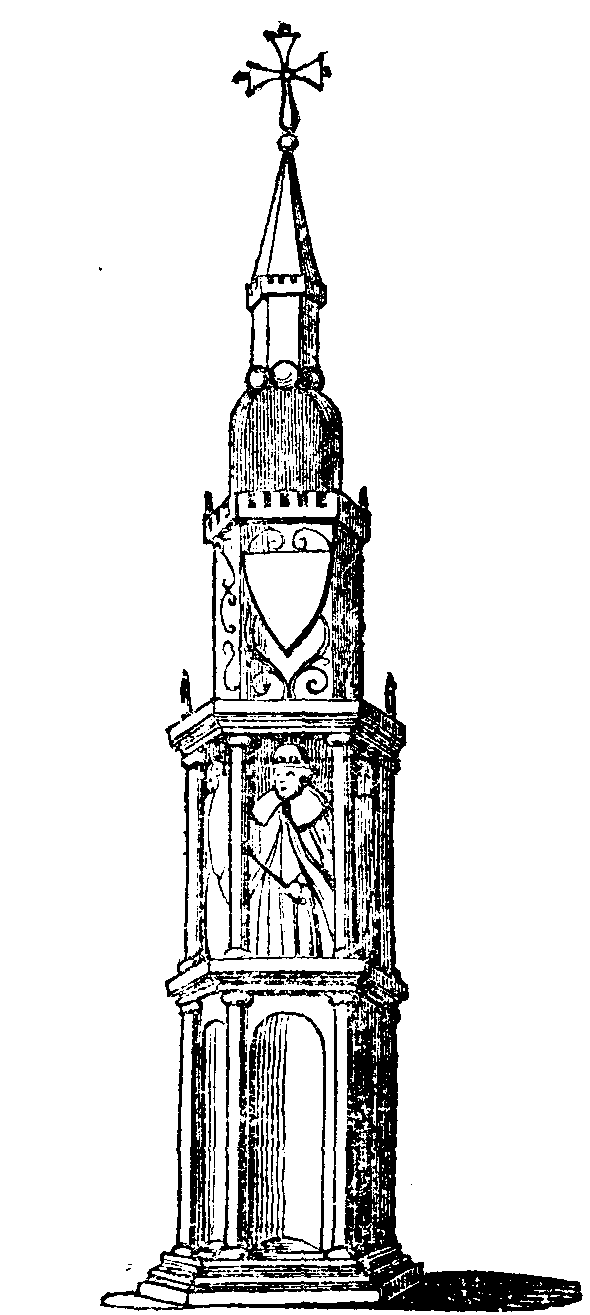
This is one of the celebrated memorials of the affection of Edward I. for his beloved Elinor, being the cross erected on the last spot on which the body rested in the way to Westminster Abbey, the place of sepulture. This and all the other crosses were built after the designs of Cavilini; and all of them were destroyed by the zeal of the Reformers.
Our illustration is from an engraving copied from a print found in a mutilated genealogy published in 1602, relative to the Stuart family, in which were portraits of James I. and family, and a print of Old St. Paul's. Pennant, speaking of Old Charing Cross, says "from a drawing communicated to me by Dr. Combe, it was octagonal, and in the upper stage had eight figures; but the Gothic parts were not rich." The above print differs from this drawing, yet it was evidently intended to represent the same subject, "Charing Cross" being engraved at the bottom.
The site of the cross is now occupied by the Equestrian Statue of Charles I. in which the figure and symmetry of the horse are beautifully displayed. Indeed, it is said to be the most finished piece of workmanship of the kind ever produced: that of Marcus Aurelius, or the two horses on the Monte Cavallo, or Quirino at Rome not excepted.