Retrospective Gleanings.
Reading edition
OLD ROSE.
Walton, in his "Angler," makes the hunter, in the second chapter, propose that they shall sing "Old Rose," which is presumed to refer to the ballad, "Sing, old Rose, and burn the bellows," of which every one has heard, but much trouble has been taken, in vain, to find a copy of it.
AUCTIONS.
Elihu Yale was remarkable for his auctions. The first of these was about the year 1700. He had brought such quantities of goods from India, that, finding no one house large enough to stow them in, he had a public sale of the over-plus; and that was the first auction of the kind in England.
LILLY, THE ASTROLOGER.
While this impudent cheat is ridiculed for his absurdities, let him have credit for as lucky a guess as ever blessed the pages even of "Francis Moore, physician." In his "Astrologicall Predictions for 1648," there occurs the following passage, in which we must needs allow that he attained to "something like prophetic strain," when we call to mind that the great Plague of London occurred in 1665, and the great Fire in the year following:
"In the year 1656 the aphelium of Mars, who is the generall significator of England, will be in Virgo, which is assuredly the ascendant of the English Monarchy, but Aries of the kingdom. When this absis, therefore, of Mars shall appear in Virgo, who shall expect less than a strange catastrophe of human affairs in the commonwealth, monarchy, and kingdom of England? There will then, either in or about these times, or neer that year, or within ten years, more or less, of that time, appear in this kingdom so strange a revolution of fate, so grand a catastrophe, and great mutation unto this monarchy and government, as never yet appeared; of which, as the times now stand, I have no liberty or encouragement to deliver any opinion. Only, it will be ominous to London, unto her merchants at sea, to her traffique at land, to her poor, to her rich, to all sorts of people inhabiting in her or her liberties, BY REASON OF SUNDRY FIRES AND A CONSUMING PLAGUE."
This is the prediction which, in 1666, led to his being examined by a Committee of the House of Commons; not, as has been supposed, that he might "discover by the stars who were the authors of the Fire of London," but because the precision with which he was thought to have foretold the event, gave birth to a suspicion that he was already acquainted with them, and privy to the (supposed) machinations which had brought about the catastrophe. Curran says, there are two kind of prophets, those who are really inspired, and those who prophesy events which they intend themselves to bring about. Upon this occasion, poor Lilly had the ill-luck to be deemed one of the latter class.
WHIGS AND TORIES.
Whenever these terms were first introduced, and whatever might be their original meaning, it is certain that in the reign of Charles the Second they carried the political signification which they still retain. Take, as a proof, the following nervous passage from Dryden's Epilogue to "The Duke of Guise," 1683:
"Damn'd neuters, in their middle way of steering, Are neither fish, nor flesh, nor good red herring: Nor whigs, nor Tories they; nor this nor that; Not birds, not beasts, but just a kind of bat: A twilight animal, true to neither cause, With Tory wings, but Whiggish teeth and claws."
OTWAY'S "CAIUS MARIUS."
When poor Otway's "unpardonable piracy," in taking part of this play from "Romeo and Juliet," was reprobated so severely, the critic might have done him the justice to mention, that, instead of attempting to pass off the borrowed beauties as his own, he, in the prologue, fully avowed his obligations. It contains an animated eulogy on Shakspeare, which thus concludes:—
"Though much the most unworthy of the throng, Our this day's poet fears he's done him wrong. Like greedy beggars, that steal sheaves away, You'll find he's rifled him of half a play; Among his baser dross you'll see it shine, Most beautiful, amazing, and divine."
NANCY DAWSON
Was a dancer at Covent Garden Theatre, previous to the accession of his late majesty; and in 1760 transferred her services to the other house. On the 23rd of September, in that year, the "Beggar's Opera" was performed at Drury Lane, when the play-bill thus announced her: "In Act III, a hornpipe by Miss Dawson, her first appearance here."—It seems she was engaged to oppose Mrs. Vernon in the same exhibition at the rival house. That her performance of it was somewhat celebrated, may be inferred from the circumstance of there being a full-length print of her in it.—Gentleman's Magazine.
RELIC OF JOHN BUNYAN.
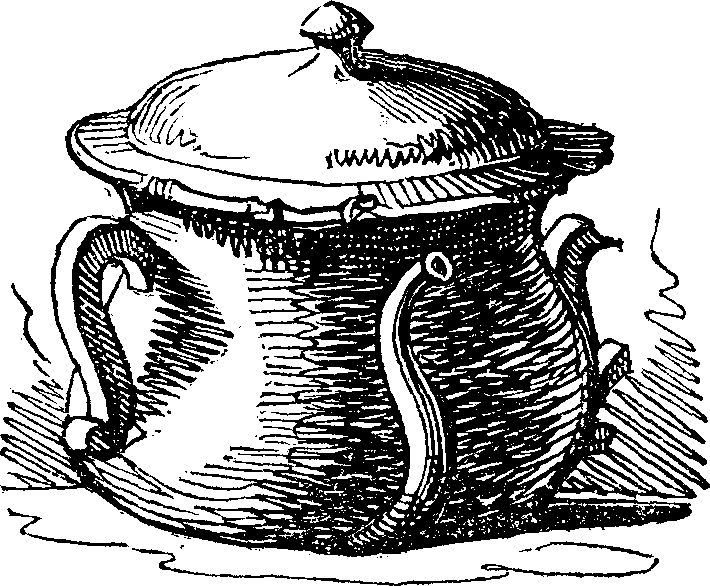
The cut represents the vessel from which John Bunyan, the author of that popular allegory, "the Pilgrim's Progress," was accustomed to drink syllabub, during his incarceration in Bedford County Gaol. The original is in the possession of the correspondent who has furnished us with the sketch for the engraver. It is of common earthen-ware, 7-1/2 inches in height, and will contain 3-1/2 pints; one of the handles is partly broken off; the glaze is of a light flesh tint; and the vessel is a fair specimen of pottery in the early part of the seventeenth century.
Bunyan, it will be recollected, was born in 1628, at Elstow, near Bedford, where the cottage stood in its original state till within these few years. It has latterly been new fronted, but the interior remains nearly as in Bunyan's time. He was the son of a tinker, and followed his father's trade; and at Elstow are the remains of a closet in which, in early life, he carried on business. During the civil war he served as a soldier in the parliament army; and subsequently joined a society of Anabaptists at Bedford, and became their public teacher. Soon after the Restoration, he was indicted for "abstaining from coming to church," and holding "unlawful meetings and conventicles," for which he was sentenced to transportation, which was not executed, as he was detained in prison upwards of twelve years, and at last liberated through the charitable interposition of Dr. Barlow, Bishop of Lincoln.
Sir Richard Phillips, in his recent "Personal Tour," says, "on inquiring for relics of honest Bunyan, I was introduced to Mr. Hilyard, the present amiable and exemplary pastor of the large Independent Congregation, which 150 years since was under the spiritual care of Bunyan. Mr. H. at his meeting-house, showed me the vestry-chair of Bunyan; and the present pulpit is that in which Bunyan used to preach. At his own house he preserves the records of the establishment, many pages of which are in a neat and very scholastic hand by Bunyan, and contain many of his signatures."
Bunyan's imprisonment gave rise to "The Pilgrim's Progress," a work, which like "Robinson Crusoe," has remained unrivalled amidst a host of imitators. He was too, a wit as well as a preacher. Towards the close of his imprisonment a Quaker called on him, probably to make a convert of the author of the Pilgrim. He thus addressed him:—"Friend John, I am come to thee with a message from the Lord; and after having searched for thee in half the prisons in England, I am glad that I have found thee at last." "If the Lord had sent you," sarcastically replied Bunyan, "you need not have taken so much pains, for the Lord knows that I have been a prisoner in Bedford Gaol for these twelve years past."
SKELETON OF AN ELEPHANT.
The bones of poor Chunee, the stupendous elephant shot at Exeter 'Change, in 1826, have, at a considerable expense, been accurately articulated, and the entire skeleton is now exhibiting in one of the chambers at "the Egyptian Hall," in Piccadilly. We remember the interest, the "sensation," which the death of Chunee occasioned: it was a fertile incident—for we gave an engraving of the enormous deceased in his den at Exeter 'Change. It is little more than three years since, and probably in three years more, Chunee will figure in books of Natural History, and Exeter 'Change in the antiquarian's portfolio.
We recommend the Naturalist and all such as delight in contemplating sublime objects of nature, to see this skeleton; and there can scarcely be an exhibition better calculated to impress the youthful mind with the vastness of creation. It stands nearly 13 feet high, and the clear space beneath the ribs is 6 feet.
It would, we think, suit the Zoological Society, and make a fine nucleus for their Museum.
ROYAL VISITS TO THE THEATRES.
When the King visited the Opera in 1821, the preparations cost upwards of £300. The ante-room and the box were hung with satin, and festoons of gold lace.
When his Majesty visited Covent Garden Theatre in 1823, there were 4,255 persons present, and the receipts were £971. 18s. 6d.—Companion to the Theatres.