GUY'S CLIFF.
Reading edition
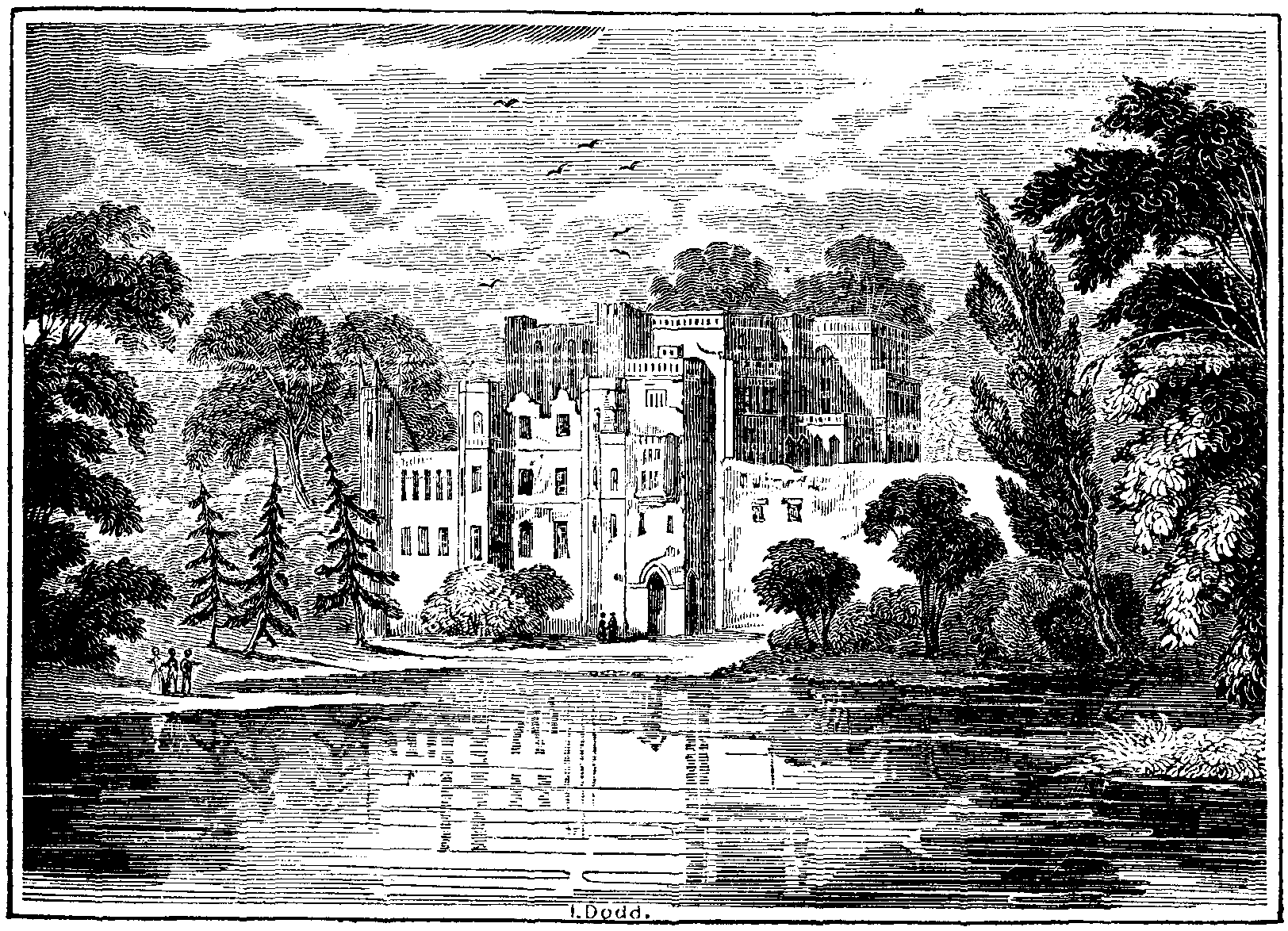
"A home of pleasure, a place meet for the Muses."—Leland.
Warwick—what olden glories and tales of other times are associated with this county. How many of its sites are connected with high-minded men and great and glorious actions. To the antiquary, the poet, and the philosopher, every foot is hallowed ground; and even the cold calculations of the commercial speculator treat with regard a county whose manufactures add to the stock of national wealth and importance. How many stories of love, war, and chivalry are told of its halls, castles, and monasteries, their lords and ladies and maidens of high birth. Kenilworth and Stratford—Leicester, Shakspeare and Warwick—like long trails of light, all flit before us in this retrospective dream of the days of "merry England."
About the middle of the eighteenth century, this estate passed to a private gentleman, who built a handsome mansion here. But the chief attractions are the natural beauties of the grounds—as the rock, on which the house and chapel are built. Here is shown a cave, devoutly believed by neighbouring peasants to be that which Guy "hewed with his own hands," and in which he lived
Like a Palmer poore.
The chapel founded by Richard Beauchamp was a plain, substantial edifice. The founder caused to be carved from the solid rock on which this chapel abuts, a rude statue of the famous Earl Guy, about eight feet in height. It would appear, from a print in Dugdale's Warwickshire, that this figure was well preserved in the seventeenth century.
ANCIENT CROSSES IN ENGLAND.
(For the Mirror.)
"She doth stray about By holy crosses, where she kneels and prays For happy wedlock hours."
Shakspeare.
In former times, an idea of peculiar sanctity was annexed to crosses. They not only marked civil and ecclesiastical limits, but probably served for stations, when the bounds were visited in processions. It was a common practice for mendicants to place themselves near some of these crosses, and ask alms; whence the ancient proverb, "He begs like a cripple at a cross." Cornwall abounds with stone crosses. In churchyards, by the side of roads, and on the open downs, they remain solitary and neglected. In almost every town that had an abbey, or any other religious foundation, there was one of these structures. The monks frequently harangued the populace from these crosses. Many of them still remain, exhibiting beautiful specimens of architecture and sculpture. The most memorable and interesting objects of this kind were those which King Edward I. erected at the different stages where the corpse of Queen Eleanor rested, in its progress from Nottinghamshire to London. Mr. Gough tells us, that there were originally fifteen of these elegant structures; but only three are now remaining, which, by their peculiar beauty, as specimens of architecture and productions of art, serve to excite regret at the destruction of the others. The first of the three above-mentioned, is the cross at Geddington, about three miles from Kettering, in Northamptonshire. The second is the Queen's Cross, near Northampton. The third is the cross at Waltham, in Hertfordshire. For a further account of these crosses, see Mr. Britton's "Architectural Antiquities of Great Britain."
P. T. W.
TO R.H., ON HER DEPARTURE FOR LONDON.
(For the Mirror.)
"Alas for me! false hearts I've found, where I had deem'd them true, And stricken hopes lie all around where'er I turn my view; Yet it may be, when far remov'd, the voice of memory May yet remind thee how we lov'd, with its reproving sigh."
Anonymous.
Farewell! farewell! a sad farewell! 'Tis fate's decree that we should part; Forebodings strange my bosom tell, That others now will pain thy heart: If so, calm as the waveless deep, Whereby the passing gust has blown, Unmark'd, the eye will turn to weep O'er days that have so swiftly flown, Remember me—remember me, My latest thought will be for thee. The tale which to thee I've confest Another ne'er shall hear again; Nor love, that link'd me with the blest, Be darken'd with an earthly chain. No, as the scroll above the dead, The dreams of parted joys will last; There is a bliss now love has fled, To trace this record of the past. Then, oh! mid all remember me— My latest thought will be for thee. Life hath been as a cloudy day, Yet still it hath not all been gloom, For many a wild and broken ray Hath cheer'd awhile my spirit's doom; As flow'rets on a river's rim, Whose shadows deck each passing wave, Thought lingers on, perturb'd and dim, Or sunbeam resting on a grave. Remember me—remember me— My latest thought will be for thee. Where'er my feet may wander now, No more awakes the slightest care; It matters not—for still wilt thou Be present 'mid my heart's despair. So springs and blooms, in lonely state, Some flow'ret on a roofless cot, And decks with smiles, though desolate, The gloomy stillness of the spot. Remember me—remember me— My latest thought will be for thee. Though calm the eye, and still the tongue, It needs not that the cheek be pale To prove the heart by feelings wrung, And brooding o'er a hopeless tale; For calm is oft the ocean's breast, Though 'neath its deep blue waters lie A thousand wrecks—so sorrows rest In still and silent misery. Remember me—remember me— My latest thought will be for thee.
H. P.
THE COURSE OF LOVE.
(For the Mirror.)
Go, trace the forest maze, Or Cretan lab'rinth solve, On Nature's myst'ries gaze, Or Gordian knot resolve. Tell whence the magnet's force, The central motive scan, Lay bare Nile's hidden source, Earth's vast circumference span. Results from such detail Skill superhuman prove: Yet powers like these would fail To tell the course of love. Direct the impulse fierce Of ocean's watery sway; When wint'ry tempests pierce, Bind Boreas to obey. Go, mould the fleeting cloud, The lucid dew-drop mix, The solar radiance shroud, The trembling moonbeam fix. Then bid the wand'ring star Within the zodiac move; 'Twere task more hard by far To guide the course of love. Stop the meridian flight Of Jove's proud plumy race; Arrest the fiercest fight When foe-men battle face. Forbid the earth to turn. Forbid the tides to flow, Forbid the sun to burn, Forbid the winds to blow. Bid the fix'd orb of day. Beyond his sphere to move, Or cease th' attempt, I pray, To stop the course of love.
T. F.
I'LL BE AT YOUR BALL
(For the Mirror.)
Ah! ce n'est pas moi qui romprait la première l'union sacrée de nos coeurs; vous le savez bien que ce n'est pas moi, et je rougirais presque, d'assurer ce qui n'est que trop certain.—Corinne, par Madame De Stael.
I'll be at your ball—dear Eliza, Could you doubt of my wish to be there, When ask'd by the maiden I prize a- Bove all maidens, though e'er so fair? Busy fancy brings back in my dreams The walks, still enchanting, we took, When the zephyrs scarce ruffled the streams, No sound heard, save the murm'ring brook; The stars we together have watched— What pleasure these thoughts do recall! Believe that your truly attached, Dear Eliza, will be at your ball. Can study those feelings estrange, Of affection so ardent and true? Or absence or time ever change A heart so devoted to you? My voice may have altered its tone, My brow may be furrow'd by care, But, oh, dearest girl, there are none Possess of my heart the least share. You say that my hair is neglected, That my dress don't become me at all; Can you feel surprised I'm dejected, Since I parted from you at your ball? I listlessly turn o'er the pages. So fraught with amusement before Tasso, Dante, and even the sages, Once pleasing, are pleasing no more. When I walk on the banks of the Mole, Or recline 'neath our favourite tree, As the needle is true to the pole, So my thoughts still concentre in thee. Old Time moves so slow, he appears, "With age quite decrepit," to crawl; And days seem now lengthen'd to years, Before we shall meet—at your ball.
Daft Jamie.