SPIRIT of DISCOVERY.
Reading edition
SPECIFIC GRAVITIES.
Table
Showing the proportion per cent, of alcohol contained in different fermented liquors.
per cent. Port wine 25.83 Ordinary port 23.71 Madeira 24.42 Sherry 19.81 Lisbon 18.94 Bucellas 18.49 Cape Madeira 22.94 Vidonia 19.25 Hermitage 17.43 Claret 17.11 Burgundy 16.60 Sauterne 14.22 Hock 14.37 Champagne 13.80 Champagne (sparkling) 12.80 Vin de Grave 13.94 Cider from 5.50 to 9.87 Perry (average) 7.26 Burton ale 8.88 Edinburgh 6.20 Dorchester 5.56 Brown stout 6.80 London porter (average) 4.20 Brandy 53.39 Rum 53.68 Gin 51.60
The figures set down opposite each liquor, exhibit the quantity of alcohol per cent. by measure in each at the temperature of 60°. Port, Sherry and Madeira, contain a large quantity of alcohol; that Claret, Burgundy, and Sauterne, contain less; and that Brandy contains as much as 53 per cent. of alcohol. In a general way, we may say, that the strong wines in common use, contain as much as a fourth per cent. of alcohol.
Extraordinary Effect of Heat.
During Captain Franklin's recent voyage, the winter was so severe, near the Coppermine River, that the fish froze as they were taken out of the nets; in a short time they became a solid mass of ice, and were easily split open by a blow from a hatchet. If, in the completely frozen state, they were thawed before the fire, they revived. This is a very remarkable instance of how completely animation can be suspended in cold-blooded animals.
J.G.L.
Method of Softening Cast-Iron.
The following method of rendering cast-iron soft and malleable may be new to some of your readers:—It consists in placing it in a pot surrounded by a soft red ore, found in Cumberland and other parts of England, which pot is placed in a common oven, the doors of which being closed, and but a slight draught of air permitted under the grate; a regular heat is kept up for one or two weeks, according to the thickness and weight of the castings. The pots are then withdrawn, and suffered to cool; and by this operation the hardest cast metal is rendered so soft and malleable, that it may be welded together, or, when in a cool state, bent into almost any shape by a hammer or vice.
W.G.C.
Washing Salads, Cresses, &c..
A countryman was seized with the most excruciating pain in his stomach, and which continued for so long a period, that his case became desperate, and his life was even despaired of. In this predicament, the medical gentleman to whom he applied administered to him a most violent emetic, and the result was the ejection of the larva, and which remained alive for a quarter of an hour after its expulsion. Upon questioning the man as to how it was likely that the insect got into his stomach, he stated that he was exceedingly fond of watercresses, and often gathered and eat them, and, possibly, without taking due care, in freeing them from any aquatic insects they might hold. He was also in the frequent habit of lying down and drinking the water of any clear rivulet when he was thirsty; and thus, in any of these ways, the insect, in its smaller state, might have been swallowed, and remained gradually increasing in size until it was ready for the change into the beetle state; at times, probably, preying upon the inner coat of the stomach, and thus producing the severe pains complained of by the sufferer.
We are surprised we do not hear more of the effects of swallowing the eggs or larva of insects, along with raw salads of different kinds. We would strongly recommend all families who can afford it, to keep in their sculleries a cistern of salt water, or, if they will take the trouble of renewing it frequently, of lime and water; and to have all vegetables to be used raw, first plunged in this cistern for a minute, and then washed in pure fresh water.—Gardener's Magazine.
Insects on Trees.
Mr. Johnson, of Great Totham, is of opinion that smearing trees with oil, to destroy insects on them, injures the vegetation, and is not a certain remedy. He recommends scrubbing the trunks and branches of the trees every second year, with a hard brush dipped in strong brine of common salt. This effectually destroys insects of all kinds, and moss; and the stimulating influence of the application and friction is very beneficial.
Manna.
The manna of the larch is thus procured:—About the month of June, when the sap of the tree is most luxuriant, it produces small white drops, of a sweet glutinous matter, like Calabrian manna, which are collected by the peasants early in the morning before the sun dissipates them.—Med. Bot.
Electricity on Plants.
It is very easy to kill plants by means of electricity. A very small shock, according to Cavallo, sent through the stem of a balsam, is sufficient to destroy it. A few minutes after the passage of the shock, the plant droops, the leaves and branches become flaccid, and its life ceases. A small Leyden phial, containing six or eight square inches of coated surface, is generally sufficient for this purpose, which may even be effected by means of strong sparks from the prime conductor of a large electrical machine. The charge by which these destructive effects are produced, is probably too inconsiderable to burst the vessels of the plant, or to occasion any material derangement of its organization; and, accordingly, it is not found, on minute examination of a plant thus killed by electricity, that either the internal vessels or any other parts have sustained perceptible injury.
STANGING.
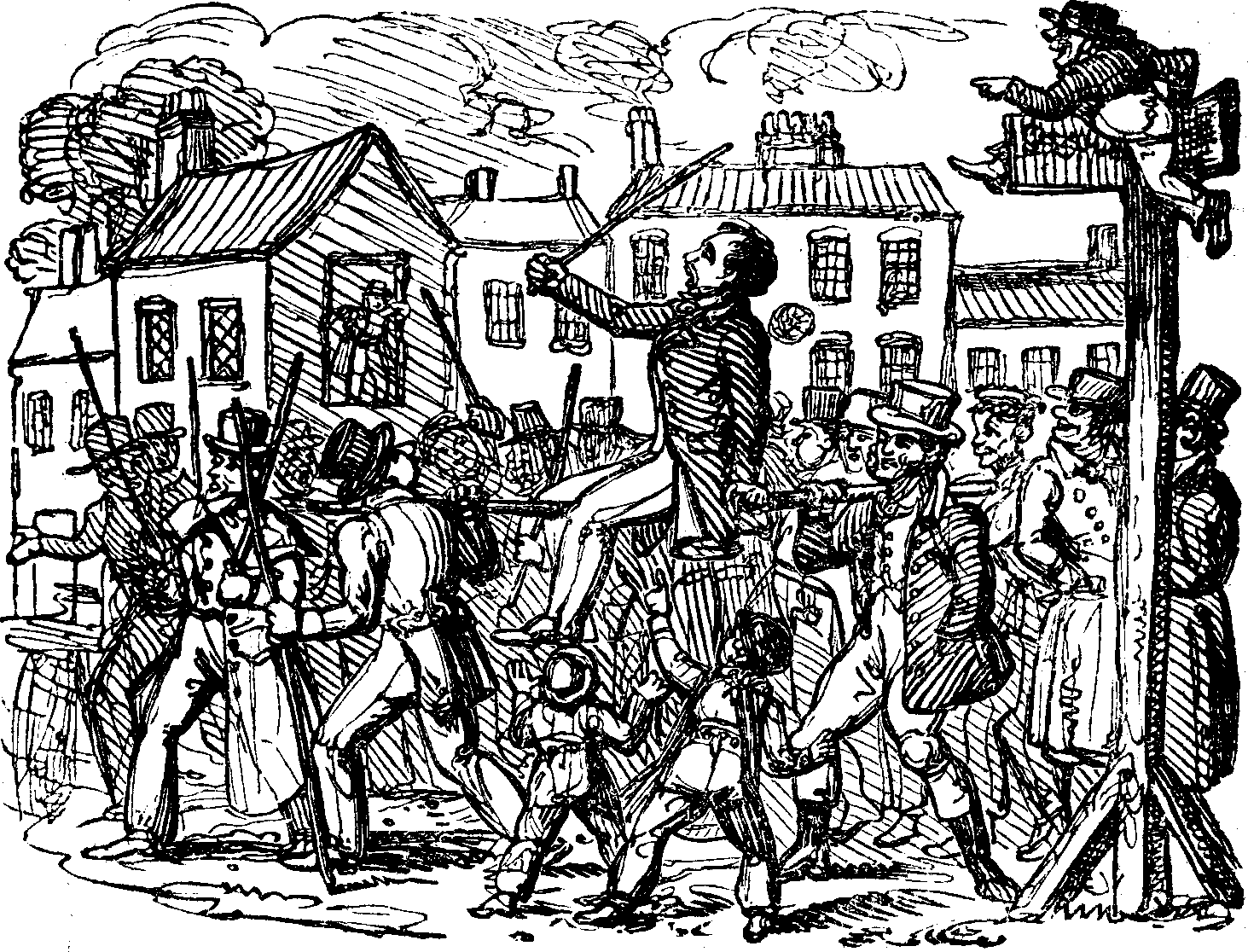
Two correspondents have favoured us with the following illustrations of this curious custom: one of them (W.H.H.) has appended to his communication a pen and ink sketch, from which the above engraving is copied:—
(To the Editor of the Mirror.)
In Westmoreland this custom is thus commenced:—When it is known that a man has "fallen out" with his wife, or beaten or ill-used her, the townspeople procure a long pole, and instantly repair to his house; and after creating as much riot and confusion before the house as possible, one of them is hoisted upon this pole, borne by the multitude. He then makes a long speech opposite the said house, condemning, in strong terms, the offender's conduct—the crowd also showing their disapprobation. After this he is borne to the market-place, where he again proclaims his displeasure as before; and removes to different parts of the town, until he thinks all the town are informed of the man's behaviour; and after endeavouring to extort a fine from the party, which he sometimes does, all repair to a public-house, to regale themselves at his expense. Unless the delinquent can ill afford it, they take his "goods and chattels," if he will not surrender his money. The origin of this usage I am ignorant of, and shall be greatly obliged by any kind correspondent of the MIRROR who will explain it.
W.H.H.
(To the Editor of the Mirror.)
At Biggar, in Lanarkshire, as well as in several other places in Scotland, a very singular ancient practice is at times, though but rarely, revived. It is called riding the stang. When any husband is known to treat his wife extremely ill by beating her, and when the offence is long and unreasonably continued, while the wife's character is unexceptionable, the indignation of the neighbourhood, becoming gradually vehement, at last breaks out into action in the following manner:—All the women enter into conspiracy to execute vengeance upon the culprit. Having fixed upon the time when their design is to be put into effect, they suddenly assemble in a great crowd, and seize the offending party. They take care, at the same time, to provide a stout beam of wood, upon which they set him astride, and, hoisting him aloft, tie his legs beneath. He is thus carried in derision round the village, attended by the hootings, scoffs, and hisses of his numerous attendants, who pull down his legs, so as to render his seat in other respects abundantly uneasy. The grown-up men, in the meanwhile, remain at a distance, and avoid interfering in the ceremony. And it is well if the culprit, at the conclusion of the business, has not a ducking added to the rest of the punishment. Of the origin of this custom we know nothing. It is well known, however, over the country; and within these six years, it was with great ceremony performed upon a weaver in the Canongate of Edinburgh.
This custom can scarcely fail to recall to the recollection of the intelligent reader, the analogous practice among the Negroes of Africa, mentioned by Mungo Park, under the denomination of the mysteries of Mumbo Jumbo. The two customs, however, mark, in a striking manner, the different situations of the female sex in the northern and middle regions of the globe. From Tacitus and the earliest historians we learn, that the most ancient inhabitants of Europe, however barbarous their condition in other respects might be, lived on terms of equal society with their women, and avoided the practice of polygamy; but in Africa, where the laws of domestic society are different, the husbands, as the masters of a number of enslaved women, find it necessary to have recourse to frauds and disgraceful severities to maintain their authority; whereas in Europe we find, among the common people, a sanction for the women to protect each other, by severities, against the casual injustice committed by the ruling sex.
CHARLES STUART.