MANNERS AND CUSTOMS OF ALL NATIONS.
Reading edition
CHRISTMAS CUSTOMS IN THE NETHERLANDS.
(For the Mirror.)
Many singular customs are observed in the Netherlands at Christmas, and as they materially differ from those known in England, a brief notice of one of them may probably prove acceptable to the readers of the MIRROR.
In almost every Dutch town, and in every considerable village, the following custom prevails:—At a little after two o'clock in the morning of Christmas-day, a number of young men assemble in the market-place, and sing some verses suited to the occasion. One of the young men bears an artificial star, which is fixed to a pole, and elevated above the heads of the people; it is very large, and is rendered beautifully transparent when a light is placed in the inside. This artificial luminary is intended to represent the star of the east, which directed the wise men to Bethlehem, the birthplace of Christ. At a little distance, the appearance is exceedingly brilliant, for there is no other light among the populace to diminish its lustre, and the whole scene is singularly picturesque. The resplendent light issuing from the star strikes powerfully upon the countenances of the principal actors, while those more remote receive only a faint and subdued gleam. The silvery effulgence of the moon, the sombre and deserted look of the buildings around, and the general stillness that pervades every object, save the scene of action, might inspire the mind of a Rembrandt, or introduce to the mere casual beholder feelings at once new and poetical.
After parading through the town, the youths repair in a body to the residence of some opulent inhabitant, where their arrival is welcomed with shouts and clapping of hands, and where they are entertained with a plentiful repast.
G.W.N.
THE JEWS.
Their present actual numbers may, perhaps, not exceed six millions—numbers, however, probably greater than those over which Solomon reigned; and of these six millions there may be resident in the contiguous countries of Moravia, Ancient Poland, the Crimea, Moldavia, and Wallachia, above three millions. Except within the countries which formed Poland before its partitions, their population contained in any one European kingdom, cannot, therefore, be great. Yet so essentially are they one people, we might almost say one family; and so disposable is their wealth, as mainly vested in money transactions, that they must be considered as an aggregate, and not in their individual portions.
The Jews in France are perhaps from thirty to forty thousand; they abound chiefly at Metz, along the Rhine, and at Marseilles and Bordeaux. In Bonaparte's time they were imagined to amount to at least twice that number.—They are relieved from civil restraints and disabilities in France, and in the Netherlands also. The Jews in Holland, of both German and Portuguese origin, are numerous; the latter are said to have taken refuge there when the United Provinces asserted their independence of Spain; they have a splendid synagogue at Amsterdam. Infidelity is supposed to have made more progress amongst them than amongst the German Jews in Holland. The Italian Jews are chiefly at Leghorn and Genoa; and there are four thousand of them at Rome. In speaking of the religion of the Jews, it is not necessary to particularize those who assumed the mask of Christianity under terror of the Inquisition, although much has been said of their wealth and numbers, and of the high offices they have filled in Spain, and especially in Portugal. But it is curious to see, in a very distant quarter, a like simulation produced amongst them by like causes. There are at Salonica thirty synagogues, and about twenty-five thousand professed Jews; and a body of Israelites have been lately discovered there, who, really adhering to the faith of their fathers, have externally embraced Mahomedanism.
The Barbary Jews are a very fine people; but the handsomest Jews are said to be those of Mesopotamia. That province may also boast of an Arab chief who bears the name of the Patriarch Job, is rich in sheep, and camels, and oxen, and asses, abounds in hospitality, and believes that he descends from him; he is also famed for his justice. The Jews at Constantinople, forty thousand in number, and in the parts of European Turkey on and near the Mediterranean, speak Spanish, and appear to descend from Israelites driven from Spain by persecution. The Bible Society are now printing at Corfu the New Testament, in Jewish-Spanish, for their benefit.
In truth, little appears to be known of the state of the Jews during some hundreds of years after the destruction of Jerusalem. The first body of learned Jews which drew attention after that disastrous event was that settled in Spain; and from it all Jewish learning descends. As in accomplishment of the prophecy, the Jew is found over the whole surface of the globe; he has been long established in China, which abhors the foreigner; and in Abyssinia, which it is almost as difficult to reach as to quit. The early Judaism of that country, and in later days the history of the powerful colony of Jews established in its heart, which at one time actually reigned over the kingdom, are matters so curious, that we regret that we can do no more than advert to them; we must say the same as to the evidence existing of Jewish rites having extended themselves very far southward along the eastern coast of Africa; the numerous Jews of Barbary; and the black and white Jews, who have been established for ages, more or less remote, on the Malabar coast. It may be here observed, that all the Israelites hitherto discovered appear to be descendants of those who held the kingdom of Judah.
The Jews in Great Britain and Ireland are not supposed to be more than from ten to twelve thousand, very many of whom are foreigners, and migratory.—Quarterly Rev.
EGYPTIAN RATIONS.
The rations of the Egyptian soldiers were, according to Herodotus, five pounds of baked bread, two pounds of beef, and half a pint of wine daily.
In the barbarous ages it was usual for persons who could not write, to make the sign of the cross in confirmation of a written paper. Several charters still remain in which kings and persons of great eminence affix "signum crucis pro ignoratione literarum," the sign of the cross, because of their ignorance of letters. From this is derived the phrase of signing instead of subscribing a paper.
COLUMN IN BLENHEIM PARK
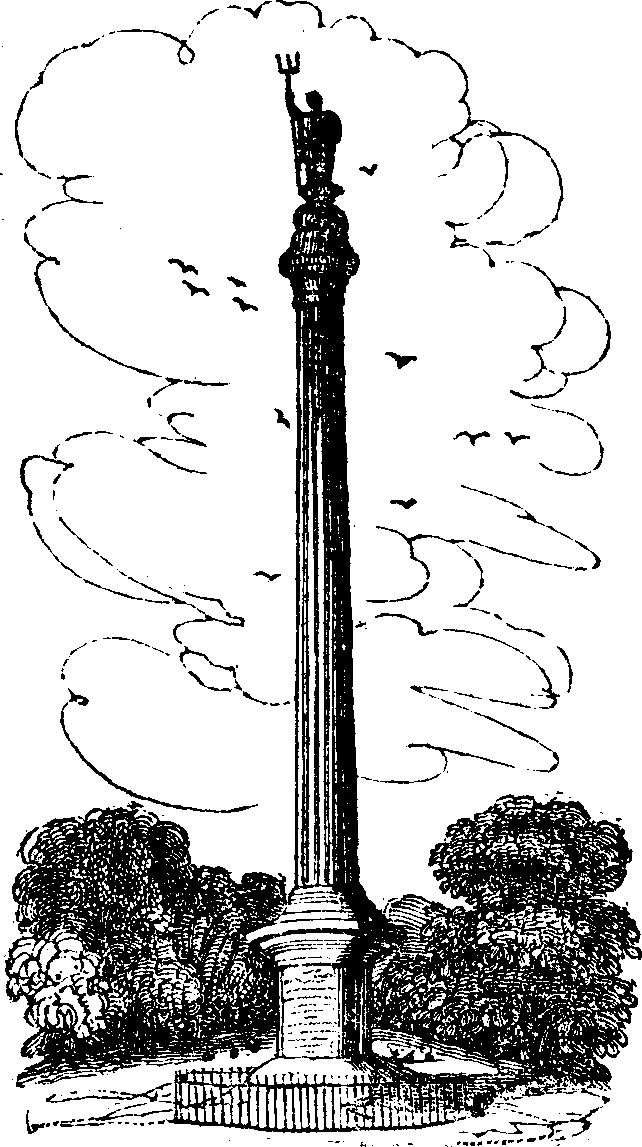
(To the Editor of the Mirror.)
You have lately directed the attention of the readers of the MIRROR to the park of Blenheim, in Oxfordshire, one of the most beautiful England can boast of, and likewise, according to Camden, the first park that was made in this country. I can bear witness to the correctness of your delineation and description of Rosamond's Well, which you gave in a recent number; but there is no trace whatever of the bower or labyrinth, the site of which is only pointed out by tradition. The park of Blenheim, besides the interest which attaches to it from the circumstance of its having been the residence of the early kings of England, and the scene of "Rosamond's" life, has in more modern times acquired additional interest from having been bestowed by the country upon the Duke of Marlborough, in testimony of the gratitude of the nation for the brilliant services he had rendered his country, particularly at the battle of Blenheim.
It was a reward at once worthy of the English nation and of the illustrious hero on whom it was bestowed; and as it is at least pleasing, and perhaps useful, to recall to the mind the epochs of England's greatness amongst nations, I have sent a sketch of one of the most prominent objects in the park of Blenheim, which our forefathers deemed (in the language of the inscription) would "stand as long as the British name and language last, illustrious monuments of Marlborough's glory and of Britain's gratitude." This is an elegant column, 130 feet in height, and surmounted by a statue of the warrior in an antique habit. On three sides of the building there are nearly complete copies of the several Acts of Parliament by which the park and manor of Woodstock were granted to the Duke of Marlborough and his heirs; and on the fourth side is a very long inscription, said to have been penned by Lord Bolingbroke, which concludes thus:—
These are the actions of the Duke of Marlborough, Performed in the compass of a few years, Sufficient to adorn the annals of ages. The admiration of other nations Will be conveyed to the latest posterity, In the histories even of the enemies of Britain. The sense which the British nation had Of his transcendant merit Was expressed In the most solemn, most effectual, most durable manner. The Acts of Parliament inscribed on the pillar Shall stand as long as the British name and language last, Illustrious monuments Of Marlborough's glory and Of Britain's gratitude.
G.W.