Chingford Church.
Reading edition
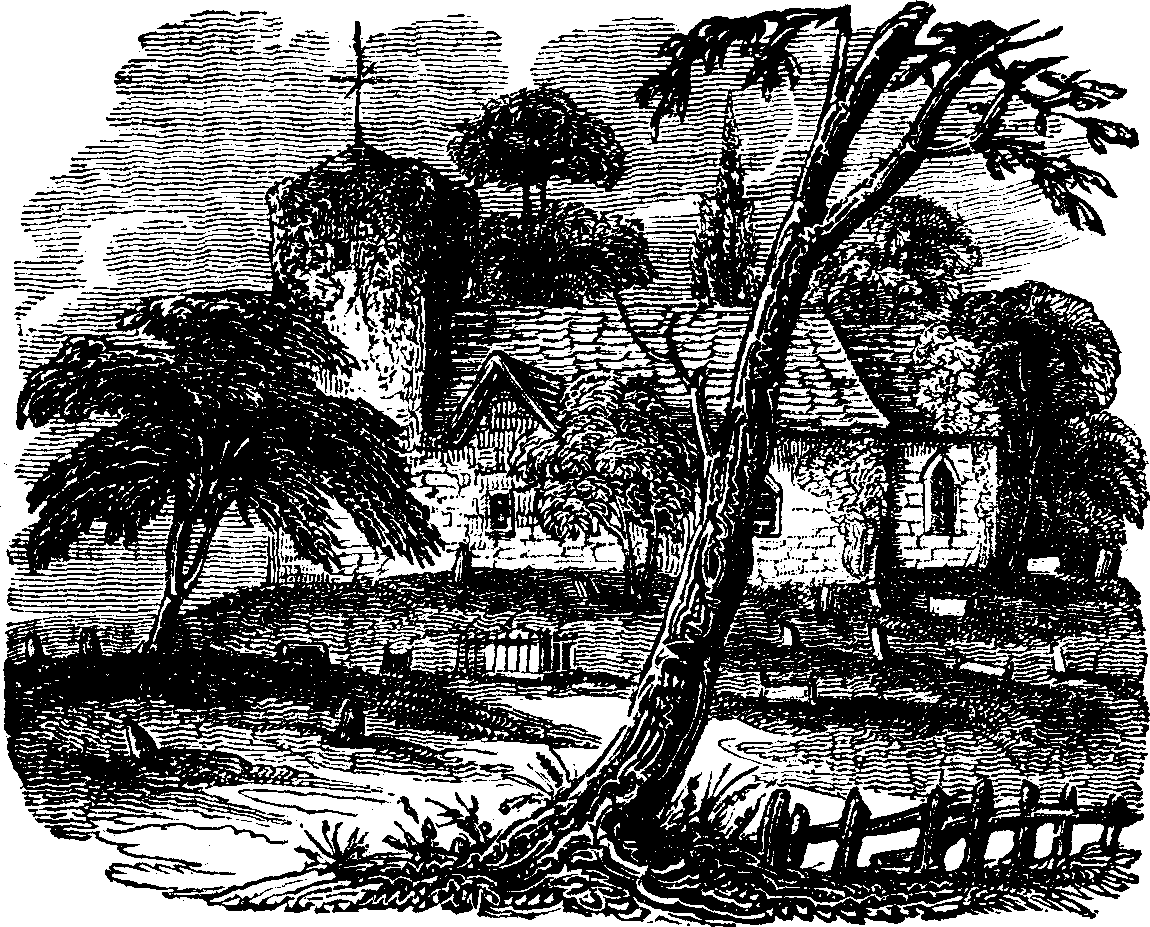
The roof with moss is green, and twines Dark ivy round the sculptur'd lines.
DELTA.
The pleasant village of CHINGFORD, in Essex, may be called a vignette of the topographer's "rus in urbe," it being only nine miles distant from the heart of London, and consequently almost within its vortex. It stands on the banks of the river Lea, and derives its name from the Saxon word Cing and ford, (signifying the king's ford,) there having formerly been a ford here; the adjoining meadows being designated the king's meads, and the Lea, the king's stream. There appears to have been two manors in this parish, one of which was granted by Edward the Confessor to the cathedral of St. Paul's, but surrendered at the reformation to Henry VIII.; the other, according to Domesday Book, was held by Orgar, the Thane; and from the latter another manor has since been taken.
The "ivy-mantled" church, represented in the above vignette, is dedicated to St. Peter and St. Paul, and consists of a chancel, nave, and south aisle, with a low square tower at the west end, containing three bells. Within the church are a few interesting monuments, among which is one to the memory of Robert Rampton, who died in 1585 and was yeoman of the chamber to Edward VI., and the Queens Mary and Elizabeth. It stands in the south aisle, with an inscription on a brass plate against the wall, underneath which is an altar tomb covered with a slab of black marble, on which are the effigies, in brass, of Robert Rampton, and his wife Margaret, who died in 1590.
Altogether, Chingford is one of the prettiest villages near London, and its church is a picturesque attraction for pedestrian tourists, and such as love to steal away from the maelstroom of an overgrown metropolis, to glide into scenes of "calm contemplation and poetic ease;" although much of the journey lies through avenues of bricks and mortar, and trim roads that swarm with busy toil.
For the original of the engraving, and the substance of this description, our thanks are due to S.I.B.
OLD SONG.
The old minstrels saw far and deep, and clear into all heart-mysteries—and, low-born, humble men as they were, their tragic or comic strains strike like electricity.—Blackwood.