Volume 10 — MEMOIR
Reading edition
OF
His Royal Highness the Duke of Clarence,
LORD HIGH ADMIRAL OF ENGLAND.
Ye sacred arks of Liberty! that float Where Tamar's waters spread their bosom wide, That seem, with towering stern and rampart stride, Like antique castles girt with shining moat: Should War the signal give with brazen throat, No more recumbent here in idle pride, Your rapid prows would cleave the foaming tide, And to the nations speak in thundering note. Thus in the firmament serene and deep, When summer clouds the earth are hanging o'er, And all their mighty masses seem asleep, To execute Heaven's wrath, and judgment sore, From their dark wombs the sudden lightnings leap, And vengeful thunders peal along the shore. Forget Me Not—for 1828.
The recent appointment of the above illustrious individual to the head of our naval administration is a gratulatory topic for every Englishman; and we doubt not the measure will contribute as largely to individual honour, as it will to the national welfare. In the abstract, nations resemble large families, of which kings are fathers or guardians; and the subdivision of this guardianship or paternal government, among the sons or younger brothers of the sovereign is calculated to promote unanimity among the governors, and to engraft with affectionate loyalty the hearts of the governed. Indeed, the tutelar presence of princes seldom fails to inspire courage, and to support the patriotic sons of arms even in the extremes of danger; and, although the princes of our times have seldom been distinguished in the camp of war,—we should recollect that
Nihil sunt foris arma nisi est consilium domi.
The DUKE of CLARENCE, who is next brother to his present Majesty, was born at St. James's Palace, August 21, 1765, at a quarter before four in the morning, and in the following month was baptized by the name of WILLIAM HENRY. It is said that in his childhood and youth, it was the frankness of his countenance and behaviour induced the king to devote him to the naval service: added to this, he surpassed his brothers in corporeal strength and constitutional hardihood; although he was exceeded by them in the more refined acquirements of study, to which he manifested comparative indifference. With a mind naturally framed for peril and enterprise, and aware of the subordinate rank and laborious stations through which he must pass to distinction, he appears to have been enthusiastic and impatient for the service long before he entered the lists, notwithstanding he commenced his career at the age of fourteen, by joining the Prince George, a ninety-eight-gun ship, recently built, and named after his present majesty. In this ship, under the command of Admiral Digby, his royal highness bore a part in the great naval engagement between the English and Spanish fleets, commanded by Admiral Rodney and Don Juan de Langara. Previous to his leaving the Prince George, he was also present at the capture of a French man-of-war and three smaller vessels, forming part of a considerable convoy; but in neither of these instances was an opportunity offered for any distinguishing effort of bravery. On this occasion, the Spanish admiral, Don Juan de Langara, on visiting Admiral Digby, was introduced to his royal highness. During the conference between the two admirals the prince retired, and when it was intimated that Don Juan wished to return, his royal highness appeared in the uniform of a midshipman, and respectfully informed the admiral that the boat was ready. The Spaniard was surprised to see the son of his Britannic majesty acting in the capacity of an inferior officer, and emphatically observed to Admiral Digby, "Well does Great Britain merit the empire of the seas, when humble stations in her navy are filled by princes of the blood."
We have next the pleasing duty of adverting to two signal exertions of his royal highness in the cause of humanity—conduct which
is twice bless'd: It blesseth him that gives, and him that takes: 'Tis mightiest in the mightiest: it becomes The throned monarch better than his crown.
The first is thus narrated by a midshipman of the Torbay, in a letter to his friends:—
"Port Royal Harbour, April, 1783.
"The last time Lord Hood's fleet was here, a court-martial was held on Mr. Benjamin Lee, midshipman, for disrespect to a superior officer, at which Lord Hood sat as president. The determination of the court was fatal to the prisoner, and he was condemned to death. Deeply affected as the whole body of the midshipmen were at the dreadful sentence, they knew not how to obtain a mitigation of it, since Mr. Lee was ordered for execution; while they had not time to make their appeal to the Admiralty, and despaired of success in a petition to Admiral Rowley. However, His Royal Highness generously stepped forth, drew up a petition, to which he was the first to set his name, and solicited the rest of the midshipmen in port to follow his example. He then himself carried the petition to Admiral Rowley, and in the most pressing and urgent manner, begged the life of our unhappy brother; in which he succeeded, and Mr. Lee is reprieved. We all acknowledge our warmest and grateful thanks to our humane, our brave, and worthy prince, who has so nobly exerted himself in preserving the life of his brother sailor."
In the same year, 1783, the prince, then a fine midshipman, visited Cape Francois, and the Havannah, where the second instance of his generous humanity occurred. It should be premised, that some of his countrymen having broken their oath of fidelity to the Spanish government, were in danger of suffering under sentence of death. The governor of Louisiana, Don Galvez, offered, at the intercession of the prince, to pardon them; and the enthusiasm which he manifested in this "labour of love" cannot be better illustrated than by the following letter addressed by his royal highness to the governor:—
"Sir,—I want words to express to your Excellency my just sense of your polite letter, of the delicate manner in which you caused it to be delivered, and your generous conduct towards the unfortunate in your power. Their pardon, which you have been pleased to grant on my account, is the most agreeable present you could have offered me, and is strongly characteristic of the bravery and gallantry of the Spanish nation. This instance increases, if possible, my opinion of your Excellency's humanity, which has appeared on so many occasions, in the course of the late war.
"Admiral Rowley is to dispatch a vessel to Louisiana for the prisoners. I am convinced they will ever think of your Excellency's clemency with gratitude; and I have sent a copy of your letter to the king my father, who will be fully sensible of your Excellency's attention to me.
"I request my compliments to Madame Galvez, and that you will be assured that actions so noble as those of your Excellency will ever be remembered by
"Yours, sincerely, WILLIAM P."
The intimacy of the prince with the gallant Nelson is well known as one of the most interesting incidents of the duke's life. They first met at Quebec in 1782, when Nelson was in the Albemarle off that station, and whence he was ordered to convoy a fleet of transports to New York. From this time they became much attached, and their separation was the cause of mutual regret. At the close of the war they met again, both being appointed to the Leeward island station. Nelson soon had an opportunity of witnessing the prince's resolute obedience to orders, amidst great personal danger, and strong temptations to avarice, the circumstances of which are briefly as follow:—The law excluded all foreign vessels from trade and intercourse with our West India islands; and America, being now independent, and as much a foreign nation as any other, Nelson, the senior captain on the station, ordered all American vessels to quit the islands within forty-eight hours, on pain of seizure, and prosecution of their owners. Four vessels at Nevis remained, which he ordered to be searched, and on being found American, they were adjudged legal prizes. This proceeding placed Nelson in considerable difficulty, but he ultimately triumphed; and though the thanks of government for protecting its commerce were given to the admiral of the station, who had in fact opposed the measure, Nelson was conscious of having done his duty, and enjoyed the approbation of such as were disinterested witnesses of it. Among these was Prince William, who thus notices Nelson's conduct on this occasion in a letter to a friend: "It was at this era," says the prince, "that I particularly observed the greatness of Nelson's superior mind. The manner in which he enforced the spirit of the Navigation Act first drew my attention to the commercial interests of my country. We visited different islands together; and as much as the manoeuvres of fleets can be described off the headlands of islands, we fought over again the principal naval actions in the American war. Excepting the naval tuition which I had received on board the Prince George, when the present Rear Admiral Keats was lieutenant of her, and for whom we both entertained a sincere regard, my mind took its first decided naval turn from this familiar intercourse with Nelson."
It is also worthy of remark, that while the prince spoke thus highly of Nelson, the latter estimated his royal highness in correspondent terms. In a letter to Captain Locker, about the same period, Nelson says, "You must have heard, long before this reaches you, that Prince William is under my command. I shall endeavour to take care that he is not a loser by that circumstance. He has his foibles as well as private men, but they are far overbalanced by his virtues. In his professional line he is superior to near two-thirds I am sure of the list; and in attention to orders, and respect to his superior officers, I hardly know his equal. His royal highness keeps up strict discipline in his ship, and without paying him any compliment, she is one of the finest ordered vessels I have seen." These opinions, it should be recollected, are quoted from private correspondence—a circumstance which adds materially to their value.
On July 11, 1818, his royal highness was married at Kew to her serene highness Adelaide Amelia Louisa Theresa Caroline, princess of Saxe Meinengen, eldest daughter of his serene highness the late reigning duke of Saxe Meinengen. The ceremony, as is usual on these occasions, was performed by the Archbishop of Canterbury, in the presence of all the royal family. By this marriage his royal highness had one daughter, who was born March 27, 1819, and died after a few hours. In 1823, his royal highness was made a general of marines; and within the past year the duke has been appointed lord high admiral of England.
It is not our intention here to enter into the supposed causes of the duke's long seclusion from public service, viz. from 1790 to the present time, except a short interval in 1814. At the commencement of the war with France, the late Duke of York took an early and active part by land; hence the question arises as to the non-appointment of the Duke of Clarence to a similar position by sea. The consequence has been, that the most vigorous portion of the duke's life has been lost to his country, whilst his royal highness has remained in comparative obscurity, amidst one of the most brilliant periods of our naval history. It is, however, gratifying to know that the duke's inactivity cannot be attributed to apathy on his part. On the contrary, he was anxious to be employed, and even sought appointment, as appears by the following letter, written by his royal highness to Commodore Owen in 1812:—
"Bath House, Saturday night.
"DEAR SIR—This evening I received your letter from Deal, and in answer to it, I beg to observe, that I have made both a public and private application to the king, that I may be permitted to hoist my flag, and relieve Lord Collingwood in the command of his majesty's fleet in the Mediterranean. There cannot be any secrecy in this thing; because, before more than fifty brother officers, I declared my resolution at Portsmouth. Until I have the order to hoist my flag, I cannot be certain; but I am very much inclined to think eventually that I shall have the honour and the happiness of commanding those fine fellows whom I saw in the spring in the Downs, and lately at Portsmouth. My short stay at Admiral Campbell's had impressed me with very favourable ideas of the improved state of the navy; but my residence at Portsmouth has afforded me ample opportunity of examining, and consequently of having a perfect judgment of the high and correct discipline now established in the king's service. * * * I could not resist what I felt; and reasons, both public and private, urged me to make the offer I have already mentioned, and I hope I shall be gratified.—I remain, dear sir, yours, &c.
"WILLIAM."
These zealous sentiments are, however, further corroborated by a recent declaration of the duke to the Goldsmiths' Company, on their presenting him with the freedom of their society.
Having sketched the principal circumstances which appertain to what may be termed the public career of his royal highness, it is our less pleasant, though equally important, duty, to notice his domestic life; for obvious reasons our details will be less perfect. It is a portion of the duke's life which cannot be entirely passed over in silence, since it must be conceded, that much of his unpopularity may be traced to this source. Neither the court nor the people of England are so ascetic as not to extenuate the indiscretions of royalty; but this charitable estimate of misgivings does not extend to approbation of any culpable dereliction of social and moral duties. The fact of his royal highness having a large family, by a lady now no more, is too well known to be concealed; but the odium attached to his royal highness for his participation in a certain scene of license and poverty, has doubtless been over-rated; but his proportion must be left for the biographer of a future age to settle; and we sincerely hope that, to quote a contemporary, "when the time arrives that the historian shall feel himself at liberty to enter into details, and sift matters to the bottom, his royal highness will come out of the investigation, (not without some blame, for which of us is faultless, but) with a character unsullied even in this respect, and in all other respects irreproachable." Mankind are, more or less, the children of error; but their propensity to exaggerate human frailty deserves to be reprobated for its cruelty and wickedness.
The happy marriage of his royal highness, to which event we have already alluded, has, we trust, been the means of clearing away the prejudices which the duke's former conduct may have engendered.
There is a tide in the affairs of man, Which taken at the flood leads on to fortune.
His royal highness's present emoluments may be stated as follow:—
Income on the Consolidated Fund, previous £. s. d.
to the death of the Duke of York: 26,500 0 0
By the death of the Duke of York 3,000 0 0
Additional grant, February, 1827 3,000 0 0
And to the Duchess 6,000 0 0
As Ranger of Bushy Park 187 9 8
Halfpay as Admiral of the Fleet 1,095 0 0
Pay as General of the Marines 1,728 15 0
Salary as Lord High Admiral 5,000 0 0
———- —- ——
5Total Annual Income 46,511 4 8
The Duke of York is acknowledged by Mr. Peel, in his speech, Feb. 17, 1827, to have had £50,000. a-year.
We subjoin the following characteristic anecdote from the New Sailor's Magazine for December, 1827, sketched with fidelity and in that rich vein of humour by which stories of the service are usually distinguished. It exhibits the character of his royal highness in all the glowing generosity of buoyant youth, and proves him to possess a warm-hearted sympathy for the sufferings of his fellow-creatures—
THE ROYAL REEFER AND BOB CLEWLINES.
It was on one of those December days, when the wind, blowing from the northward, acts almost like a razor on the surface of the skin, and when, accompanied by small sharp rain, a mixture of damp and cold produce a chilling effect upon the frame and spirits, that a ci-devant midshipman, his hands in his pockets, and
"Whistling as he went for want of thought,"
Thus saying, he walked proudly with the poor tar, astern of him, until he came to a slop-shop, near Wellclose square: it was a Jew's. "Here, Moses," quoth the middy, who detected the Israelite bending looks of disdain and mistrust on the poor man, as if he considered the contents of his shop in danger: "come, Moses, a regular built outrig for this gentleman," laying great stress on the word gentleman. This was pitching it strong, but his heart was carrying royals, sky-scrapers, moon-rakers, and his pulse was sailing at the rate of ten knots an hour at least; so elate was he to serve a brave man in distress, and above all, a son of the ocean: "come, let us have every thing good, and spic and span new."—"Pray, Shair, who's to pay?"—"Myshelf."—"O, your honour, that's right." The poor man retired to a back-room, and stepped forward clad from head to foot, and with two changes of linen and a pair of shoes (by the midshipman's order) tied up in a pocket-handkerchief under his arm. BOB CLEWLINES looked with a blush on his old clothes, and at this moment an almost naked boy passed by: the midshipman duly appreciated and truly interpreted one look of the tar. "Bob, I say, heave that overboard, and let the poor boy pick it up: one good turn deserves another." The payment was the next. "Three pounds fifteen.—Is that the lowest?"—"O, yesh: I don't gain five shillings by the whole deal."—"Well, then, do you take the case of my gold watch, and weigh it, and give me the produce of it."—"Let ush see: it's vary pretty, but not vary heavy; it's all fashion you see: indeed, it's a great pity to part, the vatch and the caish; watches are a drug now, or else I'd buy it; but just to oblige you, I'll see what I can give."—"Don't trouble yourself, Mosey; just do as you are bid: you take the outside case, and I'll keep the watch."—"I shall lend you four pounds upon it," resumed the Israelite; "and you may depend upon my honour to return it to you, when you bringsh me de monish."—"No, you won't, Mosey; you'll do just what I bid you."—"It will spoil the watch"—"Not a bit; she must work without her jacket, as my friend has often done in all weathers. I shall sell the outside case to serve a shipmate in distress; but the watch was left me by a dear friend, so I shall keep her: a metal case will do as well for a little time, and when fortune's breeze springs up again, the case will be altered."—"Vel, shair, you shall be obeyed: five pounds, five shillings is just the price of the weight; there's the money."—"Good morning, Master Moses; but do you, Clewlines, set sail again; I want to get you into port: it is only what I owe you. Were you not the kindest creature to me in the world when I was confined to my berth with the yellow fever, and not expected to live a day? Come, come, you must take your cargo in; you must be victualled as well as refitted. I have got a chalk at a house near this,—another shipmate who is set up in business in a public line: call for what you want, and here's the loose change to keep your pocket until something turns up." Poor Bob got a good dinner, a good bed, and a snug hammock, that night; and shortly afterwards he obtained a birth in an Indiaman, and is now doing well. The royal reefer's heart bounded with joy at performing this noble action to recover which he put himself for a month on short allowance. But this is only one of many such traits in the character of this heart of oak whose name the writer could scarcely venture to state, but who will here remember this scene.
HARRY HATCHWAY.
H.M.S. Perseus, off the Tower, Nov. 1827.
By way of a tail-piece to this already extended memoir, we present our readers with an accurate engraving of
THE ROYAL CLARENCE CUP,
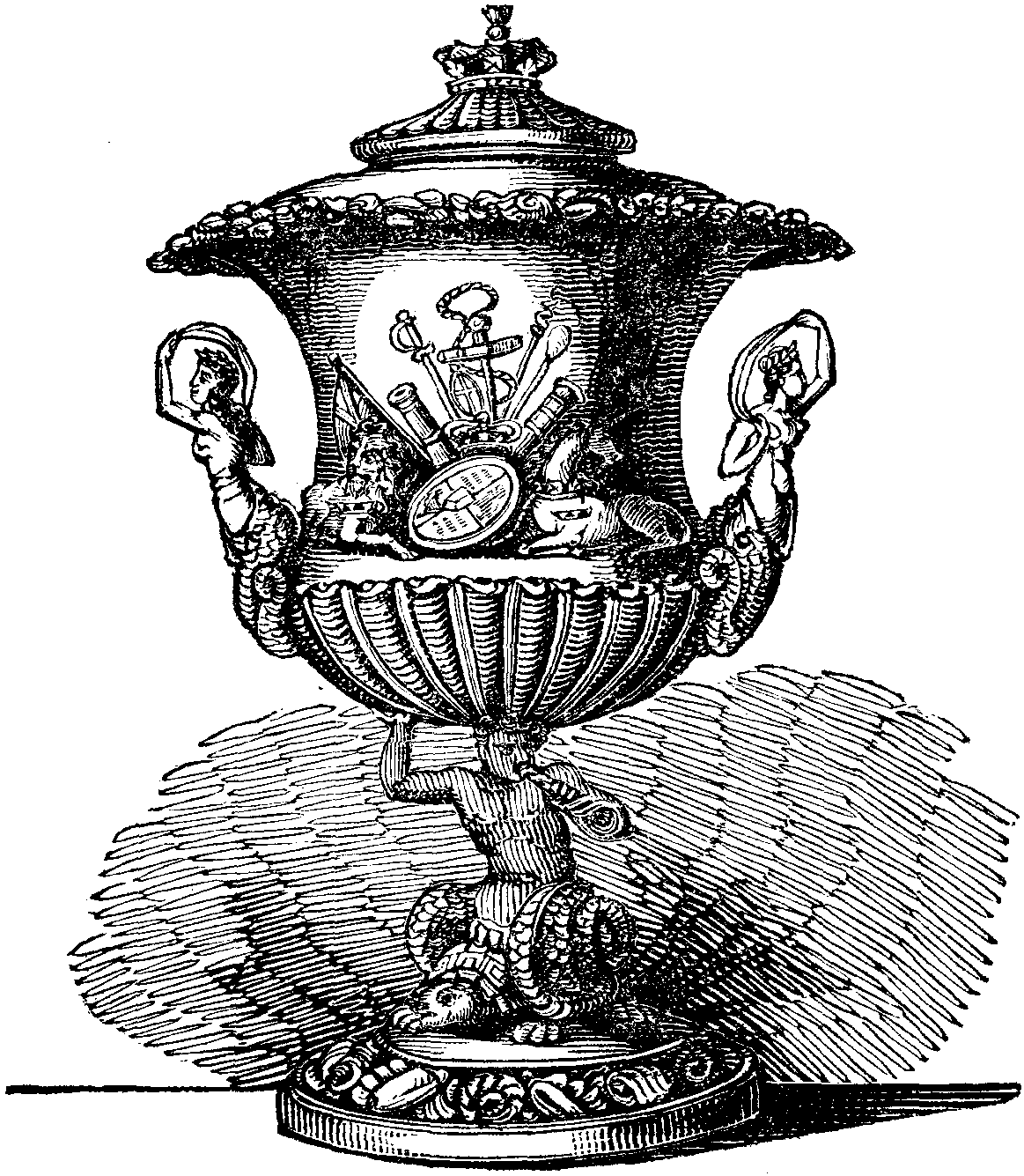
given by the gentlemen of the Thames Yacht Club, in honour of his royal highness the Lord High Admiral having condescended to become the patron of the club, on Thursday September 27, 1827. A steam packet was engaged, to accompany the match, by the Club for the accommodation of their friends, among whom we had the good fortune to be numbered. It was altogether a most grateful relaxation from our land labours. The distance sailed was from off Blackwall to Gravesend and back, and the muster of the fleet almost unprecedentedly fine. The whole of the vessels were admirably managed throughout, the match, which towards the close, became intensely interesting. At length it was decided by the Lady Louisa, (Mr. Thomas Smith, owner) arriving first at Blackwall, distancing eight others, but gaining the victory with only a few minutes to spare. If we recollect "right well," the day was fine for the advanced period of the season, and on board the several vessels packets, and on the banks of the river, there were the usual humours of an aquatic spectacle without any of its vulgarisms. The cup, weighing 85 oz. and standing nearly two feet high, is of silver, elegantly chased, and as our engraving imports, of classical design; and its exhibition, with the customary ceremony of presentation, toasting, &c. appeared to afford much satisfaction to the assembled company, and the victorious claimant of the prize, and equal credit to the taste of the artist, Mr. Hyams.