Architectural Illustrations.
Reading edition
No. III.
HANOVER TERRACE, REGENT'S PARK.
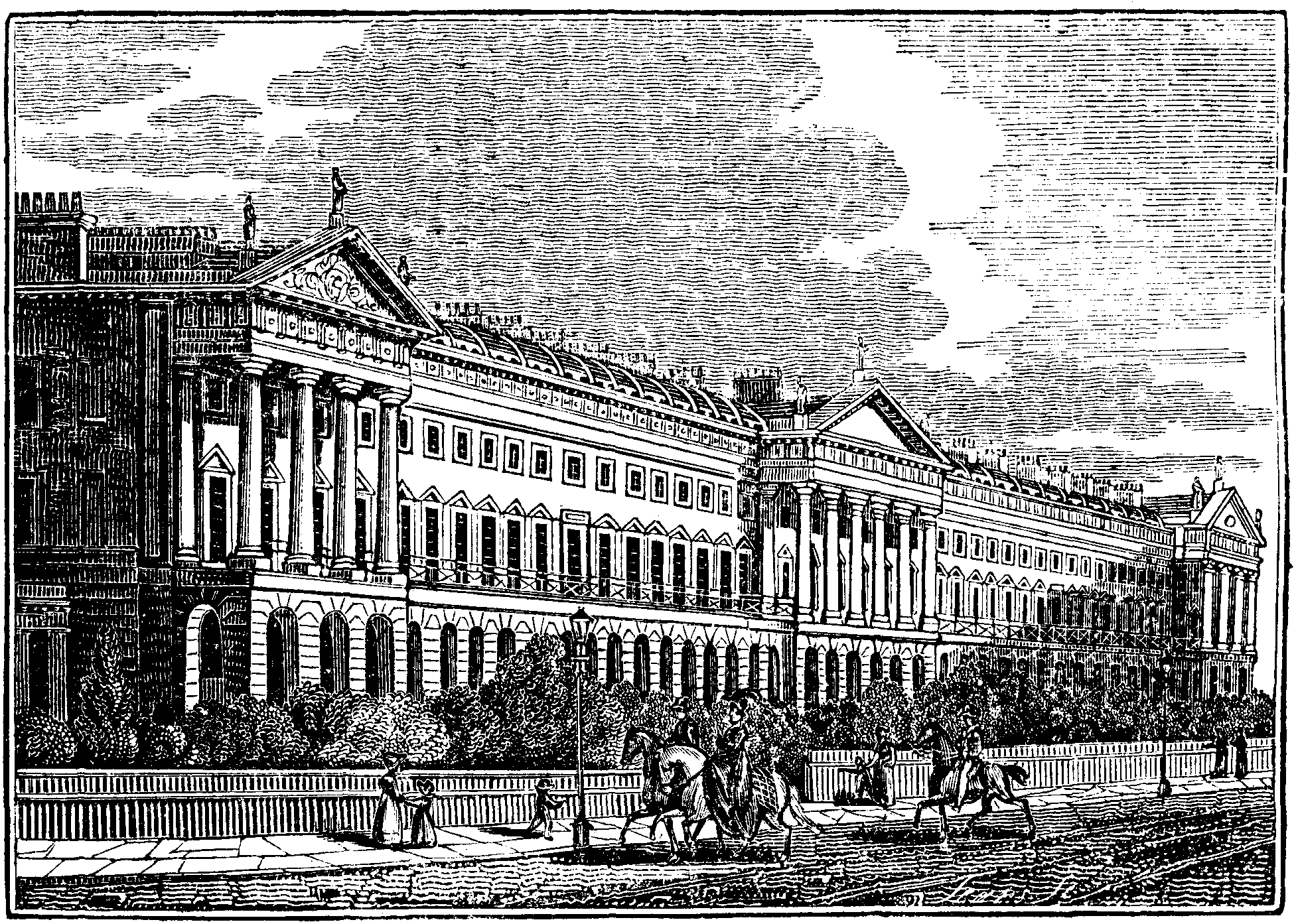
"The architectural spirit which has arisen in London since the late peace, and ramified from thence to every city and town of the empire, will present an era in our domestic history." Such is the opinion of an intelligent writer in a recent number of Brande's "Quarterly Journal;" and he goes on to describe the new erections in the Regent's Park as the "dawning of a new and better taste, and in comparison with that which preceded it, a just subject of national exultation;" in illustration of which fact we have selected the subjoined view of Hanover Terrace, being the last group on the left of the York-gate entrance, and that next beyond Sussex-place, distinguishable by its cupola tops.
Hanover Terrace, unlike Cornwall and other terraces of the Regent's Park, is somewhat raised from the level of the road, and fronted by a shrubbery, through which is a carriage-drive. The general effect of the terrace is pleasing; and the pediments, supported on an arched rustic basement by fluted Doric columns, are full of richness and chaste design; the centre representing an emblematical group of the arts and sciences, the two ends being occupied with antique devices; and the three surmounted with figures of the Muses. The frieze is also light and simply elegant. The architect is Mr. Nash, to whose classic taste the Regent's Park is likewise indebted for other interesting architectural groups.
Altogether, Hanover Terrace may be considered as one of the most splendid works of the neighbourhood, and it is alike characteristic of British opulence, and of the progressive improvement of national taste. On the general merits of these erections we shall avail ourselves of the author already quoted, inasmuch as his remarks are uniformly distinguished by moderation and good taste.
"Regent's Park, and its circumjacent buildings, promise, in few years, to afford something like an equipoise to the boasted Palace-group of Paris. If the plan already acted upon is steadily pursued, it will present a union of rural and architectural beauty on a scale of greater magnificence than can be found in any other place. The variety is here in the detached groups, and not as formerly in the individual dwellings, by which all unity and grandeur of effect was, of course, annihilated. These groups, undoubtedly, will not always bear the eye of a severe critic, but altogether they exhibit, perhaps, as much beauty as can easily be introduced into a collection of dwelling-houses of moderate size. Great care has been, taken to give something of a classical air to every composition; and with this object, the deformity of door-cases has been in most cases excluded, and the entrances made from behind. The Doric and Ionic orders have been chiefly employed; but the Corinthian, and even the Tuscan, are occasionally introduced. One of these groups is finished with domes; but this is an attempt at magnificence which, on so small a scale, is not deserving of imitation."
THE ISLE OF SHEPPEY.
(To the Editor of the Mirror.)
SIR,—Under the Arcana of Science, in your last Number, I observed an account of the inroads made by the sea on the Isle of Sheppey, together with the exhumation there of numerous animal and vegetable remains. As an additional fact I inform you, that, at about three hundred feet below the surface of the sand-bank, (of which the island is composed,) there is a vast prostrate antediluvian forest, masses of which are being continually developed by the influence of marine agency, and exhibit highly singular appearances. When the workmen were employed some years back in sinking a well to supply the garrison with water, the aid of gunpowder was required to blast the fossil timber, it having attained, by elementary action and the repose of ages, the hard compactness of rock or granite stone. Aquatic productions also appear to observation in their natural shape and proportion, with the advantage of high preservation, to facilitate the study of the inquiring philosopher. I have seen entire lobsters, eels, crabs, &c. all transformed into perfect lapidifications. Many of these interesting bodies have been selected, and at the present time tend to enrich the elaborate collections of the Museum of London and the Institute of France. During the winter of 1825, in examining a piece of petrified wood, which I had picked up on the shore, we discovered a very minute aperture, barely the size of a pin-hole, and on breaking the substance by means of a large hammer, to our surprise and regret we crushed a small reptile that was concealed inside, and which, in consequence, we were unfortunately prevented from restoring to its original shape. The body was of a circular shape and iron coloured; but from the blood which slightly moistened the face of the instrument, we were satisfied it must have been animated. I showed the fragments of both to a gentleman in the island, who, like myself, lamented the accident, as it had, in all likelihood, deprived science of forming some valuable (perhaps) deductions on this incarcerated, or (if I may be allowed the expression) compound phenomenon. I have merely related the above incident in order to show the possibility of there being other creatures accessible to discovery under similar circumstances, and in their nature, perhaps homogeneous. I left the island next day, and therefore had no further opportunities of confirming such an opinion; but the place itself abounds with substances which would authorize such conjectures.
D. A. P.1
ANTICIPATED FRENCH MILLENNIUM, OR THE PARISIAN "TRIVIA."
(For the Mirror.)
"Travellers of that rare tribe, Who've seen the countries they describe."
HANNAH MORE.
When daudling diligences drag
That odd anomaly!—or wag
That Cerberus three-bodied! and That Cerberus of music! Such rattle with their nine-in-hand! O, Cerbere, an tu sic?
When this, (and of Long Acre wits To rival this would floor some!) When this at last the Frenchman quits. Then! then is the age d'or come!
When coxcomb waiters know their trade,
When John's no longer chamber maid,
And printed well a book is.
When sorrel, garlic, dirty knife, Et cetera, spoil no dinners— (The punishment is after life, Are cooks to punish sinners?)
When bucks are safe, nor streets display
When Cloacina wends her way
In streamlet sub-terranean.
When houses, inside well as out,
When dice (if e'er 'twill be I doubt)
Send fewer—to the devil.
When riot ends, and comfort reigns,
(Who plays there's a complete ass—)
Then! then's the Aurea-Ætas!
What think'st thou of thy neighbours?
Or (what I own I'd rather know)
What—think'st thou of MY LABOURS?
A TRAVELLER OF 1827, (W. P.)
Carshalton.
CARRYING THE TAR BARRELS AT BROUGH, WESTMORELAND.
(To the Editor of the Mirror.)
As I said before, the day is prepared for, about a month previously—the townsmen employ themselves in hagging furze for the "bon-fire," which is situated in an adjoining field. Another party go round to the different houses, grotesquely attired, supplicating contributions for the "tar barrels," and at each house, after receiving a donation, chant a few doggerel verses and huzza! It is, however, well that people should contribute towards defraying the expense, for if they do not get enough money they commit sad depredations, and if any one is seen carrying a barrel they wrest it from him.
For my part, I liked the "watch night" the best, and if it were possible to keep sober, one might enjoy the fun—sad havoc indeed was then made among the poultry—when ducks and fowls were crackling before the fire all night; in fact, a few previous days were regular shooting days, and the little birds were killed by scores. But ere morning broke in upon them, many of the merry group were lying in a beastly state under the chairs and tables, or others had gone to bed; but this is what they called spending a merry night. The day arrives, and a whole troop of temporary soldiers assemble in the town at 10 P.M. with their borrowed instruments and dresses, and a real Guy,—not a paper one,—but a living one—a regular painted old fellow, I assure you, with a pair of boots like the Ogre's seven leagued, seated on an ass, with the mob continually bawling out, "there's a par o'ye!"
Thus they parade the town—one of the head leaders knocks at the door—repeats the customary verses, while the other holds a silken purse for the cash, which they divide amongst them after the expenses are paid—and a pretty full purse they get too. In the evening so anxious are they to fire the stack, that lanterns may be seen glimmering in all parts of the field like so many will-o'-the-wisps; then follow the tar barrels, and after this boisterous amusement the scene closes, save the noise throughout the night, and for some nights after of the drunken people, who very often repent their folly by losing their situations.
Now, respecting the origin of this custom, I merely, by way of hint, submit, that in the time of Christian martyrdom, as tar barrels were used for the "burning at the stake" to increase the ravages of the flame:—the custom is derived,—out of rejoicings for the abolition of the horrid practice, and this they show by carrying them on their heads (as represented at page 296, vol. 8.), but you may treat this suggestion as you please, and perhaps have the kindness to substitute your own, or inquire into it.
W. H. H.
CUSTOM OF BAKING SOUR CAKES.
(For the Mirror.)
J. S. W.
SONG.
FROM METASTATIO.
(For the Mirror.)
How in the depth of winter rude A lovely flower is prized, Which in the month of April view'd, Perhaps has been despised. How fair amid the shades of night Appears the stars' pale ray; Behold the sun's more dazzling light, It quickly fades away.
E. L. I.
THE ORIGIN OF PETER'S PENCE.
(For the Mirror.)
The custom of paying "Peter's pence" is of Saxon origin; and they continued to be paid by the inhabitants of England, till the abolition of the Papal power. The event by which their payment was enacted is as follows:—Ethelbert, king of the east angles, having reigned single some time, thought fit to take a wife; for this purpose he came to the court of Offa, king of Mercia, to desire his daughter in marriage. Queenrid, consort of Offa, a cruel, ambitious, and blood-thirsty woman, who envied the retinue and splendour of the unsuspicious king, resolved in some manner to have him murdered, before he left their court, hoping by that to gain his immense riches; for this purpose she, with her malicious and fascinating arts, overcame the king—her husband, which she most cunningly effected, and, under deep disguises, laid open to him her portentous design; a villain was therefore hired, named Gimberd, who was to murder the innocent prince. The manner in which the heinous crime was effected was as cowardly as it was fatal: under the chair of state in which Ethelbert sat, a deep pit was dug; at the bottom of it was placed the murderer; the unfortunate king was then let through a trap-door into the pit; his fear overcame him so much, that he did not attempt resistance. Three months after this, Queenrid died, when circumstances convinced Offa of the innocence of Ethelbert; he therefore, to appease his guilt, built St. Alban's monastery, gave one-tenth part of his goods to the poor, and went in penance to Rome—where he gave to the Pope a penny for every house in his dominions, which were afterwards called Rome shot, or Peter's pence, and given by the inhabitants of England, &c. till 1533, when Henry VIII. shook off the authority of the Pope in this country.
T.C.