St. Martin's, near Canterbury.
Reading edition
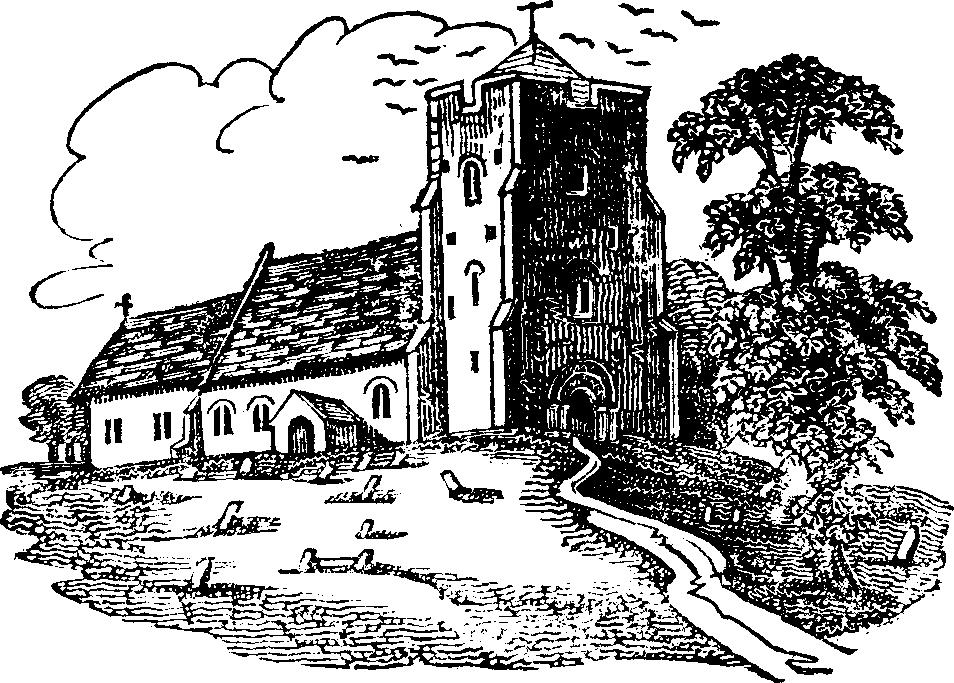
THE FIRST CHRISTIAN CHURCH ERECTED IN ENGLAND.
(For the Mirror.)
The venerable and interesting church of St. Martin is situated on the side of a hill, (named from it,) at the distance of little more than a quarter of a mile from the dilapidated walls of Canterbury. It is generally believed to have been erected by the Christian soldiers in the Roman army, about the time of king Lucius, A.D. 182, and hence is justly esteemed as the first Christian church erected in Britain, and indeed nothing appears to contradict this assertion; for the Britons, before the arrival of the Romans, were, as is well known, in a state of barbarism and idolatry, and their habitations huts of clay and turf; and as to its being built after their departure, I do not think it at all likely, for England was then ravaged and overrun by the warlike clans of its mountain neighbours, and consequently its inhabitants had not time or inclination to erect buildings, when their lives and property were daily in danger. Their successors, the early Saxons, too, I think, cannot claim any pretensions to St. Martin, they being heathens, and unacquainted with the Christian religion. Nor could they, entirely ignorant of Roman materials, have built an edifice completely composed with them.
Here then was a Christian church and a Christian congregation established in Britain full 415 years before Augustin's arrival; but as St. Martin, bishop of Tours, died in the year 395, this church could not have been erected in his honour; but it might afterwards have been dedicated to him by Luidhard, chaplain to Bertha, wife of Ethelbert, the Kentish king; and this is the more likely, as Luidhard himself was a French bishop.
In conclusion, it may not be unnecessary to state, that though the papists consider Augustin as the apostle of the English, they do not acknowledge him as their first instructor in Christianity; for, as it appears in their service for May 26, Lucius, a British king, wrote to St. Eleutherius, (who was elected priest A.D. 177,) desiring that he might be numbered among the Christians. By whom or by what means this conversion was effected does not appear; but, however, in reply to it, Eleutherius sent the monks Damian and Fryatius into Britain, from whom the king and many of his subjects received the gospel.
SAGITTARIUS.
PICTURE OF LIBERTY.
(For the Mirror.)
O, Liberty! thou goddess, heav'nly bright! Profuse of bliss, and pregnant with delight, External pleasures in thy presence reign. ADDISON.
Aristo tells a pretty story of a fairy, who, by some mysterious law of her nature, was condemned to appear, at certain seasons, in the form of a foul and poisonous snake. Those who injured her during the period of her disguise were for ever excluded from participation in the blessings which she bestowed. But to those who, in spite of her loathsome aspect, pitied and protected her, she afterwards revealed herself in the beautiful and celestial form which was natural to her, accompanied their steps, granted all their wishes, filled their houses with wealth, made them happy in love and victorious in war. Such a spirit is Liberty. At times she takes the form of a hateful reptile; she grovels, she hisses, she stings; but woe to those who in disgust shall venture to crush her! And happy are those who, having dared to receive her in her degraded and frightful shape, shall at length be rewarded by her in the time of her beauty and glory!—See Edin. Rev. vol. xlii. p. 332.
P.T.W.
FIRST AND LAST.
(From the Italian.)
One single truth before he died Poor Dick could only boast; "Alas, I die!" he faintly cried, And then—gave up the ghost!
FRENCH GAMING HOUSES.
(For the Mirror.)
Dicing-houses, where cheaters meet, and cozen young men out of their money.
Lord Herbert.
Begin with a guinea, and end with a mortgage.
Cumberland.
What more than madness reigns, When one short sitting many hundreds drains, When not enough is left him to supply Board wages, or a footman's livery. Dryden's Juvenal.
Gaming finds a man a cully, and leaves him a knave.
Tom Brown.
The last "nine days' wonder" is the excess to which gaming is carried among the higher circles of this country; but I much doubt whether the present expositions of such enormity in a neighbouring nation will work the desired effect on Englishmen.
Popular prejudices are obstinate points to combat; but every one who has had opportunities for observation, must allow, that in their taste for gaming, the French and English character are widely different. In France, every one plays at cards, or dominoes, and at all hours in the day, in every cafè, wine-shop, and road-side inn throughout the country. I remember to have frequently seen, in the wine-shops at Paris, carters in blue smock-frocks playing at ecartè and dominoes over a bottle of vin ordinaire at eleven o'clock in the morning, particularly in the neighbourhood of the markets. In England such amusements would be illegal, and the victualler who allowed them in his house would probably be deprived of his license.
In France every man plays at billiards—nay, every village has its billiard tables, one of which is almost as frequent an article of furniture in private houses, as piano-fortes are in England; and the sign of two maces crossed, and the inscriptions "Cafè et Billards" are as common over the wine-houses in the provinces, as chequers formerly were in our own country towns. I remember meeting with a curious adventure during my last residence in Paris. One morning, while leisurely walking in Rue Montmartre, I was accosted in French, by a respectably dressed man, apparently about fifty, who inquired of me the situation of —— street, (for at this moment I do not recollect the name). I replied that, being a foreigner, I could not afford him the required information, at the same time referring him to the next shop. He did not follow my suggestion, but almost at the very instant my eye caught the name of the street for which he had just inquired. The stranger then told me that being on a visit to the capital, he was anxious to see the interior of the palace of the Tuilleries, and was proceeding to a friend resident in the above street, who had promised to procure him admission to the royal residence, notwithstanding the king was then in Paris. I congratulated him on his success, having been, a few days previous, disappointed in the same object, when he offered also to procure admission for myself and one or two of my friends. We accordingly entered a second rate cafè, when, I made up to the garçon and demanded of him whether orders for viewing the Tuilleries were to be obtained there: he made no reply, but my friend of the street, who had by this time partly ascended a staircase at the extremity of the room, beckoned, and anxiously besought me to accompany him. I did so, notwithstanding I was aware that Paris, as well as London, had its "frauds." We entered a large room, the first impression of which, on some minds, would have been that of terror. In the centre stood a handsome billiard-table, over which were two dirty lamps with reflectors; the walls were papered in tawdry French taste, the ceiling black with smoke, and the whole room but indifferently lighted with a disproportionate and dusty window: the door, too, seemed planned for security, having a large lock and two bolts inside, but exhibited marks of recent repair from violent fracture. In short, there was a lurking suspicion about the place, which was not lessened by my companion meeting with a partner. From their conversation I learned they were both foreigners, and were waiting for a friend to bring the orders to view the palace, so that all the story was as yet in keeping, and I was introduced as a suitor for the same favour. My fellows "in waiting" showed much impatience, complained of cold, and politely asked me to take a glass of liqueur with them, at the same time taking up the mace and beginning to amuse themselves at the billiard-table. I looked on; they asked me to join them; I declined, and professed ignorance of the game; but their importunities became more pressing, and at last troublesome. Not a word further was said of the palace admission. I now judged it time to take my leave, and advancing towards the door for that purpose, I perceived my companions moved also: I profited by the hint, and seizing the handle of the door, thanked them for their civility, assured them I could wait no longer, but would call in half-an-hour—leaped down the stairs, and did not stop till I reached Rue Montmartre. I afterwards learned this was a common street trick in Paris to decoy strangers to the billiard-table, and had I taken the mace in hand, it would most probably have been at the expense of a good dinner for my companions, as a smart for my credulity.
But as such incidents must be common to many of your readers who have visited the French metropolis, I shall desist from further recital. The following outline of those receptacles of vice, French Gaming Houses, from facts which I collected on the spot, aided by authenticated resources, may not prove uninteresting.
Gaming-houses in Paris were first licensed in 1775, by the lieutenant of police, who, to diminish the odium of such establishments, decreed that the profit resulting from them should be applied to the foundation of hospitals. The gamesters might therefore be said to resemble watermen, looking one way and rowing another. Their number soon amounted to twelve, and women were permitted to resort to them two days in the week. Besides the licensed establishments, several illegal ones were tolerated. In 1778, gaming was prohibited in France; but not at the court or in the hotels of ambassadors, where police-officers could not enter. By degrees the public establishments resumed their wonted activity, and extended their pernicious effects. The numerous suicides and bankruptcies which they occasioned, attracted the attention of the Parlement, who drew up regulations for their observance; and threatened those who should violate them with the pillory and whipping. At length, the passion for gambling prevailing in the societies established in the Palais Royal, under the title of clubs or salons, a police ordinance was issued in 1785, prohibiting them from gaming, and in the following year, additional prohibitory measures were enforced. During the revolution the gaming-houses were frequently prevented and licenses withheld; but notwithstanding the rigour of the laws, and the vigilance of the police, they still contrived to exist; and they are now regularly licensed by the police, and are under its immediate inspection. The following items of twenty tables distributed about Paris (the established stake varying from a Napoleon to sous) are from the most authentic documents:—
Current expenses 1,551,480Francs.
Bail to Government 6,000,000Francs.
Bonus for the bail 166,666Francs.
Making together 7,716,146 Francs, or about £321,589English.
Gain of the tables, per annum 9,600,000Francs.
Expenses as above 7,718,146Francs.
Leaving a clear profit of 1,881,854Francs,
or about £78,244 English! And yet, in spite of this unanswerable logic of figures and facts, there are every day fresh victims who are infatuated enough to believe that it is possible to counterbalance the advantages which the bank possesses, by a judicious management of the power the player has of altering his stake! The revenue formerly paid to the government for licenses, has recently been transferred to the city of Paris.
In England, the outcry against gaming is loud, and deservedly so; and the extent to which it is stated to be curried in the higher circles is rather underrated than exaggerated; but the severity of our laws on this crime, and recent visitations of its rigour, confine it to the saloons of wealthy vice. With us it is not a national vice, as in France, where every license, facility, and even encouragement presents itself. Lotteries, which have been abolished in England, as immoral nuisances, are tolerated in France, with more mischievous effect, since, the risk is considerably less than our least shares formerly were, the lotteries smaller, and those drawn three times every month. The relics of our gaming system are only to be found on race-courses; but in France, half the toys sold at a fair or fête, where mothers win rattles for their children, are by lottery, whilst our gaming at fairs is restricted to a few low adventurers for snuff-boxes, &c. Despair is the gloomiest feature of the French character, and of which gaming produces a frightful proportion, notwithstanding all that our neighbours say about our hanging and drowning in November: witness their suicides:—
In 1819: Suicides, 376; of which, 126 women.
1820: do. 325; do. 114 do.
1821: do. 348; do. 112 do.
Of the suicides of these three years 25, 50, and 36, were attributed to love, and 52, 42, 43, to despair arising from gaming, the lottery, &c. In the winter of 1826, several exaggerated losses by gaming were circulated in Paris with great finesse, to enable bankrupts to account for their deficiencies, many of whom were exposed and deservedly punished.
A few words on the prevention of gaming, the consideration of which gave rise to this hasty sketch; I mean by dramatic exhibitions of its direful effects. On our stage we have a pathetic tragedy by E. Moore, which, though seldom acted, is a fine domestic moral to old and young; but the author
"Was his own Beverley, a dupe to play."
It is scarcely necessary to allude to the recent transfers of a celebrated French exposé of French gambling to our English stage, otherwise than to question their moral tendency. The pathos of our Gamester may reach the heart; but the French pieces command no such appeal to our sympathies. On the contrary, the vice is emblazoned in such romantic and fitful fancies, that their effect is questionable, especially on the majority of those who flock to such exhibitions. The extasies of the gamester are too seductive to be heightened by dramatic effect; neither are they counterbalanced by their consesequent misery, when the aim of these representations should be to outweigh them; for the authenticated publication of a single prize in the lottery has been known to seduce more adventurers than a thousand losses have deterred from risk. But they keep up the dancing spirits of the multitude, and it will be well if their influence extends no further.
PHILO.
A RETROSPECT.
Oh, when I was a tiny boy, My days and nights were full of joy; My mates were blithe and kind!— No wonder that I sometimes sigh, And dash the tear-drop from my eye. To cast a look behind! A hoop was an eternal round Of pleasure. In those days I found A top a joyous thing;— But now those past delights I drop; My head alas! is all my top, And careful thoughts the string! My marbles—once my bag was stor'd,— Now I must play with Elgin's lord,— With Theseus for a taw! My playful horse has slipt his string. Forgotten all his capering, And harness'd to the law! My kite—how fast and fair it flew. Whilst I, a sort of Franklin, drew My pleasure from the sky! 'Twas paper'd o'er with studious themes,— The tasks I wrote—my present dreams Will never soar so high! My joys are wingless all, and dead; My dumps are made of more than lead; My flights soon find a fall; My fears prevail, my fancies droop, Joy never cometh with a hoop, And seldom with a call! My football's laid upon the shelf; I am a shuttlecock, myself The world knocks to and fro;— My archery is all unlearn'd, And grief against myself has turn'd My sorrow and my bow! No more in noontide sun I bask; My authorship's an endless task, My head's ne'er out of school; My heart is pain'd with scorn and slight; I have too many foes to fight, And friends grown strangely cool! The very chum that shar'd my cake Holds out so cold a hand to shake, It makes me shrink and sigh:— On this I will not dwell and hang, The changeling would not feel a pang Though these should meet his eye! No skies so blue or so serene As these;—no leaves look half so green As cloth'd the play-ground tree! All things I lov'd are altered so, Nor does it ease my heart to know That change resides in me. O, for the garb that mark'd the boy! The trousers made of corduroy. Well ink'd with black and red; The crownless hat, ne'er deem'd an ill— It only let the sunshine still Repose upon my head! O, for that small, small beer anew! And (heaven's own type) that mild sky-blue That wash'd my sweet meals down! The master even!—and that small turk That fagg'd me!—worse is now my work,— A fag; for all the town! The "Arabian Nights'" rehears'd in bed! The "Fairy Tales" in school-time read By stealth, 'twixt verb and noun! The angel form that always walk'd In all my dreams, and look'd, and talk'd. Exactly like Miss Brown! The omne bene—Christmas come! The prize of merit, won for home'— Merit had prizes then! But now I write for days and days For fame—a deal of empty praise, Without the silver pen. Then home, sweet home! the crowded coach— The joyous shout—the loud approach— The winding horn like ram's! The meeting sweet that made me thrill, The sweetmeats almost sweeter still, No "satis" to the "jams!"
ENGLISH DRESS.
(To the Editor of the Mirror.)
Mr. Editor.—In No. 200 of the MIRROR, you will find an article, entitled Female Fashions during the early part of the Last Century. The author then promised to give a description of the dress of the English gentlemen of the same period, but as no such description has yet appeared in your pages, I trust you will insert the annexed at your first convenient opportunity.
G.W.N.
Dress of the English Gentlemen during the Early part of the Last Century.
In the reign of King William III., the English gentlemen affected to dress like their dependents. Their hats were laced, and their coats and waistcoats were embroidered with gold and silver fringe; indeed it really became extremely difficult to distinguish a man of quality from one of his lackeys. They did not, however, long persevere in this ridiculous imitation, for they soon afterwards, like the ladies, servilely followed the French fashions. The great partiality of the English beau monde towards the bon ton of France, was a wonderful advantage to that country—an advantage which the English government in vain endeavoured to abolish, although a heavy duty was imposed on all French ribbon and lace imported into this kingdom. Many millions were annually expended in French cambric, muslin, ribbon, and lace, which useless expenditure very sensibly injured our commercial transactions with other nations.
Perukes and long wigs were worn at the revolution; but these being greatly inconvenient in all weathers, some people tied up their wigs, which was the first occasion of short wigs coming into fashion. Some few years afterwards, bob-wigs were adopted by the gentlemen, especially by those of the army and the navy.
The English costume was remarkably neat and plain anterior to the year 1748; at which period, however, all gentlemen rather resembled military officers than private individuals, for their coats were not only richly embroidered with gold and silver, but they even assumed the cockade in their hats, and carried long rapiers at their sides. At length this imposing attire was adopted by the merchants and tradesmen of the metropolis, and soon afterwards by the most notorious rogues and pickpockets in town, so that when any person with a laced coat, a cockade, and a sword, walked along the streets of London, it was absolutely impossible to determine whether he affected to be thought a nobleman, a military officer, a tradesman, or a pickpocket, for he bore an equal resemblance to each of these characters.
In the year 1749, hair-powder was used by the finished gentlemen, though the use of it, a year or two previous, was prohibited in every class of society. Of the costume of this period (i.e. about 1749), the immortal Hogarth, in his works, has left us numerous specimens, which need no comment here: his productions, indeed, are so equal in merit, that it is impossible to decide which is his ne plus ultra.
In conclusion, I would advise the reader to refer to a few of Hogarth's prints, for they will admirably serve to illustrate the above observations on the fashions and habits of our forefathers.