ARCANA OF SCIENCE.
Reading edition
Sheppey.—The isle of Sheppey is quickly giving way to the sea, and if measures are not hereafter taken to remedy this, possibly in a century or two hence its name may be required to be obliterated from the map. Whole acres, with houses upon them, have been carried away in a single storm, while clay shallows, sprinkled with sand and gravel, which stretch a full mile beyond the verge of the cliff, over which the sea now sweeps, demonstrate the original area of the island. From the blue clay of which these cliffs are composed may be culled out specimens of all the fishes, fruits, and trees, which abounded in Britain before the birth of Noah; and the traveller may consequently handle fish which swam, and fruit which grew, in the days of the antediluvians, all now converted into sound stone, by the petrifying qualities of the soil in which they are imbedded. Here are lobsters, crabs, and nautili, presenting almost the same reality as those we now see crawling and floating about; branches of trees, too, in as perfect order as when lopped from their parent stems; and trunks of them, twelve feet in length and two or three diameter, fit, in all appearance, for the operations of the saw, with great varieties of fruits, resembling more those of tropical climates than of cold latitudes like ours, one species having a large kernel, with an adherent stalk, as complete as when newly plucked from the tree that produced it. An interesting collection of these relics of a former world may be seen at a watchmaker's on the cliff, at Margate, including the most remarkable productions of the isle of Sheppey.
The Camelopard.
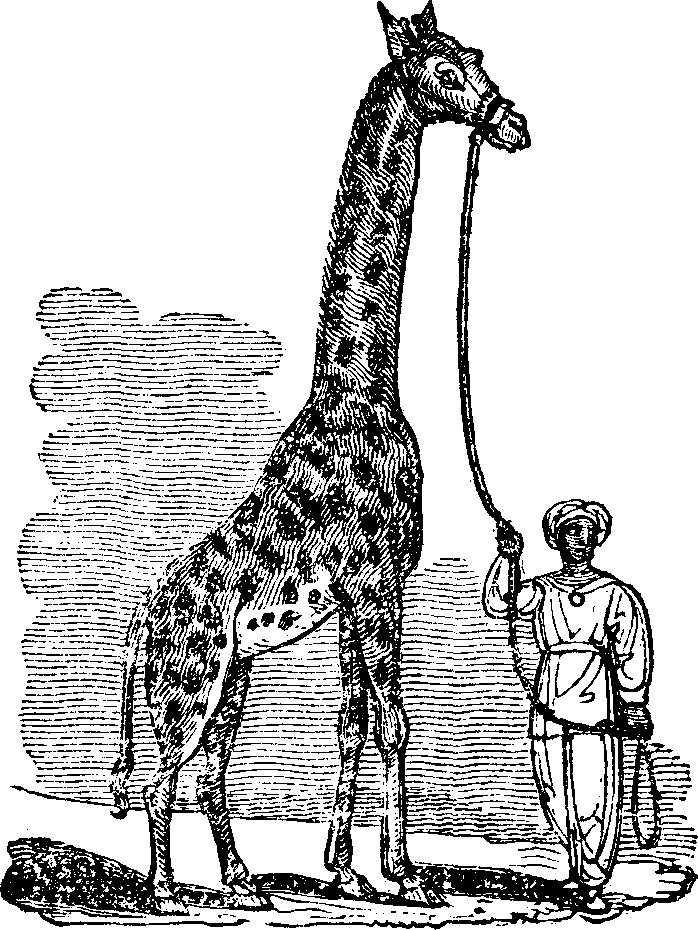
As a live camelopard has been sent to London and another to Paris, the history and habits of these animals have excited some interest. At a meeting of the Academy of Sciences in Paris, on the 2nd of July last, M. Geoffroy Saint-Hilaire observed that naturalists were wrong in supposing that there was only one species of the camelopard. The animal now in Paris differs from the Cape of Good Hope species by several essential anatomical characters, and he proposes to distinguish it by the name of the Giraffe of Sennaar, the country from which it comes. Some natives of Egypt having come to see the one in Paris in the costume of the country, the animal gave evident proofs of joy, and loaded them with caresses. This fact is explained by the circumstance that the Giraffe has an ardent affection for its Arabian keeper, and that it naturally is delighted with the sight of the turban and the costume of its keeper.
Some authors have proved the mildness and docility of the camelopard, while others represent it as incapable of being tamed. This difference is ascribed by M. Saint-Hilaire to difference of education. Four or five years ago a male Giraffe, extremely savage, was brought to Constantinople. The keeper of the present Giraffe had also the charge of this one, and he ascribes its savageness entirely to the manner in which it was treated. At the same time M. Mongez read a memoir on the testimony of ancient authors respecting the Giraffe. Moses is the first author who speaks of it. As Aristotle does not mention it, M. Mongez supposes that it was unknown to the Greeks, and that it did not then exist in Egypt, otherwise Aristotle, who travelled there, must have known about it. In the year 708 of Rome, Julius Caesar brought one to Europe, and the Roman emperors afterwards exhibited them at Rome, either for the games in the circus, or in their triumphs over the African princes. Albertus Magnus, in his Treatise de Animalibus, is the first modern author who speaks of the Giraffe. In 1486, one of the Medici family possessed one at Florence, where it lived for a considerable time.
In its native country the Giraffe browses on the twigs of trees, preferring plants of the Mimosa genus; but it appears that it can without inconvenience subsist on other vegetable food. The one kept at Florence fed on the fruits of the country, and chiefly on apples, which it begged from the inhabitants of the first storeys of the houses. The one now in Paris, from its having been accustomed in early life to the food prepared by the Arabs for their camels, is fed on mixed grains bruised, such as maize, barley, &c., and it is furnished with milk for drink morning and evening. It however willingly accepts fruits and the branches of the acacia which are presented to it. It seizes the leaves with its long rugous and narrow tongue by rolling it about them, and seems annoyed when it is obliged to take any thing from the ground, which it seems to do with difficulty. To accomplish this it stretches first one, then the other of its long fore-legs asunder, and it is not till after repeated attempts that it is able to seize the objects with its lips and tongue.
The pace of the Giraffe is an amble, though when pursued it flies with extreme rapidity, but the small size of its lungs prevents it from supporting a lengthened chase. The Giraffe defends itself against the lion, its principal enemy, with its fore feet, with which it strikes with such force as often to repulse him. The specimen in the museum at Paris is about two years and a half old.
The name Camelo-pardalis (camel-leopard) was given by the Romans to this animal, from a fancied combination of the characters of the camel and leopard; but its ancient denomination was Zurapha, from which the name Giraffe has been adopted.—Brewster's Journal.
Sugar.
About 3,700,000 cwt. of sugar are annually imported from the West Indies. An advance in price, therefore, of one penny per pound is a charge on the public of 1,726,600l. a year, being more than one-third of the gross amount of the duty levied at the Custom-house for the revenue.
Silk.
Lord Kingston has upwards of 30,000 mulberry-trees growing upon one estate in Ireland, and has already sent raw silk into the market.
SINGULAR ASSASSINATION IN KINCARDINESHIRE.
(For the Mirror.)
The fate of one of the sheriffs of this county, in former times, merits notice, especially as connected with a ruin in the parish of Eccliscraig, formerly a place of great strength, being erected on a perpendicular and peninsulated rock, sixty feet above the sea, at the mouth of a small rivulet. It was built in consequence of a murder committed in the reign of James the First, and the circumstance deserves to be recorded, as it affords a specimen of the barbarity of the times. Melville, sheriff of Kincardineshire, had, by a vigorous exercise of his authority, rendered himself so very obnoxious to the barons of the county, that they had made repeated complaints to the king. On the last of these occasions the king, in a fit of impatience, happened to say to Barclay, of Mathers, "I wish that sheriff were sodden and supped in brue." Barclay instantly withdrew, and reported to his neighbours the king's words, which they resolved literally to fulfil. Accordingly, the conspirators invited the unsuspecting Melville to a hunting party in the forest of Garvock; where, having a fire kindled, and a cauldron of water boiling on it, they rushed to the spot, stripped the sheriff naked, and threw him headlong into the boiling vessel: after which, on pretence of fulfilling the royal mandate, each swallowed a spoonful of the broth. After this cannibal feast, Barclay, to screen himself from the vengeance of the king, built this fortress, which before the invention of gunpowder must have been impregnable. Some of the conspirators were afterwards pardoned. One of the pardons is said to be still in existence; and the reason assigned for granting it is, that the conspirator was within the tenth degree of kin to Macduff, thane of Fife.
CHARLES STUART.
USE OF HORSE-CHESTNUTS.
(For the Mirror.)
These nuts are much used in France and in Switzerland, in whitening not only of hemp and flax, but also of silk and wool. They contain a soapy juice, fit for washing of linens and stuffs, for milling of caps and stockings, &c., and for fulling of stuffs and cloths.
Twenty nuts are sufficient for five quarts of water. They must be first peeled, which can be done by children, then rasped or dried, and ground in a malt-mill, or any other common steel mill. The water must be soft, either rain or river water, for hard well water will by no means do. When the nuts are rasped or ground, they must be steeped in the water quite cold, which soon becomes frothy, (as it does with soap,) and then turns white as milk. It must be well stirred at first with a stick, and then, after standing some time to settle, must be strained, or poured off quite clear. Linen washed in this liquor, and afterwards rinsed in clear running water, takes an agreeable light sky-blue colour. It takes spots out of both linen and woollen, and never damages or injures the cloth. Poultry will eat the meal of them, if it is steeped in hot water, and mixed with an equal quantity of pollard. The nuts also are eat by some cows, and without hurting their milk; but they are excellent for horses whose wind is injured.
A.B.
A FETCH.
(For the Mirror.)
"I do believe," (as Byron cries,) "There is a haunted spot, And I can point out where it lies, But cannot—where 'tis not. Turn gentle people, lend an ear, Unto my simple tale, It will not draw a single tear Nor make the heart bewail, 'Tis of a ghost! O ladies fair! Start not with sore affright, It will not harm a single hair, Nor 'make it stand upright." Attend, it was but yesternight, I in my garret sat, I saw—no, nothing yet I saw, But something went pit-pat. So did my heart responsively, Beat like a prison'd bird, That's newly caught—but no reply I made, to what I heard. It nearer came—'Angels,' I cried, 'And Ministers of Grace defend.' Yet nothing I as yet descried, My hair stood all on end. My breath was short, I'm sure my eye Was dim, so was the light, I thought that I that hour should die, With sad and sore affright. And then came o'er me—what came o'er? Some spectre grim I'll bet, O tell me!—why at every pore— A very heavy sweat. Poh, don't delay the wond'rous tale, What follow'd? tell me that, (I feel my heart and limbs too fail) The same thing, pit-a-pat. And then there came before my eyes, I pray thee 'list, O list,' You fill my heart with dread surprise What was it? why a mist. And then around my head there play'd A flame, so wond'rous bright, That made me more than all afraid— My wig had caught the light. And there came wand'ring by at last, The same thing, pit-a-pat, I found as 'cross the room it past, The cat had got a rat.
MAY.
TEA.
(For the Mirror.)
"The Muses' friend, tea, does our fancy aid, Repress those vapours which the head invade." WALLER.
The tea-tree loves to grow in valleys, at the foot of mountains, and upon the banks of rivers, where it enjoys a southern exposure to the sun, though it endures considerable variations of heat and cold, as it flourishes in the northern clime of Peking, as well as about Canton; and it is observed that the degree of cold at Peking is as severe in winter as in some parts of Europe. However, the best tea grows in a mild, temperate climate, the country about Nanking producing better tea than either Peking or Canton, betwixt which places it is situated. The root resembles that of the peach-tree; the leaves are green, longish at the point, and narrow, an inch and half long, and jagged all round. The flower is much like that of the wild rose, but smaller. The fruit is of different forms, sometimes round, sometimes long, sometimes triangular, and of the ordinary size of a bean, containing two or three seeds, of a mouse colour, including each a kernel. These are the seeds by which the plant is propagated, a number, from six to twelve, or fifteen, being promiscuously put into one hole, four or five inches deep, at certain distances from each other. The seeds vegetate without any other care, though the more industrious annually remove the weeds and manure the land. The leaves which succeed are not fit to be plucked before the third year's growth, at which period they are plentiful, and in their prime. In about seven years the shrub rises to a man's height, and as it then bears few leaves, and grows slowly, it is cut down to the stem, which occasions an exuberance of fresh shoots and leaves the succeeding summer. In Japan, the tea-tree is cultivated round the borders of the fields, without regard to soil, but as the Chinese export great quantities of tea, they plant whole fields with it. The tea-trees that yield often the finest leaves, grow on the steep declivities of hills, where it is dangerous and in some cases impracticable to collect them. The Chinese are said to vanquish this difficulty by a singular contrivance. The large monkeys which inhabit these cliffs are irritated, and in revenge they break off the branches and throw them down, so that the leaves are thus obtained. The leaves should be dried as soon as possible after they are gathered. The Chinese are always taking tea, especially at meals; it is the chief treat with which they regale their friends, but they use it without the addition of sugar and milk. Tea was first introduced into Europe by the Dutch East India Company very early in the seventeenth century, and a great quantity of it was brought over from Holland by Lord Arlington and Lord Ossory about the year 1666, at which time it sold for 60s. per pound. Tea exhilarates without intoxication, and its enlivening qualities are equally felt by the sedentary student and the active labourer. Dr. Johnson dearly loved tea, and drank great quantities of this elegant and popular beverage, and so does P.T.W.
PORSON.
The late professor having once exasperated a disputant by the dryness of his sarcasm, the petulant opponent thus addressed him:—"Mr. Porson, I beg leave to tell you, sir, that my opinion of you is perfectly contemptible." Person replied, "I never knew an opinion of yours, sir, which was not contemptible."
THE DRAMA AND ITS PROFESSORS.
(For the Mirror.)
It is remarkable with what difference actors were treated among the ancients. At Athens, they were held in such esteem, as to be sometimes appointed to discharge embassies and other negotiations; whereas, at Rome, if a citizen became an actor, he thereby forfeited his freedom. Among the moderns, actors are best treated in England; the French having much the same opinion of them that the Romans had; for though an actor of talent, in Paris, is more regarded than here, he nevertheless is deeply degraded. He may die amid applauses on the stage, but at his natural death, he must pass to his grave, without a prayer or de profundis, unless a minister of religion receives his last sigh.
Cromwell and his Puritans had a holy horror of actors. They pronounced them Sons of Belial! and professors of abomination. During the whole reign of the Republican Parliament, and Protectorate, the theatres of that day were closed, or, if opened by stealth, were subject to the visits of the emissaries of "Praise God Barebones," "Fight the Good Fight," and their crew. The actors were driven off the stage by soldiers, and the cant word of that period is still recorded, "Enter red coat, exit hat and cloak." William Prynne was celebrated for his writings against the immorality of the stage, and the furious invectives of Jeremy Collier, are still extant; his pen was roused by Dryden's Spanish Friar, and Congreve's witty, but licentious comedies. Collier inveighed without mercy, but he certainly did much to reform the stage. Our Evangelicals and Methodists denounce the histrionic art to this day, with more than the zeal of the Church of Rome. But a follower of Wesley or Whitfield would not enter the den of abomination. Here, however, we take care all our comedies shall be purified, and our tragedies free, even from an oath; both are subject to the censor's unsparing pen, and must be subsequently licensed by the Lord Chamberlain.
The actors in England, have, it is true, only become respectable within the last half century, and though they are termed his majesty's servants, yet an unrepealed statute denounces them as vagabonds. As a body, numerous in itself, they are as free from crime as any other associated body or profession of men, and yet do they "his majesty's servants" continue to lay under the stigma which the above unrepealed act fixes upon them. This is perfectly anomalous, and it was spiritedly denounced by Sir Walter Scott, when on a recent and interesting occasion he nobly and manfully declared "Its professors had been stigmatized; and laws had been passed against them less dishonourable to them than to the statesman by whom they were proposed, and to the legislators by whom they were passed." To repeal, therefore, an act nugatory in itself, would not add to the reputation of the profession, nor give a license to further abuse; but it would be an act of justice, and remove a prejudice unjustly attached to the professors of a difficult art.
The critical pen of Mrs. Inchbald justly remarks, "To the honour of a profession long held in contempt by the wise—and still contemned by the weak—Shakspeare, the pride of Britain, was a player." To the illustrious bard, the modern drama is indebted for its excellence. His writings will remain for ever the grandest monument of a genius which opened to him the whole heart of man, all the mines of fancy, all the stores of nature, and gave him power beyond all other writers, to move, astonish, and delight mankind. In the drama, the most interesting emotions are excited; the dangerous passions of hate, envy, avarice, and pride, with all their innumerable train of attendant vices, are detected and exposed. Love, friendship, gratitude, and all those active and generous virtues which warm the heart and exalt the mind, are held up as objects of emulation. And what can be a more effectual method of softening the ferocity, and improving the minds of the inconsiderate? The heart is melted by the scene, and ready to receive an impression—either to warn the innocent, or to appal the guilty; and numbers of those who have neither abilities nor time for deriving advantage from reading, are powerfully impressed through the medium of the eyes and ears, with those important truths which while they illuminate the understanding, correct the heart. The moral laws of the drama are said to have an effect next after those conveyed from the pulpit, or promulgated in courts of justice. Mr. Burke, indeed, has gone so far as to observe that "the theatre is a better school of moral sentiment than churches." The drama, therefore, has a right to find a place; and to its professors are we indebted for what may justly be considered one of the highest of all intellectual gratifications.
F.K.Y.
MEMORY.
(For the Mirror.)
How many a mortal bears a heavy chain, Of bitter sorrow, 'neath thy iron reign, And many a one, whose harder fate has given, Some early woes, by thee to madness driven, Sees the sad vision of some bygone day, And thinks on what he hath seen with dismay: So some lone murderer, wanders o'er the world By thy dread arm to desperation hurl'd; In vain he prays, or bends the lowly knee, With fiendlike power, thou dragg'st him back with thee, Point'st to some scene of early guilt and woe, Opening the source from whence his sorrows flow. As round the bark which feels the tempest's shock, The lightning plays, and shows the fatal rock, So memory brings our sorrows all to light With vivid truth presents them to the sight; Pursues the wretch who else some joy might find, To fix her seat of empire in his mind. As desert lakes in sad illusion fly, Before the weary traveller's cheated eye So memory shows, those hopes we still would cherish. Pleased but to fade, allured us but to perish.
M.B.S.