MANNERS & CUSTOMS OF ALL NATIONS.
Reading edition
No. XII.
KANEMBOO MARKET-WOMAN.
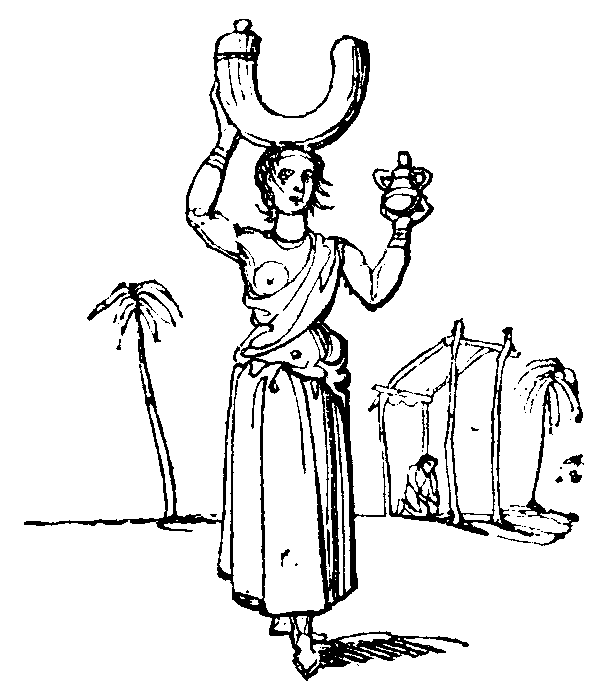
The people of Kanem, in Central Africa, are known by the name of Kanemboo, and consist of tribes of Tibboos. The women are good-looking, laughing negresses, and all but naked. Most of them have a square or triangular piece of silver or tin hanging at the back of the head, suspended from the hair, which is curiously and laboriously trained, and no one of tender years has anything like a perfect head of hair. From childhood the head is shaved, having only the top covered; the hair from hence falls down quite round from the forehead to the pole of the neck, and is then formed into one solid plait, which in front lying quite flat just over the eyes, and behind being turned up with a little curl, has just the appearance of an old-fashioned coachman's wig in London.
The women flock from the neighbouring negro villages to the weekly fsug, or market, with baskets of gussut, gafooly, fowls, and honey, which may be purchased by small pieces of coral amber of the coarsest kind, and coloured beads. Major Denham, in his "Travels in Northern and Central Africa," says "one merchant bought a fine lamb for two bits of amber, worth, I should think, about two-pence each in Europe; two needles purchased a fowl; and a handful of salt, four or five good-sized fish from the lake (Tchad)."
SHOUAA WOMAN.
Kingdom of Bornou.
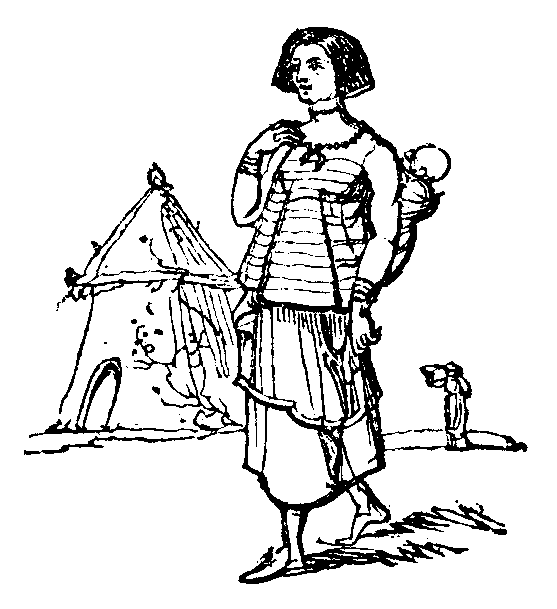
The Shouaa Arabs are a very extraordinary race, and have scarcely any resemblance to the Arabs of the north; they have fine open countenances, with aquiline noses, and large eyes; their complexion is a light copper-colour; they possess great cunning with their courage, and resemble in appearance some of our best favoured gipsies in England, particularly the women; and their Arabic is nearly pure Egyptian.
The best residences of the Shouaas consist of two enclosures, besides one for their horses, cows, and goats. In the first of these divisions is a circular hut, with a cupola top, well thatched with gussub straw, something resembling that of the Indian corn; the walls are of the same materials; a mud wall, of about two feet high, separates one part from the rest, and here their corn is kept; and a bench of like composition, at the opposite side, is their resting-place; this is covered with mats; and spears and wooden bowls for water and milk, hang on pegs, and complete the furniture; here is the master's own apartment. In the second division are two huts, rather smaller, about ten paces from each other, in which dwell his wives.
AFRICAN FUNERALS.
The custom of burying the dead in the floor of dwelling-houses, is prevalent on the Gold Coast of Africa, as far as that country is known to Europeans. The ceremony is purely Pagan, and without any form, except that of the females of the family of the deceased and their friends making a mournful lamentation; and in some instances they work their feelings up to such a degree of apparent sorrow, that their conduct has every symptom of insanity. This scene of revelry is not a little heightened by the profuse use of ardent spirits, which has so powerful an attraction, that drummers, flute-players, bards, and singing men come from great distances to partake of the libations; and as the savage uproar lasts often for a week, it leads to every kind of dissolute practice in both sexes. Another custom, or repetition of this barbarous usage, frequently takes place seven years after the demise of persons of consequence, which is still more expensive than the former: as such are the baneful prejudices in favour of these habits, that families have too frequently pawned their relatives to raise money to defray the expense; they purchase cattle, sheep, goats, and poultry, and with the assistance of what is brought by their friends and acquaintances, they are enabled to keep up a scene of riot for many days. The carcasses of animals sacrificed are not burned and sown in the wind as in times of old, but the Fantees more wisely, eat them, greater attention being paid to the flavour of the viands and the fragrance of the strong liquor than to the manes of the dead.