No. II.
Reading edition
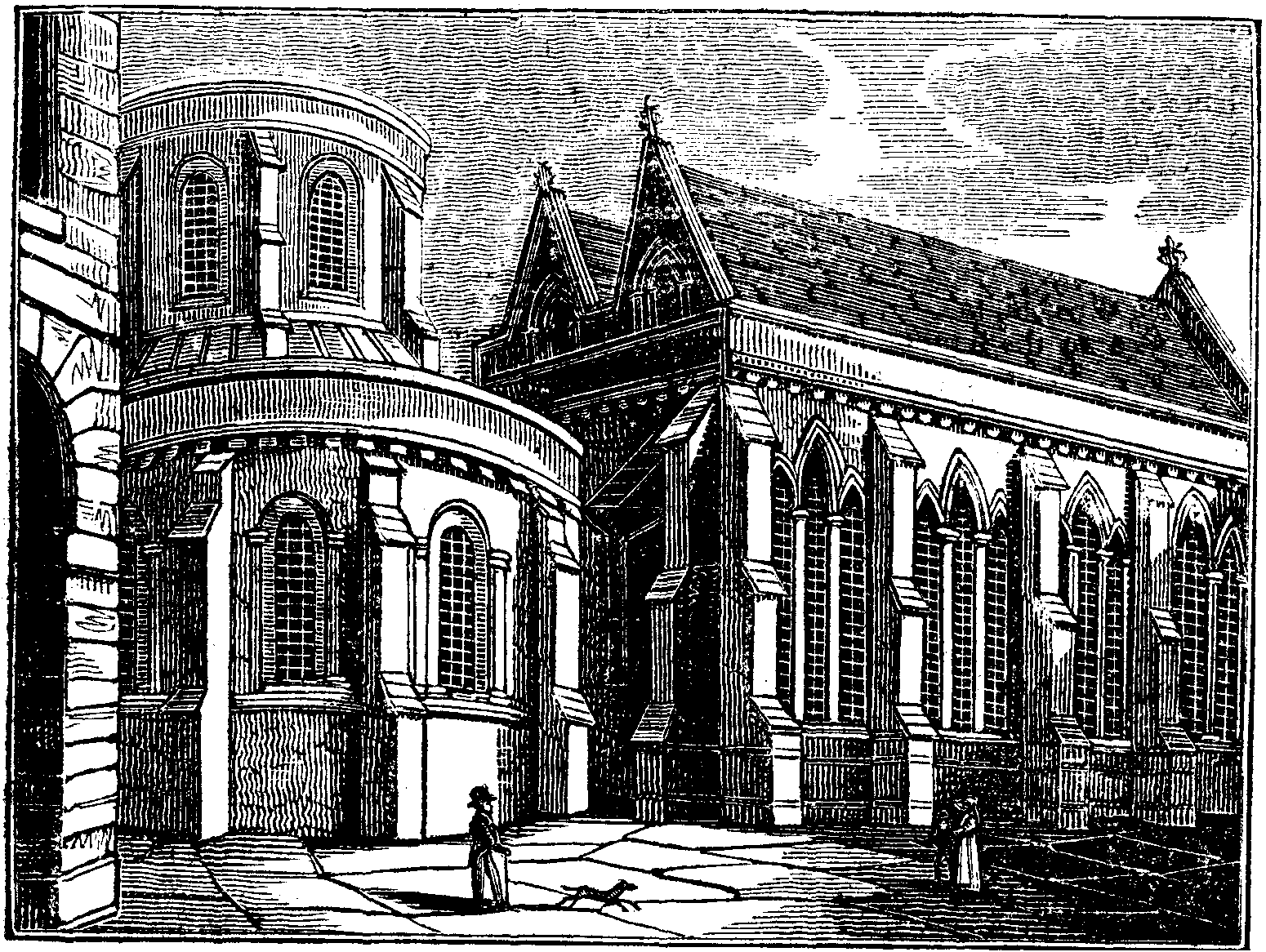
THE TEMPLE CHURCH.
The late perfect restoration of the Temple Church ought to be proudly recorded in our architectural annals. The excellence of the workmanship, and the native purity of the detail, evince not only scientific skill, but also a laudable motive of preserving this antique specimen of pure Anglo-Norman architecture from the ravages of time. Let the architect's attention be directed to the western doorway, and also to the interior of the church; and here, in good preservation, he will see excellent specimens of their mode of ornamenting the moldings by the cable, the lozenge, the cheveron, the nail-head, the billet, &c. &c., ornaments peculiar to the round style. The circular-headed windows, with their slender columns, also show, that in the restoration the style has not been tampered with; but substantial authorities have been quoted to perfect this praiseworthy attempt of the architect. That part of the church which has been added at a later date than the circular part, and for the convenience of divine worship, is lighted by the beautiful proportioned triple lancet-shaped windows, so justly admired. A writer in the Gentleman's Magazine for May, 1827, after making some judicious remarks, seems to think the crosses on the ends of the building, "as not in character with the building." Now as to architectural propriety in the decorations of a Christian church, no ornament could be better devised; and if we proceed to the antiquity of such ornament, I would observe, that the adoption would be equally correct, that being the insignia of the banner under which the Knights' Templars originally fought.
C. DAVY.
BRIDGET TROT AND TIMOTHY GREEN.
(For the Mirror.)
"'Tis a common tale, An ordinary sorrow of man's life; A tale of silent sufferings, hardly clothed In bodily form."
WORDSWORTH.
Miss Bridget Trot, a "wo"-man was, Of excellent repute, Who kept a stand in Leadenhall, And there disposed of fruit. And though in features rather dark, No fairer could be found; For what she sold, like ringing gold, When peeled, was always sound! She had moreover notions high, And thought herself above The very low-ly common way Of falling into love. And therefore when to her his suit A Snip did often press With vows of love, she cut him short At length, without re-dress. Yet nothing odd was there in this One case, it must be said; For who that wish'd a perfect man Could with a ninth part wed? Not she for one, whatever he Might do to make him smart, And howsoe'er her saying "Nay" Might add it to his heart. 'Tis very strange, (yet so it is,) That vows should go for naught. But she who strove to 'scape love's toils Quite unawares was caught! For though so hard to Snip at first, At last it chanced that she A sort of soft emotion felt Towards one Timothy, A butcher—Green by name, but red In face, as was his cap, And though he seldom tasted wine, A port-ly sort of chap. This man one day in passing by, In taste for what she'd got, Saw Biddy's stall—and 'twas her fate To sell to him a lot! She thought his manners very sweet, He gave so fond a gaze; (But dashing blades of such like trades Have ever killing ways!) And whilst he paid the coppers down, He had the brass to say Her fruit was sweet, but sweeter still The apple of her eye. Besides all this, he looked so neat Whilst shouldering his tray; So what with steel, et cetera, Her heart was stole away! Lo! shortly after both agreed, They fixed the wedding day, But long before that day arriv'd He took to stop away! From that same time her peace of mind And comfort were at steak— She did so lean to Mr. Green, Her heart was like to break! At last she went one morn to see What he could be about, And hoped, alone, to find him in, But he had just popt out. She ax'd, "Is Mr. Green at home?" Of one who, with a laugh, Replied, "He's not! but if you please I'll fetch his better half." "His what?" scarce uttered Bridget out, With uttermost dismay; And there she stopt, she could no more, And nearly swoon'd away! But when at length she was herself, And saw her faithless clown. She straightway went to blow him up, But got a good set down! "Oh, cold and faithless Tim," quoth she, "You vowed you couldn't smother Your burning love for me, but now You're married to another!" "Is this the way you treat me, sir? Too cheaply was I bought! I loved you dearly, but it seems That that all went for naught." She sighed, and gave one parting look, Then tore herself away From her false swain and Mrs. Green, For ever and a day! And very soon got very ill, And very quick did die, And very truly verified Her love for Timothy!
W.R.H.
GREAT BELL OF GLASGOW.
(For the Mirror.)
In the steeple of Glasgow is a great bell, which is twelve feet one inch in circumference, and has a grave and deep tone. In 1789, it was accidentally cracked by some persons who got admission to the steeple. It was, therefore, sent to London, and cast anew. On the outside of it is the following inscription:—
MALVINA.
FANCY.
(For the Mirror.)
Me, oft hath Fancy, in her fitful dream, Seated within a far sequestered dell, What time upon the noiseless waters fell, Mingled with length'ning leafy shade, a gleam Of the departing sun's environ'd beam; While all was hush'd, save that the lone death-bell Would seem to beat, and pensive smite mine ear Like spirit's wail, now distant far, now near: Then the night-breeze would seem to chill my cheek, And viewless beings flitting round, to speak! And then, a throng of mournful thoughts would press On this, my wild-ideal loneliness. Me, oft hath Fancy too, in musing hour Seated (what time the blithesome summer-day Was burning 'neath the fierce meridian ray) Within that self-same lonely woodland bow'r So sultry and still; but then, the tower, The hamlet tow'r, sent forth a roundelay; I seem'd to hear, till feelings o'er me stole Faintly and sweet, enwrapping all my soul, Joy, grief, were strangely blended in the sound. The light, warm sigh of summer, was around, But ne'er may speech, such thoughts, such visions tell, Then, perfect most, when indescribable!
M.L.B.