FINE ARTS.
Reading edition
THE CARTOONS OF RAPHAEL.
These Cartoons were executed by the famous Raphael, while engaged in the chambers of the Vatican, under the auspices of Pope Julius II. and Leo X. As soon as they were finished, they were sent to Flanders to be copied in tapestry, for adorning the pontifical apartments; but the tapestries were not conveyed to Rome till after the decease of Raphael, and probably not before the dreadful sack of that city in 1527, under the pontificate of Clement VII; when Raphael's scholars having fled from thence, none were left to inquire after the original Cartoons, which lay neglected in the storerooms of the manufactory, the money for the tapestry having never been paid. The revolution that happened soon after in the low countries prevented their being noticed during a period in which works of art were wholly neglected. They were purchased by king Charles I. at the recommendation of Rubens, but had been much injured by the weavers. At the sale of the royal pictures in 1653, these Cartoons were purchased for 300l. by Oliver Cromwell, against whom no one would presume to bid. The protector pawned them to the Dutch court for upwards of 50,000l., and, after the revolution, King William brought them over again to England, and built a gallery for their reception in Hampton Court. Originally there were twelve of these Cartoons, but four of them have been destroyed by damps and neglect. The subjects were the adoration of the Magi, the conversion of St. Paul, the martyrdom of St. Stephen and St. Paul before Felix and Agrippa. Two of these were in the possession of the King of Sardinia, and two of Louis XIV. of France, who is said to have offered 100,000 louis d'ors for the seven, which are justly represented as "the glory of England, and the envy of all other polite nations." The twelfth, the subject of which was the murder of the innocents, belonged to a private gentleman in England, who pledged it for a sum of money; but when the person who had taken this valuable deposit found it was to be redeemed, he greatly damaged the drawing; for which the gentleman brought an action against him. A third part of it is still remaining in the possession of William Hoare, R.A., at Bath.
Cartoon is derived from the Italian cartone, a painting or drawing upon large paper. Raphael died on the same day of the year on which he was born, Good Friday, in 1520, at the age of thirty-seven, deeply lamented by all who knew his value. His body lay for awhile in state in one of the rooms wherein he had displayed the powers of his mind, and he was honoured with a public funeral; his last produce, the transfiguration, being carried before him in the procession. The unrelenting hand of death (says his biographer) set a period to his labours, and deprived the world of further benefit from his talents, when he had only attained an age at which most other men are but beginning to be useful. "We see him in his cradle (said Fuseli); we hear him stammer; but propriety rocked the cradle, and character formed his lips."
P.T.W.
TO MARY QUEEN OF SCOTS. WRITTEN ON VISITING WESTMINSTER ABBEY.
My murder'd queen, as on thine image once The gaze alike of prince and peasant rested— As if, unsated of thy thrilling glance, They never until then of beauty tasted: So I, by lonely contemplation led To muse awhile amid the silent dead— Turn me from all around I hear or see— From all of Shakspeare and of great to thee: And think on all thy wrongs—on all the shame That dims for ever thine oppressor's name; On all thy faults, nor few nor far between, But then thou wert—a woman and a queen. Proud titles, even in a barb'rous age, To stem th' impetuous tide of party rage; While as I gaze each well-known feature seems To stir with life, and realise my dreams That paint thee seated on the Scottish throne, With all the blaze of beauty round thee thrown; Then see thee passing from thy dungeon cell, And hear thy parting sigh—thy last farewell.
Stray Leaves.
ANCIENT GRECIAN SEPULCHRE
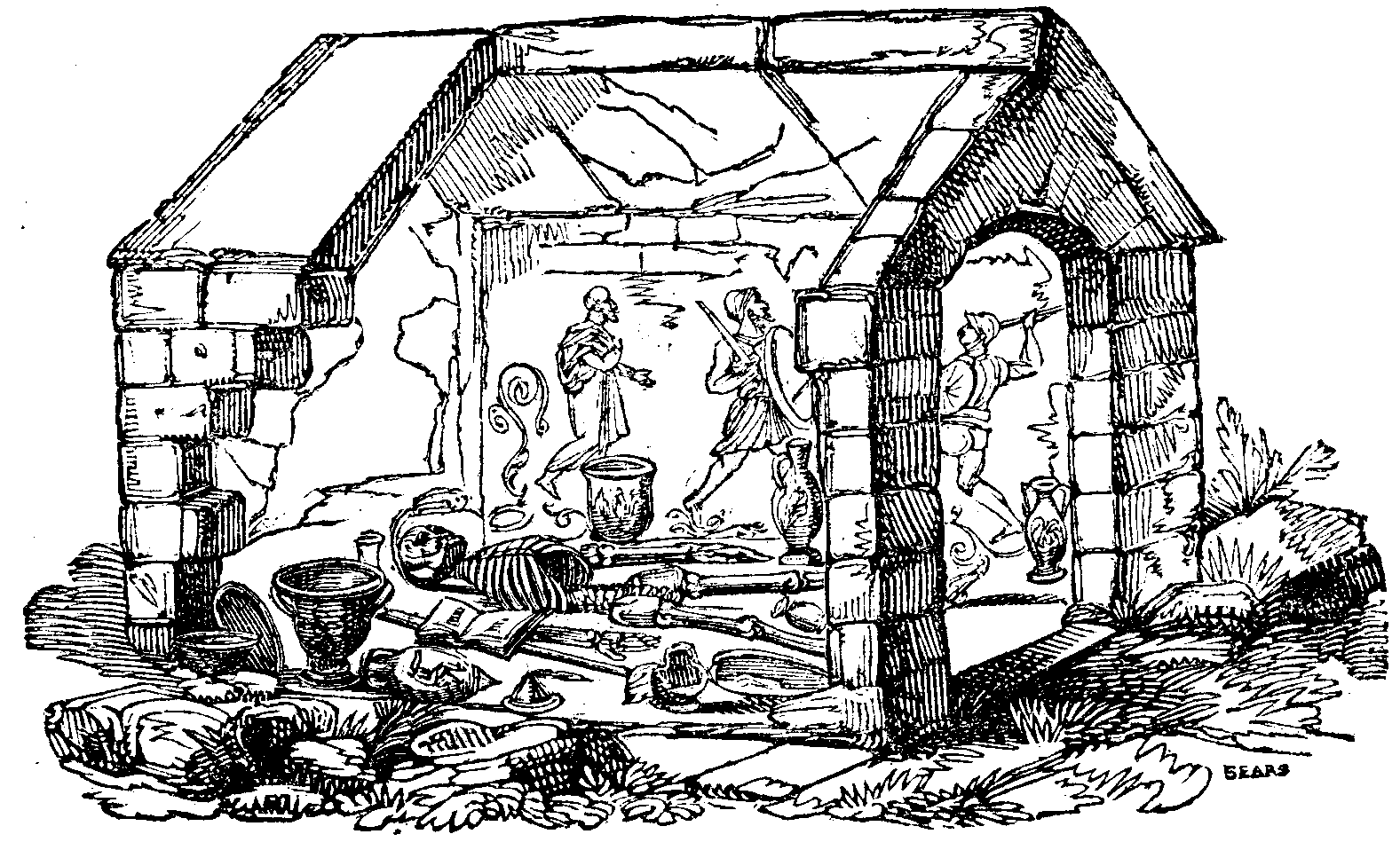
A beautiful illustration of an ancient Grecian sepulchre or funeral chamber, heads the second chapter of Mr. Britton's "Union of Architecture, Sculpture, and Painting," from which work we have copied the annexed engraved view. The interior of the chamber exhibits a skeleton and the urns containing the ashes of the dead. The combat leads us to the conclusion, that the tomb contains the remains of a chief; for it was the barbarous custom of the Greeks to sacrifice captives at the tombs of their heroes.
Of the funeral rites and ceremonies of the Greeks and other nations, we subjoin the following:—
The most simple and natural kind of funeral monuments, and therefore the most ancient and universal, consist in a mound of earth, or a heap of stones, raised over the ashes of the departed: of such monuments mention is made in the Book of Joshua, and in Homer and Virgil. Many of them still occur in various parts of this kingdom, especially in those elevated and sequestered situations where they have neither been defaced by agriculture nor inundation.
The ancients are said to have buried their dead in their own houses, whence, according to some, the original of that species of idolatry consisting in the worship of household gods.
The place of burial amongst the Jews was never particularly determined. We find that they had burial-places upon the highways, in gardens, and upon mountains. We read, that Abraham was buried with Sarah, his wife, in the cave of Macphelah, in the field of Ephron, and Uzziah, King of Judah, slept with his fathers in the field of the burial which pertained to the kings.
The primitive Greeks were buried in places prepared for that purpose in their own houses; but in after ages they adopted the judicious practice of establishing the burial grounds in desert islands, and outside the walls of towns, by that means securing them from profanation, and themselves from the liability of catching infection from those who had died of contagious disorders.
The Romans prohibited burning or burying in the city, both from a sacred and civil consideration, that the priests might not be contaminated by touching a dead body, and that houses might not be endangered by the frequency of funeral fires.
—Experiar quid concedatur in illos Quorum Flaminia tegitur cinis, atque Latina. Juv. Sat I.
The Romans commonly built tombs for themselves during their lifetime. Hence these words frequently occur in ancient inscriptions, V.F. Vivus Facit, V.S.P. Vivus Sibi Posuit. The tombs of the rich were usually constructed of marble, the ground enclosed with walls, and planted round with trees. But common sepulchres were usually built below ground, and called hypogea. There were niches cut out of the walls, in which the urns were placed: these, from their resemblance to the niche of a pigeon-house, were called columbaria.