The Months.
Reading edition
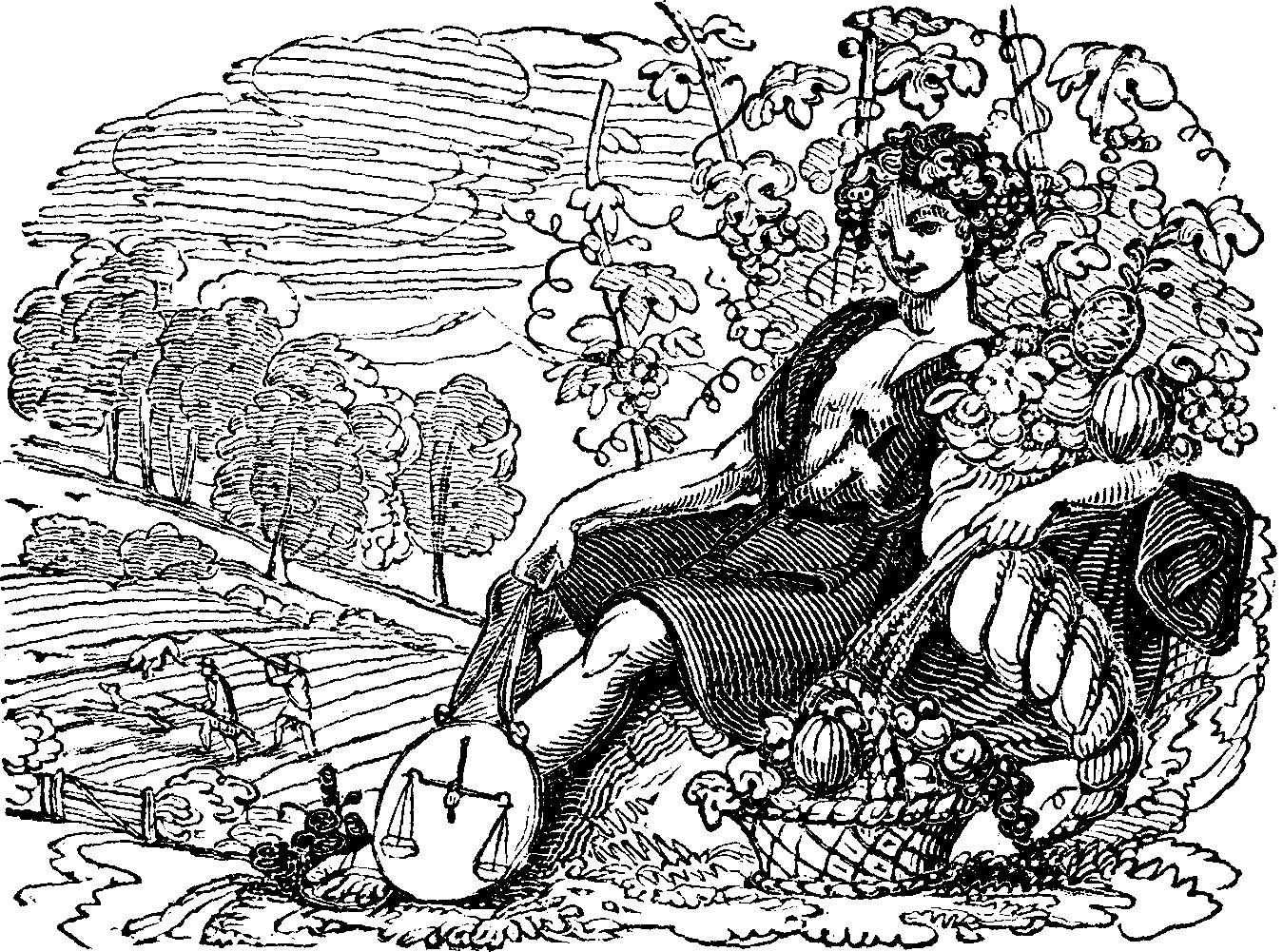
SEPTEMBER.
"Now sober Autumn, with lack lustre eye, Shakes with a chiding blast the yellow leaf, And hears the woodman's song And early sportsman's foot."
September is generally accounted the finest and most settled month in the year. The mornings and evenings are cool, but possess a delightful freshness, while the middle of the day is pleasantly warm and open. Hence the well-known proverb:
"September blows soft till the fruit's in the loft."
The destruction of the partridge commences with this month, large coveys of which may now be seen about the stubble fields, and in the corn, if any be left standing. These birds get very shy towards the end of the month, in consequence of being repeatedly fired at. Sportsmen, therefore, prefer the early part of the season, before the birds get too wild. Partridges, while the corn is standing, have a secure retreat from their numerous enemies; but when the harvest is gathered in, they resort in the day-time to groves and covers. At night, however, they return to the stubble to avoid foxes and weasels, &c., and there nestle together.
The swallow now takes his departure for milder regions, and many other of the small billed birds that feed on insects disappear when the cold weather commences. The throstle, the red-wing, and the fieldfare, which migrated in March, now return; and the ring-ouzel arrives from the Welsh and Scottish Alps to winter in more sheltered situations. All these birds feed upon berries, of which there is a plentiful supply, in our woods, during a great part of their stay. The throstle and the red-wing are delicate eating. The Romans kept thousands of them together in aviaries, and fed them with a sort of paste made of bruised figs and flour, &c., to improve the delicacy and flavour of their flesh. These aviaries were so contrived as to admit but little light; and every object which might tend to remind them of their former liberty was carefully kept out of sight, such as the fields, the woods, the birds, or whatever might disturb the repose necessary for their improvement. Under this management, these birds fattened to the great profit of their proprietors, who sold them to Roman epicures for three denarii, or about two shillings each of our money.
Towards the end of September the leaves of trees begin to put on their autumnal dress. Mr. Stillingfleet remarks, that, about the 25th, the leaves of the plane tree were tawny; of the hazel, yellow; of the oak, yellowish green; of the sycamore, dirty brown; of the maple, pale yellow; of the ash, a fine lemon-colour; of the elm, orange; of the hawthorn, tawny yellow; of the cherry, red; of the horn-beam, bright yellow; of the willow, still hoary. Yet, many of these tints cannot be considered complete, in some seasons, till the middle or latter end of October.
When the harvest is gathered in, the husbandman prepares for seed-time; and the fields are again ploughed up for the winter corn, rye, and wheat, which are sown in September and October. The entrances to bee-hives are straightened, to prevent the access of wasps and other pilferers.
ASTRONOMICAL OCCURRENCES
FOR SEPTEMBER, 1827.
(For the Mirror.)
The sun enters the cardinal and equinoctial sign Libra, on the 23rd at 8 h. 24 min. evening, once more bringing our day and night to an equal length; when 8 deg. of Gemini are due east, and 4 deg. of Aquarius due south, all the planets having a direct motion, and being below the horizon, Herschel excepted. The astrological aspects at this ingress are as follow:—Saturn is located in the third house; Mercury, Venus, and Mars in the fifth, the Sun, Moon, and Jupiter are in the sixth, while Herschel occupies the ninth.
Mercury is in conjunction with Mars on the 4th, at 1 h. morning; on the 6th with the fixed star, Regulus, or Corheoni; with Venus on the 18th, at midnight; and in superior conjunction with the Sun on the 24th, at 9-1/2 h. evening.
Venus rises at the beginning of the month about 4-1/2 h. morning, and towards the end at 5-1/2 h.
Mars rises through the month at 31/2 h. morning.
Jupiter is now gradually receding from our view, and will ere long be totally surrounded with the brighter beams of the Sun; his eclipses are therefore not visible.
Saturn is apparently now fast approaching this part of our hemisphere; he rises on the 1st at 12-1/2 h. and on the 31st at 10-3/4 h. evening.
Herschel culminates on the 1st at 9h. 6m. and on the 31st at 7h. 12m.
If the reader will refer to page 131 of the 8th vol. of the MIRROR, he will find his attention invited to the relative positions of the principal northern stars and constellations for September last year: their present appearance is precisely similar. Pasche.