ARCHERY
Reading edition
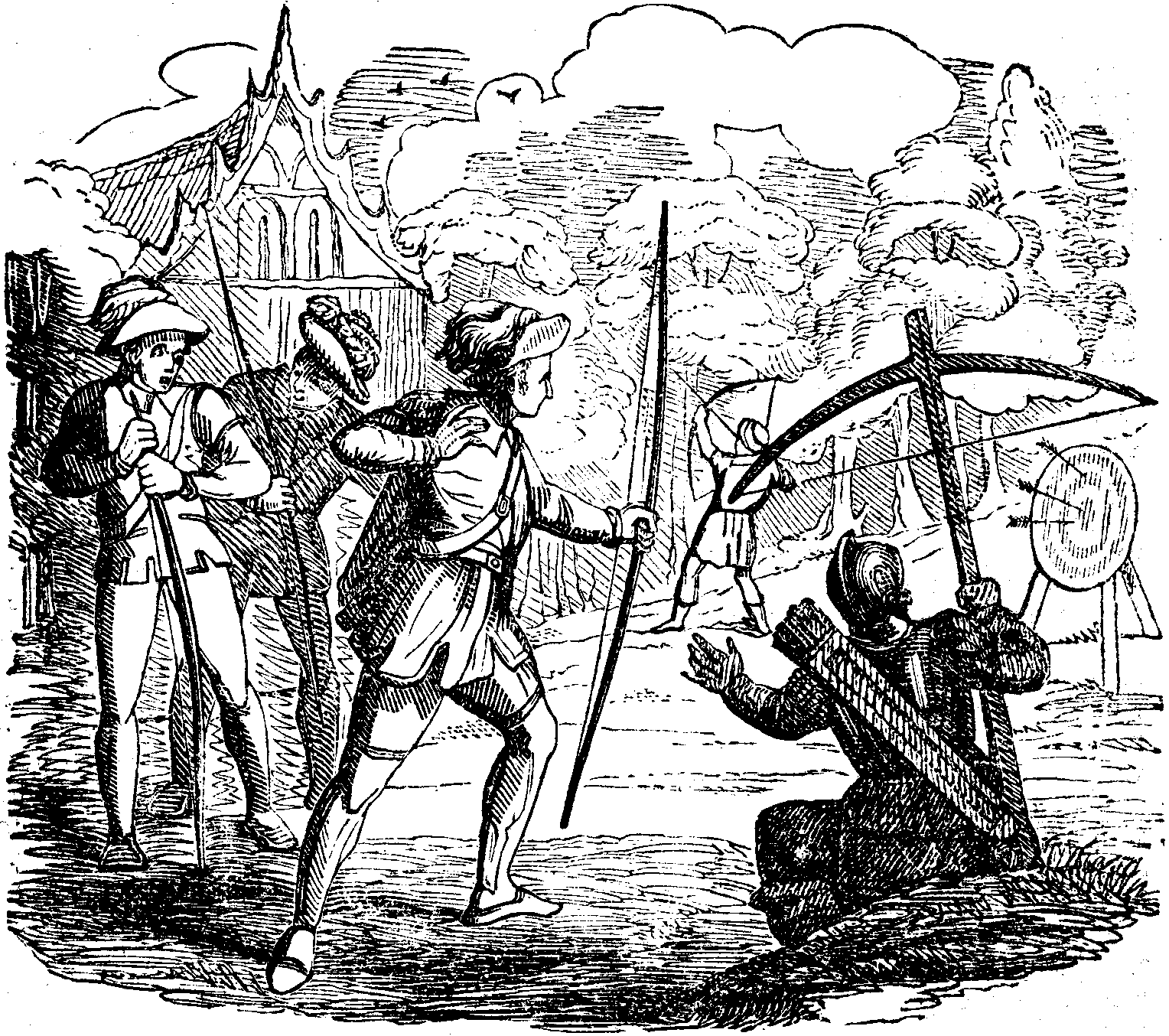
Previous to introducing the communication of a much respected correspondent, who has well described, by drawing and observation, a Royal Archer of Scotland, we shall offer a few general remarks on the subject of the above engraving, which relates to an amusement which we are happy to find is patronized in many counties in England by respectable classes of society at this day. No instrument of warfare is more ancient than that of the bow and arrow, and the skill of the English bowmen is celebrated. It seems, that in ancient times the English had the advantage over enemies chiefly by their archers and light-armed troops.
The archers were armed with a long-bow, a sheaf of arrows, a sword, and a small shield.
The cross-bowmen, as their name implies, were armed with the cross-bow, and arrows called quarrels.
A ROYAL ARCHER OF SCOTLAND.
(For the Mirror.)
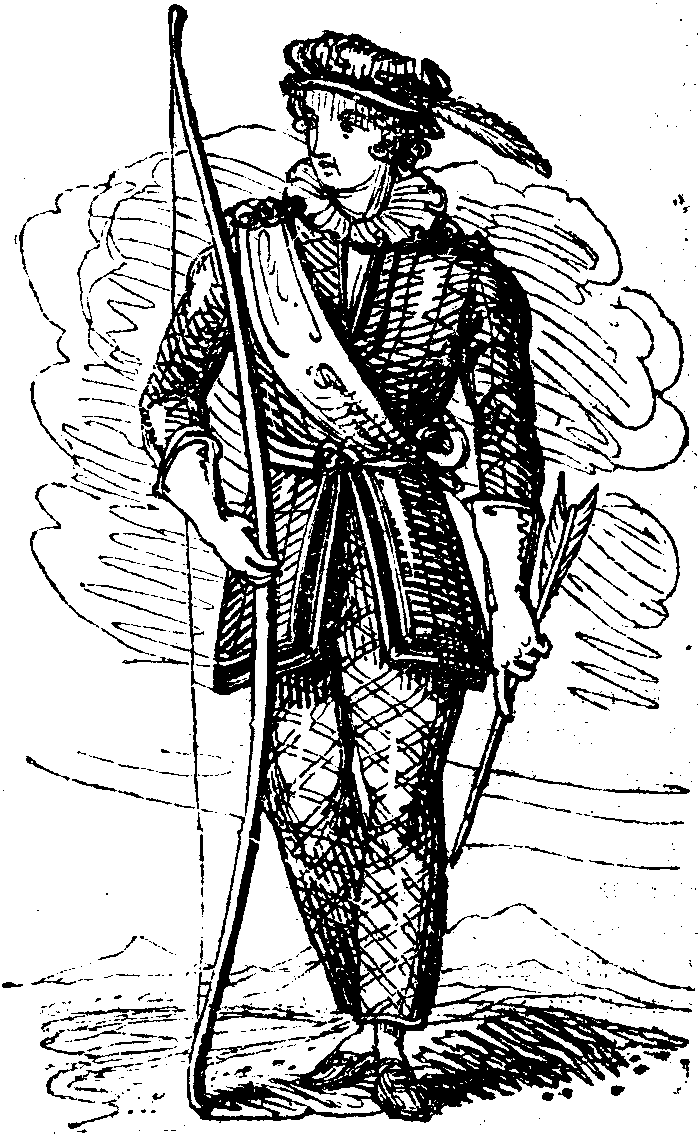
"Good-morrowe, good fellow,— Methinks, by this bowe thou beares in thy hand A good archere thou shouldst bee."
Old Ballad.
To this notice may I be permitted to subjoin a few stanzas? Old Izaak Walton hath put songs and sylvan poesy in plenty into the mouths of his anglers and rural dramatis personae, and shall I be blamed for following, in all humility, his illustrious example? Perchance—but hold! it is one of the fairest of summer mornings; the sun sheds a pure, a silvery light on the young, fresh, new-waked foliage and herbage; a faint mist veils the blue distance of the landscape; but the pearly shroud conceals not yonder troop of young blithe men, who, arranged in green, after the olden fashion, each bearing the implements of archery, and tripping lightly over the heath, are carolling in the joy of their free spirits, while the fresh breeze brings to my ear most distinctly the words of
THE ARCHER'S SONG.
Away!—away!—yon golden sun Hath chas'd nights' shadows damp and dun; Forth from his turfy couch, the lark Hath sprung to meet glad day: and hark! A mingling and delicious song Breathes from the blithe-voiced plumy throng; While, to the green-wood hasten we Whose craft is, gentle archery! Now swift we bound o'er dewy grass! Rousing the red fox as we pass, And startling linnet, merle, and thrush, As recklessly the boughs we brush. The hunter's horn sings thro' the brakes. And its soft lay apt echo takes; But soon her sweet enamoured tone Shall tell what song is all our own! On!—on!—glad brothers of the bow! The dun deer's couching place ye know, And gallant bucks this day shall rue Our feather'd shafts,—so swift,—so true; Yet, sorer than the sylvan train, Our foes, upon the battle-plain, Will mourn at the unerring hands Of Albion's matchless archer bands! Now hie we on, to silent shades, To glist'ning streams, and sunlit glades, Where all that woodland life can give, Renders it bliss indeed, to live. Come, ye who love the shadowy wood, Whate'er your days, whate'er your mood. And join us, freakish knights that be Of grey-goose wing, and good yew-tree! Say—are ye mirthful?—then we'll sing Of wayward feasts and frolicking;— Tell jests and gibes,—nor lack we store Of knightly tales, and monkish lore; High freaks of dames and cavaliers, Of warlocks, spectres, elfs, and seers, Till with glad heart, and blithesome brow, Ye bless your brothers of the bow! Is sadness courted?—ye shall lie When summer's sultry noons are high, By darkling forest's shadow'd stream To muse;—or, sweeter still, to dream Day-dreams of love; while round ye rise Distant, delicious harmonies; Until ye languishing declare An archer's life, indeed is fair!
M. L. B.