Chapter VI · (continued 2)
Reading edition
"'I questioned her closely, but did not express my opinion on the subject. I went to Bar-sur-Aube to get additional information; the physician declares it astonishing, especially when we consider her former hopeless condition. The hospital Sisters, the curés of Bar-sur-Aube, the patients, all say it is truly a miracle. The people of Ormoy and even of the vicinity, who come to see her, wonder that I do not mention it from the pulpit. I beg of you to let me know how to act in the affair, and also that you will speak to the Bishop about it.'
"The Bishop has since sent word through me to the curé of Ormoy, to publish this miraculous occurrence to his parishioners; he has also charged me with forwarding you a copy of the good curé's letter, leaving to your discretion the use you may make of it.
"I am, etc.,
"BARILLOT, Canon, Vicar General."
Before printing this, we wished to ascertain if the cure were permanent, and the Vicar General sent us the following response from the curé of Ormoy:
"The cure is permanent; for several months past the young woman has been with the Ursulines of La Chapelle, who consider her physically able to share in the labors of the house; her condition having been attested by three doctors. Her sudden recovery, as above mentioned, leads us to believe that it was surely supernatural. I was far from meriting this favor which has been granted my poor parish. I hope the Blessed Virgin will finish her work.
"November 3, 1835."
CURES WROUGHT IN THE CHABLAIS DISTRICT (SAVOY).
"The Borders of Lake Geneva, June 18, 1835.
"Monsieur:
"The country purged of Calvin's heresy by the labors of Geneva's holy bishop, is not a stranger to the blessings figured by the medal's mysterious rays. This wonderful instrument of Mary's liberality has been propagated with astonishing rapidity, though only a few months since we heard of it in our midst. I consider it a pious obligation to offer you a few small stones towards the construction of that temple of glory now in process of erection, to the honor of her, who has lately proved herself more powerful and merciful on earth than ever before. I am a young villager living amidst my family; I do not announce miracles to you, but merely recount facts just as I have seen or heard them. I could have subjoined a list of signatures, but I did not judge it necessary, the docile, religious heart deeming them superfluous, and the skeptic, fraudulent, like the facts. On a perusal of the first few phrases in each incident, persons living in the vicinity will recognize the individuals concerned, and thereby be more deeply impressed.
"1st. In the month of July, 1824, Mlle. C., aged twenty-nine years, bade, as she thought, a last adieu to her family; she and some other generous companions were going to one of the large cities in southern Italy to consecrate themselves there to the service of the sick and poor. After a few months' novitiate in a religious house devoted to works of this nature, she was attacked by one of those debilitating, wasting maladies that physicians are at a loss to define. Attributing it to the climate, the Superiors, after twenty-two months' ineffectual treatment at the novitiate, sent her to breathe her natal air. But change of air proved vain also, and the doctors at last ceased their visits, judging the re-establishment of her health an impossibility. About six years ago, she had improved sufficiently to walk a few steps beyond her chamber, and even remain in the open air some minutes, but amelioration was illusory, and since 1830 she had not been able to leave her couch of suffering except for a few instants. Many times during these last five years was she apparently on the verge of death, and that for several consecutive days, always, however, retaining her hearing and intellectual faculties, since she could respond by signs to the priest who visited her. It was he who gave me these particulars. Her condition had become such that it was judged advisable to administer the Last Sacraments. This house was now a school of edification, where Christians might study the price of sufferings and the heroism of patience. Finally, about the end of last April, this poor creature, so tortured for the past eleven years, conceived a hope of relief through the Miraculous Medal, but, mistrusting the somewhat extraordinary impressions the thought made upon her imagination, it was only from obedience she could be induced to commence a novena. The sole exercises consisted of repeating, three times a day, the invocation: 'O Mary! conceived without sin, pray for us who have recourse to thee!' On Wednesday, April 24th, the second or third day of the novena, she felt an irresistible desire to arise. It was yet very early in the morning; a little child assisted her to dress. Finding that her limbs support her, she begins to think it must be something miraculous, and, filled with joy, she wishes to announce the news to her mother, who is in an adjoining room. Arrived at the door, she is seized with fright, and precipitately turns back; but, being reassured of her newly restored strength by the facility with which she reaches her own chamber, she overcomes herself, and, retracing her steps, seeks the embraces of her mother, her sister and brother. Her unexpected appearance fills them with great emotion, and abundant tears attest the depths of their joy and gratitude. A clergyman, who often visited this lady, soon heard rumors of her recovery, but gave no credit to them. Meeting her mother on the street not long after, she burst into tears at sight of him, and was unable to express the cause of her emotion. Suspecting it, he went immediately to the house, and saw for himself what a miracle had been wrought. With Mlle. C., he unites in blessing her powerful protectress, the Immaculate Mary.
"Since that time, April 24, to the present date, June 18th, Mlle. C. rises about seven o'clock, hears Mass on her knees, employs herself in various duties during the day, makes visits and walks of half an hour's or even an hour's duration, and continues well, even her complexion begins to assume a healthy tinge. Her legs are still a little swollen, and she cannot yet take much nourishment.
"The sudden appearance of this person, whom every one had known to be seriously afflicted for eleven years, created an extraordinary sensation. All eyes were fixed upon her, and many persons even followed her. This took place in the capital of the province.
"2d. In the month of August, 1833, my sister, at the sight of a child who barely missed falling through an open trap door, was suddenly attacked by frightful nervous convulsions, which henceforth returned daily, and even as often as fifteen times a day. It was only at the end of two months that remedies, and a four weeks' strict hospital treatment, succeeded in checking them. Last year, they manifested themselves again in the month of February, but disappeared, leaving her a prey to great weakness, and a fever that kept her in bed four weeks.
"In the February of this year, the nervous convulsions returned, and with a frequency and force that were truly alarming. The patient wasted visibly, the paroxysms were renewed seven and ten times a day, and were of a most frightful character; the circulation of her blood seemed checked, her feet and hands were deathly chilled, she jerked her head with violence and precipitation, an agitated cry escaped her breast; the attack lasted from three to six minutes, and left her completely exhausted. The witnesses of this painful spectacle were affected to tears. She was taken to a skillful physician, who after seeing her in one of these convulsions, pronounced the case hopeless, saying, 'it baffled him, he could not understand it.' However, he prescribed remedies. Meanwhile, the first medals arrived in our midst. On Shrove Tuesday, my sister had five attacks, which she assured me were the worst she had ever had. Next day, wearing the medal, she began a novena, and the two convulsions she had that day were the last; never since has she felt the slightest symptom (and that without employing the prescribed remedies), neither has she had a sign of the fever, which last year replaced the less violent convulsions. This cure was wrought in an insensible, but very efficacious manner, the first day of a novena made through the medal. My sister immediately resumed the manifold duties of a laborious household. She attributes, and we also, her recovery to Mary alone. Thousands of times be love and glory to this good Mother!
"3d. In the Chablais district, on the frontiers of the canton of Geneva, lived a poor widow, the mother of quite a large family. This good woman, about sixty years old, had a natural predisposition to paralysis. At the age of forty-eight, an attack of this disease deprived her of the use of her left arm. At intervals since then, she has had spells of illness so serious and so protracted, that at least a hundred times she seemed on the verge of the tomb. She never consulted a physician, but animated with a lively, persevering faith, she employed only supernatural means. 'God and the Saints are the only good doctors,' she would say, and 'God and the Saints' rewarded her confidence. She has recovered from these hopeless maladies in an extraordinary manner. On the first of last March, her left foot lost the power of supporting her body in walking, doubtless owing to her natural predisposition to paralysis. Persons informed on the subject have given the following description of the convulsive movements of this poor woman's foot: suspended, it preserved its natural position, but on putting it to the ground, it immediately lost its balance; her body was bent, her knee turned out, the sole of her foot exposed, and the left side of her foot was the foundation of support for the left limb in walking. She went thus to church, distant about four minutes' walk; but even in that short space of time, the convulsive movements of the foot were sometimes such that she was not able to keep her balance, but fell to the ground. Every one pitied her, she was always calm and perfectly resigned. Her children had made for her an iron brace which reached to the knee, but after a trial, she was obliged to discard it, the remedy causing more suffering than the disease. During the Lenten season, some charitable persons advised her to seek Mary's assistance through the Miraculous Medal. The good widow did so, and wore her medal with the utmost confidence. On Holy Saturday, she perceived that her foot had become steady; the next day, Easter, without any remedies having been used, it resumed its natural position, and since that time, though a little weaker than the right, not once has it given way or turned. She attributes her recovery to the Blessed Virgin, whom she invoked by wearing the medal, so justly styled miraculous.
"I could cite many other less striking cases; one time it is a hardy peasant who attributes to Mary's intercession relief from violent pains; another time, a little child, who in a few days, is completely cured of a large tumor under its arm, accompanied by fever; a mother who tells me how her daughter's ill health is sensibly improved by the application of the medal; or a Protestant girl, who, after wearing it, abjures heresy, etc. Nearly all the children of our village wear the Miraculous Medal around their neck, they recite the invocation, they kiss the precious image and give it to their little sisters and brothers in the cradle to kiss.
III.
Graces obtained from 1836 to 1838 in France, Italy, Holland, etc.
CONVERSION AND CURE OF M. GAETAN (BOULOGNE).
This account was sent me by the curé of Boulogne, February 8, 1836.
"In my parish, a young man named Gaetan U—-, aged twenty-seven years, was leading a life of criminal intimacy with a woman. Several years after abandoning his mother and brother, that he might be under no restraint in his shameless course, he was prostrated by a serious pulmonary attack. M. Jean Pulioli, an excellent physician, undertook the case; but the violence or the disease overcame his skill, and the patient (still in the house of the bad character with whom he lived,) was reduced to such a deplorable state of exhaustion, that he could not move himself. From the beginning of his sickness he had insisted that he would not be worried by a priest. But the disease making very rapid progress, the doctor believed it his duty to warn a priest of his condition. My chaplain went immediately to see him, and earnestly entreated him to put an end to this scandalous state of affairs by marrying the woman, but all in vain. I then paid him a visit, and besides remarking in him neither any intention of marrying her nor of separating from her, I perceived from the excuses he gave, that his soul was enshrouded in impenetrable indifference. Having uselessly exhausted all efforts to effect a change, I concluded it would be better to leave him awhile to quiet and serious reflection, and return later to know his decision. I urged him to seek the mediation of that refuge of sinners, the Blessed Virgin, and slipping the Miraculous Medal under his pillow, I left. There was no necessity for my returning to learn his decision, he sent his mother for me, with whom he had become reconciled in the meantime; after informing me of the very just reasons he had for not marrying the woman, he asked me if I would not request her to leave, a commission I willingly accepted. She consented, and immediately abandoned the house. The sick man's peace and joy at this were indescribable; when I showed him the medal, he kissed it most fervently and impulsively, notwithstanding his state of exhaustion. Then, with every mark of sincere repentance, he confessed, received the Holy Viaticum and Extreme Unction, for we expected each moment he would breathe his last. This occurred January 19, 1836. Interiorly, he enjoyed unspeakable peace, a favor he always attributed to the Blessed Virgin. From this time he began to improve, and in a few days his health was completely re-established. He continues to persevere in his good resolutions, and full of the tenderest affection for his celestial Benefactress, he still reverently wears the medal I gave him, often kissing it with truly filial love.
"Monsieur, I was a witness of the above-mentioned fact; I send it to you, not only with the permission of the newly converted and cured, but at his request, and I hope that the knowledge will redound to the honor and glory of the Omnipotent God, who, through the intercession of the Blessed Virgin, has wrought this double miracle.
"I subjoin the certificate of the physician who attests the disease and its cure."
CURE OF A JUDGE AT NAPLES.
The judge of the civil tribunal of Naples, M. Joseph Cocchia, seriously debilitated by a chronic disease of the bowels, was afflicted with most violent pains, accompanied by a spasmodic sensation that, continually increasing, banished sleep and appetite, and perceptibly diminished his frame. This was followed by a bilious gastric fever, long and obstinate, of fifty days duration. When freed from the fever, the sick man found himself in a frightful state of emaciation and exhaustion; signs of inflammation in the bowels, and such extreme irritation that the least jolt induced fever, made skillful physicians fear lest these were the symptoms of an incurable malady still more deplorable. Whilst in this pitiable condition, there reached the sick man's ears accounts of the prodigies Divine mercy had wrought in favor of those who wore the medal; he eagerly asked for one, and received it with faith; henceforth, he had no longer any need of medical assistance, for he recovered the strength and perfect health he now enjoys.
CURE OF F.P. DE MAGISTRIS.
M.F. Paul de Magistris, aged seven years, was attacked about the middle of November, 1835, by a bilious gastric fever, which, by reason of accompanying circumstances, threatened to shorten his life. After three weeks' illness, his nervous system was also attacked, and he became a prey to a state of profound drowsiness that resulted in the loss of reason and speech. His afflicted parents, seeing the obstinacy of the disease, notwithstanding all efforts of medical skill to the contrary, considered the case hopeless, and their child lost to them. On the evening of January 9th, the curé administered Extreme Unction, believing, as did all the assistants, that the little sufferer had but a few hours to live. A young person, who came to the house, having mentioned the Miraculous Medal brought from France by the priests of the Congregation of the Mission, it was immediately procured, and, with confidence in its healing powers, applied to the child, whilst all present knelt around his bed and recited the Ave Maris Stella. Scarcely had they finished, ere he was considered out of danger. With renewed confidence in the medal, it was resolved to begin a novena in honor of the Blessed Virgin. During its progress, the disease diminished perceptibly, and the child has now entirely recovered. Its parents, as well as other persons of credit and veracity, among them the attendant physician, attest that, having witnessed his deplorable condition, they feel convinced his recovery was a miracle, resulting from the application of the medal.
February 22, 1836.
CURE OF A DROPSICAL MAN (SWITZERLAND).
"Soleure, January 19th, 1836.
"Baptiste, a wood sawyer, whom you knew during your sojourn in this city, was confined to his bed two whole months by an attack of the severest form of dropsy on the chest. One of our best physicians, who attended him at the beginning of his sickness, having told Baptiste's wife that the case was a hopeless one, the family decided to consult another, M. Gougelmann, at Attyswill, a league from Soleure. After seeing the patient, he also gave the same opinion, and the poor wife's distress was beyond expression. A pious lady, witnessing her grief, gave her a Miraculous Medal. The sick man's arms, legs, and whole body were greatly swollen. His breath was short, and he had scarcely any power of motion; his back, and his elbows upon which he was obliged to lean, were a mass of sores. In this pitiable state, death might be expected any moment. His confessor having come to visit him, brought the Notice of the miracles wrought through the Miraculous Medal. The sick man on receiving it began to read it aloud, greatly to the astonishment of his wife and the priest, who were both witnesses that he had been almost past the power of speech but a few minutes before. And he continued reading thus until he had finished the little book (it was one of the first editions). This was the evening of January 19. His wife, overcome with fatigue, fell asleep for a few moments, his children were in an adjoining room expecting at any instant to hear the sad news of their father's death. He slept a little towards three o'clock in the morning, and on awaking found himself so well that it was impossible to resist the desire of rising from his bed and throwing himself on his knees before a crucifix, in thanksgiving to Our Lord and His divine Mother. His wife awoke, and not seeing him in bed, called to know where he was. 'I am well; the Blessed Virgin has cured me,' was the answer of Baptiste, whom she perceived kneeling before the crucifix. The children, hearing the noise, hastened to their father's presence, believing him about to breathe his last, but judge of their surprise at finding him restored to health, and his sores perfectly healed! Imagine, if you can, the joy of this poor family, and the happy effects the news of this wondrous cure produced upon the many who heard it. Baptiste has had excellent health ever since."
CURE OF FRANÇOIS WENMAKERS, OF BOIS-LE-DUC (HOLLAND).
The Noord Brabander, a Holland journal, printed at Bois-le-Duc, contains in number 68 the following account of an extraordinary cure, which is attributed to the Blessed Virgin:
"Bois-le Duc, June 6th, 1836.
"The 25th of last April, François Wenmakers, a young apprentice, aged fourteen years, fell from a height of about sixteen feet. An affection of the brain and an almost complete paralysis of the lungs, larynx and oesophagus were the result; he was not in a condition to take any medicine into his stomach, or even to swallow the least liquid, and he was deprived of consciousness. One of the physicians, feeling worried at his fixed stare, advised the administration of Extreme Unction; and yet another, the eve of his recovery, declared him on the verge of death. The sick man moreover, had become nearly blind the last few days. On the 1st of May, advantage was taken of a lucid interval, to give him the Holy Viaticum; and on the 4th of the same month, he received Extreme Unction from one of the chaplains of St. Jean. His parents, who immediately after his fall, had hung a medal of the Immaculate Conception around his neck, seeing there was now no hope of his recovery, except in the divine goodness and the intercession of the Blessed Virgin, began, on the 16th of May, a novena in honor of the Mother of God. Three days after, about six o'clock in the morning, the patient suddenly asked his mother if the medal around his neck were blessed. She answered yes, regarding the question as the effect of delirium. He immediately kissed it, and sat up for the first time since the fall, for heretofore he had been stretched out helpless on the bed, and, for some days past, had been deprived of the use of his limbs. 'Something tells me,' he exclaimed, 'that I must get up, that I am cured!' The astonishment of those present may easily be imagined. The mother called his sisters, who repaired to the room with an elder girl, and they, seeing that he stoutly persisted in declaring himself cured, persuaded his mother to let him rise. He did indeed get up, and pointing to a picture in the room, representing the medal, he said: 'It is this good Mother who has cured me.' From that moment the boy's health was perfectly re-established, and his intellectual faculties were brighter than ever.
"Reflections here are superfluous. Glory to God and her who thus rewards the confidence of her servants! The parents and their child will ever remember the blessing they have received, and never cease to publish it!"
CURE OF ROSALIE DUCAS, OF JAUCHELETTE (BELGIUM).
Rosalie Ducas, of Jauchelette, near Jodoigne, aged four years and a-half, was, on the 9th of November, 1835, suddenly struck with total blindness without the slightest premonitory symptoms; there was no disease, no weakness, she was in apparently perfect health. Not only was the least light, but the least breath of air so painful, that her face had to be kept constantly covered with a cloth four doubled. This poor child's sufferings night and day, were heart-rending! At last the mother herself was taken sick. Some pious individual procured her a blessed medal of the Immaculate Conception. She took it and commenced a novena. Another medal was put on the child's neck, the 11th of June, 1836, about six o'clock in the evening; at midnight, the little one ceased its moans, on the fourth or fifth day of the novena, it opened its eyes. The mother and father redoubled their prayers to the Blessed Virgin, and on the ninth day, towards evening, the child recovered its sight entirely, to the great astonishment of the neighbors and all who were witnesses of the occurrence.
"The curé of Jodoigne-la-Souveraine, who had given the medal, has himself seen the child who lives not more than half a league distant; he positively asserts that it has perfectly recovered its sight, and that not the slightest vestige of the attack remains, which fact is well known, and contributes not a little in exciting devotion to the Immaculate Mary."
CONVERSION OF THE FATHER OF A FAMILY (BELGIUM).
"There are still in existence here some families who, persistently recognizing in the present clergy only a purely civil power, hold themselves utterly aloof, live in a state of schism, and comply with none of the duties of religion.
"One of these miserable creatures was afflicted with a virulent cancer on the side of his face, which for a long time had been eating away the flesh. The malady increasing, I believed it my duty to visit him and offer the consolations of my ministry. I saw him several times, he was suffering greatly; the oesophagus was exposed, the right side of his emaciated face presented only a deep sore, the eye, starting from its socket, hung suspended over a terrible disfigured mouth; his tongue caused him acute pain; his condition was pitiable indeed, especially as he seemed determined to die impenitent. He was a rough, blunt man, who wanted to hear nothing about priests or Sacraments. In vain was he reminded of our Lord's bountiful kindness and the rigors of His justice, nothing touched him; to all expostulations his invariable reply was: 'God's mercy is great, I will confess to God, the Blessed Virgin, to St. Barbara and the good Saints.' He was the counterpart of those men to whom Jesus Christ said: 'In peccato vestro moriemini—you shall die in your sin.'
"His relations and numerous friends endeavored both by prayers and entreaties to snatch him from perdition, but on the other side visited daily and sustained by his old associates in impiety, he persisted in dying as he had lived, in schism.
"In the meantime, I was obliged to be absent several days. This period was for him one of Divine mercy. A lady of the parish made a last attempt to recall him to God, by bringing him one of those medals of the Immaculate Conception called miraculous. She sent it to him with the request to wear it and put all his confidence in the Blessed Virgin. The sick man took the medal, kissed it respectfully, and put it under his pillow. In giving it to him, his daughter had taken care to acquaint him with its origin and advantages, at the same time urging him, as usual, to make his confession. 'Leave me in peace,' was the wretched father's reply, and she could say no more. Next day, a neighboring curé was sent for to administer Extreme Unction to another person in the parish. He came, and forgetting, as it were, the one for whom he had been sent, he thought only of the cancerous patient. 'I felt,' he afterwards told me, 'an inexplicable and irresistible desire to visit him, I could not have returned without seeing him.' He asks some one to announce his arrival to the sick man; this person speaks to the latter, and urges him to confess. 'The curé of P. is here,' she adds, 'and would like to see you, if you have no objection.' 'Well, yes, let him come.' The curé went to him immediately; at first there was a slight air of resistance about the patient, but it vanished, the hour of grace had come, he confessed with every indication of true repentance, and received Extreme Unction with an indescribable peace and joy, that never faltered during the four remaining days of his life. The Holy Viaticum could not be administered because he was not able to swallow.
"At noon, on the 18th of last May, the month consecrated to Mary, he died, aged seventy-eight.
"Except his former companions in irreligion, this conversion was a subject of rejoicing to the parish, and doubtless it will rejoice all the servants of Mary who hear of it. May this example, among thousands, inspire sinners with great confidence in the Blessed Virgin, propagate devotion to her, and multiply the medal styled miraculous!
"I have thought it a duty to give these few details, for the purpose of making known the truly visible effects of the protection of the Mother of God, and the ever impenetrable springs of grace in regard to man.
"I have the honor to be, Monsieur, with great esteem, &c."
CURE OF MLLE. ANTOINETTE VAN ERTRYCK (BOIS-LE-DUC).
"The protection of the Blessed Virgin, which for the last few months has shown itself so powerful in a neighboring kingdom, has also wrought wonders in Bois-le-Duc. Mary has here likewise given equal proofs of her maternal bounty when we have implored her intercession.
"Mlle. Antoinette Van Ertryck, aged twenty-five years, was for more than twenty months deprived of the use of her limbs; they were stiff and paralyzed, almost without feeling, and stretched motionless on a sort of bench made for the express purpose. Medicine afforded no relief. In this sad condition, wearing a blessed medal of the Immaculate Conception, she thought of making a novena in honor of the Feast, to recover her health. On the last day of the novena, she made a fervent communion. Even after the departure of the priest, who came to administer the Blessed Sacrament, there seemed no change for the better, but she felt a shiver through all her body, like the impression often experienced from sudden cold. Just whilst finishing the last prayers, however, she seemed to hear an interior voice saying to her: 'You are cured.' On attempting to move, she found that her limbs had become flexible, and she was able to walk. The miracle was wrought on Saturday, May 16th. The next day, Sunday, she went to church to return thanks for this blessing to the common Mother of all the faithful. The people of our city, always distinguished for their veneration for the Blessed Virgin, and their confidence in her intercession are not wanting in gratitude, and this new favor will but increase their devotion to Mary Immaculate.
"The duration of the malady, the inutility of medical skill, and her astonishing sudden cure are attested by the doctor.
"A. BOLSIUS, M.D."
CURE OF A YOUNG GIRL AT CRACOW, POLAND.
Extract from a letter of the Countess Lubinska:
"March 12th, 1837.
"I took into my service, the 20th of last December, a young girl whose excellent qualities elicited my deepest interest.
"After being with me some months, she began to suffer most acute pains in the head; the remedies we employed affording no relief, the attending physician advised her to keep her bed, and did not conceal from her his opinion that these pains proceeded from the humor flowing constantly from her ears, and which seeming to be upon the brain, threatened her life, or at all events, her reason.
"What confirmed this opinion was the fact that whenever she walked rapidly or stooped, she was forced by the pain to throw her head back, as she assured me various times during her sickness. The continued suffering induced her, at last, to follow the physician's advice, and consent, if necessary, to the operation of trepanning. I shuddered at the very idea, and made her promise to ascertain if a delay of ten days would be attended with any serious consequences. Upon a negative answer from the physician, I stopped all medicines and determined to try the efficacy of the Miraculous Medal. This was on a Saturday, and the very day observed by her as a strict fast, in thanksgiving to the Blessed Virgin for having miraculously cured her of a mortal typhus, after her mother had dedicated her to Mary. Her confidence in Mary was great; and as I did not give her the medal for some hours after promising it, she told one of her friends, as I have since learned, that her impatience to receive it was almost beyond bounds, and assured her that she would not have hesitated between it and two thousand francs had she been allowed a choice, and we must remember that this girl was very poor. To display more clearly the miraculous nature of the cure, God permitted her sufferings to increase to such a degree that very day, that notwithstanding her patience and resignation, it seemed as if she really could not endure them much longer. Knowing her lively faith and confidence, I deemed it unnecessary to enter into a detailed account of the salutary effects of the medal; I gave it to her; she immediately made with it the sign of the cross upon her poor head, repeated the invocation and fell asleep amidst excessive sufferings. On awaking she was perfectly cured, and has never since experienced the slightest symptom of the disease.
"Filled with sentiments of the deepest humility and the most lively gratitude, the miraculously cured now wishes to consecrate herself to God in the religious life.
"Blessed a thousand times be God and the Immaculate Mary, and may we ever appreciate such boundless mercy!"
CONVERSION OF M. REGNAULT, MAYOR OF POITIERS.—1837
The following account was sent us by the abbé of Chazelle:
"Poitiers, June 12th, 1837.
"M. Regnault, mayor of Poitiers, had exercised his functions since the year 1830. In some difficulties, occurring during his administration, with the bishop and several of the clergy, he had shown himself just and equitable. His charity to the poor was well known. But far different are these moral virtues, which generally receive their recompense here below, from the Christian virtues so seldom rewarded, except in a better world! M. Regnault never appeared at church, except when his presence as mayor was necessary. A prey for some time to a grave malady, he continued to exercise his functions as long as possible, imposing upon himself for that purpose many sacrifices, and displaying an admirable zeal; but, vanquished by the disease, he was at length forced to suspend his duties, and, since the 1st of last January, to resign altogether. The curé of St. Hilaire, having learned the alarming state of his parishioner's health, hastened to visit him, and offer the consolations of his ministry, but in vain. He repeated his visits. He was received into the house, but not taken to see the patient. He now sent word to the latter that he was at his command, and would come immediately when sent for. Meanwhile, the disease made such rapid progress that there was no longer any hope of recovery. Several of his friends, interested in his salvation, were grieved to see him so near death without the slightest preparation for it. One of them brought him a Miraculous Medal, and, not being able to see him herself, she asked a woman about the house to give it to him for her. The woman did so, and, fearing he might reject it with contempt, she begged him to receive it for the donor's sake. He took it, saying: 'It is a medal of the Blessed Virgin; I accept it respectfully, God is not to be trifled with.' And, putting it under his pillow, he sent a kind message of thanks to the lady who had given it. Some moments after, he takes it out, contemplates it, and kisses it respectfully.
"Having placed his temporal affairs in order, he now expresses a wish to do the same with his conscience, and requests his attendants to send for the parish curé. The latter hastens to the sick man's bedside. 'I have made you come in a hurry,' says the patient, 'I want to have a conversation with you.' After this conversation, he asks the curé to return next day, as he wishes time to prepare himself for the grand action he contemplates. 'The step I am about to take,' he adds, 'I do with full knowledge and entire conviction.' The curé of St. Hilaire, with whom, as mayor, he had just had a law-suit, suggested that he make his confession to some other priest; he answered that he wished no one but his pastor. Next day, the curé returned, and as he addressed his penitent by the title of M. the Mayor: 'Do not call me that,' said M. Regnault; 'you are now my father, I am your son, I beg you to address me thus.' The curé paid him frequent visits, and as the disease continued to progress, he suggested administering the Holy Viaticum and Extreme Unction. 'I have not been confirmed,' replied the pious patient, 'I ardently desire to receive Confirmation.' The bishop was soon informed, and, readily forgetting all subject of complaint, and thanking God for this unexpected change, the venerable prelate went at once to the sick man. The happy dispositions of the latter touched him deeply, and he administered to him the Sacrament of Confirmation the very day of his receiving Extreme Unction and the Holy Viaticum.
"It is impossible to give an idea of M. Regnault's faith and truly angelic fervor during this ceremony, or the deep impression made upon him at seeing Monseigneur enter his chamber. It was Saturday, January 21st, the eve of Septuagesima Sunday. Monseigneur addressed him in a few words full of unction and charity, and to inspire him with hope, reminded him of the very touching parable of the next day's Gospel, the laborers in the Father's vineyard, who coming at the last hour received the same recompense as those who had borne the heat and burden of the day. All the assistants were deeply affected at this edifying spectacle, and many were moved to tears. The bishop, on leaving, charged the curé to testify again to M. Regnault how great consolation he had experienced at this happy change, and how much he had been edified at his piety during this touching but long ceremony. 'As first magistrate of the city,' he answered, with a peaceful smile, 'I ought to set good example to those under my administration.' The curé sought by repeated visits to sustain this new-born piety, already tried most severely by the excruciating sufferings of the malady, sufferings which the patient bore with calmness and resignation, offering them to God in expiation of his past offences. To recompense his services to the city during his administration, the government bestowed upon him the cross of honor. The curé could not refrain from congratulating him. 'I do not know,' was the modest answer, 'I do not know what I have done to merit it,' and when reminded of his services to the city, 'Oh! do not speak of them,' said he, 'such things might awaken self-love!' What immense progress virtue makes in the soul in a very little while! It was in these happy dispositions he died, the 2d of the following February, Feast of the Purification. The whole city of Poitiers, we might say, assisted at the funeral. The bishop, the authorities, and a host of other distinguished personages came to pay their tribute of gratitude and admiration to his memory, and the prefect congratulated the curé of St. Hilaire on so wonderful a conversion."
MARY'S PROTECTION OF A LITTLE CHILD (PARIS).
Madame Rémond, living number 70, rue Mouffetard, held at her chamber window, on the second story, one of her children, aged twenty-two months. Fainting suddenly, she fell back into the room, and the child was precipitated upon the pavement below. Immediate death might naturally have been expected as the inevitable consequence of such a fall; but no, wonderful to relate, the child was not injured. After reading the Archbishop's circular (upon the occasion of the consecration of the church of Notre Dame de Lorette), in which he recommends all the faithful to wear the Miraculous Medal, the pious parents had hastened to procure one and put it on their child. The Immaculate Mary did not fail to reward their piety. On picking the poor little creature up, and examining it, not even the slightest bruise was discovered. As the mother was a long time recovering from her swoon, it caused great anxiety, and several physicians were called in to see her. They also saw the child, and declared its escape wonderful indeed. But by way of precaution, they applied a few leeches to it, and a poultice to one knee which seemed to be the seat of some slight pain. The child had been eating an instant before this terrible fall, which, strange to say, occasioned no vomiting, and immediately after being picked up it took all the little delicacies offered it. Every one declared this occurrence a miracle, and the innocent little creature itself seemed to proclaim it, by kissing the medal and pressing it to its lips, especially when the subject was mentioned, as we ourselves witnessed when the father showed him to us the 25th of June, 1837.
"The mother recovered perfectly, and she never ceases to thank the Immaculate Mary for the double protection she considers due the medal."
THE ARCHCONFRATERNITY OF
NOTRE DAME DES VICTOIRES.
Scarcely six years since the apparition of 1830, and already the designs of Providence were realized; the Miraculous Medal had awakened devotion to the Blessed Virgin, belief in the Immaculate Conception had penetrated all classes of society, and the innumerable favors accorded those who fervently recited the prayers revealed by Mary, had clearly proved how she prizes this first of all her privileges. But so far, her servants remained isolated, having no bond of union, no central point where they could meet; the majority of those who wore the medal as the livery of the spotless Virgin, knew neither the place, the mode, nor date of its origin.
God was now about to complete the work, by giving to this devotion, an organization and fixed exercises which favored its development, and increased the efficacy of prayer, by the power of association.
Towards the end of the year 1836, a man was raised up to execute the divine plans; this man was M. Dufriche Desgenettes, curé of Notre Dame des Victoires, Paris. From 1820 to 1832, in charge of St. Francis Xavier's Church, he numbered among the religious establishments of his parish, the Mother House of the Daughters of Charity, where the Blessed Virgin had appeared. He was one of the most earnest in thanking God for this grace, and most eager to propagate the medal. It was his desire that the privileged chapel should become a pilgrim shrine, but this desire not being realized, he was chosen by Providence to supply the substitute.
Let us quote his own words, relating how he was led to found the Archconfraternity of the Holy and Immaculate Heart of Mary. "There was in Paris, a parish scarcely known even to many of the Parisians. It is situated in the centre of the city, between the Palais Royal and the Bourse, surrounded by theatres and places of dissipation, a quarter swallowed up in the vortex of cupidity and industry, and the most abandoned to every species of criminal indulgence. Its church, dedicated to Notre Dame des Victoires, remained deserted even on the most solemn festivities.... No Sacraments were administered in this parish, not even to the dying.... If, by dint of novel persuasion, the curé obtained permission to visit a person dangerously ill, it was not only on condition of waiting until the patient's faculties were dimmed, but also on another almost insuperable condition, that of presenting himself in a secular habit. What benefit were such visits? They were merely a useless torment to the dying."[20]
Such was the parish confided to M. Desgenettes. With the hope of recalling to God, even a few strayed souls, the poor curé, for four years, employed every means that the most active zeal could suggest, but in vain. Sad and grieved beyond measure, he thought of quitting this ungrateful post, when a supernatural communication revived his drooping courage.
On the 3d of December, Feast of St. Francis Xavier, thoroughly penetrated with the inutility of his ministry in this parish, he was saying Mass at the Blessed Virgin's altar, now the altar of the Archconfraternity.... After the Sanctus, he distinctly heard these words pronounced in a very solemn manner: "Consecrate thy parish to the most Holy and Immaculate Heart of Mary." They did not strike his ears, but seemed to proceed from an interior voice. He immediately recovered peace and liberty of spirit. After finishing his thanksgiving, fearing to be the dupe of an illusion, he endeavored to banish the thought of what was apparently a supernatural communication, but the same interior voice resounded again in the depths of his soul. Returned to his house, he begins to compose the statutes of the association, with a view of delivering himself from an importunate idea, and scarcely does he take his pen in hand, ere he is fully enlightened on the subject, and the organization of the work costs him nothing but the manual labor of the writing.[21]
The statutes prepared, are submitted to Mgr. de Quélen who approves them, and the 16th of the same month, an archiepiscopal ordinance erects canonically the Association of the Holy and Immaculate Heart of Mary for the conversion of sinners. The first meeting took place on Sunday, the 11th of December. In announcing it at High Mass, the pious pastor expected to see in the evening not more than fifty or sixty persons at most. Judge of his astonishment on finding assembled at the appointed hour, a congregation of about five hundred, a large proportion of whom are men! What had brought them? The majority were ignorant of the object of the meeting. An instruction explaining the motive and end of the exercises made a deep impression; the Benediction was chanted most fervently, and there was a notable increase of fervor during the Litany of the Blessed Virgin, especially at the thrice repeated invocation: "Refugium peccatorum, ora pro nobis." The cause was gained, Mary took possession of the parish of Notre Dame des Victoires.
The good curé still doubted; to assure himself that the association was truly the work of God, he demanded a sign, the conversion of a great sinner, an old man on the borders of the tomb, who had several times refused to see him. His prayer was granted, the old man received him gladly, and became sincerely converted. It was not long before new graces showered upon his parish increased M. Desgenette's confidence, numberless sinners changed their lives, indifferent Christians became practical and fervent, the offices of the Church were attended, the Sacraments frequented, the apparently extinguished Faith was relighted, and this parish, lately so scandalous, soon became one of the most edifying in Paris.
The Confraternity of the most Holy and Immaculate Heart of Mary was not to embrace one parish only. God willed that it should extend throughout France, and even the entire world. M. Desgenettes, who understood this design, addressed himself to the Sovereign Pontiff, and obtained, April 24th, 1838, a brief, erecting the association into an Archconfraternity, with the power of affiliating to itself other associations of the same kind throughout the Church, and granting them a participation in the spiritual favors accorded it. From this day, the Archconfraternity developed wonderfully, and became an inexhaustible source of graces. The church of Notre Dame des Victoires was henceforth numbered among the most celebrated sanctuaries in the world. At all hours may the faithful be seen around its altars in the attitude of prayer and recollection. The re-unions which take place every Sunday present a touching spectacle, a dense crowd composed of persons of every condition, who, after fervently chanting Mary's praises, listen attentively to a long series of petitions received in the course of the week from all quarters of the globe.
These present a picture of all the miseries, all the sufferings, all the corporal and spiritual necessities possible; to which are added numberless acts of thanksgiving for benefits obtained through the associates' prayers. These petitions are so multitudinous that they cannot be announced except in a general manner and by categories; they actually amount, each week, to the number of twenty-five or thirty thousand, and, for the entire year, form a total of a million and a half. At the time of its founder's death, the Archconfraternity numbered fifteen thousand affiliated confraternities in all quarters of the globe, and more than twenty million associates. At the beginning of this year, 1878, the affiliated confraternities amount to 17,472.
A bulletin, issued monthly, gives an account of the progress of the Archconfraternity, the exercises which take place at Notre Dame des Victoires, the graces obtained, etc. The first nine numbers were published by M. Desgenettes himself, but at irregular intervals; they are full of interest and edification.
Amidst the wonderful success of his work, the venerable pastor, far from seeking any of the glory, thought only of humbling himself; regarding his share in it as naught but that of a simple instrument, he confesses even his resistance to the inspirations of grace, his doubts, his incredulity;[22] he will not admit that he may be called the founder of this work of mercy; it is God who has done all, it is the Immaculate Heart of Mary, that has opened to poor sinners a new source of graces, as for himself, he was not even the originator of the idea.
These sentiments reveal the soul of a saint; the true servants of God are always humble of heart, and the good they accomplish is in proportion to their self-abasement.
In his deep gratitude to God, the pious curé never forgot the bond attaching Notre Dame des Victoires to the chapel of the Daughters of Charity; he always loved this blessed sanctuary; it was there Mary had concealed the source of those vivifying waters which flowed through his parish; it was there this Mother of divine grace had promised those benedictions which the Archconfraternity reaped so abundantly. To preserve the remembrance of this mysterious relation, he desired that the medal of the association should be the Miraculous Medal. Henceforth, the influence of this medal became confounded with that of the Archconfraternity, the extraordinary graces attributed to the former were often due the associates' prayers, and reciprocally, for example, the conversion of M. Ratisbonne. In this case, as in many others, two equally supernatural means united to obtain the same result.
It is related that M. Desgenettes, seeing the Daughters of Charity frequently around the altar of the most Holy Heart of Mary at Notre Dame des Victoires, would sometimes say to them: "My good Sisters, I am much pleased to see you in my dear church, but know that your own chapel is the true pilgrim shrine, it is there you have the Blessed Virgin, there she manifested herself to you.——"
The Miraculous Medal, as revealed to Sister Catherine, bears on the reverse the Sacred Hearts of Jesus and Mary, the first crowned with thorns, the second pierced by a sword. These are symbols which all comprehend. Are they not, at the same time, a prophetic sign?
We are permitted to recognize here a foreshadowing of that devotion which would be rendered by the Archconfraternity of Notre Dame des Victoires, to the most Holy and Immaculate Heart of Mary.
We may likewise see pre-figured, that later development in our day, of devotion to the Sacred Heart of Jesus, a devotion born in France, and which the entire nation wishes to proclaim amidst pomp and grandeur, by the construction of a splendid monument, that from the heights of Montmartre, shall overlook all Paris.
Thus by a mysterious gradation, the medal of the Immaculate Conception has conducted us to the Immaculate Heart of Mary, and the Heart of the Mother has introduced us into the Heart of the Son, the adorable Heart of Jesus, that Heart which has so loved men, and which saves nations as well as individuals.
IV.
Graces Obtained from 1838 to 1842, in Greece, America, China, etc.
CURE WROUGHT IN SANTORIN (GREECE)—1838.
Letter of M.N., Priest of the Mission, in Santorin:
"Mme. Marie Delenda, wife of M. Michel Chigi, son of the Vice-Consul from Holland to Santorin, for seven years had suffered most excruciating pains, inducing such a state of nervous sensibility, that she was unable to bear the least excitement. She had had several children, but they all died before birth and receiving baptism. The physicians consulted, declared unanimously, that her disease was incurable, and that none of her children would ever come into the world alive. Greatly distressed at such a sad prospect, she had recourse to the Miraculous Medal, and obtained from it what medical skill was unable to effect; her next child, born not long after, was a fine, live, healthy one. Her husband, as pious as herself, was transported with joy and gratitude. 'Behold!' said he to the attendant physician, and conducting him to an image of the Immaculate Mary, 'Behold our Protectrice, our Liberatrix, the Mother of our child!' The physician knelt, said a prayer and retired. Since then, the mother's health is good; at least she has had no relapse of her former apparently incurable disease, which recovery is sufficient to attest the protection of Mary Immaculate. Full of gratitude, the two spouses have never ceased to urge the erection of the altar and inauguration of the image of Mary Immaculate, in fulfillment of their promise.
"Several other miraculous cures have also been wrought there through the invocation of Mary Immaculate. I am assured of this; four of them are well attested, and really marvelous. The bishop, the clergy, the people of Santorin, are all ready to affirm my assertions, and not one of them but would be more likely to exaggerate than detract from my account. When Monseigneur went to visit the Chigi family after the birth of their child, he asked to see the image, and looking at it, said: 'This is the second miracle wrought in Santorin by the Immaculate Virgin. The first is known to me through the confessional, and consequently, I cannot divulge it.'
"It was on the 28th of May, the inauguration of the image of the Immaculate Conception took place. Monseigneur himself officiated in the translation, after the High Mass and procession terminating the Forty Hour's Devotion at the cathedral. The image was placed upon an altar prepared for the purpose, in the court-yard of the donor's house. From the altar to the outer door, a very prettily decorated arched pathway was formed by means of drapery, and upon the threshold, was a triumphal arch. All the pavement, not only in the court but even to our church, was covered with flowers and fragrant grasses. Monseigneur, preceded by the clergy, and followed by all the Catholics and a number of Greek schismatics, repaired to the place where the image was exposed. Having incensed it, he intoned the Ave, Maris Stella, and the procession began to move. The clergy with the cross at their head commenced to defile. Then came two young girls bearing each a banner of white silk, whereon was depicted the spotless Virgin, these were suspended diagonally at the entrance of the sanctuary. Next, were two more young girls holding extended, the front of the altar representing the reverse of the medal, and finally, the image borne by the donor and one of his nearest relatives. Monseigneur walked immediately after, and behind him, Mme. Chigi holding her child in her arms and accompanied by her sister. The people were not in the ranks of the procession, but ranged along each side, that they might readily see the image and kiss it as it passed, which they did with so much eagerness and enthusiasm that there was considerable danger of its meeting with an accident. This, however we averted by many precautions, and at length reached the church. At the entrance, another very beautiful triumphal arch had been erected, surmounted by a large representation of the reverse of the medal upon a floating banner, bearing the inscription: 'Ave, Maria Immaculata.' The church door was decorated with drapery, likewise the interior of the walls, which were also hung with flowers, verdant crowns and garlands. The image was now placed upon a temporary throne, which had been prepared until a more suitable one could be erected. Another High Mass was celebrated, at the end of which the children chanted alternately with the choir the 'Te Mariam laudamus,' this being the first time it was ever heard in this country. The other individuals I have already mentioned as having been cured through the Immaculate Mary's intercession, made each one a votive offering to her image. One gave a veil, another a pretty golden cross, which decorated the Blessed Virgin's bosom during the ceremony; a third proposed having a silver crown made in fulfillment of her vow, but she was advised to give something else, since several others in unison had already promised a most beautiful golden crown."
CURE OF MLLE. ÉLISE BOURGEOIS.
Letter of the Superior of the Daughters of Charity, in Troyes:
"Troyes, March 4th, 1842.
"In 1838, we had in our work-room a young woman, named Élise Bourgeois, aged eighteen years, who, after great suffering, was attacked by an anchylosis in the knee. For seven months and a half she suffered excruciatingly, and her malady had reached the crisis. Her limb had shrunk up about two inches, and she could not walk without the aid of a cane or some one's arm. On the 8th of April, which was Monday in Holy Week, one of our young Sisters told me that the Notice contained an account of a Christian Brother, whose foot on the point of being amputated, was cured by the sole application of the Miraculous Medal, one night when his sufferings were greater than usual. I now reproached myself for having allowed this poor child to be so long afflicted, without our once thinking of having recourse to Mary for her recovery; and ascending to the work-room, I related to the children this account of the Christian Brother, and told the young woman to arouse her faith, to put all her confidence in Mary Immaculate, to apply the medal to her knee, and commence a novena with her companions. All Tuesday night her sufferings were great indeed, she said it seemed as if all her bones were dislocated. Nor was she able to obtain a moment's repose the next day. There now issued from a little hole which had formed in her knee, a quantity of serous matter. The day following, she arose with much difficulty, and was taken to the chapel where she heard Holy Mass. At the elevation, she placed her sound knee upon the bench, saying most fervently to the good God: 'Since Thou art present, deign to cure me, that I may be entirely Thine.' She immediately felt something like the touch of a hand, which replaced the bones in their natural position, and lengthened the shrunken limb; but she did not yet dare rest upon it, for fear of injury. At the end of Mass, she knelt to receive the priest's benediction, and in spite of herself, she rested her weight upon the afflicted knee. She remained in the chapel with her companions to say her prayers and thank the Blessed Virgin for the great favor just obtained. From that time she has never suffered the slightest pain in the limb, and it appears perfectly sound.
"As soon as the children perceived that she was cured, they declared it a miracle, and all hearts were filled with the deepest emotion and gratitude. Élise now asked permission to go to the cathedral to confession; a request I granted reluctantly, although she assured me she was not suffering in the slightest, yet she had not been out for seven months and a-half, and I could scarcely realize her recovery. Several Masses of thanksgiving were said in our chapel, during the first of which we had the Blessed Sacrament exposed, and the Te Deum chanted. The noise of this miracle soon spread throughout the city, and several persons came to see the healed one. She also requested permission to go to the house of one of her uncles, who had a very impious neighbor, that had been informed of her miraculous recovery, but who had also been told that he need not believe until he had seen Élise for himself. He was perfectly convinced, acknowledged it beyond denial, and said that in thanksgiving, a Te Deum should be chanted in the cathedral.
"I forgot to say, that our physician had seen this young woman two months before her recovery and pronounced the disease incurable. I had also had her examined by a surgeon, who ordered much blistering, but without expecting a cure."
Accompanying this letter are the signatures of seven Sisters of Charity and twenty-three other individuals, witnesses of the miracle.
A TRAIT OF PROTECTION. (TEXAS).
The following was sent us by Mgr. Odin, Vicar Apostolic of Texas, in a letter dated April 11th, 1841.
"I had, in the city of Nacogdoches, an opportunity of witnessing how Mary Immaculate loves to grant the prayers of those who put their trust in her. A Maryland lady, on leaving her native State to settle in Texas, had received a Miraculous Medal; her confessor, on giving it to her, exacting the promise, that she would never omit the daily recitation of the little prayer, 'O Mary! conceived without sin, pray for us who have recourse to thee!' and assuring her at the same time that this good Mother would never allow her to die without the last consolations of religion. She faithfully complied with her promise. For four years she was confined to her bed, and often, it was thought, at the point of death, but her confidence in Mary, always inspired her with the hope of receiving the last Sacraments ere leaving this world. As soon as she heard of our arrival, we were summoned to her bedside; she received the Holy Viaticum and Extreme Unction, and expired a few days after, filled with gratitude for her celestial Benefactress.
CURES AND INCIDENTS OF PROTECTION. (CHINA).
In a letter of July, 1838, Mgr. Rameaux, Vicar Apostolic of the provinces of the Kiang-Si and Tché-Kiang, in sending us the invocation of the medal translated into Chinese, says, that the Chinese have a great devotion to this little prayer, and always follow the Ave Maria by a recitation of it. He also informed us, that Mgr. de Bézy, Vicar Apostolic of the Hou-Kouang, and M. Perboyre, Missionary Apostolic, would transmit to us several accounts of miraculous marks of protection. We received these accounts some months later, and quote them as follows:
"1st. In the province of the Hou-Kouang, a Christian had been racked by a terrible fever for two months, accompanied by constant delirium. Three physicians had attended him, but in vain. Finding himself on the verge of death, he sent for me to administer the Last Sacraments. I gave him the Holy Viaticum, but deferred Extreme Unction, seeing that my duties would retain me in that locality some time longer. I made him a present of the medal, and advised a novena, assuring him, that if it were for the benefit of his soul, he would be restored to health. He began the novena; on the seventh day, the fever left him, and on the eighth he had recovered his usual strength. On the ninth day of the novena he came to see me, and assured me that he was perfectly well. I reminded him of thanking the Blessed Virgin for so great a favor, and he promised to recite with his friends the Rosary in her honor. But our Christian, pre-occupied with various affairs that his sickness had interrupted, forgot the promise. Five days after, he had a relapse. This made him conscious of his fault; he approached the Sacraments again, and began another novena. Though he continued to grow worse from day to day, I still had great hopes that the Immaculate Mary would come to his assistance, and I assured him of his recovery before the end of the novena. My confidence was not deceived; he recovered entirely, to the great astonishment of all the Christians. This time his gratitude was effectual, and the fever did not return.
"2d. In Tien-Men, a village of the same province, the Christians, numbering about two hundred, are distinguished for their piety and a great devotion to the Blessed Virgin. For eight years, successive inundations had reduced these Christians to extreme poverty; but this year, at the first sign of an overflow, they had recourse to Mary Immaculate by means of the medal, and soon the waters retired without doing the slightest harm to the Christian territory, whilst that of the pagans was devastated. And our Christians now return most grateful thanks to their good Mother for the abundant harvest they have just gathered.
"3d. The following account was sent us by M. Perboyre, in a letter of August 10th, 1839. The reader will learn, with interest, that this is the same missionary who, arrested a month after for his religion, so generously confessed the Faith one whole year amidst the most frightful tortures, and at last consummated the sacrifice by his glorious martyrdom, September 11th, 1840.
"Whilst I was giving a mission to the Christians of the Honan province, November, 1837, they brought to me a young woman who had been afflicted with mental aberration for about eight months, telling me she was very anxious to confess, and, though she was incapable of the Sacrament, they begged me not to refuse her a consolation she appeared to desire so earnestly. Her sad condition of mind precluded all idea of her deriving any benefit from the exercise of my ministry, but I heard her out of pure compassion. In taking leave of her, I placed her under the especial protection of the Blessed Virgin—that is, I gave her a medal of the Immaculate Conception. She did not then understand the value of the holy remedy she received; but, from that moment, she began to experience its beneficial effects, her shattered intellect improving so rapidly that, at the end of four or five days, she was entirely changed. To a complete confusion of ideas, to fears that kept her ever in mortal agony, and which, I believe, were the work of the demon, succeeded good sense, peace of mind and happiness. She made her confession again, and received Holy Communion, with the most lively sentiments of joy and fervor. This especial instance of Mary's generosity will doubtless surprise you little, you who know so well that the earth is filled with her mercy; but your hearts will be excited anew to fervent thanksgiving for this particular favor, which is the principal reason of my acquainting you with it."
1st. Letter from a Missionary of Macao, dated August 25th, 1841:
"A widow who had but one son, reared like herself in paganism, saw him suddenly fall under the power of the demon; his paroxysms were so furious that all fled before him, and he ran through the fields uttering the most lamentable cries. Anyone that attempted to stop him was immediately seized and thrown to the ground. His poor mother was in despair, and almost dying of grief, when Divine Providence deigned to cast upon her a look of compassion. One day when he was unusually tormented, the young man fled hither and thither like a vagabond, not knowing where he went; everyone tried to stop him, but he brutally repulsed all who lay hands on him. The most merciful God permitted a Christian to be among the number of those who witnessed this spectacle. Animated with a lively faith, and touched at the unfortunate creature's sufferings, the Christian told all who were pursuing the demoniac to desist, that he unaided could arrest him, that he would quiet him, and restore him docile and gentle to his mother. This language astonished the pagans, but they did as requested, although thinking the Christian ran a great risk. Our good Christian wore the Miraculous Medal of the Immaculate Mary; taking it in his hands he approached the possessed, and showing it to him he commanded the demon to flee and leave the young man in peace. The demon obeyed instantly, and the young man seeing the medal in the Christian's hands, humbly prostrated himself before the miraculous image, without knowing what it was. The pagans, watching from a distance, were greatly astonished. The Christian now commanded the young man to rise and follow him, and still holding in his hand the medal, which was as a magnet attracting the young pagan, he thus conducted him to his mother. 'Mother,' he exclaimed, to her great consolation, as soon as he saw her, 'Do not weep any more, I am freed from the demon; he left me as soon as he perceived this medal.' Imagine the poor mother's joy, on hearing these words! She was perplexed to know whether it was a dream or a reality! The Christian reassured her, and recounted all that had passed, adding, that her son would never be possessed again, if she renounced her idols and became a Christian. She promised sincerely, and they immediately began to divest their altar of its false gods. Then the Christian, feeling assured they would be faithful when instructed in the truths of religion, withdrew, laden with the thanks of both mother and son for the inestimable service he had just rendered them."
2d. Extract of a Letter from M. Faivre, Priest of the Mission in the Province of Nankin, May 6th, 1841:
"The two great means God uses for the accomplishment of good in this Mission are our Lord's cross and the Immaculate Mary's protection. As to the most powerful protection of Mary conceived without sin, we have experienced it so often, and in so especial a manner, both as regards ourselves and the welfare of the Mission, that it would be tedious to recount in detail, even if I wished to do so, all the favors we have received at her maternal hands.
"Seeing the Blessed Virgin's clemency towards us and our Christians, we have done all we could to honor her and advance her honor among the Christians, by seeking to inspire them with the most lively confidence in this good, holy Mother. On the Feast of the Assumption, 1839, we consecrated this Mission to her, and ever since it has been called Mary's Diocese. We have given as a rule to our virgins especial devotion to the Immaculate Conception. We have established Mary Immaculate patroness of the seminary Providence has created in this Mission. (This seminary now numbers six scholars who lead lives of regularity and edification, and make rapid progress in the study of Latin.) One of our virgins, already advanced in age, had been for several years confined to her bed, without the slightest hope of recovery, the thirteen physicians who had been successively consulted having declared her malady incurable. Seeing her end approach, she asked for the missionary, that she might receive the Last Sacraments. He came, and administered the Sacraments of the dying, exhorting her to accept death in a spirit of conformity to the will of God. She replied that she was fully resigned to His holy will, and had no hope of deriving any benefit from human means, but she felt convinced that if she could get a Miraculous Medal, her health would be restored. The missionary, seeing so much faith and confidence, gave her the one he wore, having no other convenient just then, and recommended her to make a novena in honor of the Immaculate Conception of the Blessed Virgin. All the family joined her in making the novena, and from the fifth day she was entirely cured. The attending physician, who was a pagan, coming to see her at the end of the novena, was utterly surprised to find her so well, and he eagerly inquired what extraordinary remedy had been employed to effect such a change. She replied that she had used no remedies, but the Lord of Heaven had restored her health. The physician returned, filled with veneration for the Lord of Heaven, who had displayed such great power; and the virgin, in expression of her gratitude to the Immaculate Mary, her august Benefactress, donated three hundred piastres to repair a chapel dedicated to Mary."
CONVERSION OF M. RATISBONNE, AN ISRAELITE.
Rome, 1842.
M. Alphonse Ratisbonne belonged to a Jewish family of Strasburg, distinguished in the world as much for its social position as the universal esteem in which it was held; he himself was a member of a society for the encouragement of labor, contributing thus to the benefit of his unfortunate brethren. Towards the end of the year 1841, he became affianced to a young Jewess, who united in her person all those qualities calculated to assure his happiness. Before entering upon this new state of life, he decided to take a pleasure trip to the East, visiting on the way some of the most remarkable cities of Italy. There was nothing, he thought, interesting to him in the Eternal City, so from Naples he would direct his course to Palermo; but Divine mercy called him, though he did not recognize the voice; he is constrained, as it were, by a secret design of Heaven, to change his determination, and visit Rome. It was in this centre of Catholic unity that the God of all patience and goodness awaited him, it was here that grace was to touch his heart. But what were his dispositions? Thou, O Lord, knowest them!... His hatred of Catholicity was very far from suggesting a thought of his ever embracing it. He felt for our holy and sublime religion that violent animosity which could not contain itself, which chafed at anything reminding him of Christianity, and which had even grown more rancorous since his brother M. Theodore Ratisbonne's abjuration of Judaism and reception of Holy Orders. He could not pardon this desertion, and his implacable hatred increased with time. But the innocent object of his aversion never ceased to supplicate Heaven to shed a ray of divine light upon the deluded brother, who loaded him with indignation and contempt. Made sub-Director of the Archconfraternity of Notre Dame des Victoires, he often implored the associates' prayers for this brother's conversion.
Such were M. Ratisbonne's sentiments when he entered Rome. He had scarcely arrived ere he thought of leaving; everything he saw in the Holy City urged him to hasten from it, everything excited him to declaim against what shocked and vilified his belief.... He was not proof, however, against a species of emotion in visiting the church of Ara Coeli; but it was an emotion which lost all its influence, (if influence it could be said to have exerted upon this heart buried in the shades of death,) when he understood that it was the general effect produced by the first sight of this remarkable monument. So, far from giving way to it, he hastened, on the contrary, to affirm that it was not a Catholic emotion, but an impression purely religious. In traversing the Ghetto, his hatred against Christianity was still more inflamed at witnessing the misery and degradation of the Jews; as if the chastisement of that deicidal people had been inflicted by the children of the Church, as if this people had not called down upon itself the vengeance of innocent blood!
Before leaving Rome, M. Ratisbonne was to visit one of his childhood's friends, an old schoolmate with whom he had always kept up an intimacy, although their religious belief was so widely at variance. This friend was M. Gustave de Bussière, a zealous Protestant, who several times had endeavored to profit by their intimacy, by persuading M. Ratisbonne to embrace Protestantism, but the latter was immovable, and the two friends, after useless discussions, usually ended by a renewal of their faith in two words, expressing most emphatically how invincible each deemed himself. "Headstrong Jew!" said one; "Enraged Protestant!" replied the other. Such was the result of these conversations, which never succeeded in shaking the opinion of either, or dissipating any of their deplorable errors. This opposition of principles, however, did not estrange their friendship. M. Ratisbonne called to see M. De Bussière, and was admitted by an Italian servant. He inquired for M. Gustave de Bussière, but this gentleman was absent, and by a providential mistake the servant introduced him into the salon of M. Theodore Bussière, Gustave's brother, whom M. Ratisbonne had seen but once. It was too late to withdraw, and though somewhat disconcerted at the mistake, he stopped to exchange a few words of courtesy with his friend's brother. M. De Bussière had had the happiness of abjuring Protestantism, and he was a zealous advocate of the Faith he had so lately learned to prize. He knew that M. Ratisbonne was a Jew; he received him with affectionate eagerness, and the conversation naturally turning upon the various places of interest in Rome visited by the young French traveler, it soon drifted into a religious discussion. M. Ratisbonne did not disguise his real sentiments, he expressed his animosity against Catholicity, his inalterable attachment to Judaism and to the baron De Bussière's solid arguments, his only replies were the frigid politeness of silence, a smile of pity, or new protestations of fidelity to his sect, repeating that a Jew he was born and a Jew he would die!
It was then that M. De Bussière, not the least discouraged by M. Ratisbonne's emphatic language, and impelled by a secret impulse of grace, thought of offering him the Miraculous Medal. Doubtless this idea appears rash to many, and many would have banished it as a veritable folly, but the simplicity of faith teaches us to discern things by a very different light from that in which they are revealed to the world. Filled with this holy fearlessness of the Saints, M. De Bussière presents the young Jew a medal of the Immaculate Conception. "Promise me," said he, "to always wear this little image, I beg you not to refuse me." M. Ratisbonne, unable to conceal his astonishment at so strange a proposition, rejects it instantly with an expression of indignation that would have disconcerted any other than his new friend. "But," continues our fervent Catholic undismayed, "I cannot understand the cause of such a refusal, for, according to your view of things, the wearing of this object must be to you a matter of total indifference, whilst it would be a real consolation to me if you would condescend to my request." "Ah! I will comply, then, if you attach so much importance to it," replied the other with a hearty laugh; "I should not be sorry, moreover, to have an opportunity of convincing you that Jews are not so headstrong as they are represented. Besides, it will give me an interesting chapter to add to my notes and impressions of travel." And he continued to jest on the subject in a manner rather painful to the Christian hearts around him.
During this debate, the good father of the family had told his two little daughters (interesting children, whom an eminently religious education had already imbued with sentiments of piety), to put the precious medal on a cord. They did so, and gave it to their father, who hung it around the young Israelite's neck. Encouraged by this first success, he wishes to go still farther. He attempts nothing less than binding M. Ratisbonne himself to ask the favor and protection of Mary, of Mary whom he despises without knowing, Mary whose image he receives most reluctantly! M. De Bussière presents him a paper upon which is written St. Bernard's powerful invocation, the Memorare.... This time, the Jew can still less dissimulate his displeasure, it seems tried to the utmost; but the baron feels himself actuated by a secret impulse, that urges him to persevere in his solicitations, and conquer. He repeats his request, and even goes so far when he presents the prayer as to beg M. Ratisbonne to take a copy of it for him, as he has but one. M. Ratisbonne, convinced that resistance is useless, rather than repeat his refusal prefers acceding to the request, and thus ridding himself of such vexatious importunity. "Agreed," said he, "that you take my copy and I keep yours." And, hastening to this indiscreet zealot, he retired, murmuring to himself: "I really wonder what he would say if I were to insist upon his reciting the Jewish prayers? I must admit that I have, indeed, met a striking original!" It was thus he left this house of benediction and salvation, ignorant of the treasure he bore with him, the key of Heaven that had been given him; the image of the Mother of holy hope he wore upon his heart, and whose blessed effects he would so soon experience.
M. De Bussière, deeply grieved at the young Jew's levity, united with his family in conjuring the God of mercy to pardon the words of one who knew not what he said; and he recommended his dear children to lift up their hands to the Refuge of Sinners, supplicating her to obtain the gift of Faith for this poor soul in the shades of darkness and error!... O Mary! your tender love graciously welcomed these prayers of the innocent, they penetrated your maternal heart, and soon obtained the object of their desires. The zeal of this devout servant of the Queen of Heaven was not confined within the narrow limits of his own family circle.... Going, that evening, according to a pious custom in Rome, to keep watch before the Blessed Sacrament with the prince B. and some other friends, he also engaged their prayers for the young Israelite's conversion.... Let us follow attentively all the details preceding the ever memorable day which was to crown M. De Bussière's pious efforts. Let us not forget that a generous Christian, elevated by a lively faith above the vain prejudices of the world, and docile to the secret inspirations of grace, becomes the instrument of Providence in procuring God's glory and the salvation of a soul.
Meanwhile, M. Ratisbonne was making arrangements to leave Rome; he had already fixed upon the day of his departure, and had come to say good-bye to his friend and acquaint him with his intention of starting the next evening. "Going!" replied M. De Bussière; "do not think of it. I want you to grant me just eight days longer; our conversation of yesterday occupies my thoughts more than ever; let me entreat you to prolong your stay, and let us go to the diligence office to countermand your order." It was in vain. M. Ratisbonne declined, saying he had already decided to go, and had no motive for deferring his departure. Under the pretext of a very imposing ceremony which was to take place at St. Peter's, M. De Bussière forced, rather than persuaded him to remain a few days longer.
We shall not here enter into a detailed account of what passed between them from the moment M. De Bussière's constancy gained the last triumph—that is, from the 16th of January to the 20th—inasmuch as there was not the slightest sign of the happy change, either in the language or conduct of M. Ratisbonne, towards the new friend divine Providence had given him, in spite of himself. He could not, however, avoid receiving this new friend's civilities, or refuse to be accompanied by him in visiting the various places of note in the Eternal City. M. De Bussière, full of hope against all human hope, allowed no opportunity to escape of enlightening his young friend; but not one consoling response could he obtain, M. Ratisbonne, by jest and raillery, always avoiding the arguments he would not take the trouble to refute, always ridiculing Catholicity, and thus afflicting the heart of the servant of Jesus Christ by responding coldly to the assiduity of his zeal, the serious nature of his propositions. "Make your mind easy; I will think of all this, but not at Rome. I am to spend two months at Malta; it will serve to while away the time." He was astonished at the imperturbable tranquillity with which M. De Bussière persevered in trying to convince him; he could not understand that union of serenity (which religion alone inspires) with that ardent desire (that he doubtless attributed to obstinacy) of leading him to a new belief, for which, according to his own words, he felt more aversion than ever. To him this tranquillity appeared incomprehensible. M. De Bussière did not hesitate to express his belief in the triumph of his cause; for instance, in passing the Scala Sancta with the young Israelite, as he pointed it out he bared his head respectfully and said aloud, as if in a voice of prophecy, "Hail, holy staircase! here is a man who one day will ascend your steps on his knees." This was on the 19th. M. Ratisbonne's only response was a disconcerting peal of laughter, and the two friends separated again, without the slightest religious impression having been made upon the Israelite, although, unknown to human ken, he was on the eve of the brightest day of his life.
During this short interval, M. De Bussière tasted the bitterness of losing one of his dearest friends. M. De La Ferronays died suddenly on the evening of the 17th, leaving to his family and all who knew him the sweet hope that he had bid adieu to this perishable life only to enter upon the joys of a blissful immortal one. Doubtless this event contributed to the young Israelite's speedy conversion, for whilst on earth M. De La Ferronays had prayed for him, and we have every reason to believe that he soon became his advocate in heaven. M. De Bussière had informed this dear friend of his hopes and the means employed for gaining the young Israelite to Jesus Christ, and he had received the consoling answer: "Do not be uneasy; if you have succeeded in making him say the Memorare, he is yours." ... Such was the admirable confidence of this fervent Christian in the powerful protection of the most compassionate Virgin Mary!
Yet notwithstanding the bitterness of the sacrifice Heaven had just demanded of the Baron De Bussière, he found it hard to part from this young man whom he longed to conquer to the Faith, and the resignation of his grief was a new prayer attracting the Divine mercy. Immediately after leaving him on the 19th, he went to prostrate himself beside the remains of his virtuous friend, begging that friend's assistance from the heights of heaven in obtaining what had been already recommended to his prayers on earth.
Thursday, 20th.—M. Ratisbonne's dispositions are not changed in the least; he never raises his thoughts above terrestrial things, the religious discussions of the preceding days have not even fixed his attention, or apparently not excited in his soul the slightest anxiety. As to his false belief, he never dreams of taking one step towards a knowledge of the truth; M. De Bussière is not with him to continue the conversation on religion, and he dismisses the subject from his mind. Leaving the café, he meets one of his fellow-boarders; they discourse of balls and other frivolous amusements in such a way as to convince one that he was surely not engrossed with anything serious. It was then noon, and two hours later the young Jew had seen the light, two hours later he eagerly desired the grace of holy baptism, two hours later he believed in the Church!... Who is like to Thee, O my God? Who can thus, in an instant, triumph over human reason, and force it to render homage to Thy sovereign truth?... Ah! it is Thyself, Thyself alone, Lord, it is the prerogative of Thy mercy to work such prodigies! Let us return to our Israelite.
It is one o'clock; M. De Bussière must repair to the church of St. Andrew delle Fratte to make some arrangements for the funeral ceremonies of M. De La Ferronays, which take place on the morrow. He sets out, and on the way happily meets M. Ratisbonne, who joins him, with the intention of taking one of their usual walks, when M. De Bussière had fulfilled the imperative duty that required his immediate attention.... But the moment of grace has come. They enter the church, where various decorations already announce the morrow's ceremonies; the Israelite inquires the meaning of them, and M. De Bussière, having replied that they were for the funeral obsequies of M. De La Ferronays, the intimate friend he had just lost, begs him to wait there an instant, whilst he goes into the house to execute a commission with one of the monks. M. Ratisbonne then glances coolly around the church, seeming to say by his air of indifference, that it is not worth his attention. We must remark that he was then at the epistle side of the altar. M. De Bussière returns after an absence of about twelve minutes, and is surprised at not seeing his young companion. Could he have grown weary of waiting in a place that inspired only repugnance and disgust?... He knew not, and sought M. Ratisbonne. What was his astonishment at finding him on the left hand side of the church, kneeling, and apparently wrapt in devotion!... He could scarcely believe his eyes, and yet it was no mistake.... It was in the chapel of the archangel St. Michael that the prince of darkness had just been crushed.... A great victory already rejoiced all Heaven.... The young Jew was vanquished.
M. De Bussière approaches, but he is not heard; he touches his friend, but he cannot distract him; he touches him again, but still no response; he repeats it a third or fourth time, and at last M. Ratisbonne turns to answer, and his tearful countenance, his utter inability to express what has passed, his hands clasped most fervently, partly reveal the heavenly secret. "Oh! how M. De La Ferronays has prayed for me!" he exclaims. This is all he says. Never did M. De Bussière enjoy a more consoling surprise. The bandage of error blinding the young Israelite had fallen, and M. De Bussière's heart was filled with the most lively gratitude to God.... He raises his young friend, who was completely overcome by this celestial visitation; he takes him and almost carries him out of the church.... He is all eagerness to know the details.... He asks M. Ratisbonne to reveal the mystery, and begs him to say where he wishes to go. "Lead me," replies the new Paul, completely vanquished, "lead me where you will.... After what I have seen, I obey." ... And not being able to say more, he draws forth the unknown treasure he had been wearing upon his heart for four days. He takes the dear medal in his hands, he covers it with kisses, he waters it abundantly with tears of joy, and amidst his sobs escape a few words expressive of his happiness, but which a profound emotion almost prevents his articulating. "How good is God! What a plentitude of gifts! What joy unknown! Ah! how happy I am, and how much to be pitied are they who do not believe!" And continuing to shed torrents of tears over the miseries of those whom Faith has never enlightened, he already feels the holy desire of seeing the kingdom of Jesus Christ extended throughout the world. He can scarcely himself understand such a transformation, and amidst the various feelings surging through his heart, he interrupts his tears, his exclamations and his silence, to ask M. De Bussière if he does not think him crazy.... Then answering his own question, "No," he continues: "I am not crazy.... I know well what I think and what passes within me.... I know that I am in my right mind.... Moreover, everybody knows that I am not crazy!" By degrees, these first transports of emotion give place to a more composed frame of mind; he can at last express his new desires, his new belief, and he asks to be conducted to the feet of a priest, for he craves the grace of holy baptism.... Already favored with the most lively Faith, he aspires after the happiness of confessing his Divine Master in the midst of torments and recalling the sufferings of the martyrs he had seen represented upon the walls of St. Étienne le Rond; he wishes to shed his blood in attestation of his Faith as a disciple of Jesus Christ.... Meanwhile, he has told M. De Bussière nothing of the sudden blow that vanquished him, and he refuses to tell except in the presence of God's minister; "for what he saw he ought not, he could not reveal except on his knees."
Father De Villefort, of the Society of Jesus, is chosen to receive the neophyte and hear this consoling secret, which will reveal the excess of Divine mercy towards the soul of the young Israelite. M. De Bussière himself conducts him to the Reverend Father, who welcomes him tenderly.... Then, in the presence of M. De Bussière, M. Ratisbonne takes in his hand the medal, the dear pledge of the Immaculate Mary's protection, and again covers it with respectful kisses, mingled with a shower of tears. He endeavors to overcome his emotion, and exclaims in a transport of joy: "I have seen her! I have seen her!" Conquering his feelings, he continues his narration, interrupted from time to time by the sighs of an overburdened heart.
"I had been in the church but an instant, when suddenly I was seized with an inexplicable fear. I raised my eyes, the whole edifice had disappeared from my view, one chapel alone had, as it were, concentrated all the light, and in the midst of this effulgence there appeared standing upon the altar the Virgin Mary, grand, brilliant, full of majesty and sweetness, such as she is represented upon the medal—an irresistible force impelled me to her. The Virgin made me a sign with her hand to kneel, and she seemed to say: 'It is well.' She did not speak to me, but I understood all."
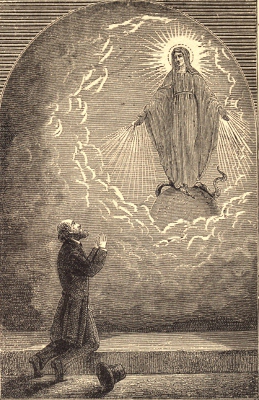
APPARITION OF THE MIRACULOUS MEDAL
To M. Ratisbonne, January 20, 1842, in the Church of St. Andrew, delle Fratte, in Rome. "She did not speak one word to me," said M. Ratisbonne, "but I understood it all."
He ceased, but this short account eloquently revealed the abundant favors with which his soul had just been inundated. Reverend Father De Villefort and the pious baron listened with a holy joy, mingled with an involuntary feeling of religious awe, at thoughts of the infinite power which had just triumphed by such a striking manifestation of mercy.... The mystery was revealed, but M. Ratisbonne, now the disciple of the most humble of Masters, a God annihilated, expressed a wish to have the wonderful vision kept a profound secret; he even earnestly entreated that it should be, but Father De Villefort considered it wiser not to yield to the neophyte's modesty, God's glory, the Immaculate Mary's honor, demanding that such a miracle should be proclaimed. M. Ratisbonne's humility gave way to obedience. In the brief narration just quoted, one thing especially had struck the Reverend Father, "She did not speak to me, but I understood all!" What, then, had he understood, he who, having hitherto lived in the shades of darkness, found himself in an instant instructed in heavenly knowledge? What, then, had he understood, he who was suddenly recalled from the bosom of death which he loved, to a new life which but a short time previous he had solemnly declared he would ever ignore, 'a Jew he was born and a Jew he would die?' What had he understood, he the young Jew, so lately headstrong in his belief, an avowed enemy of Catholicity, but who now humbly prostrates himself at the feet of our Lord's minister to retract his words and renounce his own will, for he declares that, after what he has seen, he obeys?... What has he understood? What has he seen? He has seen the Mother of divine grace, the bright aurora of the Sun of Justice; he has understood the gift of God, the eternal truth ... the unity of the Church, its infallibility, the sanctity of its morals, the sublimity of its mysteries, the grandeur and elevation of its hopes.... He has understood Heaven, and henceforth everything is changed for him, everything is renewed within him, he is no longer the same. His desires, projects, thoughts, earthly affections, where are they in the brilliancy of this celestial radiance? Vain prejudices of error, where are they?... The Immaculate Mother of Jesus has rent asunder the band that veiled the young Israelite's eyes, and the shades of error are dissipated, the blind man sees the light, and his joy is inexpressible, for he knew not till then the true gifts, the blessings promised the children of the true Church.——