THE SAID WILLIAM ROBERTSON’S WIND MILL ...
Reading edition
Most windmills belonged to one or other of the two basic categories: post mill or tower mill. The truth of this general rule is easily proved by the exception—the composite mill that belonged to neither group, but was in effect a post mill set on top of a tower. Another truism—perhaps without any exception—states that since every mill was custom designed and made by hand, no two were exactly alike.
Every English and colonial millwright had his favorite tricks of design and construction, and often the mills of a region showed a family resemblance that distinguished them from the mills of the neighboring shire or colony. In addition, improvements and refinements were developed from time to time and gradually put into use. Many of them, like the grain elevating machinery invented by Oliver Evans of Delaware and the adjustable lattice sails of the English inventor Sir William Cubbitt, came long after 1716-1723, the years during which Robertson’s original mill was built.
21
Clearly, this is not the place in which to describe the almost infinite variety in structure and operation of windmills in different places and at succeeding stages in the perfection of the mill as a machine. A list of a few easily procured books appears on page 32 for those who wish to pursue the subject further. This little pamphlet must be limited to a description of the reconstructed mill in Williamsburg and how it operates.
First, a word needs to be said about the men behind the mill, Edward P. Hamilton, former director of historic Fort Ticonderoga, New York, and Rex Wailes, then of London, who were Colonial Williamsburg’s consultants in the careful process of design and construction. Mr. Wailes, a world authority on mills and milling machinery, furnished information on all phases of the use of windmills in England, and in particular provided measured drawings of a seventeenth-century mill still standing at Bourn in Cambridgeshire. Mr. Hamilton carried on from there. By vocation an investment counselor (retired) and by avocation a collector of watch and clock mechanisms, an authority on windmills in America, and a skilled model builder, he transformed the drawings into miniature reality, creating a perfect working model in which every part performs the function assigned to its larger counterpart in the mill itself.
William Robertson, who sold to John Holloway in 1723 four lots near the Palace “whereon the said William Robertson’s wind mill stands,” was not a miller. Neither was Holloway. The records left by both men provide no clue as to the exact appearance of the mill in question. In fact, the deed to the land itself did not give any more precise location for the mill.
Reconstruction of the mill, therefore, had to depend on answers to two questions: Just where did Robertson’s windmill originally stand? and What kind of a mill was it?
22
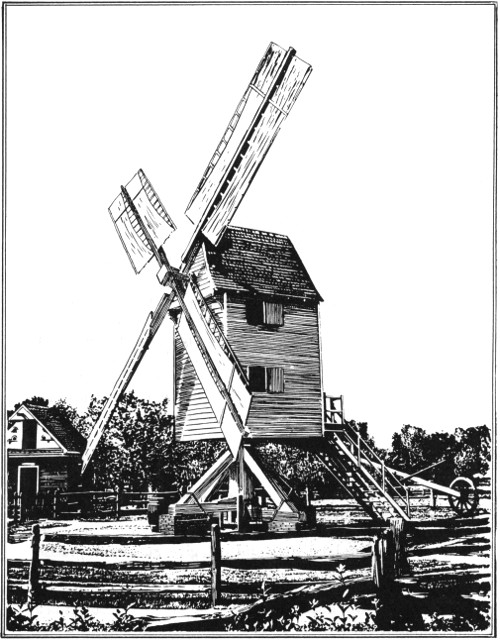
Robertson’s Windmill, a faithfully authenticated post mill, stands in Williamsburg today on a spot near the Governor’s Palace where its predecessor is believed to have stood about 1720.
23
By eliminating every other possibility, the site of the lots was established with certainty at the corner of North England and Scotland streets. By elimination again, the spot where the mill must have stood was placed at or near the present site—simply because other buildings were known to occupy various other locations in the tract. Thorough archeological excavation of the whole area, however, disclosed no corroborative evidence to show the precise location of the mill.
At the same time, the absence of such evidence was itself almost conclusive evidence that the mill was a post mill such as were common in tidewater Virginia at that time. A tower mill, which was the second variety often built hereabouts in colonial days, would have had foundations in the ground. Traces of these would have been revealed by digging at the site. Since none of the foundations excavated in the four lots was suitable to the underpinning of a tower mill—ergo the mill must have been supported above ground on a wooden post.
And so it was rebuilt: a small post mill, simple in design and operation, with but a single pair of millstones. The tail pole, extending to the rear, ends in a wagon-wheel support that eases the miller’s task of turning the mill by hand to face the wind. Other millers sometimes had shoulder yokes attached to the tail pole, or pulled it around with the help of a small winch anchored to one of a circle of posts.
The stairway from the ground up to the body of the mill, called the “ladder,” is hinged at the upper end so that when the mill is to be turned, a lever raises the foot of the ladder off the ground. When the mill has been positioned to face the wind, the end of the ladder is lowered to the ground again where it helps hold the mill against further turning.
Beneath the body of the mill are the heavy timbers on which it rests: the horizontal “crosstrees,” the sloping “quarterbars,” and the great post, all hand hewn of well-seasoned oak. The tree from which the post is hewn was itself young when Williamsburg first became the colonial capital. A count of its annual rings shows it to have been a sapling in 1675, which makes it one of the town’s oldest “antiques.”
24
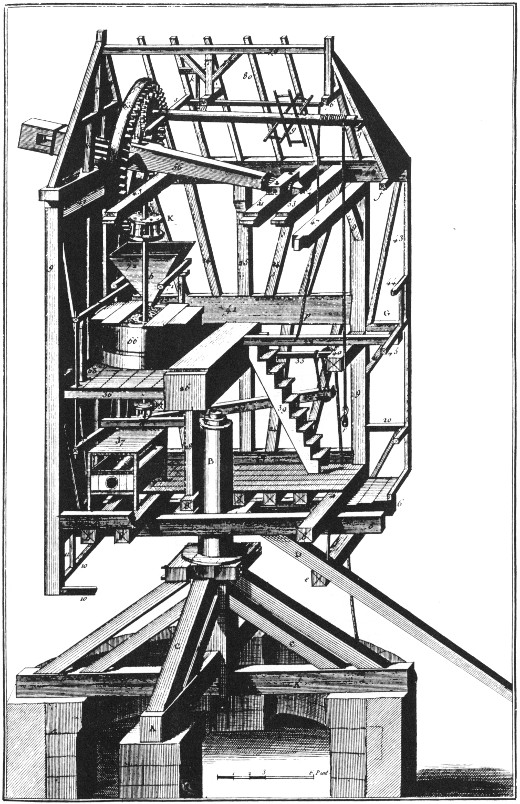
An eighteenth-century cutaway drawing, from Diderot’s great French encyclopedia, showing the structure and mechanism of a post mill. The artist has “lifted” the body of the mill a few feet off the post to reveal the pivot bearing on which the massive crowntree would in fact rest. Note also the power takeoff from the brake wheel for the sack hoist.
25
Mounting the ladder and looking into the mill’s lower or “meal floor,” we see that the post ends in a wrought-iron bearing set into another beam of impressive size that “crosses” the post like the top of a giant “T.” This beam is the “crowntree,” on which the framework of the mill body is built. Below the lower floor is another bearing or loose collar around the post to keep the body steady on its perch.
The primary machinery of the mill consists of sails, stones, and the necessary shafts and gearwheels to transmit power from the sails to the stones. In addition, there are devices for braking the sails, for hoisting bags of grain from the ground to the upper or “stone floor,” for feeding grain at the proper speed to the stones, for warning the miller when the supply of grain in the hopper is getting low, for adjusting the distance between stones, and for separating the meal from the bran.
The sails of the Williamsburg mill are of the early pattern in which the backbone of each sail frame extends along the centerline of the sail. That is, the area of sail ahead of the backbone—in the direction of turning—is the same as the area following it. Incidentally, windmill sails usually turn counterclockwise (viewed from in front of the mill).
The sailcloths themselves are handmade, of imported Scottish linen. To meet changes of weather they are furled by hand, each arm in turn being stopped at the lowest position while the miller unties the outward corners and twists the long strip into a more or less tight roll. For this purpose he can set and release the brake from the ground, using the rope that hangs out the side of the mill.
Whereas each sailcloth of Robertson’s windmill must be wholly furled or not trimmed at all, the sails of many early mills could be partially reefed. The four degrees of reefing were known as full sail, first reef, dagger point, 26 and sword point. Trimming the sails was a difficult and sometimes dangerous task, for a sudden storm with sleet and shifting gusts of wind could make the job almost impossible at the very moment that it had to be accomplished quickly. A miller caught with his sails up in such a storm might suffer what was known as “tail winding” if the wind veered faster than he could work. In this event he might be lucky to get off with nothing worse than having the sailcloth stripped from the frame.
A hurricane could do more serious damage—and might overturn the whole mill—no matter which way it faced. For the wind was the miller’s master as well as his servant, an evil genius that he feared as well as a heavenly blessing for which he prayed. Without wind the mill stood idle and the miller earned nothing. When the wind arose the miller must heed its call to work, whether in the middle of a meal or in the middle of the night. And always, he must keep a weather eye on the horizon for signs of too much wind.
Fire and lightning were other great perils to every windmill. If the hopper ran empty of grain, the friction of the stones rubbing against one another could generate enough heat for combustion. So could the friction of the brake if it were used continuously in a strong wind. In either event, a building made entirely of wood and open to every breeze burned readily, and more windmills probably fell victim to fire and storm than to old age. Similarly, its height and exposed position made the windmill an attractive target for lightning.
The sail wheel of the Williamsburg mill has a diameter of fifty-two feet—about average for a small post mill of this type. In a wind of about twenty miles an hour, which seems to be generally best for windmill operations, it will turn at about twenty revolutions per minute. This apparently slow and majestic rate is deceptive; for at twenty rpm the tips of the sails travel at a linear speed of 3,266 feet a minute or about thirty-seven miles an hour! An operating windmill is something to stay well clear of, as Don Quixote 27 and uncounted innocently grazing cows and sheep have discovered to their sorrow.
The four arms are fixed into the hub of the massive “windshaft.” This is the main horizontal axle that brings the power of the turning sails into the mill. Actually, it is not exactly horizontal but slants at a ten-degree angle. Since the wind has always been thought to descend from heaven, this ancient arrangement may at one time have been intended to let the sail wheel “look up” a bit into the wind. It has, in any case, both structural and aerodynamic advantages.
Just inside the front wall of the mill the windshaft rests in a metal bearing, and next to it is the large gear wheel, known as the “brake wheel,” that can be seen when one looks up through the trap door from the mill’s little back platform. The platform, incidentally, was not unusual in post mills, although it was often a convenience added after the mill was built and on which the miller could enjoy a pipe and a moment of repose while the mill ground merrily away.
The brake wheel, a little more than seven feet in diameter, is firmly fixed to the windshaft and turns at the same speed as the sails. Its fifty-one hickory gear teeth and eighteen other major pieces, plus at least as many wooden pegs to hold the pieces together, were all carefully shaped and fitted together by hand. Around its outer edge is the brake band—of bent hickory—that can stop the sails and hold them at any position when the long, heavy brake lever is lowered. As an emergency aid in slowing down the sails in a strong wind, the stones can be choked with grain, thus making them harder to turn. The mill can also be operated with partially furled sails.
The stones themselves consist of the lower or “bed stone,” which does not move, and the upper or “runner stone,” which turns at a little more than five times the rate of the sails. Its normal speed for best results is 108 revolutions per minute, at which speed it produces five to ten pounds of meal per minute.
28
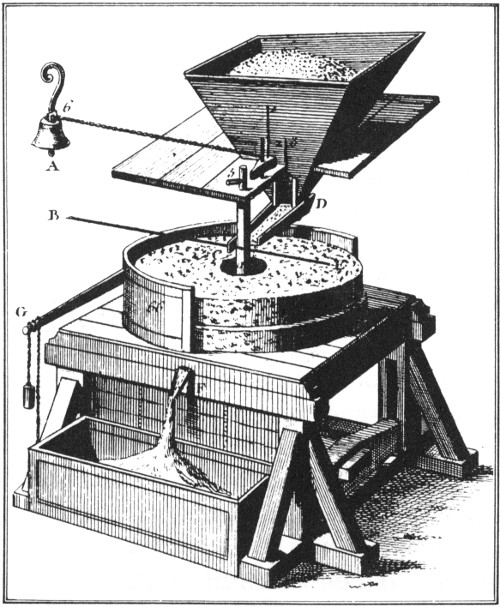
Another engraving from Diderot’s encyclopedia showing the passage of grain from hopper to millstones, and its reappearance as meal. Notice the arrangement to set the bell ringing when the hopper is about empty and the weighted lever at the left by which the miller can control the distance between the millstones.
The cogs of the brake wheel stay in constant mesh with the staves of a sort of wooden-bird-cage gear called a “wallower.” This is fixed to the upper end of the wrought-iron vertical drive shaft, whose lower end stands in the center or “eye” of the runner stone and turns it.
This simple drive mechanism is complicated by the fact that the runner stone must be held suspended above the bed stone. Ideally, the faces of the two stones—however close together—should never touch. To accomplish this, the runner stone is balanced to turn freely on the point of a spindle that comes up from below through the eye of the bed stone. The spindle, in turn, rests at its lower end in a pivot bearing that can be raised or lowered very slightly by a series of levers.
29
By this means the miller can adjust the distance between stones according to the kind of grain he is grinding and also according to the speed at which his mill is operating. In a variable wind, for instance, he may have to make the adjustment continuously as the feel of the meal coming from the stone indicates.
The faces of both stones must be “dressed” periodically—perhaps once every ten days when the mill is in constant operation. For this the runner stone must be removed and turned over so that the stone dresser, with his pickaxe-like “millbill,” can operate on both faces. The dresser deepens the furrows, if necessary, and roughens the “lands” between the furrows toward the outer edges of the stones.
When the stones are in good condition, the grain kernels are opened out near the eye of the stones, gradually reduced in the middle area, and the bran scraped and cleaned in the outer one-third of the face. The condition of the bran is the best index of the stone dressing, while the feel of the meal tells the miller whether his mill is running at the best speed and if the stones are set at the proper distance apart.
French burr stones produced the best quality flour in colonial mills, and most Virginia mills that ground for export seem to have had a pair of them. Cologne, or “cullin,” stones from the Rhine were somewhat less choice, and the same mills often had a pair of these for country work, especially for grinding corn. Stones quarried in Virginia, Pennsylvania, New York, and elsewhere were also used. The pair in the Williamsburg mill are of quartz-bearing granite quarried in Rowan County, North Carolina. They are four and one-half feet in diameter. The bed stone is seven inches thick and the runner stone ten inches. Together they weigh more than two tons.
Although colonial millers ground all varieties of grain between the same set of stones—making only the necessary adjustment in distance between the stones—Robertson’s windmill today processes only corn. But whatever the grain, the difference of a newspaper’s thickness makes the 30 difference between a good grind and a poor one. So for all its clumsiness in appearance and lumbering clatter in operation, the windmill is an extremely precise mechanism at the point where precision counts.
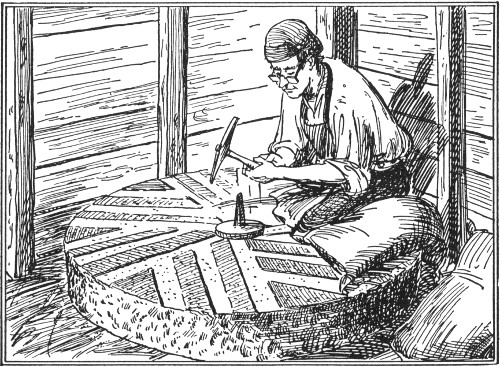
The stone dresser often steadied his forearm on a sack of meal as he worked. His hands were constantly bombarded with bits of stone and slivers of metal from the point of his pick or “millbill.” Some of these slivers became imbedded under the skin, and an itinerant stone dresser looking for work could prove his experience by “showing his metal,” i.e., the backs of his hands.
The grain, raised bag by bag through trapdoors on a rope sack hoist, is poured into a hopper above the stones, which are themselves entirely enclosed in an octagonal wooden box called the “stone casing” or “vat.” Suspended from the bottom of the hopper, an inclined trough or “shoe” carries the grain to the central opening of the runner stone. The turning of the drive shaft constantly joggles the shoe, and by raising or lowering one end of it the miller can regulate the flow of grain to the stones.
The grain is ground as it works its way outward between the stones. At the outer edge of the bed stone the meal falls into the narrow space between the stone and the casing. 31 There, air currents moving with the turning stone continually sweep the meal around to an opening in the floor of the casing.
From this opening a chute leads downward to the sifting device on the lower floor. The sifter, on the left side of the mill as you look in from the platform, separates the bran from the meal. The miller can bag each product almost automatically, since the sifter, too, is constantly shaken by an ingenious connection to the mill’s driving mechanism.
The entire mill, thus, is about as simple a machine as one could devise. The moving parts are few and could be called primitively clumsy in comparison to some of the sleek masterpieces of modern industrial design. The miller can make only three operating adjustments: in the sail area presented to the wind, in the rate of grain fed to the stones, and in the distance between the stones. He has no control over wind speed, cannot shift the gear ratio of the mill—or even shift the stones out of gear—and, finally, cannot determine his own hours of work and rest.
Perhaps the reader will be inclined to marvel a bit that the product of such a mill is so good. And perhaps he will look with some compassion on a man who is so completely a slave to the elements. If some of the miller’s fellows have been disposed—on occasion—to take just a trifle more toll than law and custom allow, well, let him who is without fault cast the first stone. Millstone, that is.
32