Chapter XXII
Reading edition
THE STRUGGLE FOR KANSAS CONCLUDED
The Lecompton Convention Ordered—Robert J. Walker and F. P. Stanton—Stanton and the "Free-state" Men—Walker's Address—The "Free-State" Legislature and Mass-meeting—The Plan to Capture the Territorial Legislature by the "Free-state" Men—The "Free-state" Men in Majority in the Territorial Legislature—The Lecompton Convention—The Lecompton Constitution—Only the Slavery Article to be Submitted Fully to the People—Protest of the "Free-state" Men—The Extra Session of the New Territorial Legislature—Stanton Removed—Lecompton Constitution With Slavery Adopted—The "Free-state" Men Capture the Lecompton Government and Reject the Lecompton Constitution—Denver Advises the President Against the Admission of Kansas Under the Lecompton Instrument—The President's Message of February 2nd (1858)—The Passage of the Lecompton Bill by the Senate—The Rejection of the Bill by the House—The English Bill—The Rejection of the Lecompton Constitution by the People of Kansas—A Fourth Government for Kansas—The Struggle for Kansas Closed—Dr. Robinson—The General Government—Mr. Jefferson Davis—The Beginning of Error and Wrong—Brown's Atrocities—The Forerunners of War.
According to the dictum of the Court in the great case reviewed in the preceding chapter, slave property was lawful in Kansas during the Territorial period, and could be first dealt with by the constitutional convention, which should prepare the organic law for Kansas as a Commonwealth of the Union.
The Lecompton convention ordered.
Already before the promulgation of the decision, the Territorial legislature had provided for the holding of the constitutional convention at Lecompton, and for the election of the delegates thereto. This election was appointed for June 15th, 1857.
It was certain that the "Free-State" men now outnumbered the pro-slavery men, and that upon a fair census, registration, and distribution of seats, and with a fair election and count, they would be able to secure the majority in the convention. But could they consistently participate in an election ordered by, and under the control of, the Territorial government? Many of them felt that they could not. Others, however, were inclined to do so, if the regulations were impartial. They examined the provisions made by the Territorial legislature for the machinery of the registration and the election, and found that they were grossly favorable to the pro-slavery party. They also found that the legislature had made no provision for submitting the constitution which might be framed to the vote of the people.
Robert J. Walker, and F. P. Stanton.
While the "Free-state" men were deliberating upon this matter, the new Territorial officials appointed by the new President appeared. President Buchanan had selected Robert J. Walker, of Mississippi, to be Governor, and F. P. Stanton, of Tennessee, to be Secretary, of the Territory. Both of these men were capable, honest, and resolute. Walker was a shrewd politician, indeed, but he was fair-minded and faithful to his plighted word. Stanton arrived on the scene about the middle of April. Walker came a month later. Stanton, therefore, was Acting Governor during the first month of his residence in the Territory.
Stanton and the "Free-state" men.
Stanton went to Lawrence, on the 24th, and urged the "Free-state" men to take part in the approaching election. He had, however, already apportioned the representation in the convention on the basis of the existing census. It was evident that he was unaware that this was unjust to the "Free-state" men. Seeing this, the "Free-state" men made a counter proposition for a new census and apportionment, and for an impartial control of the elections. Stanton did not think he had the power to conclude an agreement with them on this basis, and the negotiations fell through.
Walker's address.
The new Governor now arrived, and bent all his energies to induce the "Free-state" men to participate in the election. He issued an address, in which he solemnly declared that he would secure honest elections and returns, and pledged himself that the constitution, which the convention might form, should be submitted to the people for ratification or rejection. He also threatened that he would enforce the laws of the Territory. His idea seems to have been to create an Administration party, which would win a majority of the seats in the convention and make Kansas a Democratic non-slaveholding Commonwealth. The pro-slavery men discovered the plan at once, and accused the Governor of leaning toward the "Free-state" party.
The "Free-state" legislature and mass-meeting.
The "Free-state" men were not yet, however, ready to trust the Governor. They thought it wisest to maintain their own organization, and make the Governor feel their power. On June 9th the "Free-state" legislature assembled, to provide for the election of successors to the existing members and officials. Along with it was convoked a sort of mass-meeting of citizens. The legislature was at first without a quorum, and never had an honest quorum. This fact was sedulously concealed from the Governor, while the orators at the mass-meeting raised enough dust and smoke to cover up the real condition of affairs. They made the place fairly blue with their bluster and their threats, and the little Governor was greatly impressed by the apparent seriousness of the situation.
The plan to capture the Territorial legislature by the "Free-state" men.
By this time, however, the "Free-state" men had become considerably discouraged in regard to the admission of Kansas into the Union under the Topeka constitution. The Senate had given the application the cold shoulder, and had, apparently, laid it aside permanently. The prevarications of Lane were said to have produced this result. As matters now stood, Robinson and the more conservative men of the "Free-state" party began to consider the advisability of attempting to capture the Territorial legislature, by participating in the election of members, which was to take place in the following October. They felt certain that upon a true census and a fair apportionment, and with an honest election, they could win a majority of the seats in the legislature, and would then be in a position to nullify the work of the Lecompton convention, which, on account of the abstention of the "Free-state" men from the election of the delegates, would be packed with pro-slavery representatives.
The matter of first importance was to obtain a true census. Senator Wilson, of Massachusetts, was at the moment in Lawrence, conferring with Robinson and his friends concerning the state of affairs, and he strongly advised these gentlemen to take a correct census under the auspices of the "Free-state" government, and to nominate candidates for seats in the Territorial legislature, and elect them. He felt so decidedly about the matter that he offered to secure the funds necessary to defray the expenses of taking the new census.
Robinson and his friends were now convinced that this was the wise course, but they knew that it would be difficult to persuade the radical elements in their party to go with them. The mass-meeting at Topeka of June 9th had voted to stick to the "Free-state" government, and a convention of the "Free-state" men had assembled on July 15th to provide for its continuance. This convention, after nominating candidates for the legislative seats and for the offices, and resolving to adhere to the "Free-state" government, recommended the people to assemble in mass convention, at Grasshopper Falls, on the 26th of the following August, to take action in regard to the participation of the "Free-state" men in the October election of members of the Territorial legislature, since Governor Walker had declared that this election would be held under the laws of Congress, and not under the acts of the Territorial legislature, and had pledged himself to secure an honest election. It was evident from this that the conservative element in the "Free-state" party had won the day.
Before the day appointed for the Grasshopper Falls convention had arrived, the new census had been completed under the direction of the "Free-state" government, and it was morally certain that the "Free-state" men could elect a majority of the members of the new Territorial legislature. When the convention assembled, it therefore resolved, by a large majority, that the "Free-state" men should participate in the October election, warning the people, however, of the seriousness of the undertaking, and cautioning them against over-confidence in success.
The Lecompton convention assembled on the seventh day of September, and, after organizing, adjourned to October 19th, as if to await the result of the election of the members of the Territorial legislature.
The "Free-state" men in majority in the Territorial legislature.
This election came off on October 5th. The Governor remained true to his pledge of protecting the ballot-box. The presence of United States soldiers discouraged any movements from Missouri, and peace reigned at the polls. The returns from the counties of McGee and Johnson were, however, so manipulated by the pro-slavery election officers as to give the majority of the seats in the legislature to the pro-slavery party. These returns, as well as those from the other counties, were, however, to be canvassed finally by the Governor and Secretary. The "Free-state" men now demanded of them the fulfilment of their pledge of pure elections. The "Free-state" men had their newly taken census, and they convinced the Governor and Secretary that about ten times as many votes had been returned from these localities as there were residents in them. Walker and Stanton threw out the fraudulent returns, and gave, thus, the Territorial legislature to the "Free-state" men.
The Lecompton convention.
Two days before the Governor announced his intention of purging the returns of the frauds committed by the pro-slavery men in regard to them, and while the excitement about them was intense, it was suddenly discovered by the conservative "Free-state" men that Lane was working up a conspiracy for using violence against the members of the Lecompton convention. He, as commander-in-chief, had ordered the "Free-state" forces to assemble in Lawrence on October 19th for that purpose. The conservative men at once set themselves against this movement, and after a serious struggle happily won the day. They appointed a mass-meeting of the party at Lecompton for the following week, as much to protect the members of the convention against any sudden attack by Lane and his reckless adherents as to watch their constitution-framing work. Before the meeting took place the Governor had announced the rejection of the fraudulent returns, and had thus deprived the "Free-state" men of all excuse for violence. Some boisterous speeches were, nevertheless, indulged in at the meeting, but the convention was allowed to complete its work in peace.
The Lecompton constitution. Only the Slavery article to be submitted fully to the people.
The convention framed an instrument after the Missouri model, and incorporated in it an article guaranteeing the property in slaves already within the Territory. The convention then framed an independent provision in regard to slavery as a permanent institution of the new Commonwealth. This provision alone was to be fully submitted to the vote of the people. The people must take the Lecompton constitution with slavery as a permanent institution, or the Lecompton constitution without slavery as a permanent institution but containing a guarantee of the slave property already in the Territory. The day appointed by the convention for the voters to signify their approval or disapproval of the provision in regard to slavery as a permanent institution was December 21st, 1857, and the day designated for the election of members and officers under the new constitution was January 4th following.
Protest of the "Free-state" men.
The "Free-state" men regarded this submission of only a single article of the constitution to popular vote as a fraud upon the principle of "popular sovereignty," and demanded of Stanton, who was then discharging the Governor's duties, in the temporary absence of the latter, that the Governor's pledge as to the full submission of the proposed constitution to the people at the polls should be redeemed. Stanton bravely resolved to keep the Governor's word of honor, although he believed it would cost him his position.
The extra session of the new Territorial legislature.
What the "Free-state" men asked of him was to convene at once the new Territorial legislature, in which the "Free-state" men now had a majority of the seats, for the purpose of giving it the opportunity to order the full submission of the Lecompton constitution to the suffrages of the people. Stanton yielded to their request, and called the legislature to meet at Lecompton on December 7th. This body at once resolved to submit the proposed constitution fully and in all its parts to the people, to be adopted or rejected by them at their pleasure, and appointed the 4th day of the following January as the time for taking the vote.
Stanton removed.
Stanton was immediately removed from office by the Administration, and General John W. Denver, of Virginia, at the moment Indian Commissioner, was assigned to the duties of Acting Governor in the Territory.
Lecompton constitution with slavery adopted.
The "Free-state" men resolved to take no part in voting upon the slavery article of the Lecompton constitution, since they must take this constitution either with or without slavery as a permanent institution, and could not vote against the constitution as a whole. Consequently the Lecompton constitution with slavery as a permanent institution was, so far as the returns of the voting on December 21st were concerned, adopted. According to these returns six thousand two hundred and sixty-six votes were cast for it. Of these, nearly three thousand were afterward shown to be fraudulent. Between five and six hundred votes were cast for this constitution without slavery as a permanent institution. None were counted against it in toto. That is to say, out of a voting population of about fifteen thousand, less than four thousand were in favor of this constitution in either form.
The more prudent of the "Free-state" men now thought, however, that it would be wise to participate in the election of members and officers of the Lecompton "State" government on the day fixed by the Lecompton constitution, January 4th, 1858. They were to vote fully at that time, as we have seen, upon the Lecompton constitution, by order of the Territorial legislature, now in their hands. They felt certain of defeating the constitution, and they knew that they could win in the election of the officers and members. They nominated a ticket with G. W. Smith at its head, as their candidate for Governor.
The "Free-state" men capture the Lecompton government and reject the Lecompton constitution.
On January 4th, more than ten thousand votes were cast against the Lecompton constitution entire, and only about one hundred and fifty votes were cast in its favor. The "Free-state" men also elected their candidates for the offices and seats in the government created by the Lecompton constitution.
The "Free-state" men now had possession of the Topeka "Free-state" government, of the Territorial legislature, and of the Lecompton "State" government, and had rejected the Lecompton constitution by an undoubted majority of the suffrages of the citizens of Kansas.
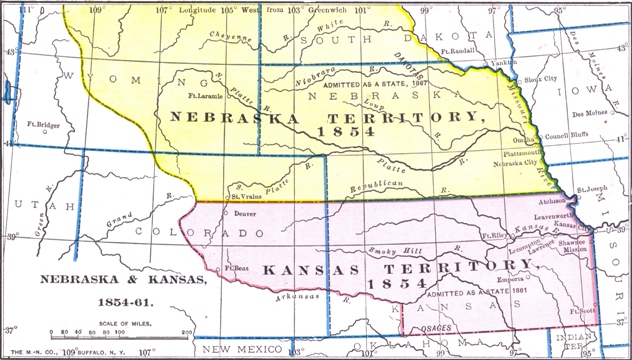
Denver advises the President against the admission of Kansas under the Lecompton instrument.
As yet the Lecompton constitution had not been presented by the President to Congress, and Acting Governor Denver hastened to give him a truthful statement of the condition of affairs in the Territory, and to urge him not to recommend to Congress the admission of Kansas under this constitution, but to suggest to that body the passage simply of an enabling act, under which the people of Kansas might begin again the work of forming a Commonwealth constitution.
The President's message of February 2nd (1858).
But the President did not heed this wise warning. On February 2nd, 1858, he sent the Lecompton constitution, with the provision making slavery a permanent institution in Kansas, to Congress, and recommended the admission of the distracted Territory into the Union, as a "State," under it. His line of argument was that every step in the procedure of framing and adopting this constitution had been regularly and legally taken, and that all the voters could have participated in the work if they had chosen to do so. He claimed that the act of the Territorial legislature, after it came under the control of the "Free-state" men, in ordering another vote, and a different sort of vote, upon the constitution, than and from that appointed and required by the convention, was irregular; and he undertook to comfort the "Free-state" men with the suggestion that, Kansas once admitted, they could change its constitution to suit themselves, if they were really in majority.
The passage of the Lecompton bill by the Senate.
The President's argument carried the Senate with him despite the powerful opposition of Mr. Douglas, who bravely antagonized the Administration, and held firmly that his great principle of "popular sovereignty" required the unreserved submission of every part of the constitution to the free suffrages of the people, in order to establish its validity. He declared that unless this should be done Congress could not know whether the people of Kansas had made a constitution or not, and that without that knowledge the admission of Kansas under the constitution before the Senate was tantamount to making a constitution for Kansas by Congressional act. The honest and manly stand taken by Mr. Douglas upon this great subject certainly presents him in the rôle of a patriotic statesman, rather than in his usual character of the shrewd politician.
The rejection of the bill by the House.
The Senate passed the Lecompton bill on March 23rd, 1858, by a substantial majority, but the House promptly rejected it. The House passed a measure, instead, for referring the Lecompton constitution back to the people of Kansas, who should vote freely upon it in all its parts, and for admitting Kansas, without further Congressional action, under this constitution, if it should receive the popular ratification; but the Senate rejected this substitute for its bill.
The English bill.
The matter was then sent to a conference committee of the two Houses. After long deliberation a measure was matured by this committee which appeared to deal with a subsidiary question only, but which, by some sort of an understanding, was held to give the people of Kansas the chance to reject the Lecompton constitution in toto at the polls. The measure is known as the English bill from its projector, Mr. W. H. English, a member of the conference committee from the House of Representatives. It provided for a reduction of the land grants from twenty-three millions of acres, asked for by Kansas under the Lecompton constitution, to about four millions of acres, and proposed the submission of this change to a vote of the people of Kansas. If the people adopted the change, they would be considered as having adopted the Lecompton constitution in toto. If, on the other hand, they rejected this change, they would be considered as having rejected this constitution in toto.
The rejection of the Lecompton constitution by the people of Kansas.
The English bill was agreed to by both Houses; and on August 2nd, 1858, the people of Kansas voted upon the measure. They rejected it, and with it the Lecompton constitution, by a vote of more than eleven thousand in a total vote of about thirteen thousand.
A fourth government for Kansas.
In the meantime, fearing that Congress might pass the bill for admitting Kansas under the Lecompton constitution, the Territorial legislature, now in the hands of the "Free-state" men, passed a bill ordering a new constitutional convention. The bill was passed within a few days of the end of the session, and Governor Denver, thinking that Kansas had about enough governments already, pocketed the measure. The convention was, however, held, and a constitution was framed and submitted to the people which received some three thousand votes in favor of its adoption, while none were cast against it. Officers were chosen under it, and thus a fourth government for Kansas was created. All of these governments were now, however, in the hands of the conservative men of the "Free-state" party.
The struggle for Kansas closed. Dr. Robinson.
With the rejection of the Lecompton constitution by the people of Kansas, on August 2nd, the struggle for Kansas was closed. It was to be a non-slaveholding Commonwealth and a Republican Commonwealth. The record of this struggle is certainly one of the most remarkable chapters in the history of the United States. There is much to admire in it, much to be ashamed of, and much to be repudiated as foul and devilish. The prudence, moderation, tact, and bravery of Dr. Robinson and his friends have rarely been excelled by the statesmen and diplomatists of the New World or of the Old. They were placed in a most trying situation both by their foes and by those who, professing to be their friends, endangered the cause more by violent and brutal deeds than did their open enemies. Their triumph over all these difficulties is a marvel of shrewd, honest, and conservative management, which may well serve as one of the best object-lessons of our history for succeeding generations.
The general Government. Mr. Jefferson Davis.
The attitude of the general Government was also honorable and praiseworthy. It did its best to hold the balance even and impartial between the contending forces. It sent out intelligent, honest, and resolute men as Governors; and it used the army to maintain the peace, and protect person and property from violence. Even President Pierce's Secretary of War, Mr. Jefferson Davis, who was considered the very high-priest of the slavery interest, sent a military commander, Colonel E. V. Sumner, to Kansas, whom he knew to be in sympathy with Free-soil principles, and instructed him only to do what was just between all parties; and when Colonel Sumner, fearing that, from personal sympathy with the cause of the "Free-state" men, he might unconsciously act too favorably toward them, really went farther than his duty required against them, in dispersing their legislature, Mr. Davis expressed the opinion that the United States forces ought not to have interfered with the "Free-state" government until it had undertaken to execute some of its measures. It was said at the time that Mr. Davis' quasi disavowal of Colonel Sumner's act was caused by its unpopularity throughout the North; but Mr. Davis was not to any such degree sensitive to Northern opinion. Personally and officially Mr. Davis was a remarkably upright man, and was accustomed to take counsel chiefly of his own judgment and conscience, and to disturb himself very little about the views of others concerning his duties and acts. Governor Robinson has recently testified to the impartial attitude of the military power of the United States in Kansas, and has declared that "had it not been for the officers of the United States army, the 'Free-state' struggle would have ended in disaster on more than one occasion."
The beginning of error and wrong. Brown's atrocities.
Error began, unquestionably, with the repeal of the Act prohibiting slavery in the Louisiana territory above thirty-six degrees and thirty minutes north latitude, and wrong began, just as unquestionably, with the incursion of the Missourians, and their fraudulent voting at the Territorial election in March of 1855. A bogus legislature was thus thrust upon Kansas Territory at the outset. It was a political outrage of the first degree, and it would have justified rebellion against the execution of the enactments of this body. But it does not excuse, or even palliate, the criminal atrocities inaugurated by John Brown at Dutch Henry's Crossing, and the wild reign of murder and robbery which followed in their train. All this was common crime of the blackest and most villainous sort, and the men who engaged in it were cutthroats and highwaymen, who took advantage of the confusion in Kansas to prosecute their nefarious work.
It is often said that the Civil War began in Kansas, and simply spread from there over the country. It is true that violence began there, and in its degeneration into savagery developed those devilish dispositions that carried murder and robbery into Virginia, and thereby helped mightily to create that intensely hostile feeling between the North and the South which resulted in Civil War, but we affront good morals and common sense when we dignify those Kansas atrocities by the title of war; and we obliterate moral distinctions when we attempt to justify them by the end which their authors professed to have in view, the extermination of African slavery throughout the country. Such deeds are not means to anything except the establishment of the reign of hell on earth, and the maudlin adoration sometimes accorded their doers is evidence of an unbalanced moral sense. It is a source of congratulation that the juristic sense of the last decades of the nineteenth century refuses to place the crank who kills or robs for what he considers, or professes to consider, the welfare of society under any other class than that of the most dangerous criminals. It remains for the ethical sense of the twentieth century to sweep the hero-worship too often accorded such characters out of the world's literature.
The forerunners of war.
But if the murders, and robberies, and arson committed in Kansas were not war, they were the forerunners of war. The last expedient which the minds of men could invent for putting the slavery question in the position of a purely local matter had been tried, and had utterly and miserably failed. The nation must now settle the question, by peaceable means if it could, but if it could not, then by force. The record of its attempts, first upon the one line, and then upon the other, will be the chief subject of the next and last volume of this series.
APPENDIX I.
THE ELECTORAL VOTE IN DETAIL, 1820-1856.
ELECTORAL VOTE IN 1820.
STATES. PRESIDENT. VICE-PRESIDENT.
James Monroe, of Virginia. John Quincy Adams, of Massa- chusetts. Daniel D. Tompkins, of New York. Richard Stockton, of New Jersey. Daniel Rodney, of Dela- ware. Richard Rush, of Pennsyl- vania. Robert G. Harper, of Maryland.
Alabama Connecticut Delaware Georgia Illinois Indiana Kentucky Louisiana Maine Maryland Massachusetts Mississippi Missouri1 New Hampshire New Jersey New York North Carolina Ohio Pennsylvania Rhode Island South Carolina Tennessee Vermont Virginia 3 9 4 8 3 3 12 3 9 11 15 2 3 7 8 29 15 8 24 4 11 7 8 25 .. .. .. .. .. .. .. .. .. .. .. .. .. 1 .. .. .. .. .. .. .. .. .. .. 3 9 .. 8 3 3 12 3 9 10 7 2 3 7 8 29 15 8 24 4 11 7 8 25 .. .. .. .. .. .. .. .. .. .. 8 .. .. .. .. .. .. .. .. .. .. .. .. .. .. .. 4 .. .. .. .. .. .. .. .. .. .. .. .. .. .. .. .. .. .. .. .. .. .. .. .. .. .. .. .. .. .. .. .. .. .. 1 .. .. .. .. .. .. .. .. .. .. .. .. .. .. .. .. .. .. .. 1 .. .. .. .. .. .. .. .. .. .. .. .. .. ..
Total 231 1 218 8 4 1 1
1 Missouri was not formally admitted as a state until August, 1821.
ELECTORAL VOTE IN 1824.
STATES. PRESIDENT.
Andrew Jackson, of Tennessee. John Quincy Adams, of Massachusetts. William H. Crawford, of Georgia. Henry Clay, of Kentucky.
Alabama Connecticut Delaware Georgia Illinois Indiana Kentucky Louisiana Maine Maryland Massachusetts Mississippi Missouri New Hampshire New Jersey New York North Carolina Ohio Pennsylvania Rhode Island South Carolina Tennessee Vermont Virginia 5 .. .. .. 2 5 .. 3 .. 7 .. 3 .. .. 8 1 15 .. 28 .. 11 11 .. .. .. 8 1 .. 1 .. .. 2 9 3 15 .. .. 8 .. 26 .. .. .. 4 .. .. 7 .. .. .. 2 9 .. .. .. .. .. 1 .. .. .. .. .. 5 .. .. .. .. .. .. .. 24 .. .. .. .. .. .. 14 .. .. .. .. .. 3 .. .. 4 .. 16 .. .. .. .. .. ..
Total 992 84 41 37
2 Since no President was elected, the House of Representatives proceeded to elect one, and John Quincy Adams was chosen on the first ballot, the vote standing Adams, 13 States; Jackson, 7 States; Crawford, 4 States.
ELECTORAL VOTE IN 1824.
STATES. VICE-PRESIDENT.
John C. Calhoun, of South Carolina. Nathan Sanford, of New York. Henry Clay, of Ken- tucky. Andrew Jackson, of Tennes- see. Martin Van Buren, of New York. Nathaniel Macon, of North Carolina. Vacan- cies.
Alabama Connecticut Delaware Georgia Illinois Indiana Kentucky Louisiana Maine Maryland Massachusetts Mississippi Missouri New Hampshire New Jersey New York North Carolina Ohio Pennsylvania Rhode Island South Carolina Tennessee Vermont Virginia 5 .. 1 .. 3 5 7 5 9 10 15 3 .. 7 8 29 15 .. 28 3 11 11 7 .. .. .. .. .. .. .. 7 .. .. .. .. .. .. .. .. 7 .. 16 .. .. .. .. .. .. .. .. 2 .. .. .. .. .. .. .. .. .. .. .. .. .. .. .. .. .. .. .. .. .. .. 8 .. .. .. .. .. .. .. 1 .. .. 3 1 .. .. .. .. .. .. .. .. .. .. .. .. .. 9 .. .. .. .. .. .. .. .. .. .. .. .. .. .. .. .. .. .. .. .. .. .. .. .. .. .. .. .. .. .. .. .. .. .. .. .. .. .. .. .. .. .. .. 24 .. .. .. .. .. .. .. .. .. .. .. .. .. .. .. .. .. .. .. 1 .. .. .. ..
Total 182 30 2 13 9 24 1
ELECTORAL VOTE IN 1828.
STATES. PRESIDENT. VICE-PRESIDENT.
Andrew Jackson, of Tennes- see. John Quincy Adams, of Massa- chusetts. John C. Calhoun, of South Carolina. Richard Rush, of Pennsyl- vania. William Smith, of South Carolina.
Alabama Connecticut Delaware Georgia Illinois Indiana Kentucky Louisiana Maine Maryland Massachusetts Mississippi Missouri New Hampshire New Jersey New York North Carolina Ohio Pennsylvania Rhode Island South Carolina Tennessee Vermont Virginia 5 .. .. 9 3 5 14 5 1 5 .. 3 3 .. .. 20 15 16 28 .. 11 11 .. 24 .. 8 3 .. .. .. .. .. 8 6 15 .. .. 8 8 16 .. .. .. 4 .. .. 7 .. 5 .. .. 2 3 5 14 5 1 5 .. 3 3 .. .. 20 15 16 28 .. 11 11 .. 24 .. 8 3 .. .. .. .. .. 8 6 15 .. .. 8 8 16 .. .. .. 4 .. .. 7 .. .. .. .. 7 .. .. .. .. .. .. .. .. .. .. .. .. .. .. .. .. .. .. .. ..
Total 178 83 171 83 7
ELECTORAL VOTE IN 1832.
STATES. PRESIDENT.
Andrew Jackson, of Tennessee. Henry Clay, of Kentucky. John Floyd, of Virginia. William Wirt, of Maryland. Vacancies.
Alabama Connecticut Delaware Georgia Illinois Indiana Kentucky Louisiana Maine Maryland Massachusetts Mississippi Missouri New Hampshire New Jersey New York North Carolina Ohio Pennsylvania Rhode Island South Carolina Tennessee Vermont Virginia 7 .. .. 11 5 9 .. 5 10 3 .. 4 4 7 8 42 15 21 30 .. .. 15 .. 23 .. 8 3 .. .. .. 15 .. .. 5 14 .. .. .. .. .. .. .. .. 4 .. .. .. .. .. .. .. .. .. .. .. .. .. .. .. .. .. .. .. .. .. .. .. .. 11 .. .. .. .. .. .. .. .. .. .. .. .. .. .. .. .. .. .. .. .. .. .. .. .. .. 7 .. .. .. .. .. .. .. .. .. .. 2 .. .. .. .. .. .. .. .. .. .. .. .. .. ..
Total 219 49 11 7 2
ELECTORAL VOTE IN 1832.
STATES. VICE-PRESIDENT.
Martin Van Buren, of New York. John Sergeant, of Pennsyl- vania. William Wilkins, of Pennsyl- vania. Henry Lee, of Massa- chusetts. Amos Ellmaker, of Pennsyl- vania.
Alabama Connecticut Delaware Georgia Illinois Indiana Kentucky Louisiana Maine Maryland Massachusetts Mississippi Missouri New Hampshire New Jersey New York North Carolina Ohio Pennsylvania Rhode Island South Carolina Tennessee Vermont Virginia 7 .. .. 11 5 9 .. 5 10 3 .. 4 4 7 8 42 15 21 .. .. .. 15 .. 23 .. 8 3 .. .. .. 15 .. .. 5 14 .. .. .. .. .. .. .. .. 4 .. .. .. .. .. .. .. .. .. .. .. .. .. .. .. .. .. .. .. .. .. .. 30 .. .. .. .. .. .. .. .. .. .. .. .. .. .. .. .. .. .. .. .. .. .. .. .. .. 11 .. .. .. .. .. .. .. .. .. .. .. .. .. .. .. .. .. .. .. .. .. .. .. .. .. 7 ..
Total 189 49 30 11 7
ELECTORAL VOTE IN 1836.
STATES. PRESIDENT.
Martin Van Buren, of New York. William Henry Harrison, of Ohio. Hugh L. White, of Tennessee. Daniel Webster, of Massa- chusetts. Willie P. Mangum, of North Carolina.
Alabama Arkansas Connecticut Delaware Georgia Illinois Indiana Kentucky Louisiana Maine Maryland Massachusetts Michigan3 Mississippi Missouri New Hampshire New Jersey New York North Carolina Ohio Pennsylvania Rhode Island South Carolina Tennessee Vermont Virginia 7 3 8 .. .. 5 .. .. 5 10 .. .. 3 4 4 7 .. 42 15 .. 30 4 .. .. .. 23 .. .. .. 3 .. .. 9 15 .. .. 10 .. .. .. .. .. 8 .. .. 21 .. .. .. .. 7 .. .. .. .. .. 11 .. .. .. .. .. .. .. .. .. .. .. .. .. .. .. .. .. .. 15 .. .. .. .. .. .. .. .. .. .. .. .. .. 14 .. .. .. .. .. .. .. .. .. .. .. .. .. .. .. .. .. .. .. .. .. .. .. .. .. .. .. .. .. .. .. .. .. .. .. .. 11 .. .. ..
Total 167 73 26 14 11
ELECTORAL VOTE IN 1836.
STATES. VICE-PRESIDENT.
Richard M. Johnson, of Kentucky. Francis Granger, of New York. John Tyler, of Virginia. William Smith, of South Carolina.
Alabama Arkansas Connecticut Delaware Georgia Illinois Indiana Kentucky Louisiana Maine Maryland Massachusetts Michigan3 Mississippi Missouri New Hampshire New Jersey New York North Carolina Ohio Pennsylvania Rhode Island South Carolina Tennessee Vermont Virginia 7 3 8 .. .. 5 .. .. 5 10 .. .. 3 4 4 7 .. 42 15 .. 30 4 .. .. .. .. .. .. .. 3 .. .. 9 15 .. .. .. 14 .. .. .. .. 8 .. .. 21 .. .. .. .. 7 .. .. .. .. .. 11 .. .. .. .. .. 10 .. .. .. .. .. .. .. .. .. .. .. 11 15 .. .. .. .. .. .. .. .. .. .. .. .. .. .. .. .. .. .. .. .. .. .. .. .. .. .. .. 23
Total 144 77 47 23
3 Michigan had not been formally admitted as a State at the time when the electors were chosen. When the votes were counted the President of the Senate declared Martin Van Buren elected President, no election for Vice-President. The Senate then elected a Vice-President, Richard M. Johnson receiving 33 votes and Francis Granger 16.
ELECTORAL VOTE IN 1840.
STATES. PRESIDENT. VICE-PRESIDENT.
William Henry Harrison, of Ohio. Martin Van Buren, of New York. John Tyler, of Virginia. Richard M. Johnson, of Kentucky. Littleton W. Tazewell, of Virginia. James K. Polk, of Tennessee.
Alabama Arkansas Connecticut Delaware Georgia Illinois Indiana Kentucky Louisiana Maine Maryland Massachusetts Michigan Mississippi Missouri New Hampshire New Jersey New York North Carolina Ohio Pennsylvania Rhode Island South Carolina Tennessee Vermont Virginia .. .. 8 3 11 .. 9 15 5 10 10 14 3 4 .. .. 8 42 15 21 30 4 .. 15 7 .. 7 3 .. .. .. 5 .. .. .. .. .. .. .. .. 4 7 .. .. .. .. .. .. 11 .. .. 23 .. .. 8 3 11 .. 9 15 5 10 10 14 3 4 .. .. 8 42 15 21 30 4 .. 15 7 .. 7 3 .. .. .. 5 .. .. .. .. .. .. .. .. 4 7 .. .. .. .. .. .. .. .. .. 22 .. .. .. .. .. .. .. .. .. .. .. .. .. .. .. .. .. .. .. .. .. .. 11 .. .. .. .. .. .. .. .. .. .. .. .. .. .. .. .. .. .. .. .. .. .. .. .. .. .. .. .. 1
Total 234 60 234 48 11 1
ELECTORAL VOTE IN 1844.
STATES. PRESIDENT. VICE-PRESIDENT.
James K. Polk, of Tennessee. Henry Clay, of Kentucky. George M. Dallas, of Pennsylvania. Theodore Frelinghuysen, of New Jersey.
Alabama Arkansas Connecticut Delaware Georgia Illinois Indiana Kentucky Louisiana Maine Maryland Massachusetts Michigan Mississippi Missouri New Hampshire New Jersey New York North Carolina Ohio Pennsylvania Rhode Island South Carolina Tennessee Vermont Virginia 9 3 .. .. 10 9 12 .. 6 9 .. .. 5 6 7 6 .. 36 .. .. 26 .. 9 .. .. 17 .. .. 6 3 .. .. .. 12 .. .. 8 12 .. .. .. .. 7 .. 11 23 .. 4 .. 13 6 .. 9 3 .. .. 10 9 12 .. 6 9 .. .. 5 6 7 6 .. 36 .. .. 26 .. 9 .. .. 17 .. .. 6 3 .. .. .. 12 .. .. 8 12 .. .. .. .. 7 .. 11 23 .. 4 .. 13 6 ..
Total 170 105 170 105
ELECTORAL VOTE IN 1848.
STATES. PRESIDENT. VICE-PRESIDENT.
Zachary Taylor, of Louisiana. Lewis Cass, of Michigan. Millard Fillmore, of New York. William O. Butler, of Kentucky.
Alabama Arkansas Connecticut Delaware Florida Georgia Illinois Indiana Iowa Kentucky Louisiana Maine Maryland Massachusetts Michigan Mississippi Missouri New Hampshire New Jersey New York North Carolina Ohio Pennsylvania Rhode Island South Carolina Tennessee Texas Vermont Virginia Wisconsin .. .. 6 3 3 10 .. .. .. 12 6 .. 8 12 .. .. .. .. 7 36 11 .. 26 4 .. 13 .. 6 .. .. 9 3 .. .. .. .. 9 12 4 .. .. 9 .. .. 5 6 7 6 .. .. .. 23 .. .. 9 .. 4 .. 17 4 .. .. 6 3 3 10 .. .. .. 12 6 .. 8 12 .. .. .. .. 7 36 11 .. 26 4 .. 13 .. 6 .. .. 9 3 .. .. .. .. 9 12 4 .. .. 9 .. .. 5 6 7 6 .. .. .. 23 .. .. 9 .. 4 .. 17 4
Total 163 127 163 127
ELECTORAL VOTE IN 1852.
STATES. PRESIDENT. VICE-PRESIDENT.
Franklin Pierce, of New Hampshire. Winfield Scott, of Virginia. William Rufus King, of Alabama. William A. Graham, of North Carolina.
Alabama Arkansas California Connecticut Delaware Florida Georgia Illinois Indiana Iowa Kentucky Louisiana Maine Maryland Massachusetts Michigan Mississippi Missouri New Hampshire New Jersey New York North Carolina Ohio Pennsylvania Rhode Island South Carolina Tennessee Texas Vermont Virginia Wisconsin 9 4 4 6 3 3 10 11 13 4 .. 6 8 8 .. 6 7 9 5 7 35 10 23 27 4 8 .. 4 .. 15 5 .. .. .. .. .. .. .. .. .. .. 12 .. .. .. 13 .. .. .. .. .. .. .. .. .. .. .. 12 .. 5 .. .. 9 4 4 6 3 3 10 11 13 4 .. 6 8 8 .. 6 7 9 5 7 35 10 23 27 4 8 .. 4 .. 15 5 .. .. .. .. .. .. .. .. .. .. 12 .. .. .. 13 .. .. .. .. .. .. .. .. .. .. .. 12 .. 5 .. ..
Total 254 42 254 42
ELECTORAL VOTE IN 1856.
STATES. PRESIDENT. VICE-PRESIDENT.
James Buchanan, of Pennsyl- vania. John C. Frémont, of California. Millard Fillmore, of New York. J. C. Breckenridge, of Kentucky. William L. Dayton, of New Jersey. A. J. Donelson, of Tennes- see.
Alabama Arkansas California Connecticut Delaware Florida Georgia Illinois Indiana Iowa Kentucky Louisiana Maine Maryland Massachusetts Michigan Mississippi Missouri New Hampshire New Jersey New York North Carolina Ohio Pennsylvania Rhode Island South Carolina Tennessee Texas Vermont Virginia Wisconsin 9 4 4 .. 3 3 10 11 13 .. 12 6 .. .. .. .. 7 9 .. 7 .. 10 .. 27 .. 8 12 4 .. 15 .. .. .. .. 6 .. .. .. .. .. 4 .. .. 8 .. 13 6 .. .. 5 .. 35 .. 23 .. 4 .. .. .. 5 .. 5 .. .. .. .. .. .. .. .. .. .. .. .. .. 8 .. .. .. .. .. .. .. .. .. .. .. .. .. .. .. .. .. 9 4 4 .. 3 3 10 11 13 .. 12 6 .. .. .. .. 7 9 .. 7 .. 10 .. 27 .. 8 12 4 .. 15 .. .. .. .. 6 .. .. .. .. .. 4 .. .. 8 .. 13 6 .. .. 5 .. 35 .. 23 .. 4 .. .. .. 5 .. 5 .. .. .. .. .. .. .. .. .. .. .. .. .. 8 .. .. .. .. .. .. .. .. .. .. .. .. .. .. .. .. ..
Total 174 114 8 174 114 8
APPENDIX II.
THE CABINETS OF MONROE, ADAMS, JACKSON, VAN BUREN, HARRISON, TYLER, POLK, TAYLOR, FILLMORE, PIERCE, AND BUCHANAN—1816-1858.
THE SECRETARIES OF STATE. Department created by Act of Congress, September 15, 1789.
NAME. STATE. FROM
John Quincy Adams Henry Clay James A. Hamilton Martin Van Buren Edward Livingston Louis McLane John Forsyth J. L. Martin Daniel Webster Hugh S. Legaré Abel P. Upshur Abel P. Upshur John Nelson John C. Calhoun James Buchanan John M. Clayton Daniel Webster Charles M. Conrad Edward Everett William Hunter William L. Marcy Lewis Cass Mass. Ky. N. Y. N. Y. La. Del. Ga. N. C. Mass. S. C. Va. Va. Md. S. C. Penna. Del. Mass. La. Mass. R. I. N. Y. Mich. March 5, 1817. March 7, 1825. March 4, 1829, ad int. March 6, 1829. May 24, 1831. May 29, 1833. June 27, 1834. March 3, 1841, ad int. March 5, 1841. May 9, 1843, ad int. June 24, 1843, ad int. July 24, 1843. February 29, 1844, ad int. March 6, 1844. March 6, 1845. March 7, 1849. July 22, 1850. September 2, 1852, ad int. November 6, 1852. March 3, 1853, ad int. March 7, 1853. March 6, 1857.
THE SECRETARIES OF THE TREASURY. Department created by Act of Congress, September 2, 1789.
NAME. STATE. FROM
William H. Crawford Samuel L. Southard Richard Rush Samuel D. Ingham Asbury Dickins Louis McLane William J. Duane Roger B. Taney McClintock Young Levi Woodbury McClintock Young Thomas Ewing McClintock Young Walter Forward McClintock Young John C. Spencer McClintock Young George M. Bibb Robert J. Walker McClintock Young William M. Meredith Thomas Corwin James Guthrie Howell Cobb Ga. N. J. Penna. Penna. N. C. Del. Penna. Md. Md. N. H. Md. Ohio Md. Penna. Md. N. Y. Md. Ky. Miss. Md. Penna. Ohio Ky. Ga. October 22, 1816. March 7, 1825, ad int. March 7, 1825. March 6, 1829. June 21, 1831, ad int. August 8, 1831. May 29, 1833. September 23, 1833. June 25, 1834, ad int. June 27, 1834. March 3, 1841, ad int. March 5, 1841. September 13, 1841, ad int. September 13, 1841. March 1, 1843, ad int. March 3, 1843. May 2, 1844, ad int. June 15, 1844. March 6, 1845. March 6, 1849, ad int. March 8, 1849. July 23, 1850. March 7, 1853. March 6, 1857.
THE SECRETARIES OF WAR. Department created by Act of Congress, August 7, 1789.
NAME. STATE. FROM
Isaac Shelby George Graham John C. Calhoun James Barbour Samuel L. Southard Peter B. Porter John H. Eaton Philip G. Randolph Roger B. Taney Lewis Cass Benjamin F. Butler Joel R. Poinsett John Bell John McLean John C. Spencer James M. Porter William Wilkins William L. Marcy George W. Crawford Winfield Scott Charles M. Conrad Jefferson Davis Samuel Cooper John B. Floyd Ky. Va. S. C. Va. N. J. N. Y. Tenn. Va. Md. Ohio N. Y. S. C. Tenn. Ohio N. Y. Penna. Penna. N. Y. Ga. Va. La. Miss. N. Y. Va. March 5, 1817. April 7, 1817, ad int. October 8, 1817. March 7, 1825. May 26, 1828, ad int. May 26, 1828. March 9, 1829. June 18, 1831, ad int. July 21, 1831, ad int. August 1, 1831. October 25, 1836, ad int. March 7, 1837. March 5, 1841. September 13, 1841. October 12, 1841. March 8, 1843. February 15, 1844. March 5, 1845. March 8, 1849. July 23, 1850, ad int. August 15, 1850. March 7, 1853. March 3, 1857, ad int. March 6, 1857.
THE SECRETARIES OF THE NAVY. Department created by Act of Congress, April 30, 1798.
NAME. STATE. FROM
Benjamin W. Crowninshield Smith Thompson John Rodgers Samuel L. Southard John Branch Levi Woodbury Mahlon Dickerson James K. Paulding George E. Badger Abel P. Upshur David Henshaw Thomas W. Gilmer John Y. Mason George Bancroft John Y. Mason William B. Preston William A. Graham John P. Kennedy James C. Dobbin Isaac Toucey Mass. N. Y. Md. N. J. N. C. N. H. N. J. N. Y. N. C. Va. Mass. Va. Va. Mass. Va. Va. N.C. Md. N. C. Conn. December 19, 1814. November 9, 1818. September 1, 1823, ad int. September 16, 1823. March 9, 1829. May 23, 1831. June 30, 1834. June 25, 1838. March 5, 1841. September 13, 1841. July 24, 1843. February 15, 1844. March 14, 1844. March 10, 1845. September 9, 1846. March 8, 1849. July 22, 1850. July 22, 1852. March 7, 1853. March 6, 1857.
THE SECRETARIES OF THE INTERIOR. Department created by Act of Congress, March 3, 1849.
NAME. STATE. FROM
Thomas Ewing Thomas M. T. McKennan Alexander H. H. Stuart Robert McClelland Jacob Thompson Ohio Penna. Va. Mich. Miss. March 8, 1849. August 15, 1850. September 12, 1850. March 7, 1853. March 6, 1857.
THE ATTORNEYS-GENERAL. Duties prescribed by the Judiciary Act of September 24, 1789. Department reorganized in 1870.
NAME. STATE. FROM
Richard Rush William Wirt John M. Berrien Roger B. Taney Benjamin F. Butler Felix Grundy Henry D. Gilpin John J. Crittenden Hugh S. Legaré John Nelson John Y. Mason Nathan Clifford Isaac Toucey Reverdy Johnson John J. Crittenden Caleb Cushing Jeremiah S. Black Penna. Va. Ga. Md. N. Y. Tenn. Penna. Ky. S. C. Md. Va. Me. Conn. Md. Ky. Mass. Penna. February 10, 1814. November 3, 1817. March 9, 1829. July 20, 1831. November 15, 1833. July 5, 1838. July 11, 1840. March 5, 1841. September 13, 1841. July 1, 1843. March 6, 1845. October 17, 1846. June 21, 1848. March 8, 1849. July 22, 1850. March 7, 1853. March 6, 1857.
THE POSTMASTERS-GENERAL. A Bureau of the Treasury until 1829. Made a Cabinet office in that year.
NAME. STATE. FROM
Return J. Meigs, Jr. John McLean William T. Barry Amos Kendall John M. Niles Francis Granger Charles A. Wickliffe Cave Johnson Jacob Collamer Nathan K. Hall Samuel D. Hubbard James Campbell Aaron V. Brown Ohio Ohio Ky. Ky. Conn. N. Y. Ky. Tenn. Vt. N. Y. Conn. Penna. Tenn. March 17, 1814. June 26, 1823. March 9, 1829. March 1, 1835. May 19, 1840. March 6, 1841. September 13, 1841. March 6, 1845. March 8, 1849. July 23, 1850. August 31, 1852. March 7, 1853. March 6, 1857.
CHRONOLOGY
Territory of Missouri erected June 4, 1812
Treaty of Fort Jackson August 10, 1814
Treaty of Ghent signed December 24, 1814
Commonwealth of Indiana admitted December 11, 1816
Madison's veto of internal improvements bill March 3, 1817
Attack on Fowltown November 21, 1817
Commonwealth of Mississippi admitted December 10, 1817
Jackson's "Rhea" letter to Monroe January 6, 1818
Execution of Ambrister and Arbuthnot April 29, 1818
Convention with Great Britain as to Oregon October 20, 1818
Commonwealth of Illinois admitted December 3, 1818
Tallmadge amendment offered February 13, 1819
Treaty with Spain as to Florida February 22, 1819
Decision in McCulloch vs. Maryland 1819
Commonwealth of Alabama admitted December 14, 1819
Thomas amendment offered February 3, 1820
Maine bill approved March 3, 1820
First Missouri bill approved March 6, 1820
Commonwealth of Maine admitted March 15, 1820
Report of Clay's Committee of Thirteen February 10, 1821
Second Missouri bill approved March 2, 1821
Jackson, as Governor, takes command in Florida July 17, 1821
Commonwealth of Missouri admitted August 10, 1821
Congress of Verona October-December, 1822
Monroe's veto of internal improvements bill May 4, 1822
Clay nominated for presidency by the Kentucky legislature November 18, 1822
"Monroe Doctrine" announced December 2, 1823
Congressional caucus nominates Crawford February 14, 1824
Harrisburg convention March 4, 1824
Jackson's "Coleman Letter" April 26, 1824
Presidential election in House of Representatives February 9, 1825
Indian Springs convention February 12, 1825
Mexico-Columbia treaty September 25, 1825
The Creek treaty January, 1826
Abduction of Morgan September 11, 12, 1826
Protectionist convention at Harrisburg July 30, 1827
Treaty with Great Britain August 6, 1827
Tariff bill approved May 19, 1828
The "South Carolina Exposition" published 1828
Hayne's speech on Foote's resolution January 19, 1830
Webster's reply to Hayne January 26, 1830
Jackson's speech on the Union April 13, 1830
Veto of the Maysville Road bill May 27, 1830
Publication of the "Liberator" begun January 1, 1831
"Address to the People of South Carolina" published July 26, 1831
The Southampton massacre August, 1831
Anti-Masonic convention at Baltimore September 26, 1831
National Republican convention at Baltimore December 12, 1831
New England Anti-Slavery Society formed January 6, 1832
Bank of the United States asks re-charter January 9, 1832
National Democratic convention at Baltimore May 21, 1832
Calhoun's letter to Governor Hamilton August 28, 1832
South Carolina convention meets at Columbia November 19, 1832
Ordinance of nullification November 24, 1832
President Jackson's nullification proclamation December 10, 1832
Clay proposes compromise tariff February 12, 1833
The "Force Bill" approved March 2, 1833
Compromise tariff bill approved March 2, 1833
Re-assembling of the South Carolina convention March 11, 1833
The "Paper read in the Cabinet" September 18, 1833
Removal of the deposits ordered September 26, 1833
American Anti-Slavery Society formed December, 1833
Van Buren nominated by Baltimore convention May 20, 1835
Charleston, S. C., post-office robbed July 29, 1835
Provisional declaration of Texan independence November 7, 1835
Meeting of Texas convention March 1, 1836
Declaration of Texan independence March 2, 1836
The Alamo massacre March 6, 1836
Battle of San Jacinto April 21, 1836
House adopts the "gag" resolution May 26, 1836
Commonwealth of Arkansas admitted June 15, 1836
The "Specie Circular" July 11, 1836
Senate passes the "expunging resolution" January 16, 1837
Commonwealth of Michigan admitted January 26, 1837
Financial panic begins April, 1837
Murder of Lovejoy November 7, 1837
Harrisburg "harmony" convention September 4, 1839
Whig convention at Harrisburg December 4, 1839
Democratic Republican convention at Baltimore May 5, 1840
Independent Treasury bill approved July 4, 1840
Death of President Harrison April 4, 1841
The Ashburton treaty August 9, 1842
Veto of National Bank bill August 16, 1842
Second bank bill vetoed September 9, 1842
Abolition convention at Buffalo August 30, 1843
Whitman's party reaches the Columbia September 5, 1843
Whig convention at Baltimore May 1, 1844
Democratic convention at Baltimore May 27, 1844
Commonwealth of Florida admitted March 3, 1845
Polk's message on Oregon December 2, 1845
Commonwealth of Texas admitted December 29, 1845
Mexicans cross the Nueces April 23, 1846
Arista notifies Taylor of beginning of hostilities April 24, 1846
Battle of Palo Alto May 8, 1846
Congress declares war begun by Mexico May 12, 13, 1846
Treaty with Great Britain as to Oregon June 15, 1846
Kearny takes Santa Fé August 18, 1846
Battle of Monterey September 21-23, 1846
Commonwealth of Iowa admitted December 28, 1846
Battle of Buena Vista February 22, 23, 1847
Capture of Vera Cruz March 27-29, 1847
Battle of Cerro Gordo April 18, 1847
Battle of Chapultepec September 12, 13, 1847
Treaty of Guadalupe Hidalgo February 2, 1848
Democratic convention at Baltimore May 22, 1848
Special message on Oregon May 29, 1848
Commonwealth of Wisconsin admitted May 29, 1848
Abolition convention at Rochester June 2, 1848
Whig convention at Philadelphia June 7, 1848
Special message on California and New Mexico July 6, 1848
Free-soil convention at Buffalo August 9, 1848
Territory of Oregon organized August 14, 1848
California convention at Monterey September 1, 1849
Clay proposes his compromise January 29, 1850
Calhoun's last speech March 4, 1850
Webster's speech on the Constitution March 7, 1850
Death of Calhoun March 31, 1850
Clayton-Bulwer treaty April 19, 1850
Clay reports on the compromise May 8, 1850
Death of President Taylor July 9, 1850
Commonwealth of California admitted September 9, 1850
President's message on the fugitive slave law February 21, 1851
The "Jerry rescue" October, 1851
Democratic convention at Baltimore June 1, 1852
Whig convention at Baltimore June 16, 1852
Death of Clay June 29, 1852
Free-soil Democratic convention at Pittsburg August 11, 1852
Death of Webster October 23, 1852
The Gadsden treaty December 30, 1853
Douglas reports on Nebraska January 4, 1854
Kansas-Nebraska bill approved May 30, 1854
Salt Creek Valley convention June 10, 1854
The Ostend manifesto October 18, 1854
Congressional election in Kansas November 29, 1854
Territorial election in Kansas March 30, 1855
Kansas legislature meets at Pawnee July 2, 1855
Robinson's speech at Lawrence July 4, 1855
Convention at Lawrence, Kansas August 14, 1855
Convention at Big Springs, Kansas September 5, 1855
Convention at Topeka, Kansas September 19, 1855
Convention at Topeka, Kansas October 23, 1855
Popular vote on the Topeka constitution December 15, 1855
Robinson elected governor of Kansas January 5, 1856
President's proclamation on Kansas February 11, 1856
Kansas Free-state legislature meets March 4, 1856
Philadelphia convention of the "American party" February 22, 1856
Congressional committee begins sessions at Kansas City April 14, 1856
Sumner's speech on the "Crime against Kansas" May 19, 20, 1856
The sack of Lawrence May 21, 1856
Brooks's attack on Sumner May 22, 1856
Massacre at Dutch Henry's Crossing May 24, 1856
Affair at Black Jack June 2, 1856
Democratic national convention at Cincinnati June 2, 1856
Republican national convention at Philadelphia June 17, 1856
Assault on Sheriff Jones June 23, 1856
House Committee reports on Kansas July 1, 1856
Dispersal of Free-state legislature at Topeka July 4, 1856
Oliver makes minority report on Kansas July 11, 1856
Treaty at Lawrence August 17, 1856
Woodson's proclamation in Kansas August 25, 1856
Destruction of Ossawattomie August 29, 1856
Whig convention at Baltimore September 17, 1856
Free-state legislature dispersed at Topeka January 6, 1857
Territorial legislature meets at Lecompton January 12, 1857
Dred Scott decision March 6, 1857
Election of Lecompton constitutional convention June 15, 1857
Meeting of Free-state convention at Topeka July 15, 1857
Convention at Lecompton, Kansas September 7, 1857
Free-state election in Kansas October 5, 1857
Convention at Lecompton, Kansas October 19, 1857
Mass-meeting at Lawrence, Kansas December 2, 1857
Kansas legislature meets at Lecompton December 7, 1857
Pro-slavery vote on the Lecompton constitution December 21, 1857
Free-state vote on the Lecompton constitution January 4, 1858
Buchanan's message on Kansas February 2, 1858
Commonwealth of Minnesota admitted May 11, 1858
Vote in Kansas on the English bill propositions August 2, 1858
Commonwealth of Oregon admitted February 14, 1859
BIBLIOGRAPHY
This bibliography must not be taken as containing the material used in the preparation of this volume, but as a list of good books recommended to the general reader, which treat of, or touch upon, the subjects considered. Only a few of the books in this list have been consulted by the author in the preparation of this work. As indicated in the preface, the author has endeavored, in all cases, to go back to original matter, which is usually disconnected and fragmentary, and practically inaccessible to the general reader.
LIST OF TITLES
The alphabetical arrangement is, in most instances, based upon the names of authors or editors.
Adams, C. F.: Railroads; their origin and problems. New York, 1878.
Adams, H.: Life of Albert Gallatin. Philadelphia, 1879.
Adams, H.: History of the United States. 9 vols. New York, 1889-91.
Adams, H.: John Randolph. Boston, 1882.
Adams, J. Q.: Memoirs; Comprising Parts of His Diary from 1795 to 1848. 12 vols. Philadelphia, 1874-77.
Alfriend, F. H.: Life of Jefferson Davis. Cincinnati, 1868.
Baker, G. E. [Ed.]: Works of William H. Seward. 5 vols. New York, 1853-54.
Bancroft, H. H.: Arizona and New Mexico, 1530-1888. San Francisco, 1889.
Bancroft, H. H.: History of California. 7 vols. San Francisco, 1884-90.
Bancroft, H. H.: North Mexican States and Texas, 1531-1889. 2 vols. San Francisco, 1884.
Bancroft. H. H.: Oregon, 1834-1888. 2 vols. San Francisco, 1886-88.
Barrows, W.: Oregon: The Struggle for Possession. Boston, 1883.
Benton, T. H.: Thirty Years' View; or, History of the Working of the American Government for Thirty Years, from 1820 to 1850. 2 vols. New York, 1854-56.
Birney, W.: James G. Birney and His Times. New York, 1890.
Blaine, J. G.: Twenty Years of Congress (1860-80). 2 vols. Norwich, 1884-86.
Bolles, A. S.: The Financial History of the United States. 3 vols. New York, 1879-86.
Bolles, A. S.: Industrial History of the United States. Norwich, 1878.
Bourne, E. G.: History of the Surplus Revenue of 1837. New York, 1885.
Bruce, H.: Life of General Houston. New York, 1891.
Bryce, J.: The American Commonwealth. 2 vols. New York, 1895.
Cairnes, J. E.: Slave Power: Its Character, Career, and Probable Designs. New York, 1862.
Calhoun, J. C.: Works. 6 vols. New York, 1853-55.
Carr, L.: Missouri, a Bone of Contention. Boston, 1888.
Channing, E.: The United States of America, 1765-1865. New York, 1896.
Choate, R.: Works, with a Memoir by S. G. Brown. 2 vols. Boston, 1862.
Chase, L. B.: History of the Polk Administration. New York, 1850.
Cobb, T. R. R.: Historical Sketch of Slavery. Philadelphia, 1858.
Cobb, T. R. R.: Enquiry into the Law of Negro Slavery in the United States. Philadelphia, 1858.
Colton, C. [Ed.]: Works of Henry Clay. 6 vols. New York, 1857.
Colton, C.: Life and Times of Henry Clay. 2 vols. New York, 1846.
Colton, C. [Ed:]: Private Correspondence of Henry Clay. New York, 1855.
Colton, C.: The Last Seven Years of the Life of Henry Clay. New York, 1856.
Cooper, T.: Lectures on the Elements of Political Economy. Columbia, 1826.
Curtis, G. T.: Constitutional History of the United States. 2 vols. New York, 1889, 1896.
Curtis, G. T.: Life of James Buchanan. 2 vols. New York, 1883.
Curtis, G. T.: Life of Daniel Webster. 2 vols. New York, 1870.
Davis, J.: The Rise and Fall of the Confederate Government. 2 vols. New York, 1881.
Davis, V. H.: Jefferson Davis, ex-President of the Confederate States. 2 vols. New York, 1890.
Douglass, F.: Life and Times. Written by himself. Hartford, 1881.
Draper, J. W.: History of the American Civil War. 3 vols. New York, 1867-70.
Dunbar, C. F.: Laws of the United States relating to currency, finance and banking from 1789 to 1891. Boston, 1893.
Frémont, J. C.: Memoirs of My Life. Chicago, 1887.
Frothingham, O. B.: Gerrit Smith; A Biography. New York, 1879.
Frothingham, O. B.: Theodore Parker; A Biography. Boston, 1874.
Gannett, H.: Boundaries of the United States, and of the several States and Territories. Washington, 1885.
Giddings, J. R.: Speeches In Congress. Boston, 1853.
Gillet, R. H.: Democracy in the United States. New York, 1868.
Gilman, D. C.: James Monroe in his Relation to the Public Service. Boston, 1883.
Greeley, H.: The American Conflict. 2 vols. Hartford, 1864-67.
Greeley, H.: Recollections of a Busy Life. New York, 1868.
Greeley, H.: History of the Struggle for Slavery Extension or Restriction in the United States. New York, 1856.
Hall, B. F.: The Republican Party, 1796-1832. New York, 1856.
Hammond, J. D.: The History of Political Parties in the State of New York. 4th edit. 2 vols. Cooperstown, 1846.
Hay, J.: see Nicolay, J. G.
Helper, H. R: Impending Crisis of the South, and how to meet it. New York, 1857.
Hildreth, R.: The History of the United States. 6 vols. New York, 1851-56.
Holst, H. E. von: The Constitutional History of the United States. 8 vols. Chicago, 1876-92.
Holst, H. E. von: John Brown. Boston, 1888.
Holst, H. E. von: John C. Calhoun. Boston, 1882.
Hurd, J. C.: Law of Freedom and Bondage in the United States. 2 vols. Boston, 1858-62.
Jay, W.: Miscellaneous writings on slavery. Boston, 1853.
Jay, W.: Review of the Causes and Consequences of the Mexican War. Boston, 1849.
Jenkins, J. S.: History of Political Parties in the State of New York. Auburn, 1846.
Jenkins, J. S.: Life of James K. Polk. Auburn, 1850.
Johnson, O.: William Lloyd Garrison and his Times. Boston, 1880.
Johnston, A.: History of American Politics. New York, 1880.
Johnston, A. [Ed.]: Representative American Orations. 3 vols. New York, 1884.
Julian, G. W.: Life of Joshua R. Giddings. Chicago, 1892.
Kapp, F.: Die Sklaverei in den Vereinigten Staaten. Hamburg, 1861.
Kinley, D.: History, Organization, and Influence of the Independent Treasury of the United States. New York, 1893.
Knox, J. J.: United States Notes. New York, 1888.
Lalor, J. J.: Cyclopædia of Political Science, Political Economy, and of the Political History of the United States. 3 vols. Chicago, 1881-84.
Lodge, H. C.: Daniel Webster. Boston, 1883.
Lyman, T.: Diplomacy of the United States. Boston, 1826.
Mackenzie, W. L.: Life and Times of M. Van Buren. Boston, 1846.
McLaughlin, A. C.: Lewis Cass. Boston, 1891.
McCulloch, H.: Men and Measures of Half a Century. New York, 1888.
Mallory, D.: Life and Speeches of Henry Clay. 2 vols. New York, 1843.
May, S. J.: Memoirs: Consisting of Autobiography and Selections from his Diary and Correspondence. Boston, 1873.
May, S. J.: Some Recollections of our Anti-Slavery Conflict. Boston, 1869.
Morse, J. T., Jr.: Abraham Lincoln. 2 vols. Boston, 1893.
Morse, J. T., Jr.: John Quincy Adams. Boston, 1882.
Nicolay, J. G. and Hay, J.: Abraham Lincoln: A History. 10 vols. New York, 1890.
Nicolay, J. G. and Hay, J. [Eds.]: Complete Works of Abraham Lincoln. 2 vols. New York, 1894.
Nixon, O. W.: How Marcus Whitman Saved Oregon. Chicago, 1895.
Ormsby, R. McK.: History of the Whig Party. Boston, 1860.
Parker, J.: Personal Liberty Laws. Boston, 1861.
Parton, J.: General Jackson. New York, 1893.
Parton, J.: Life of Andrew Jackson. 3 vols. Boston, 1883.
Phillips, W.: Conquest of Kansas. Boston, 1856.
Phillips, W.: Speeches, Lectures, and Letters. Boston, 1863.
Pierce, E. L.: Memoir and Letters of Charles Sumner. 4 vols. Boston, 1893.
Pike, J. S.: First Blows of the Civil War. New York, 1879.
Pollard, E. A.: The Lost Cause. New York, 1868.
Quincy, E.: Life of Josiah Quincy. Boston, 1867.
Quincy, J.: Memoirs of the Life of John Quincy Adams. Boston, 1858.
Redpath, J.: Public Life of Capt. John Brown. Boston, 1860.
Rhodes, J. F.: History of the United States from the Compromise of 1850. 3 vols. New York, 1893-95.
Robinson, C.: The Kansas Conflict. New York, 1892.
Robinson, S. T. L.: Kansas, Its Interior and its Exterior Life. Boston, 1856.
Roosevelt, T.: Thomas Hart Benton. Boston, 1887.
Royce, J.: California from the Conquest in 1846 to the Second Vigilance Committee in San Francisco. Boston, 1886.
Schouler, J.: History of the United States Under the Constitution. 5 vols. New York, 1893.
Schurz, C.: Life of Henry Clay. 2 vols. Boston, 1887.
Schuyler, E.: American Diplomacy. New York, 1886.
Seward, W. H.: Autobiography, from 1801 to 1834, with a Memoir of His Life. New York, 1877.
Seward, W. H.: Life and Public Services of John Quincy Adams. Auburn, 1849.
Shepard, E. M.: Martin Van Buren. Boston, 1888.
Smith, W. L. G.: Fifty Years of Public Life; the Life and Times of Lewis Cass. New York, 1856.
Spring, L. W.: Kansas; the Prelude to the War for the Union. Boston, 1885.
Stanwood, E.: A History of Presidential Elections. Boston, 1892.
Stephens, A. H.: A Constitutional View of the Late War between the States. 2 vols. Philadelphia, 1868-70.
Stickney, W. [Ed.]: Autobiography of Amos Kendall. Boston, 1872.
Story, W. W.: Life and Letters of Joseph Story. 2 vols. Boston, 1851.
Story, W. W. [Ed.]: Miscellaneous Writings of Joseph Story. Boston, 1835.
Strohm, I. [Ed.]: Speeches of Thomas Corwin. Dayton, 1859.
Sumner, C.: Works. 15 vols. Boston, 1870-83.
Sumner, W. G.: Andrew Jackson as a Public Man. Boston, 1882.
Sumner, W. G.: History of American Currency. New York, 1884.
Taussig, F. W.: State Papers and Speeches on the Tariff. Cambridge, 1893.
Taussig, F. W.: Tariff History of the United States, 1789-1888. New York, 1888.
Thayer, E.: History of the Kansas Crusade. New York, 1889.
Tyler, L. G.: Letters and Times of the Tylers. 2 vols. Richmond, 1884.
Tyler, S.: Memoir of R. B. Taney. Baltimore, 1872.
Van Buren, M.: Inquiry into the Origin and Growth of Political Parties in the United States. New York, 1867.
Webster, D.: Works. 6 vols. Boston, 1851.
Webster, F. [Ed.]: Private Correspondence of Daniel Webster. 2 vols. Boston, 1857.
Williams, A. M.: Sam Houston and the War of Independence in Texas. Boston, 1893.
Williams, E.: The Statesman's Manual. 4 vols. New York, 1849.
Wilson, H.: History of the Rise and Fall of the Slave Power in America. 3 vols. Boston, 1872-77.
Wilson, W.: Division and Reunion, 1829-1889. New York, 1893.
Wise, H. A.: Seven Decades of the Union. Philadelphia, 1876.
Woodbury, L.: Writings, Political, Judicial, and Literary. 3 vols. Boston, 1852.
Yoakum, H. K.: History of Texas, from its First Settlement in 1685, to its Annexation to the United States in 1846. 2 vols. New York, 1856.
INDEX
Material in the Appendices is not included in this Index.
A
BBOTT
, J. B., leader of "Free-state" Company,
428
Abolition,
242
et seq.;
relation to Revolution of 1830,
244
,
245
;
its philosophy,
245
;
the opposite theory,
245
;
the true philosophy of history,
245
,
246
;
the beginning of abolition,
246
(
see
Garrison
, William Lloyd);
possible ways of attacking slavery,
248
;
charges as to Southampton massacre,
249
;
denials by abolitionist historians,
249
;
abolitionist methods,
249
,
250
;
killing of Lovejoy,
250
;
significance of abolition movement,
250
,
251
;
its growth,
251
;
the moderates,
251
;
petitions for abolition in District of Columbia,
251
,
252
;
position of Adams,
252
,
253
;
Quaker petition,
253
;
position of Mason and Adams,
253
;
more petitions,
253
(
see
Petition
, right of);
Dickson presents petitions,
254
;
his controversy with Chinn,
254
;
the Fairfield petitions,
254
;
excitement begun by Slade's motion,
254
;
Polk's ruling,
255
;
action on Jackson's petitions,
255
et seq.;
assumption as to ethical position,
265
;
attitude of Calhoun and Rives,
267
,
268
;
the Vermont petition,
269
;
the Calhoun resolutions,
269
;
use of mails,
270
et seq.
(
see
, United States);
significance of the contests over petitions and the mails,
274-277
;
result of struggle over petitions,
296
;
demands of Clay,
319
;
criticism of Clay as to annexation,
320
;
candidacy of Birney,
320
;
position on Polk's first message,
324
,
325
;
as to war with Mexico,
330
,
331
;
attitude on Texan boundary,
355
;
attitude to fugitive slave law of 1793,
355
;
attitude to Clay's proposals,
357
;
Webster's Seventh of March speech,
359
;
effect of propaganda,
366
;
nomination of Hale for presidency,
377
;
the
National Era
address,
389
;
effect of the address,
400
;
as to leaders of Emigrant Aid Company,
413
;
relation of Kansas affairs to presidential nominee,
431
;
point of view of the "Crime against Kansas,"
439
Abolitionists,
see
Abolition
Adams, John Quincy,
relation to Jackson,
34-36
;
opinion of treaty with Spain,
36
;
negotiations with Spain,
37
,
38
;
effect of Seminole War,
38
;
declaration to Tuyl,
124
,
125
;
qualification as presidential candidate in 1824,
132-136
;
electoral vote of 1824,
136
,
137
;
supported in House by Clay,
141
;
the Kremer charge,
141
;
elected president,
142
;
offers State Department to Clay,
142
,
143
;
threats of opposition,
142
,
143
;
no proof of bargain with Clay,
143
;
opposition to Administration organized,
144-146
;
relation to Panama Congress,
148
,
149
;
nominates commissioners to the Congress,
149
;
nomination confirmed,
150
;
relation to Spain's colonies,
152
,
153
;
as to internal improvements,
155
,
156
;
message of December, 1826,
157
;
appropriations approved for internal improvements,
169
;
chairman of committee,
184
;
reports tariff bill,
185
;
bill passed,
186
;
report on Bank,
191
;
relation to Bank history,
192
;
representations from Creek chiefs,
212
;
orders Gaines to Georgia,
213
;
controversy with Troup,
213
,
214
;
steps to carry out agreement of 1826,
214
;
defiance of Georgia,
214
;
submits matter to Congress,
215
;
refers Cherokee affair to Jackson,
215
,
216
;
view of Indian titles,
217
;
principles of administration reviewed by Supreme Court,
219
;
relation to Cabinet intrigue against Jackson,
220
;
as to authorship of Jacksonian principles,
240
;
presents abolition petitions,
252
;
his position on abolition,
252
,
253
;
prevents debate on abolition petitions,
253
;
compared with Slade,
254
;
opinion as to procedure on petitions,
256
;
appeal for right of petition,
257
;
presents petition on abolition,
258
,
259
;
his belief as to the right involved,
259
;
effort at settlement,
260
;
affair of February 6, 1837,
262
;
address on annexation,
303
"Address on the Relations of the States and Federal Government,"
179
"Address to the People of South Carolina,"
179
Admiralty jurisdiction, proposal to decrease that of federal courts,
109
Africa,
41
Alabama, Commonwealth of,
in process of creation,
62
;
slavery allowed,
63
;
Indian problem in Jackson's message of 1829,
216
,
217
;
Alabama letter of Clay,
319
,
320
;
vote on Kansas-Nebraska bill,
399
;
Buford's men in Kansas,
438
Alamo atrocities,
293
,
294
Albany Regency, The,
133
;
in election of 1824,
137
Alien and Sedition Laws,
173
Alleghanies, The,
116
,
129
,
139
,
163
,
193
Ambrister, Robert C.,
32
,
36
Amelia Island,
30
,
31
America for Americans, principle of,
418
American Anti-Slavery Society, formed,
251
American Board of Missions, sends out Whitman,
315
American Society for Emancipation,
62
"American System," The,
178
,
189
(
see
Clay
, H.)
Ampudia, Pedro de, demands Taylor's withdrawal,
329
Anderson, Richard Clough, Jr.,
nominated commissioner to Panama Congress,
149
;
nomination confirmed,
150
Appalachicola River, The,
21
,
22
,
25
,
26
,
31
Arbuthnot, Alexander,
32
,
36
Archer, William S.,
opposition to Texas treaty,
308
,
309
;
his doctrine adopted by Tyler,
309
;
report on Texas resolution,
322
,
323
Arista, Mariana, notifies Taylor of beginning of hostilities,
329
Arkansas, Commonwealth of,
admitted,
290
;
vote on Kansas-Nebraska bill,
399
Arkansas, Territory of,
88
Arkansas River, the,
33
Army of the United States,
legislation upon,
13
,
14
;
troops in Florida,
24
et seq.
(
see
Mexico
, and
Kansas
, Territory of);
as to South Carolina,
230
Ashburton, Alexander Baring, first Baron, negotiations with Webster,
314
Ashburton Treaty,
303
Asia, California the road to,
332
Astor, John Jacob, understanding with the Government,
313
Astoria, founded,
312
,
313
Atchison, Missouri, place of publication of
Squatter Sovereign,
411
Atchison, David R.,
criticism of organization of Nebraska Territory,
382
;
his record and influence,
412
,
413
;
on the Wakarusa,
429
;
agrees with Robinson,
430
;
causes Missourians to withdraw,
431
;
repudiates the sacking of Lawrence,
438
;
in command at Bull Creek,
445
Austin, Moses, secures Texan grant from Mexico,
291
Austin, Stephen Fuller, colonizes grant in Texas,
291
Austria, in Holy Alliance,
123
B
ADGER
, G
EORGE
E
DMUND
,
contention as to Chase's amendment,
394
;
offers amendment,
395
Baldwin, John, claims site of Lawrence,
415
Baltimore, Maryland,
petition for abolition,
252
;
Hamlet case,
367
;
conventions of 1852,
376
Baltimore & Ohio railroad, system begun,
169
Bank of the United States,
bill for its creation,
3
;
Calhoun's argument,
4
,
5
,
6
;
Clay's early view,
4
;
Webster's objections,
6
;
Clay's support,
6
,
7
;
modified bill passed by House,
7
,
8
;
attitude of Barbour, Bibb, Taylor, Wells,
8
;
passed by Senate,
8
;
bill of 1816 a Southern and national measure,
8
,
14
;
bank bill under comparison,
15
,
16
;
Jackson's message of 1829,
190
;
later interpretations of Jackson's attack,
191
,
192
;
the troubles in New Hampshire,
191
;
the opposition of principle,
192
,
193
;
origin of opposition to "money power,"
193
,
194
;
origin of "State's rights" opposition to Bank,
194
;
tax on branches in Ohio and Maryland,
194
;
the results,
195
;
relation to "relief party" in Kentucky,
195
,
196
;
Benton's attack,
196
;
his resolution defeated,
196
;
attitude of Benton,
197
;
and of Jackson,
197
,
198
;
Bank supported by committees,
198
;
Jackson's message of December, 1830,
198
,
199
;
relation of question to slavery,
198
;
relation to politics,
198
;
Jackson's second attack,
198
,
199
;
Benton's resolution of 1831,
199
,
200
;
Jackson's message of 1831,
200
;
the Bank question before the people,
200
,
201
;
advice of Clay and Webster,
201
;
petition for re-charter,
201
;
relation of Bank question to question of Jackson's election,
201
;
action by the Senate,
201
,
202
;
Clayton committee report in House,
202
;
McDuffie's report on Bank,
202
;
House passes the Senate bill,
202
;
veto by Jackson,
202
;
analysis of his message,
202-206
;
interpretation of the message,
206-209
;
the principles of Jackson ratified by the people,
209
;
effect on Jackson's views of election on Bank issue,
279
;
control of deposits,
279
;
removal of McLane and Duane,
280
;
deposits suspended by Taney,
280
;
Taney's contention,
280
,
281
;
Senate's resolutions of censure,
281
;
attitude of Benton,
281
;
Jackson successful in all points,
282
;
result of removal of deposits,
283
;
enforcement and effect of Act of June 23,
283
,
284
;
Bank bills vetoed by Tyler,
286
Barbour, James,
supports bank bill,
8
;
proposes union of Maine and Missouri bills,
82
;
position on Maine-Missouri bill,
83
;
on conference committee,
88
;
letter to Troup,
212
,
213
;
controversy with Troup,
213
Barbour, Philip Pendleton,
in Missouri bill debate,
70
;
opposes tariff bill of 1824,
113
,
114
Beaufort, South Carolina, instructions to collector,
230
Beecher, Henry Ward, opposes fugitive slave law,
368
Behring's Strait,
123
Belgium, recognizes Texan independence,
304
Bell, John,
report on President's powers,
235
;
proposition as to California and New Mexico,
359
;
its reference,
359
,
360
;
on Committee of Thirteen,
360
;
attitude to Kansas-Nebraska bill and to Douglas's amendment,
393
;
speech against the bill,
396
,
397
;
vote on the bill,
399
Bell, P. H., extends jurisdiction of Texas,
362
,
363
Benton, Thomas Hart,
attacks the Bank,
196
;
resolution defeated,
196
;
becomes Jackson's lieutenant,
197
;
resolution against the Bank,
199
;
his resolution not accepted,
200
;
attack on practices of Bank,
201
;
opinion on use of Government deposits by the Bank,
205
;
defends Jackson against censure of Senate,
281
;
criticism of Texas treaty,
308
;
changes vote,
347
;
opposition to Foote's motion,
360
;
offers to cudgel Foote,
360
Berrien, John McPherson,
opinion of Indian agreement of 1826,
214
;
report on Calhoun's proposition,
349
,
350
;
views on slavery in Mexican acquisition,
351
,
352
;
on Committee of Thirteen,
360
Bibb, William Wyatt, supports bank bill,
8
Biddle, Nicholas,
beginning of bank trouble,
191
;
management of bank,
195
Birney, James G., effect of Clay's Alabama letter,
320
Bishop of London,
44
Black Jack, Brown captures Pate at,
441
Blair, Montgomery, letter to Welles on Seward,
387
,
388
Blood, James,
at Kansas City, and at site of Lawrence,
414
;
in "Free-State" directory,
443
Bloomfield, Joseph, voting,
73
Blow, Taylor, connection with Dred Scott case,
452
"Blue Lodges," in Missouri,
419
Body of Liberties, Massachusetts,
41
Bonaparte, Napoleon,
relation to slavery in Louisiana,
54
,
55
;
commercial system,
123
;
relation to Holy Alliance,
123
Boon, Ratliff, in House proceedings,
254
Boston, Massachusetts,
beginning of Abolition,
246
;
meetings on fugitive slave law,
367
;
the Crafts case,
368
;
the Shadrach case,
370
;
the Sims case,
372
,
373
;
Kansas emigrants departing,
414
Boston and Albany railroad, survey begun,
169
Branscomb, Charles H.,
goes to Kansas,
413
,
414
;
at the site of Lawrence,
414
;
buys claim of Stearns,
415
Branson, Jacob,
threatens Buckley,
428
;
arrested by Sheriff Jones,
428
;
rescued by "Free-state" men,
428
,
429
;
charges as to the rescue,
429
;
effort to arrest participants in rescue,
433
Bright, Jesse D.,
motion as to Territorial governments,
346
;
on Committee of Thirteen,
360
Brooks, Preston Smith,
assault upon Sumner,
439
,
440
;
effect of assault modified by Pottawattomie massacre,
442
Brown
vs.
Maryland [12 Wheaton, 419],
195
,
198
Brown, John,
appears at Lawrence,
431
;
the Pottawattomie massacre,
440
;
the massacre characterized,
441
;
captures Pate at Black Jack,
441
;
dispersal of the gang and disappearance of Brown,
442
;
effect of massacre,
442
;
his work characterized,
473
,
474
Brown, Mary, arrest of Hamlet,
367
Brown, R. P.,
organizes company of "Free-state" men,
426
;
captured and murdered,
426
Buchanan, James,
position upon tariff bill of 1827,
158
,
159
;
attitude to fugitive slave law,
368
;
candidate for presidential nomination,
376
;
the Ostend manifesto,
408
;
relation of his election to events in Kansas,
447
;
inaugural address quoted,
447
;
charge as to improper official conduct,
458
;
appoints Walker and Stanton to office in Kansas,
461
;
special message of February 2, 1858,
469
Buckley, ——, secures peace warrant against Branson,
428
Buenos Ayres,
30
Buffalo, New York, Free-soil convention,
347
Buford, Jefferson, repudiates sacking of Lawrence,
438
Bull Creek, Kansas,
Missourians encamped on,
445
;
skirmish at,
445
Burrill, James, Jr., position on Maine-Missouri bill,
83
Burt, Armistead, moves amendment to Douglas's bill,
341
Bushnell, Horace, member of Emigrant Aid Society,
409
Bustamente, Anastasio, decree on immigration,
291
Butler, Andrew Pickens,
contention as to fugitive slave law,
371
;
minority report on president's powers,
372
;
in debate on Foote's resolutions,
374
;
attacked by Sumner,
439
C
ABOT
, S
AMUEL
, member of Emigrant Aid Society,
409
Calhoun, John Caldwell,
2
;
committee service,
3
;
argument for the bank,
4-6
;
chief author of bank bill,
8
;
speech on tariff bill,
10-12
;
on internal improvements,
14-16
;
views rejected by Madison,
17
;
relation to Jackson,
34
,
35
;
effect of Seminole War,
38
;
as to relation between protection and slavery,
109
;
bill for internal improvements vetoed, 1817,
116
,
117
;
qualifications as presidential candidate in 1824,
133
,
134
;
as to vice-presidency,
138
;
elected vice-president,
142
,
143
;
relation to administration,
143
;
relation to Adams's administration,
144
,
146
;
elected vice-president,
163
,
164
;
political scientist of slavery,
173
;
publishes "South Carolina Exposition," "Address on Relation of States and Federal Government," and "Address to the People of South Carolina,"
179
;
his argument,
180
,
181
;
his doctrine of nullification,
189
;
relation to Jackson and Seminole War,
220
;
the Forsyth letter,
220
;
hostility of Jackson and Calhoun,
220
,
221
;
his letter to Governor Hamilton,
221
;
his theory of nullification reproduced,
223
;
resigns vice-presidency and becomes Senator,
224
;
opinion on the position of South Carolina,
226
,
227
;
statement in Senate as to South Carolina's acts,
232
,
233
;
opinion of the "Force Bill,"
234
;
attitude to Clay's compromise tariff,
236
;
attitude to the Wilkins "Force Bill,"
236
;
argument answered by Webster,
237
;
attitude to Clay's bill,
237
;
motive in course on nullification,
238
;
restatement of Jefferson's principles,
239
;
opinion of slavery cited,
253
;
antedated by Hammond,
255
;
contention as to petitions,
264
;
view of slavery,
265-268
;
resolutions of December 27, 1837,
269
;
fallacy of his position,
270
;
makes committee report, with bills, on use of mails,
273
,
274
;
his plan defeated,
274
;
views on recognition of Texas,
295
,
296
;
view on annexation of Texas,
301
;
his views expressed by Wise,
302
;
again Secretary of State,
307
;
notifies Texas of proposal to move forces,
307
;
view of constitutional position of Texas,
308
;
adopts idea of Archer as to annexation,
309
;
views as to method of annexation,
321
;
characterization of his views on annexation,
323
,
324
;
attitude to Mexican War,
330
;
views as to slavery in Territories,
344
,
345
;
his last speech,
358
;
his death,
360
;
views on fugitive slave laws,
367
California,
as to Congress of Verona,
124
;
occupied by Kearny,
332
;
importance of its occupation,
332
;
importance of Buena Vista,
333
;
about to be transferred,
334
;
acquisition in view,
337
;
in negotiations,
337
(
see
Upper California
);
Polk's message of July 6, 1848,
345
,
346
;
motions of Bright and Clayton,
346
;
the Clayton bill,
346
,
347
;
Polk's message of December, 1848,
348
;
gold and silver discoveries,
348
;
Douglas's bill,
349
;
Smith's bill,
349
;
Berrien's report,
349
,
350
;
new bill by Douglas,
350
;
motion by Walker,
350
,
351
;
proceedings in Congress,
351
;
views of Berrien and Webster,
351
,
352
;
failure of Congress to act,
352
;
effect of discoveries,
352
,
353
;
plan of Taylor,
353
;
the Monterey Convention,
353
;
Taylor's message of December 4, 1849,
353
,
354
;
Foote's bill,
354
;
Clay's plan,
355
,
356
;
objections of Southerners,
356
;
attitude of abolitionists,
357
;
application for admission,
357
;
consideration begun,
357
,
358
;
Calhoun's last speech,
358
;
Webster's Seventh of March speech,
359
;
Bell's proposition,
359
;
report of Committee on Territories,
360
;
Committee of Thirteen,
360
;
Clay's report,
360-362
;
passage of bill for admission,
363
,
364
;
vote on Kansas-Nebraska bill,
399
;
Robinson in,
413
;
Sutter land troubles,
413
;
Robinson's experience in, applied to Kansas,
421
,
422
Cambreleng, Churchill C., opposes tariff bill of 1824,
113
Canada,
21
,
370
,
374
Canning, George,
proposal to Rush,
125
;
declaration to Polignac,
125
Cape Breton,
21
Capulets, tomb of the,
351
Cass, Lewis,
opposes Upham's amendment,
336
;
views on relation of slavery and Mexican War,
338
;
Presidential nominee,
345
;
letter to Nicholson,
345
;
on Committee of Thirteen,
360
;
attitude to fugitive slave law,
368
;
candidate for Presidential nomination,
376
;
attitude to Chase and Douglas,
392
Castle Pinckney,
becomes seat of custom-house for Charleston district,
230
;
Congress notified of change,
232
Catron, John, opinion on Dred Scott case,
453
Cerro Gordo, battle of,
333
Channing, William Ellery, opposition to fugitive slave law,
373
Chapultepec, battle of,
338
Charleston, South Carolina,
Government in control of anti-nullifiers,
181
;
nullifiers elect mayor,
182
;
test of tariff law,
182
;
Scott ordered to,
230
;
instructions to collectors,
230
;
removal of custom-house,
230
;
Congress notified,
232
;
post-office robbed,
271
;
committee of public safety elected,
271
;
postmaster communicates with New York postmaster,
271
;
the position of Postmaster-General Kendall,
271
,
272
Chase, Salmon Portland,
contention as to fugitive slave law,
371
;
signs
National Era
address,
389
;
moves amendment to Kansas-Nebraska bill,
391
;
speech in Senate,
391
;
proposes further amendment,
394
;
contention with Pratt,
394
,
395
;
proposes third amendment,
395
,
396
;
proposes fourth amendment,
396
;
vote on Kansas-Nebraska bill,
399
;
effect of
National Era
address,
400
Chattahoochee River, the,
211
,
214
Cheever, George Burrell, opposes fugitive slave law,
368
Cherokee Nation
vs.
Georgia [5 Peters, 1],
218
Cherokees,
brought under criminal jurisdiction of Georgia,
215
;
appeal to President,
215
,
216
;
Jackson's reply,
216
;
Cherokees refuse offers for cession of claims,
216
;
the question in Jackson's message of 1829,
216
,
217
;
different views of Indian land titles,
217
,
218
;
Cherokee lands incorporated by Commonwealth of Georgia,
218
;
the Cherokee nation case,
218
;
the case of Worcester against Georgia,
218
,
219
Cherubusco, battle of,
334
Cheves, Langdon, management of bank,
195
Chihuahua, captured by Doniphan,
332
Chili, treaty of 1823 with Columbia,
147
Chillicothe, O., bank trouble,
195
Chinn, Joseph W., resents Dickson's attack,
254
Choate, Rufus, attitude to fugitive slave law,
368
Christian baptism, relation to slavery,
44
Clark, George Rogers, sent out by Jefferson,
312
Clay, Henry,
views on the bank in 1812,
4
;
Speaker of House,
6
;
support of bank bill,
6
,
7
;
on tariff bill,
10
;
relation to Jackson,
34
,
35
;
opinion of treaty with Spain,
36
,
38
;
suggests union of Maine and Missouri bills,
77
;
plan of Clay,
100
;
report of Committee of Thirteen,
100
,
101
;
first plan defeated,
101
;
conference committee and its report on Missouri,
101
,
102
;
plan accepted,
102
,
103
;
supports tariff bill of 1824,
112
,
113
;
opposed by Barbour, Cambreleng and Webster,
113
,
114
;
efforts with reference to "Monroe Doctrine,"
128
;
qualifications as presidential candidate in 1824,
134-136
;
electoral vote of 1824,
137
;
in control of situation,
140
,
141
;
supports Adams,
141
;
the Kremer charge,
141
;
offer of secretaryship of state,
142
,
143
;
opposition threatened,
142
,
143
;
Clay accepts office,
143
;
no proof of corruption,
143
;
opposition in Senate to his appointment,
144
;
approached by ministers of Mexico and Columbia,
147
;
negotiations,
148
,
149
;
negotiations with Czar of Russia and with Spanish-American colonies,
152
,
153
;
his "American System" anticipated by Jackson,
172
;
resolution on tariff,
186
;
speech on the "American System,"
187
;
bill reported and tabled,
188
;
his ideas used,
188
;
nominated for presidency in 1831,
201
;
advice to Bank party,
201
;
proposes compromise tariff,
235
;
his purposes,
235
,
236
;
attitude of Calhoun,
236
;
his bill amended and passed by both Houses,
237
,
238
;
signed by President,
238
;
motive in course on nullification,
238
;
opinion of Jacksonian principles,
240
;
criticises Calhoun's bill as to use of mails,
274
;
his followers called Whigs,
282
;
dropped by Whigs,
286
;
reports resolution on Texas,
295
;
nominated for presidency,
309
;
election an apparent certainty,
319
;
demands of abolitionists,
319
;
the
National Intelligencer
letter,
319
,
320
;
effect of the Alabama letter,
320
;
presidential election of 1844,
320
;
the Alabama letter,
329
;
plan as to California, New Mexico and Texas,
355
,
356
;
objections of Southerners,
356
,
357
;
agrees to Douglas's motion,
357
;
relations with Foote,
357
,
358
;
debate on Clay's resolutions,
358
,
359
;
their reference,
360
;
chairman of Committee of Thirteen,
360
;
Clay's report,
360-362
;
results of debates,
362
;
passage of bills separately,
363
,
364
;
attitude to fugitive slave law,
368
;
motion on Shadrach case,
370
;
motion on President's message,
371
;
death,
377
Clayton, John Middleton,
secures appointment of committee on Bank,
202
;
makes committee report against Bank,
202
;
motion as to Territorial government,
346
;
reports bill,
346
,
347
;
not voting on Kansas-Nebraska bill,
398
,
399
Clemens, Jeremiah, in debate on Foote's resolutions,
374
,
375
Clinton, DeWitt, qualifications as presidential candidate in 1824,
132
Coahuila-Texas,
a province and Commonwealth of Mexico,
291
;
local government,
291
;
resistance to Santa Anna,
292
;
Texans in control,
292
,
293
;
war begun by Mexicans,
293
;
declaration of independence,
293
.
See
Texas
Cobb, Thomas A., relation to Jackson,
34
,
35
Coleman, L. H., letter from Jackson,
138
Coleman, F. N., murders Dow,
428
Columbia, treaties with Chili, Mexico, Peru, and Central America,
147
Colorado River,
291
Columbia, South Carolina, convention of 1827,
159
,
160
Columbia River,
123
;
sources discovered,
312
,
314
,
316
,
318
,
324
,
325
Committee on Commerce of the House of Representatives,
185
Committee on District of Columbia of House of Representatives,
252
,
253
,
254
,
257
Committee on the District of Columbia of the Senate,
253
Committee on Finance of the Senate,
198
,
199
Committee on Foreign Affairs of the House of Representatives,
321
Committee on Foreign Relations of the Senate,
150
,
295
,
308
,
322
Committee on the Judiciary of the House of Representatives,
232
,
235
,
369
Committee on the Judiciary of the Senate,
82
,
83
,
84
,
87
,
232
,
233
,
341
,
343
,
349
,
363
,
371
,
372
Committee on Manufactures of the House of Representatives,
110
,
112
,
158
,
160
,
172
,
174
,
175
,
184
,
185
Committee on Manufactures of the Senate,
188
Committee on Territories of the House of Representatives,
340
,
382
,
400
,
401
Committee on Territories of the Senate,
349
,
363
,
382
,
401
Committee on Ways and Means of the House of Representatives,
9
,
10
,
110
,
172
,
174
,
185
,
198
,
231
,
351
Compromise Measures of 1850,
in Fillmore's message,
368
,
369
;
in Fillmore's message of December 2, 1851,
374
;
memorials on finality,
375
;
Democratic platform of 1852,
376
;
Whig platform of 1852,
376
;
unity of Whig party imperilled,
376
,
377
;
effect of election of 1852,
377
;
situation in December, 1852,
381
;
the Howe-Giddings colloquy,
381
,
382
;
interpretation of the compromise,
382
;
the Douglas report on Nebraska,
383-387
;
dictum of the committee,
387
;
claim of Dixon,
388
;
as to Kansas-Nebraska bill,
389
;
dictum of Douglas,
390
;
the amendment of Chase,
391
;
the amendment of Douglas,
392
;
views of Everett,
392
,
393
(
see
Kansas
, Territory of, and
Nebraska
, Territory of);
effect of acquiescence,
403
Concord, New Hampshire,
191
Confederation of Spanish-American States,
plan initiated,
147
;
proposed congress and relations of United States,
147
et seq.
Congress of the Confederation,
lack of power over slavery,
48
;
passed Ordinance of 1787,
48
;
power in the case,
49
Congress, Continental, forbids importation of slaves,
48
Congress of the United States,
Acts of the Fourteenth,
1
,
2
;
Congress of 1801 and 1815,
3
;
power over Bank,
4
,
5
;
early action on tariff,
8
;
meeting in December, 1815,
9
;
vote as to tariff,
9
;
acts of the Fourteenth,
12-14
;
discussion of its powers by Calhoun,
13
,
14
;
powers discussed by Monroe,
15
;
pay of members,
16
;
passage of internal improvements bill,
16
;
acts as to Florida,
24
,
25
;
acts of 1811 as to Florida,
30
;
limitation as to slavery,
50
;
abolition of slave trade,
51
;
division of Louisiana territory,
55
,
56
;
power over Territories,
63
;
power to erect Commonwealths,
64
;
attitude to slavery,
65
;
debate on powers of Congress,
67
et seq.;
annals of,
74
;
powers discussed by Taylor,
79
,
80
, and by Holmes,
80
,
81
, and by McLane,
81
,
82
;
Pinckney's argument on powers of,
84-87
;
conference committee on Missouri,
88
,
89
;
interpretation of Act of Congress,
89
;
significance of the Compromise,
90-95
;
powers considered by Lowndes,
96
;
Sergeant on power of creating Commonwealths,
96
,
97
;
course of Congress considered,
97
,
98
;
oath of members,
98
;
second conference committee on Missouri,
101-103
;
significance of the compromise,
104
;
doctrine of its control of commerce,
110
;
conference committee on tariff,
114
,
115
;
early practice as to internal improvements,
116
,
117
;
vote on internal improvements bill of 1822,
118
;
Monroe on the powers of,
120
,
121
;
power over expenditures,
121
;
act of April 30, 1824,
122
;
inaction upon "Monroe Doctrine,"
128
;
Calhoun a member of,
133
;
joint session for count of electoral votes,
141
,
142
;
as to power over roads,
155
;
Act of April 30, 1824,
155
,
156
;
memorials to,
158
;
attitude of South Carolina to,
159
et seq.;
passes Maysville Road bill,
167
;
appropriations for internal improvements,
169
;
as to powers of,
170
;
attitude to tariff,
178
;
Calhoun's attitude to,
179
;
control of courts by,
180
;
President's message before,
184
;
conference committee on tariff,
188
;
attitude to the planters,
189
;
decision on Bank Act of,
195
;
relation to President as to legislation,
206
,
207
;
as a nominating body,
208
;
failure to override Jackson's veto,
209
;
inaction as to Indian problem,
215
;
Jackson's message to,
216
;
ten years' struggle of South in,
221
;
its acts nullified,
222
;
Jackson's messages on South Carolina,
231
,
232
;
abolition petitions to,
251
,
252
;
abolition petitions before,
253
;
recommendations of Jackson,
272
,
273
;
argument as to power over mails,
273
et seq.;
conflict with President over Bank,
279
et seq.;
passage of Independent Treasury bill,
285
,
286
;
erection of new Commonwealths,
290
;
President's message on Texas,
298
;
action of Congress,
298-300
;
effect of its action,
300
;
address of certain Whig members,
303
;
message of Tyler to,
305
;
affairs of Texas,
306
et seq.;
Tyler's message of December, 1844,
320
,
321
;
competency as to matters of treaty,
322
;
Polk's message on Oregon,
324
;
action as to Oregon,
325
,
326
;
power over Texan boundary,
328
;
Act as to Corpus Christi,
329-331
;
Polk's message on Mexican War,
330
;
action on war,
331
;
Polk's message to, August 8, 1846,
334
;
consent to acquisition of California and New Mexico,