Chapter I
Reading edition
GLASS-BLOWER’S APPARATUS.
Introductory.—I shall endeavour to give such an account of the operations required in constructing glass apparatus as will be useful to chemical and other students; and as this book probably will come into the hands of beginners who are not in a position to secure any further assistance, I shall include descriptions even of the simple operations which are usually learned during the first few hours of practical work in a chemical or physical laboratory. I shall not give any particular account of the manufacture of such apparatus as thermometers, taps, etc., because, being in large demand, they can be bought so cheaply that time is not profitably spent in making them. But it will be found that what is included will enable any one, who will devote sufficient time to acquiring the necessary manipulative dexterity, to prepare such apparatus as test-tubes, distillation flasks, apparatus for washing gases, ozone generating tubes, etc., when they are required, as they often are, without delay or for special purposes. The amateur probably will not succeed in turning out apparatus so finished in appearance as that of the professional glass-blower until after long practice, but after a little daily practice for the space of a few weeks, any one who is fairly skilful in ordinary manipulation, and who perseveres in the face of failure at first, will find himself able to make almost all the apparatus he needs for lecture or other experiments, with a considerable saving in laboratory expenses, and, which very often is more important, without the delay that occurs when one depends upon the professional glass-worker. In the case of those who, like myself, work in the provinces, this latter advantage is a very weighty one.
After the description of the instruments used in glass-blowing, which immediately follows, the following arrangement of the subject has been adopted. In the first place, an account of the two chief kinds of glass is given, and of the peculiarities in the behaviour of each of them before the blow-pipe, which is followed by a tolerably minute description of the method of performing each of the fundamental operations employed in fashioning glass apparatus. These are not very numerous, and they should be thoroughly mastered in succession, preferably upon tubes of both soda and lead glass. Then follows, in Chapter IV., an account of the application of these operations to setting up complete apparatus, full explanations of the construction of two or three typical pieces of apparatus being given as examples, and also descriptions of the modes of making various pieces of apparatus which in each case present one or more special difficulties in their construction; together with an account, which, I think, will be found valuable, of some apparatus that has been introduced, chiefly during recent years, for experimenting upon gases under reduced pressure, e.g. vacuum taps and joints. Finally, in Chapter V., there is a short account of the methods of graduating and calibrating glass apparatus for use in quantitative experiments.
The Working-place.—The blow-pipe must be placed in a position perfectly free from draughts. It should not face a window, nor be in too strong a light, if that can be avoided, for a strong light will render the non-luminous flames, which are used in glass-blowing, almost invisible, and seriously inconvenience the operator, who cannot apply the various parts of the flames to his glass with the degree of certainty that is necessary; neither can he perceive the condition of the glass so correctly in a strong light, for though in many operations the glass-worker is guided by feeling rather than by seeing, yet sight plays a very important part in his proceedings.
My own blow-pipe is placed near a window glazed with opaque glass, which looks southwards, but is faced by buildings at a short distance. In dull weather the light obtained is good; but on most days I find it advantageous to shade the lower half of the window with a green baize screen. Some glass-blowers prefer gaslight to daylight.
The form of the table used is unimportant, provided that it is of a convenient height, and allows free play to the foot which works the blower underneath it. The blower should be fixed in a convenient position, or it will get out of control at critical moments. The table, or that part of it which surrounds the blow-pipe, should be covered with sheet-iron to protect it from the action of the fragments of hot glass that will fall upon it. The tubes that supply air and gas to the blow-pipe should come from beneath the table, and may pass through holes cut for the purpose.
Many glass-blowers prefer to work at a rather high table, and sit on a rather high stool, so that they are well above their work. No doubt this gives extra command over the work in hand, which is often valuable. On the other hand, it is somewhat fatiguing. For a long spell of labour at work which is not of a novel character nor specially difficult, I am disposed to recommend sitting on a chair or low stool, at a table of such height as will enable the elbows to rest easily upon it whilst the glass is held in the flame. The precise heights that are desirable for the table and stool, and the exact position of the blow-pipe, will depend upon the height and length of arm of the individual workman, and it must therefore be left to each person to select that which suits him best. A moveable rest made of wood, for supporting the remote end of a long piece of glass tube a few inches above the table, whilst the other end is being heated in the flame, will be found convenient.
The Blow-pipe.—Formerly a lamp, in which sweet oil or tallow was burnt, was employed for glass-working, and such lamps are still occasionally used. Thus, lamps burning oil or tallow were used on board the Challenger for hermetically sealing up flasks of water collected at various depths to preserve them for subsequent examination. I shall not, however, give an account of such a lamp, for the gas apparatus is so much more convenient for most purposes that it has now practically superseded the oil lamps. Fig. 1 shows a gas blow-pipe of exceedingly simple construction, which can be easily made, and with which good work can be done.
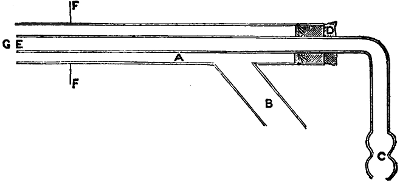
Fig. 1.
The tube A is of brass, and has a side tube B brazed to it, ten to twelve centimetres from the end E, according to the dimensions of the tube. A tube of glass, EC, is fitted into A by a cork at D. B is connected to a supply of gas by a flexible tube, C is similarly connected to the blower. By means of CE a stream of air can be forced into gas burning at the mouth of the blow-pipe G, and various flames, with the characters described in a later section, can be produced with this instrument. For producing the pointed flame (Fig. 3, p. 9) the opening E of the air-tube should be contracted to the size of a large knitting needle. For producing a flame of large size, rich in air (Fig. 4, p. 9), the internal diameter of E may be nearly half as great as that of A without disadvantage.
This blow-pipe may be fixed in position by the spike F, which will fit into holes in a block of wood or a large cork. Several of these holes in various positions should be made in the block, so that the position of the blow-pipe may be varied easily. Two taps must be provided in convenient positions near the edge of the table to enable the workman to regulate the supplies of air and gas. These taps should be fixed to the table and be connected with the gas and air supplies respectively on one side, and with the blow-pipe on the other, by flexible tubes. If blow-pipes of this kind be used, at least two of them should be provided; one of small dimensions for working on small tubes and joints, the other of larger size for operations on larger tubes. It will be convenient to have both of them ready for use at all times, as it is sometimes necessary to employ large and small flames on the same piece of work in rapid succession. By having several air-tubes of different sizes fitted to each blow-pipe, a greater variety of work may be done.
For the larger blow-pipe, the internal diameter of A may be fifteen to seventeen millimetres.
For the smaller instrument, eleven millimetres for the diameter of A would be a useful size.
When a slightly greater outlay can be afforded it will be most convenient to purchase the blow-pipe. They can be obtained of compact form, supported on stands with universal joints giving great freedom of movement, and with taps for regulating the supplies of gas and air, at comparatively small cost.
As figures of various blow-pipes can be seen in the price-lists of most dealers in apparatus, they are not given here. Their introduction would be of but little service, for the construction of that which is adopted can be readily ascertained by taking it to pieces. The simplest blow-pipe usually used for glass-working is that of Herapath. This has two taps to regulate the air and gas supplies respectively, and will give a considerable variety of flames, which will be discussed subsequently.
An excellent blow-pipe, made on the same principle as that shown in Fig. 1, but more substantially and with interchangeable jets, can be obtained from Messrs. Muller of Holborn for a moderate outlay.
Another very good blow-pipe is the Automaton blow-pipe of Mr. Fletcher of Warrington. In this, one tap regulates the supply both of air and gas, which is a great gain when difficult work is in hand. Automaton blow-pipes are made of two sizes. I have found that the larger size, with a powerful bellows, heats large pieces of lead glass very satisfactorily. On the other hand, the fine-pointed oxidising flame of the Herapath blow-pipe is, perhaps, the most suitable for working joints of lead glass. Therefore a good equipment would be a small Herapath blow-pipe and a large-sized Automaton. If only one blow-pipe is purchased it should be either a medium-sized Herapath, or the smaller Automaton, as those are most useful for general work.
Mr. Fletcher also makes an ingenious combination of two blow-pipes in which the gas and air supplies are regulated by a single lever-handle. This is very convenient, and gives flames that answer well with tubes made of soft soda glass, and it is very useful for general work. For use with lead glass the supply of air is rather too small, and does not enable one to get such good results. This can be easily amended, however. By slightly increasing the size of the air-tube of the smaller blow-pipe, and having increased the supply of air to the larger blow-pipe also, by reducing the external diameter of the end of the innermost tube, I now get medium-sized brush flames and pointed flames with this blow-pipe, that are equal to any I have used for heating lead glass.
For small laboratories the inexpensive No. 5 Bunsen burner of Mr. Fletcher, which is convertible into a blow-pipe, will be very useful.
Jets of several sizes to fit the air-tubes of blow-pipes may be obtained with them, and will serve for regulating the supply of air to the flame.
The Bellows.—The usual blowing apparatus is some form of foot-blower. These may be obtained fitted to small tables with sheet-iron tops. But a much less expensive apparatus is the large foot-blower made by Mr. Fletcher of Warrington, which can be used at an ordinary table or laboratory bench. Good foot-blowers can also be obtained from makers of furnace bellows.
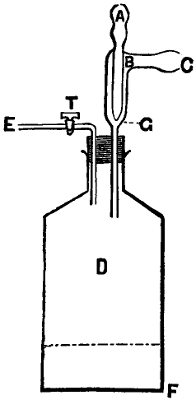
Fig. 2
No part of the glass-blower’s equipment exceeds the bellows in importance. The best blower procurable should therefore be adopted. A bellows which, when used with a large blow-pipe, will not enable you to heat large pieces of lead glass tube to redness without blackening the glass when the directions for heating lead glass on pages 17-21 are followed, should on no account be received. I am told that at some places, where the water-supply is at very high pressure, it is utilised for working blow-pipes by means of the apparatus described below, and that some glass-workers find it advantageous to use such automatic blowers. But after a little practice, the effort of working the blower with the foot whilst manipulating the glass is not a source of serious inconvenience. Indeed, as it gives a certain degree of control over the flame without the use of the hands, the foot-blower is preferable. It is worth while to describe an automatic blower, however.
Automatic Blower (Fig. 2).—A strong glass tube A is welded into a somewhat larger tube B so that its end is about 2 mm. from the contraction at G. B has a side tube C joined to it. The narrow end of B is fixed by an india-rubber cork to a strong bottle D of two or three litres capacity. The india-rubber cork also carries an exit tube E, and D is pierced near its bottom by a small hole at F.
In using the apparatus A is connected with the water-supply, and water passing through G, carries air with it into D. The water escapes from D by the opening at F, and the air is allowed to pass out by the tube E, its passage being regulated by a tap. Fresh supplies of air enter B by C.
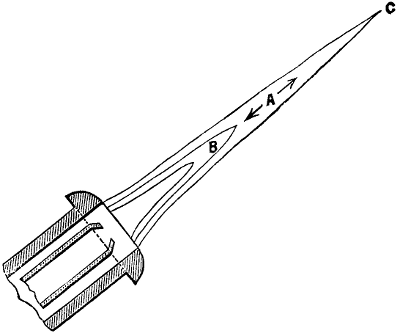
Fig. 3.
Blow-pipe Flames—The Pointed Flame.—If the gas tap of a Herapath blow-pipe be adjusted so that comparatively little gas can pass, and if the foot-blower be then worked cautiously, a long tongue of flame ending in a fine point will be produced (Fig. 3). This flame will subsequently be described as the pointed flame. It should be quite free from luminosity, and as the amount of air necessary for securing a pointed flame is large, in proportion to the gas, there is excess of oxygen towards the end C. By adjusting the proportions of air and gas, pointed flames of various dimensions can be obtained with the same blow-pipe. The part of a pointed flame to be used in glass-working is the tip, or in some cases the space slightly beyond the tip.
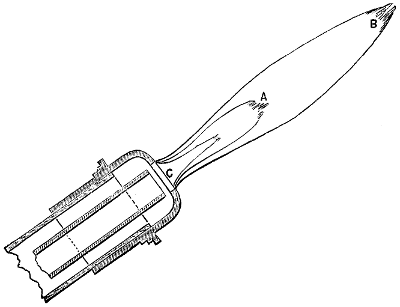
Fig. 4.
The Brush Flame.—If a large supply of gas be turned on and a considerable blast of air sent into the flame, a non-luminous flame of great size will be obtained (Fig. 4). In form it somewhat resembles a large camel’s hair pencil, and may conveniently be described as a brush flame. The chief advantage of a large-sized blow-pipe is, that with it a large brush flame may be produced, which is often invaluable. By gradually diminishing the supply of gas and air smaller brush flames may be produced.
The jet used to supply air to the Herapath blow-pipe is usually too fine, and consequently does not permit the passage of sufficient air to produce a brush flame that contains excess of oxygen, even with the aid of a very powerful blower. My own Herapath blow-pipe only gives a satisfactory oxidising brush flame when the jet is removed altogether from the end of the air-tube. For producing pointed flames the finer jet of the air-tube must be used, but when a highly oxidising flame of large size is required it must be removed. The internal diameter of the central air-tube should be nearly half as great as that of the outer or gas-supply tube. Fletcher’s Automaton with the large air jet gives a very liberal supply of air, and produces an excellent oxidising brush flame. In the case of the larger-sized Automaton a consequence of this is, however, that when fitted with the large jet it will not give so good a pointed flame as the Herapath, which, in its turn, gives an inferior oxidising brush. By fitting finer jets to the air-tube of Fletcher’s apparatus pointed flames can be secured when necessary.
The Smoky Flame.—By turning on a very free supply of gas, and only enough air to give an outward direction to the burning gas, a smoky flame, chiefly useful for annealing and for some simple operations on lead glass, is produced.
The Gimmingham blow-pipe and Fletcher’s combination blow-pipe, in addition to the above flames, are also adapted to produce a non-luminous flame, resembling that of the Bunsen gas-burner, which is very convenient for the preliminary heating of the glass, and also for gradually cooling finished apparatus. It is not necessary to describe the method of using these last-mentioned blow-pipes. With the more complicated of them directions for its use are supplied.
Mr. Madan has suggested the use of oxygen in place of air for producing the oxidising flame required for working lead glass, and to produce a flame of high temperature for softening tubes of hard, or combustion, glass. For the latter purpose the employment of oxygen may be adopted with great advantage. For working lead glass, however, it is quite unnecessary if the directions already given are followed.
The student’s subsequent success will so largely depend upon his acquaintance with the resources of his blow-pipe, and on the facility with which he can take advantage of them, that no pains should be spared in the effort to become expert in its management as soon as possible. A few experiments should now be made, therefore, upon the adjustment of the flame, until the student is able to produce and modify any form of flame with promptness and certainty.

Fig. 5.
The remaining apparatus used in glass-working consists of triangular and other files, charcoal pastils for cutting glass, pieces of sound charcoal of various diameters with conical ends; it is convenient to have one end somewhat less pointed than the other (Fig. 5). Corks of various sizes; the smallest, which are most frequently needed, should be carefully cut with sharpened cork borers from larger corks. Besides these there should be provided some freshly distilled turpentine in which camphor has been dissolved,[1] fine and coarse emery powder, and some sheets of cotton-wadding, an india-rubber blowing-bottle, glass tubes, a little white enamel, and a pair of iron tongs.