THE OPEN LETTER
Reading edition
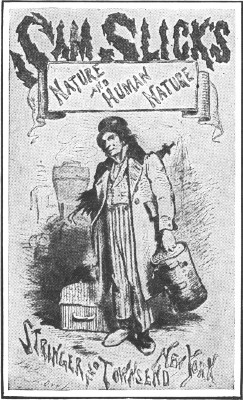
SAM SLICK
Judge Haliburton’s original Yankee character
The true origin of the character of “Uncle Sam” is a matter of doubt. The figure has been a familiar one in the history of the United States for many years, but the actual date of its first appearance is not known. As a little school girl once wrote in her essay on Ancient Rome, “its origin is wrapped in antiquity.” It appears that “Uncle Sam” emerged from the soil and began to materialize into definite form about one hundred years ago. A favored theory concerning the origin of the tall, lean, Yankee figure type is that he owes his peculiar identity to a character created by Judge Thomas Haliburton, and known in literature as “Sam Slick.” Oddly enough, the creator—if we may call him so—of the figure that now stands for the national type, was not himself an American. Judge Thomas Haliburton was born in Windsor, Nova Scotia, in December, 1796. He was a successful lawyer, and occasionally took a turn at literature. In 1835 there appeared in a Halifax journal a series of papers which were afterwards issued in book form under the title, “The Clock-Maker, or the Sayings and Doings of Sam Slick.” In this and in a later book “Nature and Human Nature,” the author pictured an acute, good-tempered Yankee who was a native of the state of Connecticut—the state of which Jonathan Trumbull, the original “Brother Jonathan,” was governor. Haliburton described Sam Slick as “a tall, thin man with hollow cheeks and bright, twinkling, black eyes.” As he sold his Yankee clocks he was supposed to meet on the road a “squire” who traveled some distance with him and found entertainment in Sam’s “down-east talk and shrewd Americanisms.” In England, where the book had a wide sale, Sam Slick came to be accepted as the symbolic American in speech, appearance and thought.
The London Times of November 27, 1840, said: “No modern book can give better insight into the politics, prejudices, manners and actions of the inhabitants of the United States than this.” Another English critic found Sam Slick “a knowing individual, sensible, sagacious, not without tact, and overflowing with humor.” According to Sam, “Push-on—keep movin’—go ahead,” was the maxim of the States. He described the typical American as “the chap with speed, wind and bottom; clear grit, ginger to the backbone, spry as a fox, supple as an eel.”
The illustrators of Sam Slick made him lean, smiling, and in all respects a contrast to the heavy-set John Bull. They put on his head the high hat and clothed him in the long-tailed coat and striped trousers that Uncle Sam still wears. “We call the American public ‘Uncle Sam,’” declared Sam Slick to the Squire, “as you call the British ‘John Bull.’” Sam’s humor was called “the sunny side of common sense.”
“The Clock-Maker” ran into fifty editions and was as popular in America and in Canada as in England—it also had many readers in France. So potent was the delineation of the Yankee, Sam Slick, that it established and still influences the foreign estimate of citizens of the United States. Judge Haliburton had a distinguished career, the latter part of which was passed in England—where he died in 1865.

We can see from the foregoing that there is some reason, then, for the claim of certain chroniclers that “Sam Slick” was the original Yankee character, and that Windsor, Nova Scotia, was the birthplace of the oddly-costumed figure that now stands for the shrewd, benevolent, wide-awake and efficient personality that we call “Uncle Sam.”
W. D. Moffat Editor