THE VIRGIN ISLANDS of the UNITED STATES of AMERICA
Reading edition
By E. M. NEWMAN, Lecturer and Traveler
Entered as second-class matter March 10, 1913, at the postoffice at New York, N. Y., under the act of March 3, 1879. Copyright, 1918, by The Mentor Association, Inc.
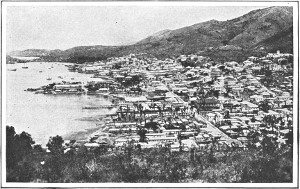
VIEW OF CHARLOTTE AMALIE, ST. THOMAS
MENTOR GRAVURES
ST. THOMAS HARBOR BEFORE THE DANISH FLAG CAME DOWN · ST. THOMAS, DANISH GOVERNMENT BUILDING, NOW U.S. MARINE HEADQUARTERS · CHARLOTTE AMALIE, ST. THOMAS · CHRISTIANSTED, ST. CROIX · STREET IN FREDERIKSTED, ST. CROIX · COUNTRY ROAD, ST. CROIX

The Virgin Islands formerly known as the Danish West Indies were purchased by the United States for the apparently exorbitant sum of $25,000,000. While the group comprises more than fifty islands, but three are inhabited. These are St. Thomas, Santa Cruz or St. Croix (sahn krwah), and St. John.
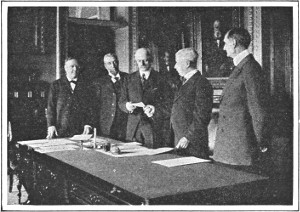
Copyright by Clinedinst Studio
TRANSFER OF THE DANISH WEST INDIES TO THE UNITED STATES
Secretary Lansing handing Constantin Brun, the Danish Minister at Washington, a Treasury Warrant for $25,000,000. The others in the group are Secretary Daniels, Secretary McAdoo, and Rear-Admiral James H. Oliver, first appointee to the Governorship of the Virgin Islands of the United States of America
Denmark received from the United States an average price of $295 per acre. Alaska was purchased at a cost of two cents per acre, and the Philippine Islands cost us about twenty-seven cents per acre. For strategic, economic and political reasons the Virgin Islands are worth far more to us than their purchase price. We were in need of a naval base to protect the Panama Canal, and the harbor at St. Thomas provides the best naval station in the West Indies.
The islands were discovered by Columbus in 1493, on his second voyage to the New World. Since then the inhabitants have been under Spanish, British, French, Dutch and Danish rule. For over two hundred years the Danish flag has flown above these islands of the Virgin group. Repeatedly the United States has tried to acquire them. In 1865 Secretary Seward offered five millions of dollars, which was increased two years later to $7,500,000. Again, in 1901, negotiations were entered into with Denmark, but Germany intervened, and once more the project failed.
A price was finally agreed upon, and the transfer of the islands took place March 31, 1917. The ceremony was most impressive, though Governor Oliver, appointed by President Wilson, could not arrive in time to take part in it. Commander Pollock, of the gunboat Hancock, was at Santo Domingo and was ordered to proceed at once to St. Thomas and take possession in the name of the United States. He arrived on the day of the ceremony, and was met by the Danish governor, Danish officials, and officers and marines of the Danish gunboat Valkyrie. In the presence of a large assemblage the Danish flag came down after nearly two and a half centuries of rule, and the Stars and Stripes was raised over the former Danish Government buildings, over forts, and on various private flagstaffs. Many of the Danes were in tears. A number of them had been born on the islands and knew no other home. To them it was a sad event, but practically all realized that the transfer was best for the people generally and for the future of the islands.
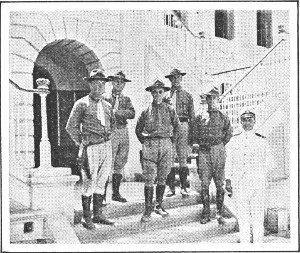
MAJOR SALLADAY AND STAFF
Commanding the United States Marines stationed at St. Thomas—on the steps of the barracks, Charlotte Amalie
The Commerce and People
Besides Charlotte Amalie, a town of about 8,000 inhabitants, there are a few scattered settlements on the island of St. Thomas. Some years ago the harbor was a free port and Charlotte Amalie enjoyed a considerable commerce. Immense warehouses were built, and merchants from Central and South America came to the island to purchase merchandise. When the port was no longer free, its commerce gradually dwindled and the harbor was almost deserted. Ships called only to go into drydock or to coal. It now remains for Uncle Sam to restore its former trade with our sister republics to the south.
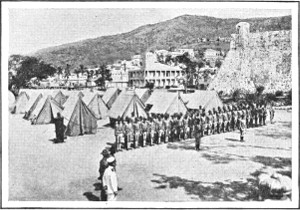
CAMP OF AMERICAN MARINES
Beneath the walls of the fort on the water-front, Charlotte Amalie
Little or nothing grows on the island of St. Thomas, and from an agricultural standpoint it offers but few opportunities. Its inhabitants, aside from about two hundred whites, are all negroes. The Danes were unable to teach them their language, and practically all speak English with that peculiar drawl that has become familiar to us in Jamaica and other islands in the West Indies. The blacks welcome the coming of Uncle Sam. They look upon us as a Santa Claus, who will bring them untold blessings and wealth beyond their dreams. They are a simple, childlike people, with bodies of men and women but with the intellect of the average child.
Charlotte Amalie
Charlotte Amalie is a clean little town with regular streets, and buildings built of stone and brick faced with cement. The Danes are a cleanly, orderly people, and this is evident in the appearance of the towns on the islands.
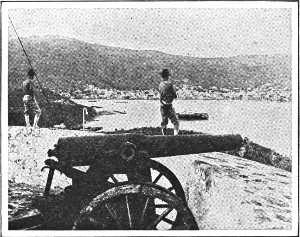
OLD DANISH FORT, ST. THOMAS HARBOR
Hurricanes are frequent, and at times do great damage. A storm of several years ago unroofed many of the houses, tore down palm trees and destroyed most of the foliage. Traces of the hurricane may still be seen, but its effect is gradually being obliterated.
Many steamers have been wrecked on these islands. Among numerous sailors stranded on St. Thomas was a Frenchman named Louis Monsanto. He founded on the shore of Krum Bay what he calls the graveyard of ships. Lying about are several odd figureheads that once adorned the bows of lost boats. Each has its story of thrilling escapes and tragic loss of life to awe the listener.
Marines now police the island, and to them has been entrusted the task of restoring order, mounting guns for the protection of the harbor, and firmly establishing American rule.
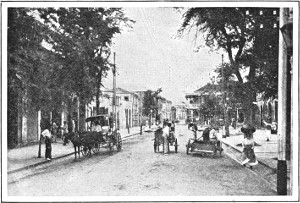
VIRGIN ISLAND TAXI-CAB AND EXPRESS SERVICE
An Island Bluebeard
These islands were once infested by pirates; in Charlotte Amalie we see Bluebeard’s and Blackbeard’s castles. An English pirate who married a woman from Charlotte Amalie went away on one of his piratical expeditions, entrusting to his wife a small box which he told her not to open unless he did not return in six months. After two months, woman’s curiosity got the better of her and she opened the box. She found therein just seven letters, but they were seven compromising letters written by women of Charlotte Amalie. She did not kill her husband, instead she invited the women to an afternoon tea at her home and poisoned all seven. So, you see it was not, in this case, the man who was the “bluebeard,” but the wife—a sort of bluebearded lady. She was arrested, tried and convicted, and was condemned to be burned at the stake. The eventful day arrived. Fagots were piled high about her, the torch was about to be applied, when the pirate ship appeared in the harbor, the pirate and his crew came ashore, and the wife was rescued. Then she sailed away with her husband, and they “lived happily ever after.”
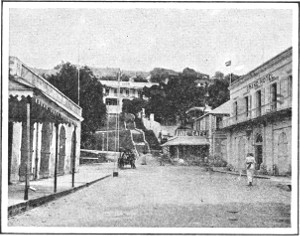
ENTRANCE OF THE GRAND HOTEL, CHARLOTTE AMALIE
From “The Virgin Islands of the United States of America,” by Luther K. Zabriskie, G. P. Putnam’s Sons, Publishers
St. John and St. Croix
The smallest of the inhabited islands is St. John. The few people living there are employed in picking bay leaves. The bay tree thrives on the island, and the oil obtained from its leaf is used in the making of bay rum.
The largest of the islands is St. Croix. It is about twenty-one miles in length and from four to fourteen miles in width. Rich and fertile, its soil produces chiefly sugar, a product capable of still further industrial development. The principal difficulty encountered is in obtaining good water. There is but one stream on the island, and except for the water from this stream the people must depend on rain water stored during the rainy season. One of the first duties that we have before us is the boring of artesian wells, as all the islands are in great need of good water for drinking and commercial purposes.
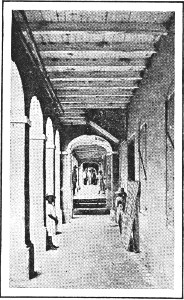
COVERED WALK
Christiansted, St. Croix
There is a primitive sugar mill on the island of St. Croix that is owned by Danes. One of the owners told me that the day the islands were transferred to the United States the negro employees formed a union and struck. They lost no time in availing themselves of the advantages that organized labor enjoys in a great republic.
The seat of government of this island is Christiansted, a town of about 4500 people. It is a neat, substantial little place, with covered colonnades extending through the business section of the town. These covered passageways enable one to walk about without being exposed to the rays of a tropical sun.
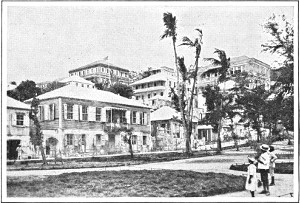
“GOVERNMENT HILL,” CHARLOTTE AMALIE
Showing Administration Building (upper right-hand) and Governor’s House (flying American flag)
It was from Frederiksted, the chief port of St. Croix, that Alexander Hamilton came to America. Born on the island of St. Nevis, his mother died when he was still an infant. He was then sent to an aunt who lived on St. Croix, and it was there that he gave evidence of the brilliant mind that in later years made him one of the most conspicuous figures in American history. It is a strange coincidence that over a hundred years after Hamilton left St. Croix it should come into possession of the nation he served so brilliantly. What might George Washington, “The Father of his Country,” say if he could know that the birthplace of the young West Indian attorney, to whom he looked for legal counsel, was now part of the great republic in whose establishment each of them had such an important share?
From “The Virgin Islands,” by Luther K. Zabriskie, G. P. Putnam’s Sons, Publishers
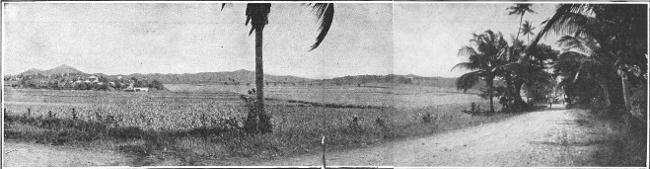
PANORAMIC VIEW SHOWING PLANTATION ON THE ISLAND OF ST. CROIX
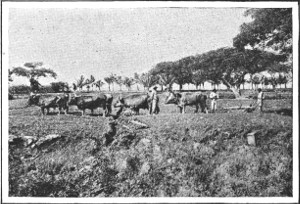
PLOUGHING ON ST. CROIX
There is but one paved highway on St. Croix, and that extends from Christiansted to Frederiksted at the west end of the island. A macadam road twenty-one miles in length connects the two towns, and over this highway passes practically all the traffic on the island. Here we see a curious procession of natives driving all kinds of queer vehicles drawn by diminutive ponies or donkeys.
Women carry upon their heads loads that would stagger the average man. They are able to balance almost anything, and one sees them carrying boxes, barrels, and even pianos, although the latter require about four women to balance their weight.
Agriculturally, St. Croix offers a good field for development. Cotton as well as sugar can be grown profitably, and, with modern American methods, its products can be materially increased.
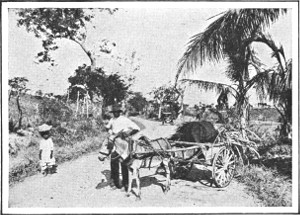
ON A SUNNY ROAD, ST. CROIX
System of Education
When the Americans first took possession there was much confusion. Danish law conflicted with American law, Danish customs differed from American customs, there was a Danish postmaster and an American postmaster; but these things are now straightened out and order has been completely restored.
The Danish method of instruction, which has long been in use, has been continued by the United States. The system differs from our own in that the schools are in session practically the year round, and religious training is required. The religious training in the schools will be discontinued, but otherwise the Danish method will obtain.
Virgin Islanders pride themselves on their low percentage of illiteracy. Only about two per cent. of the inhabitants are unable to read and write.
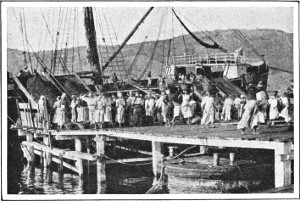
LONGSHOREWOMEN COALING A SHIP
St. Thomas Harbor
The Importance of St. Thomas
Commercially, the island of St. Thomas is destined to play the most important part of all the group, as it is a favored way-station on the route from European ports to the Panama Canal. Its lost trade can be regained, and it may be possible for American manufacturers to display samples of their wares in especially built ware-rooms at Charlotte Amalie. This would enable the merchants of Central and South America to make their purchases again as they once did. It would obviate the necessity of a long journey to New York, and the port of St. Thomas would be a convenient place in which to see American-made goods and place orders.
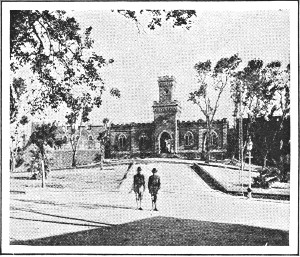
THE FORT ON THE HILL ABOVE CHARLOTTE AMALIE
Now an American jail
The gold paid by the United States to Denmark for the Virgin Islands weighed 48 tons. Like everything else, the islands have gone up in price since the first negotiations undertaken, fifty years ago, but it was necessary for us to have them, as with St. Thomas in our possession and fortified no foreign power without a naval base in this part of the world would dare attack the Panama Canal without first capturing St. Thomas. Without it they would leave a fortified base in their rear, an extremely dangerous situation for an attacking force.
The value of the harbor of St. Thomas and its strategic advantages have been recognized since the days of the Spanish buccaneers. Once the headquarters for ships sailing under the black flag, the memories of those days will always form a romantic and fascinating side of the life that was. Today there are modern harbor works, floating docks, marine slips and wharves provided with electric cranes, oil reservoirs, coal depots, fresh-water tanks, machine shops, and many other things that contribute to the commercial advantage of St. Thomas as a port of call.
We must not overlook the political importance of extending American jurisdiction over islands situated in the Caribbean Sea. The possibility of a change of sovereignty of any of the islands under foreign jurisdiction is of grave concern to this country.
The Monroe Doctrine, a settled national policy, would have caused this country to look with disfavor upon the acquisition of the Danish West Indies by any other power. The treaty of cession of these islands to the United States is therefore a matter of no small moment.
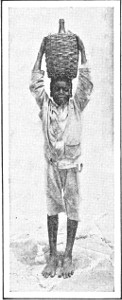
A BAY RUM CARRIER
Island of St. John
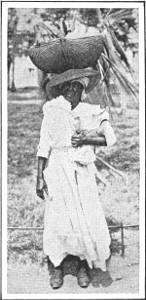
A NATIVE ON THE WAY HOME FROM MARKET
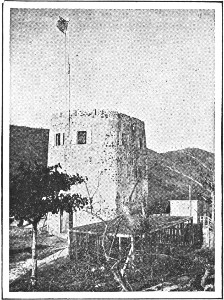
“BLUEBEARD’S CASTLE,” CHARLOTTE AMALIE
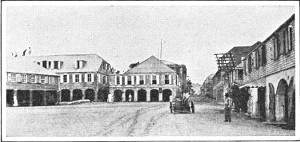
PUBLIC SQUARE, CHRISTIANSTED, ST. CROIX
Previous to the purchase, Rear Admiral Casper F. Goodrich thus defined the advantages of the transfer in an interview in the New York Times. “Were the Danish West Indies in the possession of an enemy, what interests of ours would be menaced? Let us seek the answers to this momentous question. From them, as a base, to Charleston, our nearest important Atlantic harbor, is about 1200 miles; to Norfolk about 1300 miles—distances easily covered in three or four days by a fleet which could fight an action and return with plenty of fuel left in the bunkers. Moreover, raiding operations therefrom, could, and doubtless would, seriously interfere with, if they didn’t wholly interrupt, our foreign commerce, even at remote points, such as New York, Boston and Portland. In the other direction lies Colon, a little more than one thousand miles away from St. Thomas. It is against Colon that an inimical campaign would more possibly be directed. The possession of this gateway to the Pacific would restore the conditions of the war with Spain, when the Oregon had to circumnavigate the whole of South America in order to join Sampson off Santiago de Cuba.
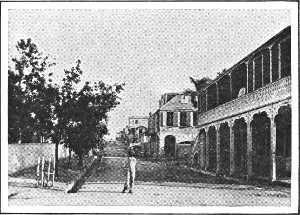
STREET IN FREDERIKSTED
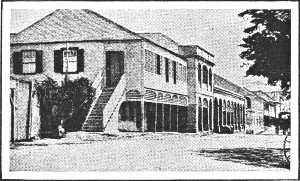
HOUSE WHERE ALEXANDER HAMILTON LIVED AS A BOY, FREDERIKSTED, ST. CROIX
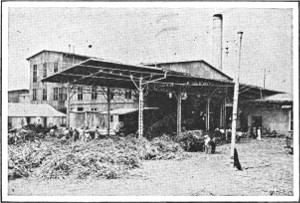
DANISH SUGAR MILL, ST. CROIX
“It is evident that a foreign nation endeavoring to acquire the Danish West Indies could in fact have no mere commercial or profitable colonial aim in view. There is but one harbor in the group that is especially fit for a naval base—Charlotte Amalie, on the south side of St. Thomas. By skill and care it could be made to accommodate a fleet large enough to occasion us grave concern. From a secure harbor for merchant steamers to a naval establishment and a military outpost, the path is neither hard nor long. It is wiser, however distasteful, to forestall any such manoeuver by a foreign power by buying the islands ourselves. We do not relish the idea of such a thorn in our side, such a threat to neighboring Porto Rico, to our naval station at Guantanamo (only 300 miles distant), to that at Key West (1000 miles distant), to the free navigation of the Caribbean Sea, and the Mona and Windward Passages (between Porto Rico and Haiti, Cuba and Porto Rico, respectively), or to our Gulf cities. Thus it appears, north, east, south and west, these islands are a most valuable point d’appui for any European government wishing to quarrel with us. It is, therefore, in the highest degree essential that we spare no effort to prevent their falling into unfriendly hands.”
Transportation
Climatically the Virgin Islands offer much to attract the tourist as a winter resort. They need first-class hotels, to be built and managed by competent Americans. There is no reason why the islands should not become popular with the tourist as soon as suitable accommodations have been provided.
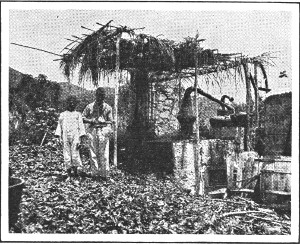
BAY OIL STILL
From “The Virgin Islands,” by Luther K. Zabriskie, G. P. Putnam’s Sons, Publishers
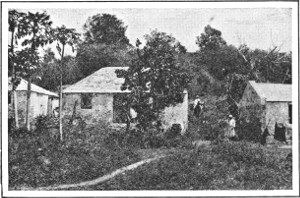
LABORERS’ HOMES ON A ST. CROIX PLANTATION
From “The Virgin Islands,” by Luther K. Zabriskie, G. P. Putnam’s Sons, Publishers
Situated 1440 miles south of New York and 1025 miles from Colon, the northern entrance to the Panama Canal, the islands are ideally placed for a short sea voyage. The population in recent years has been diminishing, because of the loss of trade and the consequent falling-off of the number of ships in the harbor. At one time there were 46,000 people on the islands; in 1911, the number had dwindled to 27,000, and the present population is said to approximate this figure.
The only means of transportation on St. John is by horseback. As the island is very hilly, the roads are not suitable for vehicles. On St. Thomas there are about fifteen miles of good roads, traversed by numerous carriages and a few automobiles. St. Croix boasts one hundred miles of roads, but few of these are paved.
We include in our West Indies possessions not only some of the Virgin Islands, but Porto Rico. Porto Rico, however, is no more American today than when we first went to the island. But the Virgin Islander welcomes the United States. The circumstances attending the purchase and transfer of the islands were most auspicious, and we foresee only the happiest outcome from the relations between the natives and the United States.
SUPPLEMENTARY READING
THE VIRGIN ISLANDS OF THE UNITED STATES OF AMERICABy Luther K. Zabriskie
THE VIRGIN ISLANDSBy T. H. N. de Booy and J. T. Faris
DANISH WEST INDIESBy W. C. Westergaard
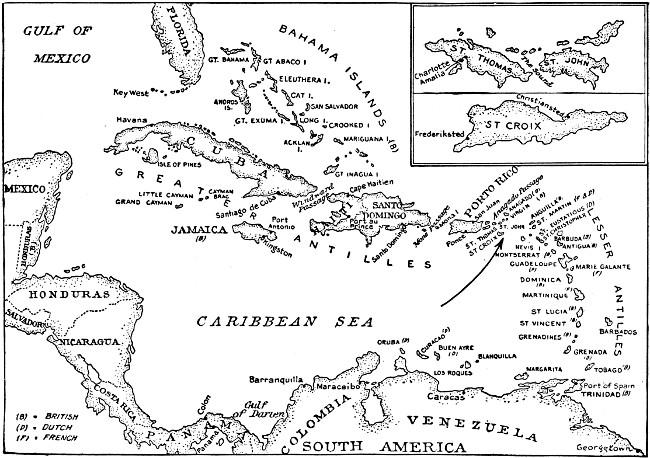
MAP SHOWING LOCATION OF VIRGIN ISLANDS
When Mr. E. M. Newman, who is now in Europe, returns, he will bring pictures and information that will mean a great deal to all the readers of The Mentor. Mr. Newman had intended to resume his South American series—which has been appearing in The Mentor—and was about to sail to the southern continent when he was summoned to Washington and commissioned by the United States Government to go over and make a special study of war conditions in England, France, and Italy. Mr. Newman’s objective is not the trenches—there are plenty of war correspondents and battle photographers. His mission is a distinctly new and important one. He is to make a record, in pictures and text, of the living conditions of the people in war time as he observes them in the allied countries. When he returns, this material will be put at once before the public in a series of lectures, the purpose being to make clear to Americans just what war means to those that are not “out there,” but are doing their bit in the home city, town, village, or farm district. Naturally, this material will have tremendous vital interest to all of us in the United States who are watching and wondering what war is going to mean in our daily lives and occupations. “I hope particularly,” said Mr. Newman, “to illustrate the conservation of human power that makes possible the release of able bodied men to the war with the least disturbance to commerce. The object is to bring back to the United States a graphic presentation of what can be done and what should be done to permit us to utilize every ounce of our strength for the successful prosecution of the war.”

The Mentor will publish Mr. Newman’s material in three articles, entitled “England in War Time,” “France in War Time,” “Italy in War Time.” We expect to have these important articles ready for publication in the Fall—the dates will depend upon the time of Mr. Newman’s return. On the opposite page we print some interesting information just received from him.

W. D. Moffat Editor