THE RING OF THE NIBELUNG
Reading edition
By HENRY T. FINCK
Music Editor of the New York Evening Post, Author of “Life of Richard Wagner” and many other works

MENTOR GRAVURES
RICHARD WAGNER By Franz von Lenbach
RICHARD WAGNER’S DREAM By Schweninger
SIEGFRIED SLAYS THE DRAGON By K. Dielitz
MENTOR GRAVURES
WOTAN’S FAREWELL By K. Dielitz
BRÜNNHILDE SLUMBERING GUARDED BY MAGIC FIRE By Hermann Hendrich
THE VALKYR’S RIDE By K. Dielitz
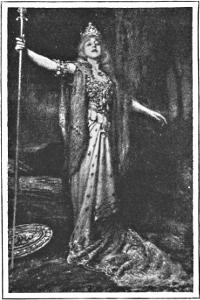
BRÜNNHILDE
From a Painting by S. de Ivanowski, studied from Mdme. Olive Fremstad
THE MENTOR · DEPARTMENT OF MUSIC · FEBRUARY 1, 1916
Entered at the Postoffice at New York, N. Y., as second-class matter. Copyright, 1916, by The Mentor Association, Inc.
In the leading operatic centers the four music dramas constituting Richard Wagner’s Ring of the Nibelung are often performed separately; but once a year—sometimes twice—they are all given within a week or two, in proper order,—“Rheingold,” “Walküre” (vol-keer-a), “Siegfried” (seeg-freed), and “Götterdämmerung” (get-ter-dem-mer-ung) as a special “Nibelung cycle,”—and such a cycle is looked on by the highest class of music lovers as a great festival, and is followed with concentrated attention in all its wonderful details.
Wagner himself gave his “Ring” (as it is often called for short) the subtitle “Bühnenfestspiel” (bee-nen-fest-speel), or stage-festival play. It was in the summer of 1876 that he first gave it to the world, in a specially constructed theater in Bayreuth, Bavaria; and he did this in accordance with a plan conceived by him as a necessity more than a quarter of a century before.
To understand why he regarded such a festival as a necessity we must know something about the operatic situation at the time when he composed this colossal and revolutionary work. The originators of Italian opera, who lived at Florence three centuries ago, held that the play (or libretto) in an opera was as important as the music. In their eagerness to make it possible for the hearer to understand every word of the text they banished all flowing melody in favor of a dry recitative, halfway between speech and song, one of them actually boasting of their “noble contempt for melody.”
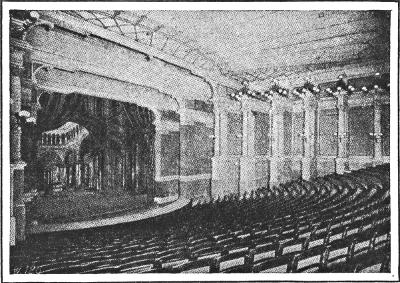
INTERIOR, BAYREUTH OPERA HOUSE
This, naturally, led to a reaction, which went so far to the side of melody that finally nobody listened except when the prima donna or the tenor sang a brilliant aria, the play being entirely ignored.
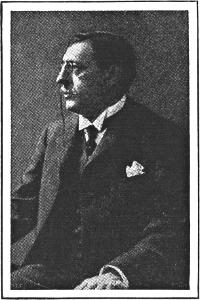
FELIX MOTTL
One of the leading conductors at the early festival performances at Bayreuth
Efforts to curb the singers and restore the play to honor were made by several composers, the most important of them being Gluck (1714-1787). So thoroughly was he imbued with the importance of the play in an opera that he once wrote, “Before I begin to work I try to forget above all things that I am a musician.” Yet in his operas, too, the arias remain the principal points of interest, as they do in the operas of his successors, Rossini, Bellini, Donizetti, Mozart, Weber.
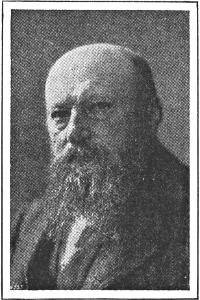
DR. HANS RICHTER
The famous conductor, in charge of the orchestral forces at Bayreuth in 1876 and after
Moreover—and this is the most important point—in Gluck’s operas, as Wagner himself pointed out in 1850, “aria, recitative, and ballet, each complete in itself, stand as unconnected side by side as they did before him, and still do, almost always, to the present day.”
It was this defect of the opera—this incoherence of its parts—that Wagner set himself the task of remedying. The result was the Music Drama—the “Artwork of the Future,” as exemplified in the Ring of the Nibelung as well as in “Tristan and Isolde,” “Die Meistersinger” (mice-ter-singer), and “Parsifal.”
DIFFERENT FROM ORDINARY OPERAS
These seven music dramas differ radically in their structure from what had been known for centuries as operas. Operas are made up of “set numbers”; that is, solo arias, duos, ensembles (ahnsahmbles) for three or four voices, besides choruses, instrumental pieces, and dances. Wagner also himself wrote some operas: “The Fairies,” “Rienzi,” “The Flying Dutchman,” “Tannhäuser” (ton-hoi-ser), and “Lohengrin,” in all of which there are set numbers which are played and sung once and do not recur.
Beginning with the “Flying Dutchman,” however, we have, besides the set numbers which do not recur, others which do recur, and these are the far-famed “motives” (German, leitmotive), usually called “leading motives,” or guiding themes.
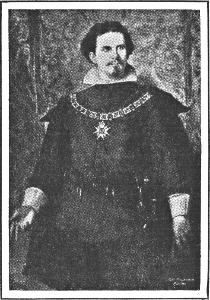
LUDWIG II OF BAVARIA
The young king who befriended Wagner and made his plans possible
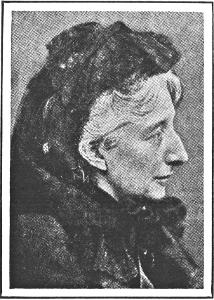
COSIMA WAGNER
Daughter of Franz Liszt, formerly wife of Hans von Bülow, who now as Wagner’s widow manages the affairs at Bayreuth
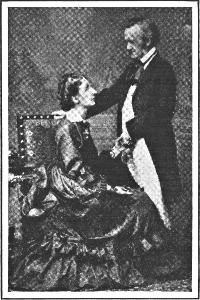
RICHARD AND COSIMA WAGNER
From a photograph taken about 1872
A leading motive may be defined as a characteristic melody, or succession of chords like the majestic strains of the Walhall music, the heavy clumsy musical tread of the giants, or the virile, heroic motive of Siegfried, which is sounded by the orchestra whenever in the course of the drama the personage or the dramatic idea with which it is associated comes forward or is referred to in the text.
Today Wagner’s early operas seem simple to all; but the German audiences that first heard them, more than sixty years ago, found them hard nuts to crack. His “Rienzi,” being in the flashy Meyerbeer style much admired at that time, won great favor, although it is the poorest of his works. His next work, “The Flying Dutchman,” was so novel in style that the audiences did not know what to make of it. “Tannhäuser” was still more Wagnerian; while his “Lohengrin” seemed so far beyond the possibility of public approval that he could not get it accepted for performance, even in Dresden, where he was conductor!
This was only one illustration of the hard set conditions of the operatic situation. Wagner had so many reasons for dissatisfaction that he joined the revolutionary uprising in 1849. This uprising was soon crushed, and Wagner, with the aid of Liszt, escaped to Switzerland, the great asylum of political fugitives. Twelve years elapsed before he was allowed to return to Germany.
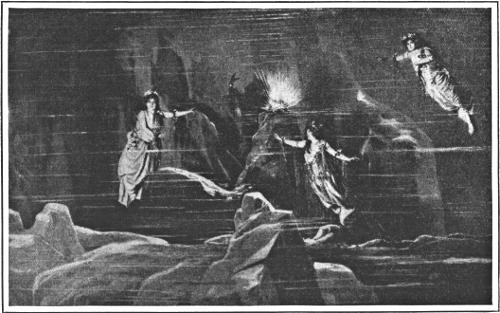
THE RHINE DAUGHTERS. FROM RHEINGOLD. Photographed from the stage performance
For six years he did not compose another opera, devoting his time instead to writing essays in which he tried to explain the aim of his “Artwork of the Future.” Nobody paid any attention to these essays. The consequence was that, as he wrote to Liszt, “I lead here entirely a dream life: if I awake, it is to suffer.” He suffered because, among other things, he heard from many sources that the performances of his operas given in German cities were so bad that it was hard to understand how anyone could possibly enjoy them.
A MUSICIAN’S DREAM
If these comparatively simple operas were so badly sung and played, what would happen to the more advanced and ultra-Wagnerian work which now began to ripen in his brain,—the four music dramas constituting the “Ring”? Their performance, he realized, would be impossible in the opera houses of Berlin, Dresden, Leipsic, and other cities, as managed and manned at that time. He had to fall back on his “dream-life.” And he dreamt a wonderful dream,—a dream of Bayreuth, of a specially built theater with singers and players selected by himself for their correct performance of his next work. This dream was not realized till twenty-six years later!
This next work was at first intended to be a music drama complete in itself, to be called “Siegfried’s Death.” On thinking the matter over, however, Wagner concluded that the poem was too full of matter for one play. Consequently he wrote a “Young Siegfried” to precede—and prepare for—“Siegfried’s Death” (the name of which was changed to “Götterdämmerung,” or “Dusk of the Gods”); then for the same reason he wrote “Die Walküre,” to precede “Siegfried”; and finally “Rheingold,” as a prelude to the other three.
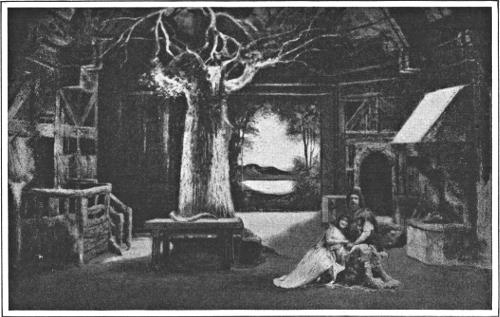
SIEGMUND AND SIEGLINDE. FROM DIE WALKÜRE. Photographed from the stage performance
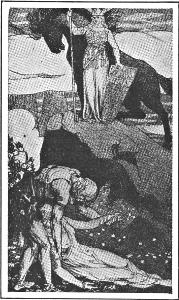
BRÜNNHILDE’S SUMMONS TO SIEGMUND
From Die Walküre
While the poems were thus written in inverse order, the plot of the whole cycle had been in his mind, and written down, before he wrote any of the verses; and the music, of course, was composed in proper order, beginning in 1853 with “Rheingold.”
Wagner not only wrote the poems of all his stage works, but he was a great dramatic poet. The full value of his poems, however, can be appreciated only in connection with the music, just as the music makes its deepest appeal in connection with the poem and the action. And yet his music alone is compelling enough; for Wagner concerts, at which the music is played without the words, are among the most popular of concerts.
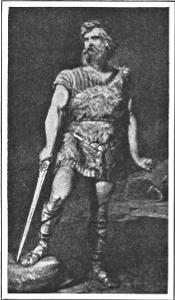
ALBERT NIEMANN
Noted tenor who created the role of Siegmund in the original performances of Die Walküre at Bayreuth in 1876
What we should specially bear in mind is that the music in ordinary operas is simply associated with the dramatic poem, or libretto, whereas in the Ring the two are identified; or, as Wagner once expressed it, in the music drama the poem and the music are “like two pairs of lips in a kiss, each giving to and taking from the other.”
To practical persons Wagner’s life in Switzerland must seem deplorable. He spent six years writing theoretical essays the sales of which hardly paid for his paper and ink. Then he began to write and compose his cycle of four Nibelung dramas, which he felt sure would never bring him in a penny, even if he succeeded (which he doubted) in ever getting them performed. But Wagner was not a practical man,—he was a genius,—he could no more help creating the Ring of the Nibelung than a volcano can help erupting when the time comes.
He finished “Rheingold”; he finished “Die Walküre”; he began “Siegfried,” and got as far as the middle of it when he was compelled to stop because of lack of funds. The royalties from his operas (which since his death have netted his heirs over a million dollars) were at that time trifling. Liszt and other friends helped him; but all his efforts to help himself failed. For rehearsing and conducting the London Philharmonic concerts during the season of four months he got one thousand dollars, or half what in recent times Jean de Reszke used to earn in four hours by singing one of the Wagner roles! He finally concluded that in order to finish the Ring he must write a separate opera that might be performed at once and bring him in some money. The result was “Tristan and Isolde”; but this was as far ahead of the times as the Ring, and no opera house attempted it till six years after its completion in 1859.
KING LUDWIG TO THE RESCUE
In despair, he next composed “Die Meistersinger.” This, being a comic opera and full of pleasing melody, would, he felt sure, turn the tide. It did so; but before this occurred important things happened.
Encouraged by the success of a series of concerts he had given in Russia, he spent his money recklessly in Vienna, and borrowed more, at usurious rates, because he had been invited for another tour in Russia. Through no fault of his own, this came to naught, and he had to fly from Vienna to escape a debtor’s prison. First he went to Switzerland, then to Stuttgart. In a moment of despair he had bought a pistol to end his life; but better counsel prevailed, and he decided to hide in the Swabian Alps, there to complete the score of his comic opera. The wagon had already been ordered, and he was packing his trunk, when a card was brought up with the name of Baron Pfistenmeister, court secretary of the king of Bavaria.
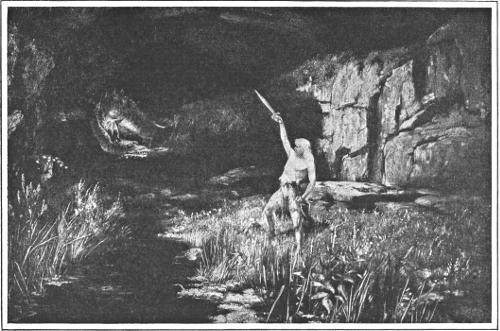
SIEGFRIED AND FAFNER THE DRAGON. From the painting by Hermann Hendrich
Ludwig II had but recently ascended the throne of Bavaria. He was very young, and very enthusiastic over Wagner’s operas. He knew that the great composer needed help, and one of his first actions was to send his secretary to find him. He was promptly brought to Munich, where he was enabled to live in luxury at the king’s expense. Not only were his operas staged at once, but also two of his music-dramas,—“Tristan and Isolde” and “Die Meistersinger.”
He now returned to his “Siegfried,” which, with tears in his eyes, he had abandoned in the middle of the second act. His plan was to complete this and “Götterdämmerung,” and then have the whole “Ring” staged in a new theater to be specially constructed in Munich. The king cordially approved this plan; but the courtiers and the populace, jealous of the great composer because of the influence he had on the king, made such a row over it that Wagner left the city to complete his work elsewhere.
BAYREUTH AND THE FIRST FESTIVAL
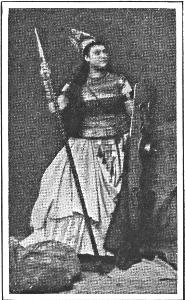
AMALIA MATERNA
Famous dramatic soprano who created the role of Brünnhilde in the original performance at Bayreuth
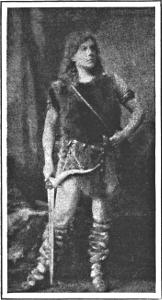
MAX ALVARY
Popular tenor who created the role of Siegfried in America in 1887 and sang it at the 100th American performance in New York, in 1895
The inhabitants of Munich have had reason to regret their action in opposing the plans of their king and Wagner. Since Wagner’s death in 1883 a score or more of festivals have been held at Bayreuth, bringing millions of profit to that Bavarian town, all of which the Munichers might have had. Bayreuth was chosen partly because it was within the realm of Wagner’s royal friend, partly because of its picturesque surroundings, and partly because of its seclusion. Special inducements had been offered him to build the Nibelung Theater at the famous summer resort, Baden-Baden; but he did not wish to produce his great and revolutionary work before audiences of mere pleasure-seekers. He had spent a quarter of a century in creating an entirely new German artwork, free from all foreign elements and operatic fripperies, and he wanted to submit it to serious music lovers, who would be sufficiently interested to take a trip to remote Bayreuth.
Edison, the wizard inventor, who never spared himself in work, said not long ago that genius was one per cent inspiration and ninety-nine per cent perspiration.
Wagner’s “Ring” is certainly a miracle of inspiration; yet when one reads of how much hard work he bestowed on its production after the infinite pains he had taken in creating it, one feels tempted to say that Edison did not exaggerate. Monumental proof of Wagner’s indefatigable industry is afforded by two volumes, one containing his business letters, the other his letters to the artists during the preparations for the Bayreuth festivals of 1876 and 1882, over both of which he presided personally. He spent a whole summer visiting all the German opera houses and picking out the artists most suitable for each of the forty-nine solo parts in the “Ring.” With most of these he corresponded personally, and also went over their parts with them before the rehearsals on the stage. The orchestra was made up with the same attention to individual merit; while the scenic features were genuine works of art.
The Nibelung Festival of 1876 was a most important event in the history of music. Among those who attended it were two emperors (William I of Germany and Don Pedro of Brazil), King Ludwig II, the grand dukes of Weimar, Baden, and Mecklenburg, together with many other representatives of the European aristocracy; while among those who represented the musical nobility were Liszt, Grieg, and Saint Saëns. On all these, as on the ordinary mortals assembled, the “Ring” made an indelible impression.
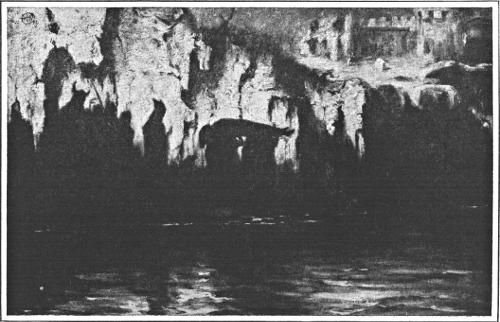
THE PASSING OF SIEGFRIED. From the painting by Hermann Hendrich
CONQUEST OF EUROPE AND AMERICA
That there were shortcomings it is needless to say; for everything was so new and difficult to the artists. Nor were the funds sufficient to enable Wagner to realize all his intentions. The cost of seats ($75 for the four performances—which were thrice repeated) kept many enthusiasts from attending, and the result was a deficit of $37,500.
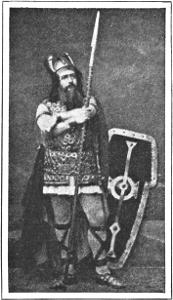
GUSTAV SIEHR
Who created the role of Hagen in Götterdämmerung, at Bayreuth, 1876
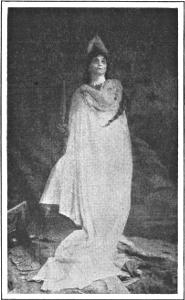
LILLI LEHMANN
Celebrated dramatic soprano, who took part in original Bayreuth performances and was the leading interpreter of Wagner roles in America for years
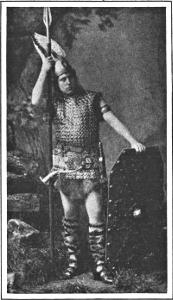
SIEGFRIED IN GÖTTERDÄMMERUNG
Photographed from Max Alvary
This deficit, while it was a cruel blow to Wagner, was for the world a blessing in disguise; for it made it impossible for him to carry out his plan of reserving the future performances of the Nibelung’s Ring for Bayreuth alone. There were no available funds; so King Ludwig, who had contributed $50,000 toward the expenses of the Nibelung scenery, got the privilege of producing the whole “Ring” in Munich. Other cities soon followed, and so great was the success that Wagner permitted Angelo Neumann, manager of the Leipsic Opera, to organize a traveling Wagner Theater for producing the “Ring” throughout the cities of Germany, as well as in Italy and other countries. These performances were, fortunately, given under the conductorship of Anton Seidl, who had been Wagner’s secretary for several years, and concerning whom Wagner wrote, “No other conductor knows as he does the proper tempi [changes of pace] of my music or how the action on the stage must be suited to the music. Seidl learned these things from me. He will conduct the Nibelungen better for you than anyone else.”
AMERICAN PERFORMANCES
Fortunately, also, it was this same Anton Seidl who conducted the first performances of the “Ring” in America, beginning with “Siegfried” in 1887. “Die Walküre” had previously been produced under Leopold Damrosch. The success in these cases was immediate; for the Metropolitan Opera House had imported the leading Wagnerian singers from Germany.
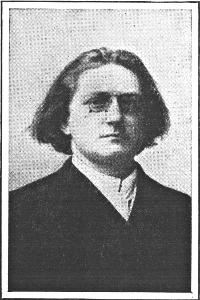
ANTON SEIDL
For years the leading conductor of Wagner opera in America
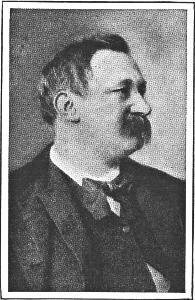
THEODORE THOMAS
Noted conductor who worked for years to make Wagner music known to the American public
The ground had been well prepared. Theodore Thomas had labored many years to educate the public up to Wagner; his activity culminating in the great Wagner festival of 1884, for which he imported three of the leading Bayreuth singers, Materna, Winkelmann, and Scaria. That same season Wagner’s operas and music-dramas began to lead the others at the Metropolitan, and among the singers who helped to popularize his works were Lilli Lehmann, Marianne Brandt, Milka Ternina, Albert Niemann, Heinrich Vogl (fo-gl), Max Alvary, Theodor Reichmann, Emil Fisher, most of whom had studied with Wagner, besides, somewhat later, Jean and Edouard de Reszke, Olive Fremstad, Johanna Gadski, and the Americans Lillian Nordica, Emma Eames, Louise Homer, and Geraldine Farrar.
The first of the Nibelung operas heard in New York was “Die Walküre.” It was sung at the Academy of Music eight months after the festival at Bayreuth, but the performance was in every way inadequate. In a way it was fortunate for the Wagner cause that Abbey and Grau lost $250,000 giving operas in Italian and French during the first season (1883-84) of the Metropolitan Opera House, just built at a cost of $1,732,978. That failure induced the directors to try German opera, and for seven years it ruled supreme; but the German singers, great as they were in their own sphere, could not, with a few exceptions (notably Lilli Lehmann) do justice to Italian and French works. The eager desire to hear those again, under more favorable conditions, led to a temporary cessation of German opera; but it so happened that one of the famous singers engaged for French and Italian opera was the great tenor, Jean de Reszke, who gradually became an ardent Wagnerite, eager to appear in the Nibelung operas. He induced the management to reengage Seidl and some of the best German singers, and once more Wagner flourished, side by side with Verdi and Meyerbeer, Gounod and Bizet. Wagner now leads in the number of performances, followed by Puccini and Verdi. Singers of every nationality now seek to appear in the Wagner operas, and an ambition of the great conductors, including the Italian, Toscanini, is to interpret the Nibelung’s Ring, of which Liszt wrote: “It overtops and commands our whole art-epoch as Mont Blanc does our mountains.”
SUPPLEMENTARY READING
THE RING OF THE NIBELUNGBy G. Kobbé
GUIDE TO THE RING OF THE NIBELUNGBy H. von Wolrogen
RICHARD WAGNERBy Adolphe Jullien
2 Vols. Fully illustrated
STUDIES IN THE WAGNERIAN DRAMABy H. E. Krehbiel
RICHARD WAGNERBy W. J. Henderson
WAGNER AND HIS WORKSBy H. T. Finck
A STUDY OF WAGNERBy Ernest Newman
LIFE OF WAGNERBy Houston S. Chamberlain
Fully illustrated
THE MUSIC DRAMAS OF R. WAGNER AND HIS FESTIVAL THEATER IN BAYREUTHBy Albert Lavignac