Editorial
Reading edition
In the early part of the nineteenth century the United States Government realized the importance of having a record on canvas of the nation’s great historical events, and several painters of that day produced pictures that hold places of honor in our Government buildings. John Trumbull was the foremost of these painters.

There has been a demand for several years for new historic paintings. The feeling exists that the painters of one hundred years ago could not have the perspective to portray the Revolution correctly, no more than a historian of the same period could write its history. The time has come for modern artists in American historic art. The World’s Fair at Chicago gave an impetus to the work, especially in decorative form. As a result, public buildings erected within the past twenty years show many interesting and distinguished examples of historic art in mural decorations, by such artists as Blashfield, Kenyon Cox, C. Y. Turner, and others. There is a demand now from many sources—from galleries, Federal and state governments, and from schools—for historical pictures which shall be true and shall also be worthy examples of modern work.
This number of The Mentor contains four distinguished examples of modern historical art. Three of them are the work of Mr. Henry Mosler, and were painted within the past five years.
Mr. Mosler has been known as an artist of great distinction for a long time. As early as 1874 he won a medal at the Royal Academy of Munich, and he won the Thomas B. Clarke prize in the National Academy of Design, New York, in 1896. Mr. Mosler, therefore, brought the ripe powers of a master painter to the work, and he has produced four paintings of great art value and historic importance.
The first picture, which appeared four years ago, is entitled “Ring, Ring, for Liberty,” and represents, with great strength and vigor, the old bell ringer in the cupola of Independence Hall, who sounded the note of liberty in July, 1776. Three years ago Mr. Mosler finished his painting of Betsy Ross and her companions making the first flag, which is reproduced in this number of The Mentor. Mr. Mosler based his work on careful sketches made in the Betsy Ross house on Arch Street, Philadelphia. Our readers will surely feel the grace and charm as well as the vital interest of this picture.
Many have said that our country needed a new painting of “Washington Crossing the Delaware.” The familiar composition, by Leutze, is regarded as stiff and constrained and as lacking a sense of reality. Mr. Mosler’s picture gives a true and spirited conception of the event, based on historical study and on sketches made in the winter time at the point of the Delaware where Washington crossed. The painting of Paul Jones is a vivid dramatic presentment of a historical subject that has never heretofore been pictured in an adequate manner.
Another interesting picture in this group is the “Signing of the Declaration of Independence,” by Miss Sarah Ball Dodson. The actual life and spirit of the scenes in Independence Hall during July, 1776, have not been fully realized by other artists. Miss Dodson’s picture is a striking presentment of the scene, distinguished not only for its art value but for its truth. Each figure is an actual portrait and takes an earnest, living part in the composition. Miss Dodson was a native of Philadelphia, and knew her subject at first hand. Her death some years ago was a distinct loss to American art.
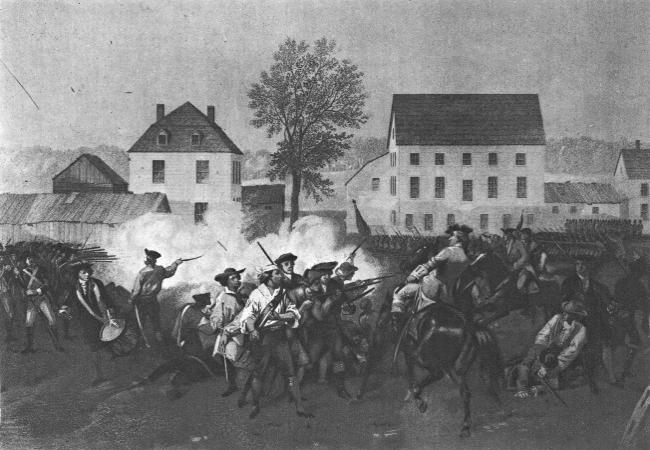
BATTLE OF LEXINGTON