THE METROPOLITAN MUSEUM OF ART Anthony van Dyck
Reading edition
THREE

The Metropolitan Museum offers an unusual chance for the study of Van Dyck’s (dike) portraits, though it possesses none of his figure subjects. In point of time, the “Portrait of a Man” from the Marquand Collection in the Museum is probably the earliest of the eight portraits attributed to him. For a long time it was attributed to Van Dyck’s master, Rubens. The “Portrait of a Lady” (holding a black feather fan) from the same source, seems also to belong to the first Antwerp period. Van Dyck was born in Antwerp on March 22, 1599. In 1621, when he was twenty-two years of age, Rubens advised him to visit Italy. Aside from some occasional journeys, he seems to have spent his time at Genoa, and for nearly five years he painted the nobility of that thriving port. It was during these years that the “Marchesa Durazzo” of the Altman Collection was done, as was also the portrait of his friend and fellow-townsman, Lucas van Uffel, whose activities as a merchant had brought him to Genoa. Upon his return Van Dyck worked for five years in Antwerp, painting during that time many altarpieces and religious subjects for the churches and chapels of the city. The portrait of Baron Arnold Le Roy (Hearn Collection) was probably painted within this period.
From Antwerp, Van Dyck went to London at the invitation of Charles I. Many portraits of the king, of Queen Henrietta and their children testify to the high esteem in which he was held. His popularity was so great and his commissions so numerous that he was compelled to hire a number of assistants. The helpers painted the costumes and draperies of the portraits, while their employer limited his brush to the painting of the faces and hands.
The portraits of the famous art patron, The Earl of Arundel and his grandson, and of James Stuart, Duke of Lennox, came in this period, when the artist’s short life of forty-two years was drawing to a close. The Duke of Lennox was a cousin of the king, who created him first Duke of Richmond. The Duke is said to have offered to ascend the scaffold in the place of his noble cousin when Charles I was condemned. Whether the rank of the sitter prevented Van Dyck from allowing his assistants to have anything to do with the portrait we cannot know positively, but seldom has a more superb portrait come from his brush. How remorselessly the weakness of his character is given! Note the mastery in the placing of the star of the Order of the Garter, and the emphasis given to the devotion of the superbly painted greyhound.
There came into the market a few years ago a number of portraits from one of the old Genoese palaces, where they had hung since Van Dyck painted them. A majority of these pictures passed into American collections. Two were secured by Mr. Frick, and three more became a part of the Widener Collection in Philadelphia, where they hang in the company of two others of this master’s fine canvases.
PREPARED BY THE EDITORIAL STAFF OF THE MENTOR ASSOCIATION ILLUSTRATION FOR THE MENTOR, VOL. 6, No. 9. SERIAL No. 157 COPYRIGHT, 1918, BY THE MENTOR ASSOCIATION, INC.
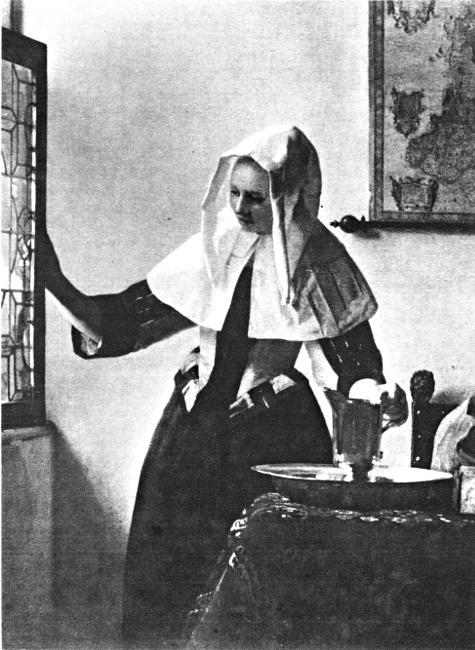
IN THE METROPOLITAN MUSEUM OF ART, NEW YORK
YOUNG WOMAN WITH A WATER JUG, BY VERMEER