The CRADLE of LIBERTY
Reading edition
By ALBERT BUSHNELL HART
Professor of Government, Harvard University
MENTOR GRAVURES
FANEUIL HALL BOSTON, MASS.

OLD NORTH CHURCH BOSTON, MASS.
THE LINE OF THE MINUTE MEN LEXINGTON, MASS.
MENTOR GRAVURES
SIGNING THE DECLARATION OF INDEPENDENCE By John Trumbull
THE LIBERTY BELL
CHILDREN OF LIBERTY
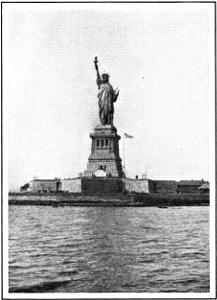
LIBERTY ENLIGHTENING THE WORLD
The Statue of Liberty is 151 feet high, standing on a granite pedestal 155 feet high. It was designed by the French sculptor, Frédéric Auguste Bartholdi. The cost, over a million francs, was subscribed by the people of France. The pedestal cost $250,000, raised by popular subscription in the United States. The statue was unveiled on October 28, 1886.
Entered as second-class matter March 10, 1913, at the postoffice at New York, N. Y., under the act of March 3, 1879. Copyright, 1918, by The Mentor Association, Inc.
Singularly enough, the freest people on earth are not the happiest (using the word “free” in the broadest sense). The Esquimaux and the Australian “black fellows” know no hours of labor, no restriction on their movements, no courts to punish offences; yet, by all accounts, their lives are filled with danger, disease, and famine. Real liberty comes into being only when men feel the contact of freemen with freemen. Liberty flourishes where men are gathered into communities, because every man must accept some abridging of that perfect freedom which the lowest savages enjoy. The essence of liberty is to recognize other people’s liberty—and that means some restrictions all around; thus arises the system of balance and elastic government which we call democracy.
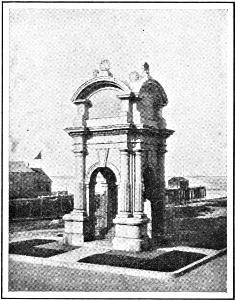
PLYMOUTH ROCK
The granite boulder enclosed by this memorial shrine is a fragment (broken off in 1774) of the large flat rock where the Pilgrims landed—which lies near the sea and is now covered by a wharf
Take an example of unlicensed liberty from the bumblebees, who have their own way, though unloved, while the honey-bees are citizens of a state, everyone going armed, as becomes a race renowned for its preparedness. The bees, however, are monarchists, who will fight and die for a sovereign queen whom they have never seen. So, at the opposite pole from the care-free, house-free—and often food-free savage, we may find a mass of individuals clustered in an empire, and obedient to the scepter or the nod of a personal sovereign.
Why do men with minds and wills accept personal sovereigns? Many times for safety. The beginning of kings is the soldier-chief, that “man on horseback,” who has been the destruction of commonwealths, and yet has founded many states,—first conqueror and then despot. As Daddy Smith said in the Massachusetts ratifying convention of 1788, in describing the social disturbances of Shays’ Rebellion, “Our distress was so great that we should have been glad to catch at anything that looked like a government for protection. Had any person that was able to protect us come and set up his standard, we should all have flocked to it, even if it had been a monarch, and that monarch might have proved a tyrant, so that you see that anarchy leads to tyranny, and better have one tyrant than so many at once.”
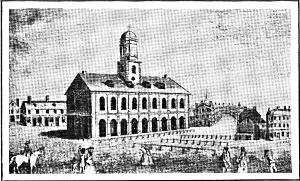
FANEUIL HALL IN 1789
The second Faneuil Hall. As rebuilt after the fire of 1761
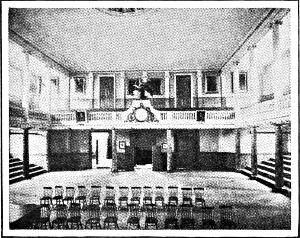
INTERIOR OF FANEUIL HALL
Ancient Despotism
One would expect to find the cradle of liberty in the cradle of the civilized human race, that is in that once wealthy valley of Mesopotamia. Whatever the previous organization of family or tribe or clan, the earliest organized states of which we have a record were the mighty empires of Babylon and Assyria, the closest-knit monarchies of history, whose kings compared themselves with divinities and were worshiped as gods. What opportunity was there for the individual? The Great King lived in one world and all his subjects in another. The Assyrian sculptures tell how Sargon and Assurbanipal relieved the oppressed that ventured to strive for home rule! Shattered, pierced, impaled, these aspirants for liberty served to illustrate the absolute power of their masters. Yet despotism proved then, as it will in future prove, that when liberty is strangled, power departs; for all those vast empires fell before the armies of other invaders and conquerors.
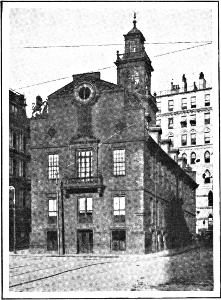
OLD STATE HOUSE, BOSTON, MASS.
Erected in 1748, and now under the guardianship of the Bostonian Society
Throughout later history the same effort has been made to corral human beings into a nation controlled over their heads by self-appointed rulers. Many dynasties began their power by seizing the citadel, destroying the freedom of their subjects, raising an army that should depend on them for pay and honors, and thus founding a lineage of sovereigns, who presently began to call themselves “Kings by the grace of God.” What mattered it that Dionysius, self-appointed Tyrant of Syracuse, built temples to the gods, offered splendid prizes for horse races, and rewarded sculptors? Did he not at the same time plunder and oppress his fellow-citizens, and murder his critics? With all his splendor he was a paltry adventurer, a thief, a usurper, a robber of liberty!
Beginnings of Liberty
The spirit of the tyrant has infuriated thousands of chieftains, despots, princes, dukes, sultans, monarchs, sovereigns and emperors, all the way through history; and all the way there has been the counterbalancing force of men who would rather die than submit to an absolute master; men who did die to keep their families and friends and countrymen from bondage. The original cradle of liberty was in the hearts of free men and women, in the villages of the Slavs, among the turbulent Goths, in the republics of Greece and Rome, in the mountains, where it is easy for small groups to defend their own valleys and upland plateaus. Even in those communities part of the people often claimed superior privileges, and many free groups changed into the form that passed for liberty during medieval times, when a small top stratum of nobles and landowners claimed to be a master group, and trampled on the dependent races or men of their own race who furnished them with their daily bread.
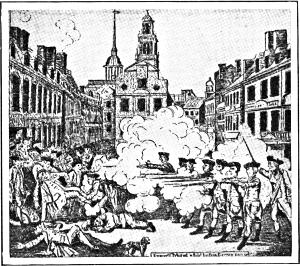
THE BOSTON MASSACRE, MARCH 5, 1770
The result of an encounter between a British sentry and the crowd
From the engraving by Paul Revere
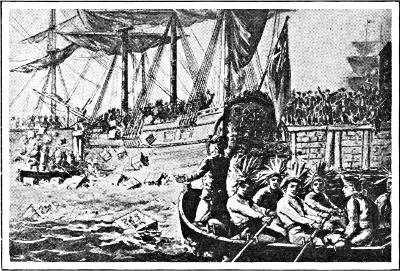
THE BOSTON TEA PARTY
From the fall of the Roman Empire to the French Revolution—a space of thirteen centuries—the only real republican governments were mountain peoples and independent trading cities, in which again the voting class was in small proportion. The only factors that ardently strove for liberty were the knights and noblemen, who did their best to weaken the power of the kings, so that they might have the more authority over their own vassals. The Middle Ages and even the period of the Restoration, with its appeal to the right to choose one’s own religion and to achieve one’s own salvation, did little to relieve the serf, the peasant, and the poor workman.
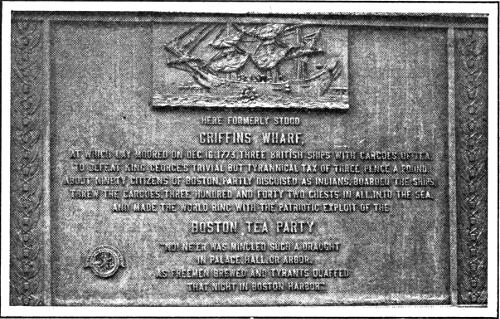
TABLET CELEBRATING THE BOSTON TEA PARTY
The inscription reads: “Here formerly stood Griffin’s wharf, at which lay moored on December 16, 1773, three British ships with cargoes of tea. To defeat King George’s trivial but tyrannical tax of three pence a pound, about ninety citizens of Boston, partly disguised as Indians, boarded the ships, threw the cargoes, three hundred and forty-two chests in all, into the sea, and made the world ring with the patriotic exploit of the Boston Tea Party.”
English Liberty
Against this gloomy background rose the wondrous structure of English liberty. At first the English people under their Norman kings were no freer than other peoples: England contained serfs and even slaves. The only people that had a share in the government were the Norman nobles who were sometimes consulted on the making of laws, and they were not different from the nobles that tried to divide power with the sovereigns of France and Sweden and the Germanic countries. The difference was that the dukes and counts and barons in most parts of Europe lost ground before the growth of an arbitrary royal power, while the English lords banded together successfully to secure pledges from their kings. In 1215 they wrung from King John the magnificent Magna Charta, including the glorious privileges that: “No freeman shall be taken or imprisoned, or disseised, or outlawed, or banished, or any way destroyed, nor will we pass upon him, nor will we send upon him, unless by the lawful judgment of his peers, or by the law of the land. We will sell to no man, we will not deny or delay to any man, either justice or right.”
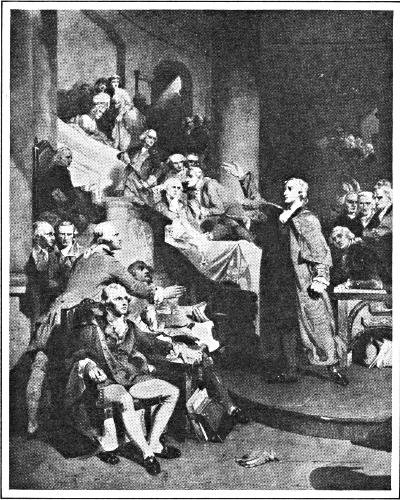
Original painting by Peter Frederick Rothermel (born 1817)
PATRICK HENRY ADDRESSING THE VIRGINIA ASSEMBLY IN 1765
Henry, supporting the resolutions to resist the Stamp Act, at one point exclaimed, “Caesar had his Brutus, Charles the First his Cromwell, and George the Third—” “Treason! treason!” shouted the Speaker of the Assembly. “Treason! treason!” shouted the members—“and,” Henry continued, “George the Third may profit by their example. If this be treason, make the most of it!”
Here we have at last a cradle of liberty; for the personal rights exacted by the nobles passed over to freemen, and in course of time all Englishmen became freemen. It was centuries before the kings at last gave way to the principle that the people through their representatives in Parliament ruled even the Crown; and in the process King Charles I lost his head, and King James II lost his throne. In the end, all the men and women of the realm were recognized as having the personal rights expressed in royal charters and acts of Parliament, which set them free from arbitrary taxes, arbitrary arrests, and arbitrary punishments.
They were entitled also to a tradition of common law, based on ideas of freedom, enforced for their benefit by independent courts and protected by trial by jury. Hence the England of the seventeenth century, from which the first colonists proceeded to North America, was that part of the globe in which law-abiding men and women had the largest opportunity of living their own lives, enjoying the fruits of their own labor, and dwelling under their own government.
Colonial Liberty
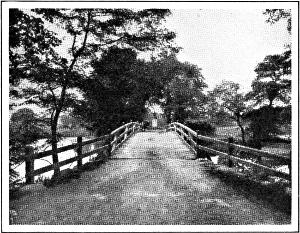
HISTORIC BRIDGE, CONCORD, MASS.
Showing battleground, and, across the bridge, the statue of the Minute Man by the sculptor, Daniel Chester French
Writers often speak of our present American system of government as founded upon the British practices of personal liberty and local self government and a free parliament. This is not accurate: Both our state and federal governments have borrowed little directly from the British parliamentary governing system. We have made our constitutions while Great Britain had none; we have organized a system of cabinet government, very different from that of parliamentary responsibility; we expanded our suffrage, and England slowly followed on that highway of liberty.
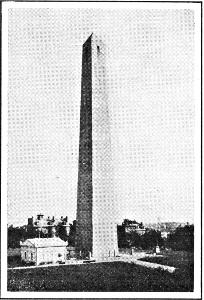
BUNKER HILL MONUMENT
Charlestown, Mass. A granite obelisk, 221 feet high, erected 1825-42 to commemorate the Battle of Bunker Hill, June 17, 1775
The truth is that the present government of Great Britain and the present government of the United States of America, with their personal liberties, both go back to a common source—the English government of the sixteenth and seventeenth centuries. It is a great mistake for us to think of Queen Elizabeth as a sovereign of a foreign country; or of the King James version of the Scriptures as something outside the United States; or of Shakespeare and Milton simply as “British poets.” We Americans have the same heritage in everything that was great and glorious in the British Isles, previous to colonization, as those that remained upon the soil, and in many respects we have made more improvement on those old models than our kin across the sea. The English had to struggle for nearly a century, from 1604 to 1688, against their kings, who wanted to turn the clock backward and take government out of the hands of the people. At that time the Colonies were very nearly independent little republics, who loved their English kings in proportion as those sovereigns kept their hands off. Except for the curse of negro slavery, which was allowed to get a firm grip on the body politic, the Colonies down to Revolutionary times were freer, happier and more prosperous than the mother country, and that was the main reason for the Revolution. Why should people who were doing so well in managing themselves continue in the leading strings of a government that saved its democracy in England for the higher classes?
The Colonies were not little political heavens. Their ideas of liberty did not extend to Indians, or Negroes, or Quakers. Nevertheless, in the main, they stood stoutly for freedom of person, freedom of judicial trial, freedom of legislative bodies; and they were about half a century earlier than England in establishing (in the famous Zenger case of 1734) the priceless right publicly to criticize their own governments. John Wise, who was one of them, had a right to say that they “hate an arbitrary power (politically considered) as they hate the devil.”
Hartford, the “Birthplace of American Democracy”
The first written constitution in history that was adopted by a people and that also organized a government, “The Fundamental Orders of Connecticut,” was drawn up in 1639 by freemen of Windsor, Hartford and Wethersfield. Under this law the people of Connecticut lived for nearly two centuries. The twelve articles it comprised expressed “pure democracy acting through representation, and imposing organic limitations.”
“Here is the first practical assertion of the right of the people, not only to choose, but to limit the powers of their rulers—an assertion that lies at the foundation of the American system. It is on the banks of the Connecticut, under the mighty preaching of Thomas Hooker, and in the constitution to which he gave life, if not form, that we draw the first breath of that atmosphere which is now so familiar to us. The birthplace of American Democracy is Hartford.”
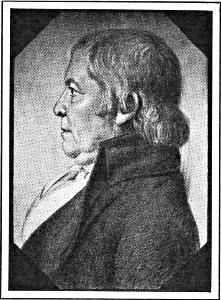
PAUL REVERE
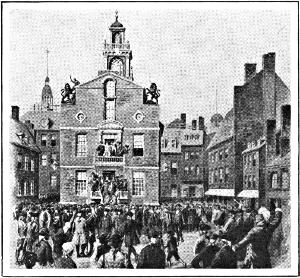
READING THE DECLARATION OF INDEPENDENCE FROM THE STATE HOUSE, BOSTON
By common consent, the period when these principles of liberty of person and of government were first clearly impressed on the world was in the American Revolution, which deserves to be called the cradle of modern liberty. When things grew squally in the Colonies, our forefathers insisted that their brand of liberty was better than the British kind, and they began to draw up lists of rights and grievances, especially in the Stamp Act Congress of 1765. The new states of the American Union, as they were organized, bound themselves to observe Bills of Rights containing such stirring principles as that, “All power is vested in, and consequently derived from, the people.” “All elections ought to be free, and that all men having sufficient evidence of permanent interest with, and attached to the community, have the right of suffrage.”—“The freedom of the press is one of the great bulwarks of liberty.”—“All men are equally entitled to the free exercise of religion, according to the dictates of conscience.”
By far the most renowned statement of the noble rights of liberty was the Declaration of Independence. At the time, people were most interested in the classified indictment of the king of Great Britain for interfering with American liberty. The world, however, has long agreed that the big memorable, permanent thing in that Declaration is found in the three magnificent sentences that fulfill the injunction of the Liberty Bell, to “proclaim liberty throughout all the land, to all the inhabitants thereof.” Those imperishable sentences are: “We hold these truths to be self-evident, that all men are created equal, that they are endowed by their Creator with certain unalienable Rights, that among these are Life, Liberty and the pursuit of Happiness,—That to secure these rights, Governments are instituted among Men, deriving their just powers from the consent of the governed,—That whenever any form of Government becomes destructive of these ends, it is the Right of the People to alter or to abolish it, and to institute new Government, laying its foundation on such principles and organizing its powers in such form, as to them shall seem most likely to effect their Safety and Happiness.”
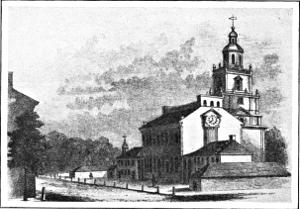
ORIGINAL INDEPENDENCE HALL
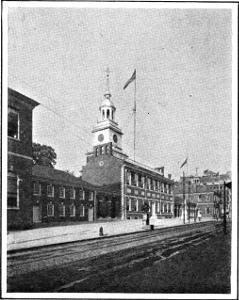
INDEPENDENCE HALL TODAY
Chestnut Street front
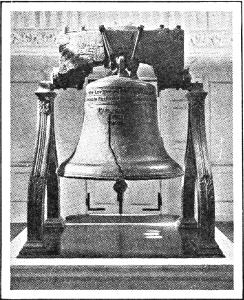
THE LIBERTY BELL
After all, anyone who can think like Franklin and write like Jefferson could draw up a Declaration of Independence; but somebody had to fight like Washington, in order to demonstrate that a democratic country, resting on principles of liberty, could (with never-to-be-forgotten aid from the French) achieve its own freedom. The lesson of liberty was deeply learned in France, where the early French Revolution of 1789 basked in the sunshine of American freedom.
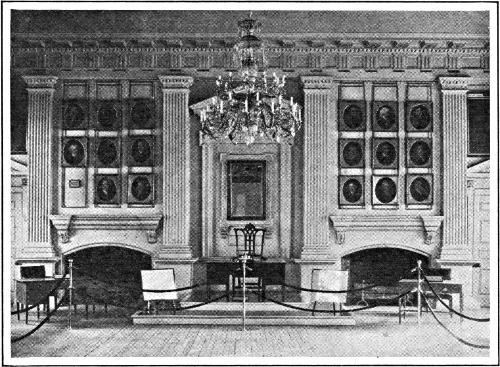
INTERIOR OF INDEPENDENCE HALL
Room in which Independence was born into a definite Declaration—showing table at which Hancock placed his signature on the historic Document
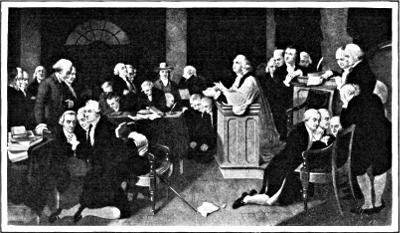
From original painting by T. H. Matteson.
FIRST PRAYER IN CONGRESS—CARPENTER’S HALL, PHILADELPHIA
Frenchmen read the Declaration of Independence, and framed a “Declaration of the Rights of Man and the Citizen.” They adopted for their watchword the three words, “Liberté, Egalité, Fraternité,” which are inscribed on the public buildings of the present French Republic. Liberty—that is, personal freedom; equality—that is, equal rights before the law; fraternity—that is, brotherhood with other people. The French, like the Americans, made it their bottom principle that freedom was the normal condition of men, and that everybody was entitled to a chance to do what in him lay, provided he did not thereby obstruct the equal privileges of his brother man. With many hesitations, and some errors, the rising nations of the nineteenth century strove to make real those glorious ideas. The Latin peoples of both North and South America all professed liberty. Republics have been set up in Switzerland, in France, in Portugal, in China, in Russia. Virtual democracies are established in the Scandinavian countries, Holland, Italy, Great Britain, and the great British commonwealths of Canada, Australia, New Zealand and South Africa. Even Germany, Austria-Hungary, Bulgaria and Turkey use the forms of popular government to conceal the real refusal of responsibility to the people by their sovereigns.
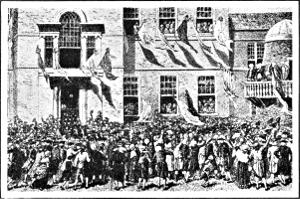
ANNOUNCEMENT OF THE DECLARATION OF INDEPENDENCE to the assembled crowd outside Independence Hall, Philadelphia, July 8, 1776
Constitutional Liberty
After the Revolution came the real test of the whole principle. How could one generation, nurtured in the cradle of liberty, pass that blessing on to its descendants? The solution was found in a system of state and national constitutions wherein, while standing by the inalienable right of men to alter their government as they saw need, checks and limitations were introduced for the protection of personal rights. All the state constitutions, and eventually the new federal constitution, included statements of those precious privileges. The share in the government, so necessary for keeping alive an interest in the welfare of the state, was extended more and more widely, till in our time it seems likely to include all legally competent men and women. As time has passed, new personal relations have developed; slavery has been rooted out, the rights of labor have come to the front and women have the vote. In time of war personal rights must yield something to the necessities of the state, but they are the bedrock of American Government.
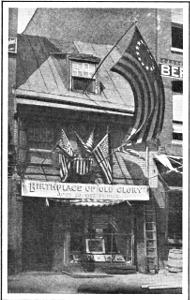
THE BIRTHPLACE OF OLD GLORY
The Betsy Ross House, on Arch Street, Philadelphia, where the first American flag was made
What Is Liberty Today?
What is this liberty for which the statesman labors and the soldier gives his life? How comes it that the United States of America is the cradle of the principle, and that the success of this great republic is the admiration of mankind? The sages and patriots of Revolutionary times strove to explain and define it without much success. Edmund Burke, the friend of the Colonies, found six “capital sources” from which “a fierce spirit of liberty has grown up.” Most of these have long ceased to operate, yet the spirit of liberty is still fierce. We all understand that liberty means personal freedom, liberty to express one’s thoughts in speech and press and religious observance; the right to be tried by impartial public courts, including a jury; the right to a government founded on the expression of the will of the people, through votes; the right to change a government that has ceased to meet the needs of the people; the right to education; an opportunity to test one’s powers;—especially the right to take the voice of the many, instead of a few, on the great questions of national life.
Liberty, however, is more than a kind of government, or a rule of action; it is a political religion, a worship, an inspiration. Statesmen strove to express it in terms of reverence and affection. Thus the Continental Congress sounded its trumpet call:
“Honour, Justice, and Humanity forbid us to surrender that freedom which we received from our ancestors, and which our posterity have a right to receive from us.”
A great poet, Emerson, later sought to set forth this passionate devotion to liberty: “What the tender poetic youth dreams, and prays, and paints today, but shuns the ridicule of saying aloud, shall presently be the resolutions of public bodies, then shall be carried as a grievance and bill of rights through conflict and war, and then shall be triumphant law and establishment for a hundred years, until it gives place, in turn, to new prayers and pictures.” So all the ideals of Liberty, like seed in the souls of mankind, take root and bear fruit in good time.
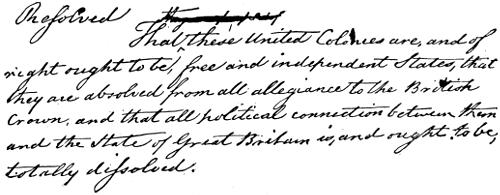
FAC-SIMILE OF THE ORIGINAL RESOLUTION AS OFFERED BY MR. RICHARD HENRY LEE
THE INITIATION OF INDEPENDENCE.
SUPPLEMENTARY READING
THE STORY OF LIBERTY, as developed in 500 years of history. Illustrated. By C. C. Coffin
INDEPENDENCE DAY. A collection of prose and verse. Edited by R. H. Schauffler
⁂ Information concerning the above books may be had on application to the Editor of The Mentor.