SCOTLAND THE LAND OF SONG AND SCENERY
Reading edition
A TRIP AROUND THE WORLD With DWIGHT L. ELMENDORF Lecturer and Traveler
ROBERT BURNS COTTAGE ELLENS ISLE MELROSE ABBEY
ABBOTSFORD STIRLING CASTLE FINGALS CAVE
In its contour and in its varied natural features Scotland is unique. It seems, indeed, as if Nature had shaped the land in a spirit of coquetry with the sea.
Though limited in territory, Scotland has a shore line thousands of miles in extent. Her coast is a series of inlets, firths, and sounds, and she has added to the irregularity of her shores by setting out innumerable beautiful islands that rear their rocky heads in the western sea. No one knows the full beauty of Scotland who has not visited the islands. Their picturesque and varied attractions pronounce them the true and natural offspring of the parent land.
Scotland has long been called the land of scenery and of song. The two are intimately associated. The scenery of Scotland has inspired many of her songs, and the songs have paid tribute in return by celebrating the beauty of the scenery in affectionate and eloquent phrase. The songs of Scotland breathe the life of the people and of the nation in a way that has won the sympathetic interest of the world. The prevailing note in Scottish song and literature is romance. The very name of Scotland is fragrant with romance. Its scenery is rich in romantic beauty and romantic associations, and its songs give eloquent expression to both.
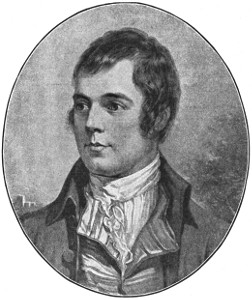
ROBERT BURNS
And so the traveler in Scotland finds the charm of her scenery happily voiced for him, and as he wanders from one spot to another he can recall the lines that enhance its beauty. It may be “The Banks and Braes o’ Bonnie Doon” or “Within a Mile of Edinboro’ Town.” Wherever he goes he may enjoy the scenery in companionship with the spirit of the poet who sang its praises.
To most of us Scotland means Wallace and Robert Bruce in heroic chivalry, and Walter Scott and Robert Burns in romance and in song. Most of the scenes and places that interest the traveler are associated with one or another of these four names.
THE HOME OF BURNS
The name of Robert Burns has a hold upon the people of Scotland and on those who visit there such as finds no parallel in any other country. This makes a visit to the small town of Ayr an incident of prime interest to the tourist. The Robert Burns Cottage is situated about two miles from the town, and it is kept with reverent care as a memorial. The building itself, low-roofed and humble, with its Burns mementos, is a veritable shrine for lovers of the poet.
The chief feature of the quaint old house is the little, low-ceilinged room in which Burns was born in 1759. You will be glad to linger there awhile. The impressions of the room will remain in your memory for all time. As you note the humble simplicity of the scene you will get close to Burns, and you will feel the full meaning and appeal of his lines:
“Gie me a spark of Nature’s fire! That’s a’ the learning I desire. Then, tho’ I drudge thro’ dub an’ mire At plow or cart, My muse—tho’ hamely in attire— May touch the heart!”
The whole country roundabout is full of Burns associations. A short distance off is Auld Alloway Kirk, where Burns’ father is buried, and where Tam o’ Shanter, overcome by the spirits that he imbibed too freely, was assailed and pursued by spirits ghostly. A short distance beyond the church are two bridges over the Doon, the old bridge being celebrated as the one over which Tam o’ Shanter made his escape from the evil spirits. In the garden near the bridges stands the formal but impressive Burns Monument.
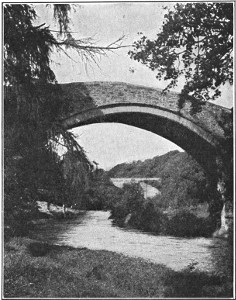
AULD BRIG O’ DOON
The old bridge at Ayr, celebrated in Burns’ lines.
Between that humble cottage down the road toward Ayr, and the Greek monument in the garden, is told the story of a simple, sweet, singing bard, whose lines so completely filled the hearts of his fellowmen that the very scenes of which he sang have become endeared to all humanity.
THE WALTER SCOTT COUNTRY
Between Loch Achray and Loch Katrine lies the Trossachs, beautiful in winding wooded roads and lake and mountain views—and famed chiefly for being Walter Scott’s own land of romance. It has often been said that one who has read Scott’s novels needs no guidebook in the Trossachs. Drive through this charming valley to Loch Katrine, a beautiful lake nearly ten miles long. From the east end steep cliffs ascend from the water’s edge, and there, looking through the brilliant foliage on the bank, you can see the pretty little Ellens Isle, made immortal in Walter Scott’s poem, “Lady of the Lake.” This is one of the most “pictured” spots in Scotland. You will find it in any illustrated volume of Scott’s poems. You will find it in color and in gravure, in large prints and on postcards, wherever you turn. It is the very heart of the Trossachs, and one of the most inviting spots in the British Isles—as attractive in its natural beauty as in the romantic associations that cast their spell about it.
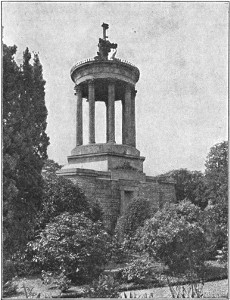
THE BURNS MEMORIAL
Standing on a hillside park near the town of Ayr. In a room within the monument are a number of Burns relics, together with his bust and portrait.
MELROSE ABBEY
Hallowed by eight hundred years of history and immortalized by Walter Scott, Melrose Abbey stands today the most interesting, as well as the most beautiful, ruin in Scotland. It is the drawing attraction of the little town of Melrose, situated on the Tweed. Enticed by the magic of Scott’s lines, thousands visit the Abbey every year.
“If thou wouldst view fair Melrose aright, Go visit it by the pale moonlight.”
So firmly have these verses stamped themselves on the hearts of readers all over the world that tourists feel that their visit is not complete unless they have seen the Abbey “by pale moonlight.” In response to this desire the Abbey is opened on moonlight nights for special visits.
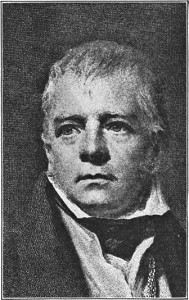
SIR WALTER SCOTT
Melrose Abbey was founded by David the First, in the twelfth century. After being destroyed by Edward the Second, it was rebuilt by Robert Bruce in the fourteenth century. It was again destroyed and rebuilt in the following century. During the many years of its history it suffered dreadfully from the ravages of war. Armies of invasion from England ruthlessly assaulted its sacred precincts and destroyed its beautiful features. In spite of that, after being reconstructed several times, it holds its place as a beautiful example of architecture and a most picturesque ruin.
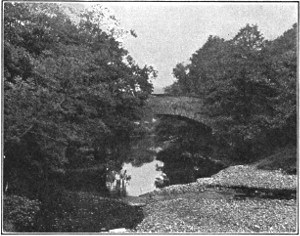
BRIG O’TURK, IN THE TROSSACHS
THE HOME OF SCOTT
About three miles from Melrose, on the right bank of the Tweed, stands Abbotsford, a name most dear to readers of the Waverley novels. There the “Wizard of the North,” as he was called, wrote his way into fame and fortune; there he lived when his fortune was swept away with that of his publisher; and there in his old age he settled himself grimly to repay debts amounting to six hundred thousand dollars—all by the work of his pen. He finished this stupendous task in about six years. He discharged his debts honorably; but he gave his lifeblood to the task. Scarcely had he come clear of his debts when his pen fell from his hand, and, in the bright, sunny dining room of Abbotsford, he dropped wearily to sleep, with the waters of his beloved Tweed murmuring musically in his ears. He had kept faith with his creditors; he had paid the last penny; he had secured his home for his children—and his work was done.
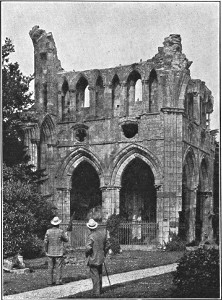
DRYBURGH ABBEY
Showing the location of Sir Walter Scott’s tomb.
Attended by a funeral procession more than a mile in length, including the great that came from distant parts to do him honor, and the humble peasant neighbors that knew and loved him, Sir Walter Scott’s body was borne reverently to Dryburgh Abbey, and in that beautiful ruin, a most appropriate spot, he now lies at rest.
THE CASTLES OF SCOTLAND
Two of the most impressive and picturesque castles of the world are in Scotland,—Stirling Castle and Edinburgh Castle.
Stirling Castle is situated on the Firth of Forth about thirty-five miles above Edinburgh, and it was for years the favorite residence of Scottish sovereigns. It played a prominent part in the history of Scotland, and is intimately associated with the name of Robert Bruce, who recaptured the castle from Edward the Second of England, in the fourteenth century, after the battle of Bannockburn.
The castle, like that of Edinburgh, is situated on a lofty height. On the esplanade before it stands a statue of Robert Bruce. The view from all sides is beautiful, and commands, on the west, a fair range of mountains, including Ben Lomond and Ben Venue, while on the south the battlefield of Bannockburn stretches away before the eye.
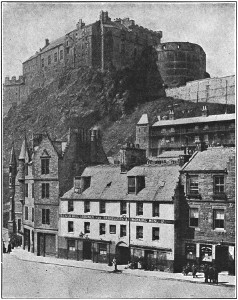
EDINBURGH CASTLE
One of the most beautiful and impressive castles in Great Britain.
Edinburgh Castle, an ancient seat of Scottish kings, has a most magnificent situation on a rocky height above the city. On three sides the mountain on which it stands drops almost sheer. On the east it slopes gradually off toward Holyrood.
THE HOME OF MARY, QUEEN OF SCOTS
There at Holyrood we find the scene of one of Scotland’s most affecting dramas,—the tragedy of Mary, Queen of Scots. Holyrood Castle, which was the unfortunate queen’s home for many years, is part ruin and part in good repair and occupied. It is there that the visitor can see the bedroom of the fair young Scottish queen, and there also the spot where her unfortunate minstrel and counselor, Rizzio, was murdered. Holyrood is intimately associated with the memories of Mary, Queen of Scots, and all who have followed with interest her sad story and want to feel an impression of her actual presence should spend a day in and about the castle.
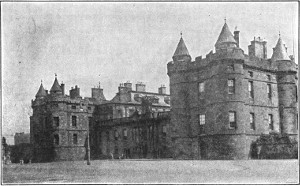
HOLYROOD CASTLE
Associated with the most dramatic years in the life of the unfortunate Mary, Queen of Scots.
The modern Scottish home of British royalty is Balmoral, situated on an estate of ten thousand acres about fifty miles from Aberdeen. This beautiful palace was purchased by the Crown in 1852 from the Earl of Fife for one hundred and fifty thousand dollars. It was for years the favorite country home of Queen Victoria, and is now said to be the most cherished residence of British royalty.
THE SCOTTISH ISLES
Months could be profitably spent in touring through the Isles of Scotland, and they would be months of unalloyed delight. Two small islands should be visited even in the course of the briefest Scottish tour, the Island of Iona, where Saint Columba, the missionary, landed from Ireland in 563, to begin his missionary work in Scotland, and on which are to be found the tombs of ancient Scottish, Irish, and Norwegian kings.
For over a thousand years the Island of Iona was the chosen “God’s Acre” for the great chieftains. The land was held sacred on account of Columba, and it was regarded as the securest spot on earth for mortal remains to rest in. Therefore the bodies of kings were taken there even from distant points in Ireland and in Norway, and for centuries Iona was the Mecca of religious pilgrims who went there to pray and to pay reverent tribute to the tombs of the great.
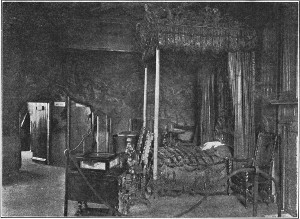
BEDROOM OF MARY, QUEEN OF SCOTS
Visited by many every year, this is the most interesting spot in Holyrood Castle.
FINGALS CAVE
Historic interest will draw you to Iona; the interest of wild nature will attract you to Staffa. On the Isle of Staffa is Fingals Cave, one of Nature’s curiosities, extraordinary in its formation and offering features of a wonder-compelling kind. The island is a rounded tableland which has been thrust up through the sea by volcanic action. It is about two miles in circumference, and rises nearly 150 feet above the surface of the ocean. The cave, which is crowned by a high arch of land, rises sixty feet above the sea, and through its interior length it varies from twenty to forty feet in width. Staffa has many caves; but the extraordinary size and character of Fingals Cave centers the interest of all visitors there. It is impossible in rough weather to enter the cave by boat. The method of visiting is to land some distance away and enter by a protected footpath. Once inside, the effect of surging, roaring waves overarched by echoing walls of basalt is most impressive. The basaltic columns—similar in formation to those of the Giants Causeway, across the sea on the coast of Ireland—rear themselves in parallel lines like a formidable palisade constructed for the support and protection of the cave.
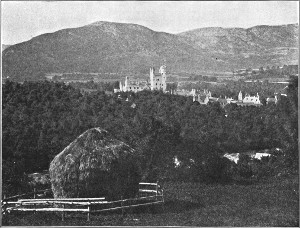
BALMORAL CASTLE
The highland home of British royalty—Queen Victoria’s favorite summer residence. Purchased by the Crown from the Duke of Fife.
We have visited but a few of the many places renowned for beauty and romance in the land of the heather. We have not seen Ben Nevis and the ruins of Inverlochy Castle; nor Swan Island in Loch Lomond; nor yet Lochleven Castle with its thrilling tradition of Queen Mary’s escape.
“No warden’s fire shall e’er again Illume Lochleven’s bosom fair; No clarion shrill of armed men The breeze across the lake shall bear; But while remains a stone of thine, It shall be linked to royal fame,— For here the Rose of Stuart’s line Hath left the fragrance of her name.”
And while we have pointed out the unique attractions of the Scottish Isles, we have said nothing of the wild, romantic beauty of the Highlands. The picturesque old ruin of Linlithgow Castle, Bothwell Castle, Loch Ness, the noble Northern peaks and their surroundings—all have been celebrated in glowing prose and verse, and around them clusters history and romance enough to make many volumes.
It is not easy to sum up the beauties of Scotland within the space of a few pages. It is a land where Nature and Romance go hand in hand, Nature affording a background of rare beauty, while Romance invests it with vital human interest. Picture an ideal tour in which each day is filled with profit and pleasure, and all Nature’s resources in land, sea, and sky combine to delight you and draw you on—then call that tour a “Summer in Scotland.”
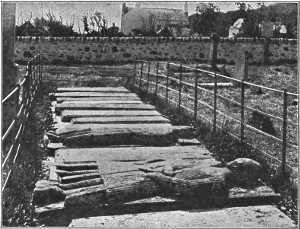
TOMBS OF THE KINGS
A part of the historic old graveyard on Iona Isle. Among forty kings of Scotland buried here are King Duncan and Macbeth, made famous by Shakespeare.