ITALY UNDER WAR CONDITIONS By E. M. NEWMAN, Traveler and Lecturer
Reading edition
MENTOR GRAVURES—A BANK IN VENICE, PROTECTED AGAINST ATTACK · A MARKET SQUARE IN ROME · AN ITALIAN KINDERGARTEN SHATTERED BY A BOMB · TAKING DOWN THE HORSES OF ST. MARK'S · CHURCH OF ST. MARK'S BOARDED UP FOR PROTECTION · PIAZZA DEL POPOLO, ROME
Entered as second-class matter March 10, 1913, at the postoffice at New York, N. Y., under the act of March 3, 1879. Copyright, 1919, by the Mentor Association, Inc.
ITALY has played a far more important part in the World War than is apparent to one who has not given the subject special consideration. The neutral nations have directed most of their thoughts to England and France. To do Italy full justice, the fact must be emphasized that she came into the war at a time when the Allies were in great need of her. The outlook for England and France was most serious when the Italian people, roused by love of liberty and democracy, demanded that their Government cast its lot with the Allies and declare war.

As a result, Austria was compelled to mobilize and mass her forces on the Italian frontier, and she was no longer able to give aid and support to the Germans on the western front. The entire course of the war was then materially changed.
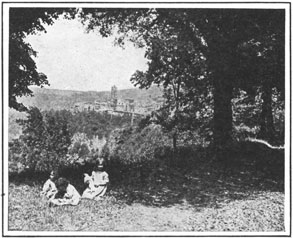
Photograph by E. M. Newman
PEACE IN THE MIDST OF WAR
This picture of Italian children playing with dolls was taken in Italy's darkest hour before the turn of the fortunes of war
Austria's army and navy were thereafter kept busy trying to hold the Italians in check. What happened in the fall of 1917 will always be more or less of a mystery. After two years of the hardest kind of fighting, during which time the Austrians were being gradually pushed back until Vienna itself was threatened, there came a retreat, one of the most disastrous in the annals of war. The Italians lost in two weeks all that they had gained in two years. Worse still, Italy was invaded and a considerable area occupied by the Austrian army.
Consternation ensued, the Italian people were dazed. Something had gone wrong; no one could understand it. But one thing every Italian knew, and that was that no braver soldiers were to be found in any country, and that when Italy had time to recover from her surprise Austria would pay the price.
How the Italian Army Came Back
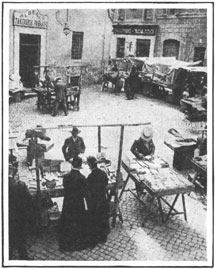
Photograph by E. M. Newman
BOOKSTALLS IN ROME
War did not drive the booklovers from their favorite haunts
The retreat of the Italian army was followed by a wave of patriotism that swept from one end of Italy to the other. If there were some that were lukewarm before, they were roused to the highest pitch of enthusiasm for the prosecution of the war. Italy had been invaded, and that was sufficient to stir the blood of every Italian.
When, in the spring of 1918, Austria launched her great offensive, she faced an army wholly changed. Indifference had vanished, every man thirsted for revenge. No Italian would breathe freely until the stain of the retreat was wiped out. Not an Austrian must remain on Italian soil. The Austrians were bewildered when, instead of encountering a demoralized and beaten army, they found themselves face to face with a new and rejuvenated force.
Instead of advancing, the Austrians were swept off their feet. Instead of a crumbling line, they met a wall of steel against which their onslaughts were of no avail. On came the infuriated Italians, crushing the Austrian offensive and forcing them to beat a hasty retreat. Austria will never forget the punishment she received on the Piave (pee-ah-vuh), along the Asiago plateau, and in the vicinity of Monta Grappa.
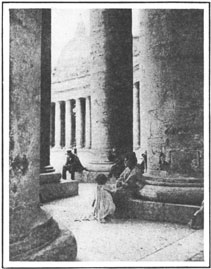
Photograph by E. M. Newman
AMONG THE COLUMNS OF ST. PETER'S, ROME
Fields were strewn with Austrian dead. So precipitate had been their flight that they had to abandon guns, ammunition, supplies, in fact everything they possessed. When, a few days later, I crossed the delta of the Piave, I saw thousands of Austrian helmets, overcoats, and supplies of every description covering the ground that extended for many miles to the Little Piave, across which the Austrian army had been driven.
It had been impossible in their retreat to bury their dead. Heaps of bodies still lay where they fell. Every ditch was filled with slain Austrians, the roadways were lined with them. It was a gruesome sight, but it told the story of a changed Italy, of a new army that meant to retrieve the honor of the country, and bring to the Italian arms the glory to which they were entitled.
Italy needed coal, she wanted steel for ammunition, and these deficiencies threatened her effort. Her allies came to her assistance, and equipped and replenished her for the prosecution of the war to a successful conclusion.
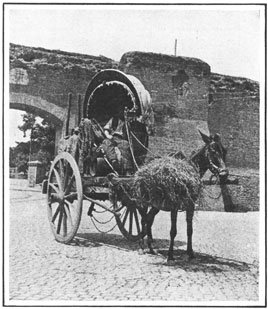
Photograph by E. M. Newman
A HUMBLE FOUR-FOOTED CITIZEN OF ROME
His voice was never for war
In relief work the Italians are particularly efficient. The central organization of the Italian Red Cross has naturally assumed the responsibility and direction of all relief work, both for soldiers and civilians. Numerous other organizations have sprung into existence; chief among them is "Le Samaritane," which is under the presidency of Her Majesty, Queen Helena of Italy. In this organization are thousands of women who are members of the best Italian society, and they have rendered effective and generous assistance in many ways, relieving distress wherever they find it.
A hospital for wounded soldiers has been established at the Royal Palace of the Quirinal, which is under the direct supervision of the Queen. The Duchess of Aosta, wife of the King's cousin, is General Inspector of the Red Cross nurses, and both of these noble ladies give actual, effective, and intelligent service to the various relief organizations to which their names are attached.
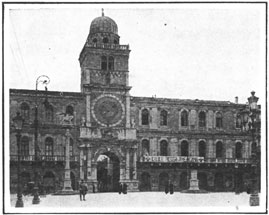
Photograph by E. M. Newman
AMERICAN RED CROSS HEADQUARTERS, PADUA
Italian women have proved themselves worthy mates and daughters of the heroic sons and soldiers of Italy. To them is due the initiative in the forming of several patriotic organizations, such as the "White Cross," for the protection of little children, "The Sowers of Courage," and "The Smile to the Strong," formed for helping and encouraging the fighting sons of Italy. Soldiers' huts have been erected and put in charge of the members of an association known as "Soldiers' Mammas." The members are women that have sons at the front, and may therefore be expected to give affectionate and maternal care to the young soldiers. There are other organizations, such as "The Mothers of Fallen Soldiers" and "The Widows of the War," whose object is mutual help among the women that have suffered the loss of son or husband.
Men who, because of advanced age, have been compelled to remain at home, have not failed to take up the burden of assistance and relief. Local committees have everywhere been formed under the name of "Assistenza Civile." There is also the "Segratariato del Popolo," besides many others. All these societies are banded together to assist the families of soldiers, to care for the mutilated, and to aid wherever help is needed.
The Italian Government has enacted special laws for the benefit of those stricken by the war. For instance, the Government furnishes shoes below cost to Government employees earning less than four thousand lire per year (about $800).
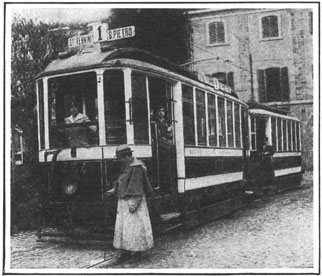
Press Illustrating Service, Inc.
TRAMWAY IN ROME
Showing women as conductor, motorist, and despatcher
Education
School life continues practically as in normal times, with the exception that, in the elementary schools and in the grades of the grammar and high schools, there is a larger proportion of women teachers. Many instructors who had been retired have asked to re-enter service, thus relieving the young men called to the colors.
In the universities a few distinguished professors of military age have been permitted to retain their chairs, but a considerable number have gone to the front. Naturally the number of students has been greatly reduced.
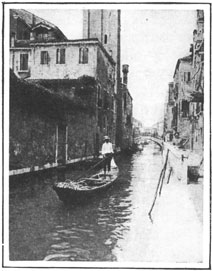
Photograph by E. M. Newman
THE SMALL CANALS OF VENICE WERE ALMOST DESERTED
Special dispensations have been made for the schools of medicine, so that the services of the more advanced students may be utilized while at the same time they are enabled to continue their studies. This has been made possible by the establishment of the so-called "Universita Castrense," or Camp University, situated in the war zone, where distinguished physicians who are also university professors teach the young students, while teachers and pupils alternate the hours of class with those of service in the camp hospitals. The change caused by the war in the condition of women has probably been more profound and more keenly felt in Italy than in other countries, such as England and France, where women have for many years been engaged in various useful pursuits. In Italy the women of the middle class, with rare exceptions, remained at home. Those of the lower class, when they worked at all, generally chose some occupation such as teaching. Most women had no economic independence. Unmarried girls usually lived with their parents or some married brother or sister.
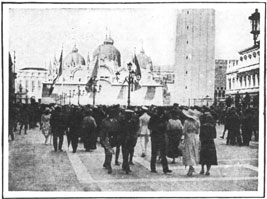
Photograph by E. M. Newman
ST. MARK'S PLACE, VENICE
Though the beautiful buildings were protected, crowds gathered daily and regular occupations were pursued
An ardent group of Italian women prepared the ground and labored for years to convince their sisters that they were wrong in the belief that under all conditions "a woman's place is in her home." This belief was almost a religion in the southern provinces of Italy; the prejudice there was so strong that it required the utmost courage of the women to combat it. Intelligent, progressive and cultured Italian girls are now to be found in almost every occupation in which their English, French and American sisters are engaged. This revolution in the attitude of Italian women is accepted, not as a temporary war necessity, but as a permanent change that cannot fail to have a deep and, on the whole, beneficent effect upon social conditions in Italy.
Food Regulations
Conditions in civil life are comparatively good. Of course, there are many restrictions, above all in food conservation and supply. Prices have increased, but so have salaries. There are no unemployed, and the working classes generally are prosperous.
War conditions required three meatless days per week, as in the other countries of the Allies. Cards were given for bread, sugar, coal, olive oil, macaroni and rice. That the quantity allowed to each individual was sufficient was proved by the fact that the authorities often received offers to diminish the rations of some families who found they had more than they needed. The use of gas was limited to meal hours for heating, and for illumination until ten o'clock at night.
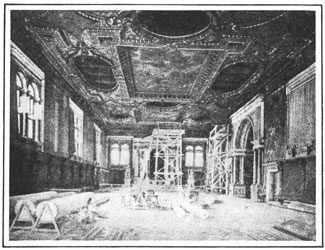
Hall of the Great Council, Ducal Palace, Venice. [1]
On the floor may be seen in rolls paintings taken from ceiling and wall
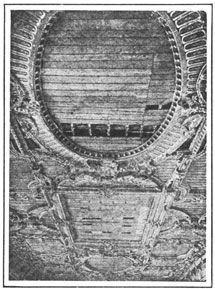
Ceiling showing spaces from which art masterpieces have been removed
No restrictions were placed on the use of electricity in most city homes, although street illumination was diminished and in certain cities in the advanced zone was abolished entirely, as a defensive measure. The abundance of electricity is explained by the fact that it is very often generated by water power, as, for instance, in Rome.
Restaurants must send to the authorities a list of food furnished, with prices charged for each portion, or for the whole meal, or for the week. They must indicate also any extra charges, and the reason for such charges. The authorities will approve the menu only if it corresponds with normal or prescribed prices, and a copy, stamped and signed by an authorized person, must be exposed to the public where it can easily be seen.
No food can be served unless it is on the approved list. In large cities, there is a committee of control, composed of five citizens appointed by the mayor, whose duty it is to see that the restrictions are rigidly observed. If the police authorities do not approve of a certain menu, it is submitted to the committee, and unless they put their O. K. upon it, the restaurant is not permitted to use it.
Two factors combine to keep prices of necessities and even luxuries down to a reasonable level. One is the so-called "calmiere," or government regulation, that certain products may not be sold at a higher price than that fixed by the regularly constituted authorities. The other factor is the prevalence of co-operative societies that sell to their members at cost or almost at cost. Retailers have to compete with these societies, and there is a consequent curb on profiteering. Nearly every trade or profession has its own co-operative stores. The entrance fee which must be paid to join a co-operative society is very moderate, in some instances as low as five lire (about one dollar).
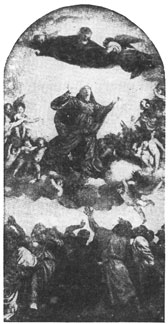
THE ASSUMPTION OF THE VIRGIN
Titian's great masterpiece in the Academy of Fine Arts, Venice
Amusements and Sports
Theaters, cinematograph theaters, and other places of amusement had to close at midnight. Restaurants and cafés closed an hour earlier. This did not apply to the war zone, where the military authorities made their own regulations and imposed all kinds of restrictions for defensive purposes.
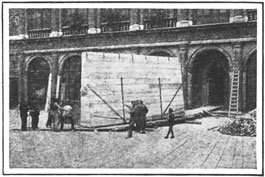
TITIAN'S "ASSUMPTION" BEING TAKEN OUT
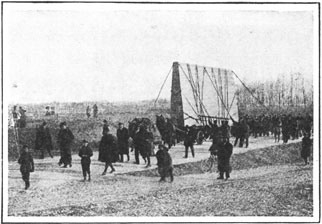
TITIAN'S "ASSUMPTION" BEING TRANSPORTED ACROSS COUNTRY TO A SECURE PLACE
In general, theaters and motion-picture shows in Italy are well patronized. Opera is still popular, and performances are given in various cities. Society does not consider it good form to wear evening dress. It would not be in taste for women to be elaborately gowned, or to attempt to give dances or house parties. Officers do not wear their dress uniforms, no matter what may be the function they attend. Ladies avoid the use of jewels, and there is, generally speaking, a soberness in the dressing of both men and women. Italy, however, is not gloomy nor depressed. On the contrary, the Italians are vivacious, and their sunny dispositions are manifested throughout the troublous times.
Sports generally have been abolished. There is no horse-racing, but, for the purpose of breeding fine animals, horses are still being trained.
Travel is freely permitted, though, of course, the war zone has been carefully guarded. In the restricted area a pass was necessary, and vital reasons had to be given for permission to travel. On account of the shortage of coal, the number of trains has been reduced, as well as the number of cars in each train. Travel is therefore lacking in comfort, and it is not uncommon to see people standing even in first-class compartments throughout journeys lasting six or seven hours. The discomforts are accepted good-naturedly, and there is far less grumbling than one would expect.
Conditions in Venice
The morale of the Italians has never been better. Caporetto has been avenged, the Austrians were thrown back across the Little Piave, and brought to their knees. Venice has been saved. The city by the sea has had its trials. Severe, indeed, have been some of the air raids, and three-fourths of the population fled. About fifty thousand of the inhabitants remained, but this represents but one-fourth of the people that lived along the canals of Venice before the war.
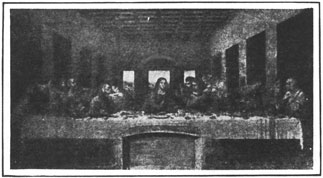
THE LAST SUPPER. By Leonardo da Vinci
This famous painting has been half effaced by the ravages of time
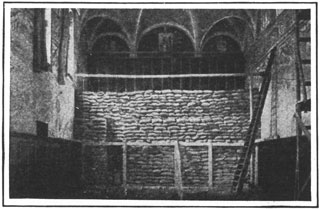
THE LAST SUPPER PROTECTED BY PADDING
Da Vinci's great picture is painted on the wall of the Refectory of the Church of Santa Maria della Grazie, Milan, Italy
Many hotels are closed, tourists come no more. No Italian city has suffered from the effects of war so much as Venice. Industries have been ruined, its commerce depleted. Its churches and hospitals have again and again been bombed from the air. Frescoes have been obliterated that can never be replaced, though much of the damage done will soon be repaired.
All about the populous Square of St. Mark heaps of sand-bags were piled to protect the arcades. The beautiful façade of St. Mark's Cathedral has been, for some time, hidden from view. The famous horses were taken down, the wonderful Byzantine mosaics were removed, and the entire front of the building covered with sand-bags and protected by huge timbers.
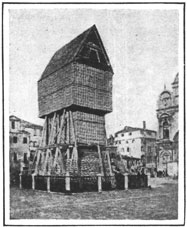
THE COLLEONI STATUE UNDER PROTECTIVE COVERING
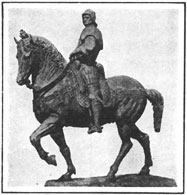
THE FAMOUS EQUESTRIAN STATUE OF BARTOLOMMEO COLLEONI, BY VERROCHIO—VENICE
The Doges' (Ducal) Palace was supported by columns of bricks; everywhere evidence could be seen of the attempt of the Italians to save the most remarkable city in the world. Inside the sumptuous Cathedral of St. Mark's, the effect was startling—all the works of art gone, the altar covered beyond recognition, mounds upon mounds of sand-bags heaped around the columns. It was more like a cave than the interior of one of the most beautiful of churches. Along the Grand Canal the large hotels have been converted into hospitals. Vast palaces have been closed and deserted. Life on the Canal is so quiet that it is almost painful. It is not the same Venice so many travelers recall. Only one good-class hotel is open. There are a few boarding-houses, but all the magnificent hotels are either closed or filled with wounded men.
It was difficult in war times to get into Venice, and more difficult to get out. Everyone was looked upon as a spy until he proved that he was not. Officials inquired into your life history, traced your every movement, watched every step you took, and if finally you passed muster and got away without a long delay, you knew that there was not a suspicion of your ever having even dreamed of being a spy.
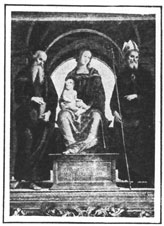
THE MADONNA AND TWO SAINTS BY PERUGINO-CREMONA
At the right, the painting covered with timber and sand-bags
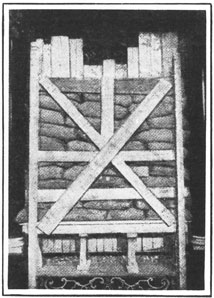
It was, of course, more difficult in the war zone. Once inside the restricted area one became a suspect, and it sometimes took weeks to obtain police and military permission to leave Italy. The Italians were in earnest, they had had a severe lesson, and they did not intend to be caught napping.
An Allied victory was the one object, and Italy was ready to pay her share of the price. No braver men ever faced an enemy than the Arditi, and no enemy army ever forgot an encounter with these "shock troops" of the Italian army. These men were born and brought up in an atmosphere that has taught them how to fight. They are as hard as nails, as fearless as lions—the pick of Italy's best troops.
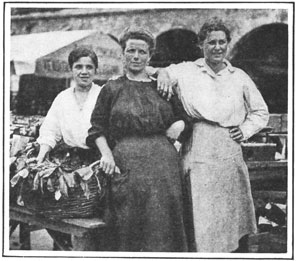
Photograph by E. M. Newman
MARKET WOMEN OF ITALY
Italy, though needing food, is not starving, nor is she depressed. She has recovered from the shock of 1917, and there is no disaffection among her people. All are united. Socialists cannot overturn the conditions of the nation. As for their military stamina—Austrians can testify to the fact that the Italian army is a foe worthy to engage itself at any time, against any hostile power.
The Spirit of Italy
We cannot close more fittingly than by quoting Mr. Sidney Low's highly informing comments on the spirit of Italy:[2]
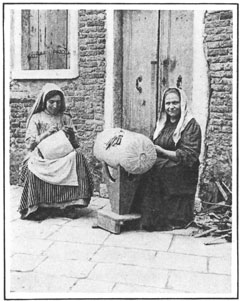
Photograph by E. M. Newman
LACE MAKERS HOLD TO THEIR TRADE
Island of Burrano, Venice
"Of all the belligerent nations I have seen, Italy seems to me the most tranquil, contented and serenely confident. She has endured heavy losses and is called upon to make great sacrifices, but her people have counted the cost and they pay it resolutely, cheerfully, almost, one would say, gaily. They have no love for war and on this one they entered with hesitating and doubtful steps, but now, I think, they feel, not only that it was necessary and right, but that it will give them some things which were wanting in the years of peace. War is a monstrous evil; but from its furnace of pain and suffering Italy, with other nations, may emerge hardened and tempered. She will gain a larger unity and that not merely by annexing the unredeemed territory. The war has gone far to obliterate that division of classes and localities which was the inheritance of her troubled past. The common effort and the common burden have crowned the edifice which the makers of Italy built up in the nineteenth century....
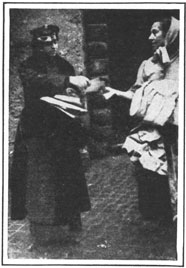
Copyright, Western Newspaper Union
WOMAN LETTER CARRIER, ROME
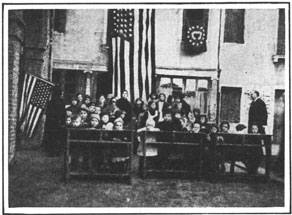
Press Illustrating Service. Inc
SCHOOL INSTITUTED BY AMERICAN RED CROSS
At the Italian front, behind the war zone
"What Italy needs is security, sufficient to develop to the full her economic resources and her national individuality; and that she intends to obtain. She is resolved to be independent of external patronage, protection and supervision of any kind, and to enjoy all the rights, privileges, ambitions, which belong to the greater nations of the earth. She believes herself capable of excelling, not merely in art, science, letters, philosophy, laws, but in production, manufacturing, commerce, the exploitation of waste and backward lands. She is not content that her people, so intelligent, so industrious, so capable, should be packed off year by year in shoals to form the ill-paid labor helots of wealthier communities; she prefers that they should be kept at home to develop the riches and intensified vitality of their own land. She has watched the rise of Germany from poverty and weakness to strength and industrial magnificence; and she believes that the Latin capacity for organization, invention, scientific adaptation and enterprise, is not inferior to the Teutonic. She thinks she can do many of the things that Germany has done, and some things which Germany will never do; and she means to try. It is for the great free nations, with which she is now associated, to survey her effort with sympathetic eyes, and extend to it all the aid and encouragement in their power."
SUPPLEMENTARY READING
ITALY IN THE WAR. By Sidney J. M. Low
ITALY AT WAR. By H. Vivian
EUROPE'S FATEFUL HOUR. By G. Ferrero
THE BOOK OF ITALY. Edited by Raffaelo Piccoli
A book of story, essay, verse and picture, interpreting the spirit of Italy.
*** Information concerning the above books may be had on application to the Editor of The Mentor.
FOOTNOTES